
Soluciones del 1991 AMC 8
Desplázate hacia abajo para ver las soluciones preparadas profesionalmente de LIVE by Po-Shen Loh, imprime las soluciones en PDF, consulta la clave de respuestas, o haz el examen cronometrado completo.
Todos los problemas se usan con el permiso legal oficial de la Mathematical Association of America (MAA).
1.
¿Cuál es el valor de la siguiente expresión?
What is the value of
Pista pequeña:
Piensa en cuánto debes sumar a para llegar a
Think of the amount you must add to to reach
Pista grande:
Trabajando de derecha a izquierda: las cifras de las unidades deben sumar con un acarreo, y luego cada columna suma con ese acarreo
Work from the right: the units digits must add to with a carry, and every other column then adds to with that carry
Solución:
Al alinear la resta se obtiene
De forma equivalente, para subir de hasta se suma en las unidades y en cada uno de los otros once lugares.
Por lo tanto, la respuesta correcta es B.
Lining up the subtraction gives
Equivalently, to climb from up to you add in the units place and in each of the other eleven places.
Thus, the correct answer is B .
2.
¿Cuál es el valor de
What is the value of
Pista pequeña:
La barra de fracción agrupa todo el numerador sobre todo el denominador
The fraction bar groups the whole numerator over the whole denominator
Pista grande:
Simplifica y por separado antes de dividir
Simplify and separately before dividing
Solución:
Por lo tanto, la respuesta correcta es C.
Thus, the correct answer is C .
3.
Doscientos mil por doscientos mil es igual a
Two hundred thousand times two hundred thousand equals
cuatrocientos mil
four hundred thousand
cuatro millones
four million
cuarenta mil
forty thousand
cuatrocientos millones
four hundred million
cuarenta mil millones
forty billion
Pista pequeña:
Escribe doscientos mil como
Write two hundred thousand as
Pista grande:
Multiplica las cifras iniciales y luego cuenta los ceros: cada factor tiene cinco ceros
Multiply the leading digits, then count the zeros: each factor has five zeros
Solución:
que es cuarenta mil millones.
Por lo tanto, la respuesta correcta es E.
which is forty billion.
Thus, the correct answer is E .
4.
Si entonces
If then
Pista pequeña:
Cada uno de los cinco números es solo un poco menor que
Each of the five numbers is just a little less than
Pista grande:
Escribe cada uno como la suma se convierte en
Write each as the sum becomes
Solución:
Como se obtiene
Por lo tanto, la respuesta correcta es E.
Since we get
Thus, the correct answer is E .
5.
Un «dominó» está formado por dos cuadrados pequeños:

. ¿Cuál de los «tableros de ajedrez» ilustrados a continuación NO se puede cubrir exacta y completamente con un número entero de dominós que no se solapen?
A “domino” is made up of two small squares:
. Which of the “checkerboards” illustrated below CANNOT be covered exactly and completely by a whole number of non-overlapping dominoes?


Pista pequeña:
Cada dominó cubre exactamente dos cuadrados pequeños, así que fíjate en cuántos cuadrados pequeños tiene cada tablero.
Each domino covers exactly two small squares, so focus on how many small squares each board has.
Pista grande:
Un tablero solo se puede cubrir por completo si su número total de cuadrados es par; halla el número de cuadrados de cada tablero multiplicando sus dos dimensiones.
A board can be fully covered only if its total number of squares is even; find the number of squares in each board by multiplying its two dimensions.
Solución:
Cada dominó cubre exactamente cuadrados, así que cualquier tablero que se cubra por completo con dominós que no se solapan debe tener un número par de cuadrados pequeños.
Contando cuadrados: y Solo es impar, así que ese tablero no se puede cubrir. (Cada uno de los tableros pares tiene un lado de longitud par y se cubre fácilmente con dominós.)
Por lo tanto, la respuesta correcta es B.
Every domino covers exactly squares, so any board that is completely covered by non-overlapping dominoes must contain an even number of small squares.
Counting squares: and Only is odd, so that board cannot be covered. (Each of the even boards has a side of even length and is easily tiled with dominoes.)
Thus, the correct answer is B .
6.
¿Qué número del arreglo de abajo es a la vez el mayor de su columna y el menor de su fila? (Las columnas van de arriba abajo y las filas de izquierda a derecha.)
Which number in the array below is both the largest in its column and the smallest in its row? (Columns go up and down, rows go right and left.)
Pista pequeña:
Primero halla el número mayor de cada una de las cinco columnas
First find the largest number in each of the five columns
Pista grande:
Después comprueba cuál de esos máximos de columna es también el número menor de su propia fila
Then check which of those column-maxima is also the smallest number in its own row
Solución:
El mayor de cada columna es: (columna ), (columna ), (columna ), (columna ) y (columna ).
De estos, solo es el número menor de su propia fila, ya que la fila es .
Por lo tanto, la respuesta correcta es C.
The largest entry in each column is (column ), (column ), (column ), (column ), and (column ).
Of these, only is the smallest number in its own row (row is ).
Thus, the correct answer is C .
7.
El valor de la expresión es más cercano a
The value of is closest to
Pista pequeña:
El numerador tiene un factor común de
The numerator shares a common factor of
Pista grande:
Redondea cada número a una sola cifra inicial antes de dividir, por ejemplo y
Round each number to a single leading digit before dividing, for example and
Solución:
Factoriza el numerador:
Redondeando a las cifras iniciales, esto es aproximadamente El denominador es aproximadamente
Así que el valor total es aproximadamente
Por lo tanto, la respuesta correcta es D.
Factor the numerator:
Rounding to leading digits, this is about The denominator is about
So the value is roughly
Thus, the correct answer is D .
8.
¿Cuál es el mayor cociente que se puede formar con dos números elegidos del conjunto ?
What is the largest quotient that can be formed using two numbers chosen from the set
Pista pequeña:
Un cociente es mayor cuando es positivo y de gran tamaño
A quotient is largest when it is positive and large in size
Pista grande:
Un negativo dividido entre un negativo es positivo; prueba el negativo de mayor magnitud entre el negativo de menor magnitud
A negative divided by a negative is positive; try the largest-magnitude negative over the smallest-magnitude negative
Solución:
Para obtener un cociente grande debe ser positivo, así que usa dos números positivos o dos números negativos.
El mejor par positivo es El mejor par negativo es El mayor es
Por lo tanto, la respuesta correcta es D.
For a large quotient it should be positive, so use two positive numbers or two negative numbers.
Best positive pair: Best negative pair: The larger is
Thus, the correct answer is D .
9.
¿Cuántos números enteros del al son divisibles por , por o por ambos?
How many whole numbers from through are divisible by either or or both?
Pista pequeña:
Cuenta por separado los múltiplos de y los múltiplos de
Count the multiples of and the multiples of separately
Pista grande:
Los números divisibles por y por a la vez son múltiplos de y se cuentan dos veces, así que réstalos una vez
Numbers divisible by both and are multiples of and get counted twice, so subtract them once
Solución:
Hay múltiplos de y múltiplos de hasta . Los múltiplos de (a saber, ) se contaron dos veces.
Por inclusión-exclusión, la cuenta es
Por lo tanto, la respuesta correcta es B.
There are multiples of and multiples of up to The multiples of (namely ) were counted twice.
By inclusion-exclusion, the count is
Thus, the correct answer is B .
10.
¿Cuál es el área, en unidades cuadradas, de la región encerrada por el paralelogramo ?
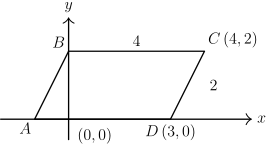
The area in square units of the region enclosed by parallelogram is
Pista pequeña:
Toma como base; es horizontal desde hasta
Take as the base; it is horizontal from to
Pista grande:
El área es base por altura, donde la altura es la distancia vertical entre los dos lados horizontales
The area is base times height, where the height is the vertical distance between the two horizontal sides
Solución:
El lado va desde hasta así que la base es El lado opuesto está sobre el eje , así que la altura es
El área es
Por lo tanto, la respuesta correcta es B.
Side runs from to so the base is The opposite side lies on the -axis, so the height is
The area is
Thus, the correct answer is B .
11.
Se pueden elegir varios conjuntos de tres números diferentes cuya suma sea de ¿Cuántos de estos conjuntos contienen un ?
There are several sets of three different numbers whose sum is which can be chosen from How many of these sets contain a
Pista pequeña:
Si es uno de los tres números, entonces los otros dos deben sumar
If is one of the three numbers, the other two must add to
Pista grande:
Enumera los pares de números diferentes de que suman
List the pairs of different numbers from that sum to
Solución:
Elegido el , los otros dos números diferentes deben sumar Esos pares son lo que da conjuntos.
Por lo tanto, la respuesta correcta es B.
With chosen, the other two different numbers must sum to The pairs are giving sets.
Thus, the correct answer is B .
12.
Si entonces
If then
Pista pequeña:
Simplifica primero el lado izquierdo
Simplify the left side first
Pista grande:
La suma de tres enteros consecutivos dividida entre el del medio es igual a
The sum of three consecutive integers divided by the middle one equals
Solución:
El lado izquierdo es El lado derecho es y al igualarlo a se obtiene
De forma equivalente, así que dividir entre deja el término del medio. Aquí el término del medio es
Por lo tanto, la respuesta correcta es D.
The left side is The right side is and setting it equal to gives
Equivalently, so dividing by leaves the middle term. Here the middle term is
Thus, the correct answer is D .
13.
¿Cuántos ceros hay al final del producto
How many zeros are at the end of the product
Pista pequeña:
Un cero final proviene de un factor
A trailing zero comes from a factor of
Pista grande:
Cuenta el total de factores de y de el número de ceros finales es la menor de las dos cuentas
Count the total factors of and of the number of trailing zeros is the smaller count
Solución:
Como los siete dan Como los tres dan
El número de ceros finales es
Por lo tanto, la respuesta correcta es C.
Since the seven ’s give Since the three ’s give
The number of trailing zeros is
Thus, the correct answer is C .
14.
Varios estudiantes compiten en una serie de tres carreras. Un estudiante gana puntos por ganar una carrera, puntos por quedar segundo y punto por quedar tercero. No hay empates. ¿Cuál es el menor número de puntos que un estudiante debe obtener en las tres carreras para tener garantizado más puntos que cualquier otro estudiante?
Several students are competing in a series of three races. A student earns points for winning a race, points for finishing second, and point for finishing third. There are no ties. What is the smallest number of points that a student must earn in the three races to be guaranteed of earning more points than any other student?
Pista pequeña:
Para garantizar la ventaja, considera el peor caso, en el que otro estudiante lo hace lo mejor posible
To be guaranteed the lead, plan for the worst case where another student does as well as possible
Pista grande:
Revisa en orden creciente los totales posibles de las tres carreras; para cada uno, comprueba si los puestos restantes permiten que otro estudiante lo iguale o lo supere
Check the attainable three-race totals in increasing order; for each one, see whether the remaining places allow a rival to tie or exceed it
Solución:
Un total de (por ejemplo ) no garantiza el primer lugar, ya que otro estudiante también podría llegar a
Pero si un estudiante obtiene los lugares restantes dan a cualquier otro estudiante como máximo Así que puntos garantizan la ventaja.
Por lo tanto, la respuesta correcta es D.
A total of (for example ) does not guarantee first place, since another student could also reach
But if one student scores the remaining places give every other student at most So points guarantees the lead.
Thus, the correct answer is D .
15.
Las seis caras de un prisma rectangular eran rectángulos. Se recortó del prisma rectangular un cubo de un pie, como se muestra. ¿En cuántos pies cuadrados es mayor o menor la superficie del nuevo sólido que la del original?
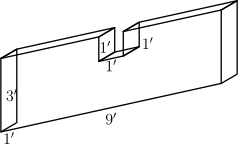
All six sides of a rectangular solid were rectangles. A one-foot cube was cut out of the rectangular solid as shown. The total number of square feet in the surface of the new solid is how many more or less than that of the original solid?
menos
less
menos
less
lo mismo
the same
más
more
más
more
Pista pequeña:
Al cortar el cubo se quitan algunas caras que estaban en la superficie, pero se descubren otras nuevas; compara las dos cantidades
Cutting the cube removes some faces that were on the surface but uncovers new ones; compare the two amounts
Pista grande:
Las caras superior, frontal y trasera del cubo estaban en la superficie ( pies cuadrados quitados); el fondo de la muesca y sus dos paredes laterales se vuelven superficie nueva ( pies cuadrados añadidos)
The cube’s top, front, and back faces were on the surface ( square feet removed); the notch’s floor and its two side walls become new surface ( square feet added)
Solución:
El cubo retirado tenía tres caras en la superficie del sólido (superior, frontal y trasera), así que se quitan pies cuadrados de superficie.
Al recortarlo se exponen tres caras nuevas (el fondo de la muesca y sus dos paredes laterales), lo que añade pies cuadrados. El área de la superficie no cambia.
Por lo tanto, la respuesta correcta es C.
The removed cube had three faces on the surface of the solid (top, front, and back), so square feet of surface are removed.
Cutting it out exposes three new faces (the floor of the notch and its two side walls), adding square feet. The surface area is unchanged.
Thus, the correct answer is C .
16.
Los cuadrados de una hoja de papel están numerados como se muestra en el diagrama. Mientras está sobre una mesa, el papel se dobla por la mitad cuatro veces en la siguiente secuencia:
doblar la mitad superior sobre la mitad inferior;
doblar la mitad inferior sobre la mitad superior;
doblar la mitad derecha sobre la mitad izquierda;
doblar la mitad izquierda sobre la mitad derecha.
¿Qué cuadrado numerado queda encima después del paso ?
The squares on a piece of paper are numbered as shown in the diagram. While lying on a table, the paper is folded in half four times in the following sequence:
fold the top half over the bottom half;
fold the bottom half over the top half;
fold the right half over the left half;
fold the left half over the right half.
Which numbered square is on top after step
Pista pequeña:
Después de cada doblez, sigue qué cuadrados quedan en la parte inferior (o superior) de la pila
After each fold, track which squares end up on the bottom (or top) of the stack
Pista grande:
Los dobleces y dejan las filas del medio; los dobleces y dejan las columnas del medio, y el último doblez de izquierda sobre derecha lleva el cuadrado hasta arriba
Folds and leave the middle rows; folds and leave the middle columns, and the final left-over-right fold flips square to the top
Solución:
El doblez (superior sobre inferior) deja los cuadrados abajo. El doblez (inferior sobre superior) deja abajo. El doblez (derecha sobre izquierda) deja y abajo.
El doblez (izquierda sobre derecha) pone abajo y lleva hasta arriba.
Por lo tanto, la respuesta correcta es B.
Fold (top over bottom) leaves squares on the bottom. Fold (bottom over top) leaves on the bottom. Fold (right over left) leaves and on the bottom.
Fold (left over right) puts on the bottom and brings to the top.
Thus, the correct answer is B .
17.
Un auditorio con filas de asientos tiene asientos en la primera fila. Cada fila sucesiva tiene un asiento más que la anterior. Si a los estudiantes que hacen un examen se les permite sentarse en cualquier fila, pero no junto a otro estudiante de esa fila, entonces el número máximo de estudiantes que se pueden sentar para un examen es
An auditorium with rows of seats has seats in the first row. Each successive row has one more seat than the previous row. If students taking an exam are permitted to sit in any row, but not next to another student in that row, then the maximum number of students that can be seated for an exam is
Pista pequeña:
En una fila de asientos, el mayor número de estudiantes sin dos adyacentes es
In a row of seats, the most students with no two adjacent is
Pista grande:
La fila tiene asientos; suma a lo largo de las filas
Row has seats; add over the rows
Solución:
La fila tiene asientos, así que caben estudiantes. Para las filas a (con a asientos), los máximos son
Estos suman
Por lo tanto, la respuesta correcta es C.
Row has seats, so it holds students. For rows through (seats through ) the maxima are
These sum to
Thus, the correct answer is C .
18.
El eje vertical indica el número de empleados, pero la escala se omitió por accidente en esta gráfica. ¿Qué porcentaje de los empleados de la compañía Gauss ha trabajado allí durante años o más?
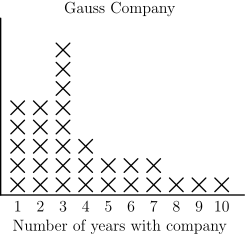
The vertical axis indicates the number of employees, but the scale was accidentally omitted from this graph. What percent of the employees at the Gauss Company have worked there for years or more?
Pista pequeña:
Como la escala vertical es desconocida, trabaja con el número de X en lugar de con cualquier valor
Since the vertical scale is unknown, work with the number of X’s rather than any value
Pista grande:
Divide las X de los años a entre el número total de X
Divide the X’s over years through by the total number of X’s
Solución:
Sin importar la escala que falta, cada X representa el mismo número de empleados. Hay X sobre los años a y X en total.
Así que la fracción es
Por lo tanto, la respuesta correcta es C.
No matter the missing scale, each X represents the same number of employees. There are X’s over years through and X’s in all.
So the fraction is
Thus, the correct answer is C .
19.
El promedio (media aritmética) de números enteros positivos diferentes es El mayor valor posible de cualquiera de estos números es
The average (arithmetic mean) of different positive whole numbers is The largest possible value of any of these numbers is
Pista pequeña:
La suma de los diez números debe ser
The ten numbers must sum to
Pista grande:
Para hacer un número lo más grande posible, haz los otros nueve lo más pequeños posible:
To make one number as large as possible, make the other nine as small as possible:
Solución:
Los diez números suman Para maximizar uno de ellos, los otros nueve (todos enteros positivos diferentes) deben ser lo más pequeños posible:
El número mayor es entonces
Por lo tanto, la respuesta correcta es C.
The ten numbers sum to To maximize one of them, the other nine (all different positive whole numbers) should be as small as possible:
The largest number is then
Thus, the correct answer is C .
20.
En el problema de suma que se muestra, cada dígito se reemplazó por una letra. Si letras diferentes representan dígitos diferentes, entonces
In the addition problem shown, each digit has been replaced by a letter. If different letters represent different digits, then
Pista pequeña:
Escribe la suma en términos de
Write the sum in terms of
Pista grande:
Suma los tres números para obtener
Solución:
Los tres números suman Como es demasiado pequeño y es demasiado grande,
Entonces lo que obliga a y Así que
Por lo tanto, la respuesta correcta es A.
The three numbers add to Since is too small and is too large,
Then which forces and So
Thus, the correct answer is A .
21.
Por cada aumento de en la temperatura, el volumen de cierto gas se expande centímetros cúbicos. Si el volumen del gas es centímetros cúbicos cuando la temperatura es ¿cuál era el volumen del gas en centímetros cúbicos cuando la temperatura era ?
For every rise in temperature, the volume of a certain gas expands by cubic centimeters. If the volume of the gas is cubic centimeters when the temperature is what was the volume of the gas in cubic centimeters when the temperature was
Pista pequeña:
La temperatura bajó de a un cambio de
The temperature dropped from to a change of
Pista grande:
Cada descenso de reduce el volumen en centímetros cúbicos
Each drop shrinks the volume by cubic centimeters
Solución:
De a hay un descenso de , que son pasos de
El volumen disminuye en centímetros cúbicos, de hasta
Por lo tanto, la respuesta correcta es A.
From to is a decrease, which is steps of
The volume decreases by cubic centimeters, from down to
Thus, the correct answer is A .
22.
Cada ruleta está dividida en partes iguales. Se multiplican los resultados obtenidos al girar las dos ruletas. ¿Cuál es la probabilidad de que el producto sea un número par?
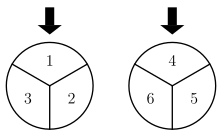
Each spinner is divided into equal parts. The results obtained from spinning the two spinners are multiplied. What is the probability that this product is an even number?
Pista pequeña:
El producto es impar solo cuando ambos números son impares; en cualquier otro caso es par
A product is even unless both spun numbers are odd
Pista grande:
Halla primero la probabilidad de un producto impar, es decir, impar por impar, y luego réstala de
Find the probability of an odd product (odd times odd), then subtract from
Solución:
El producto es impar si y solo si ambos números son impares. La primera ruleta cae en un impar ( o ) con probabilidad y la segunda cae en el impar con probabilidad
Así que el producto es impar con probabilidad y par con probabilidad
Por lo tanto, la respuesta correcta es D.
The product is odd only when both numbers are odd. The first spinner is odd ( or ) with probability and the second is odd () with probability
So the product is odd with probability and even with probability
Thus, the correct answer is D .
23.
La banda de la Escuela Secundaria Pitágoras tiene mujeres y hombres. La orquesta de la Escuela Secundaria Pitágoras tiene mujeres y hombres. Hay mujeres que pertenecen tanto a la banda como a la orquesta. En total, estudiantes están en la banda, en la orquesta o en ambas. El número de hombres de la banda que NO están en la orquesta es
The Pythagoras High School band has female and male members. The Pythagoras High School orchestra has female and male members. There are females who are members in both band and orchestra. Altogether, there are students who are in either band or orchestra or both. The number of males in the band who are NOT in the orchestra is
Pista pequeña:
Primero halla cuántas mujeres están en al menos un grupo, usando
First find how many females are in at least one group, using
Pista grande:
Resta las mujeres del total de para obtener los hombres que están en al menos un grupo; luego usa inclusión-exclusión para hallar cuántos hombres están en ambos grupos
Subtract the females from the total to get the males in at least one group, then use inclusion–exclusion to find how many males are in both groups
Solución:
Mujeres en la banda o la orquesta: Así que los hombres en al menos un grupo:
Con hombres en la banda y en la orquesta, los hombres en ambas son Por lo tanto, los hombres en la banda pero no en la orquesta:
Por lo tanto, la respuesta correcta es A.
Females in band or orchestra: So males in at least one group:
With males in band and in orchestra, the males in both are Hence males in band but not orchestra:
Thus, the correct answer is A .
24.
Un cubo de arista cm se corta en cubos más pequeños, no todos del mismo tamaño. Si la arista de cada uno de los cubos más pequeños es un número entero de centímetros, entonces
A cube of edge cm is cut into smaller cubes, not all the same size. If the edge of each of the smaller cubes is a whole number of centimeters, then
Pista pequeña:
La arista de los cubos más pequeños debe ser un número entero, así que solo puede ser arista o arista
The smaller cubes must have whole-number edges, so each is edge or edge
Pista grande:
Solo cabe un cubo de arista ; el resto son cubos unitarios que llenan el volumen restante
Only one edge- cube fits; the rest are unit cubes filling the remaining volume
Solución:
El cubo de tiene volumen Como los cubos pequeños tienen aristas enteras y son menores, sus aristas miden o . No pueden caber dos cubos disjuntos de arista dentro del cubo original, pues separarlos exigiría una extensión total de al menos en alguna dirección. Por tanto, cabe como máximo un cubo de arista .
El volumen restante se llena con cubos unitarios. El total es cubos.
Por lo tanto, la respuesta correcta es E.
The cube has volume Since the cubes are smaller and have whole-number edge lengths, their edges are or . Two edge- cubes cannot be disjoint inside the original cube: separating them would require a total span of at least in some direction. Thus at most one edge- cube fits.
The remaining of volume is filled by unit cubes. That is cubes.
Thus, the correct answer is E .
25.
Un triángulo equilátero está pintado de negro al principio. Cada vez que se modifica el triángulo, el cuarto central de cada triángulo negro se vuelve blanco. Después de cinco modificaciones, ¿qué fracción del área original del triángulo permanece negra?
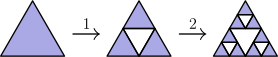
An equilateral triangle is originally painted black. Each time the triangle is changed, the middle fourth of each black triangle turns white. After five changes, what fractional part of the original area of the black triangle remains black?
Pista pequeña:
Después de una modificación, el cuarto central se vuelve blanco, así que queda del área negra
After one change the middle fourth turns white, so of the black area remains
Pista grande:
Cada modificación multiplica el área negra por así que después de cinco modificaciones se multiplica por
Each change multiplies the black area by so after five changes multiply by
Solución:
Cada modificación deja negra del área negra actual. Después de cinco modificaciones, la fracción negra es
Por lo tanto, la respuesta correcta es C.
Each change leaves of the current black area black. After five changes the black fraction is
Thus, the correct answer is C .