
Soluciones del 2022 AMC 12B
Desplázate hacia abajo para ver las soluciones preparadas profesionalmente de LIVE by Po-Shen Loh, imprime las soluciones en PDF, consulta la clave de respuestas, o haz el examen cronometrado completo.
Todos los problemas se usan con el permiso legal oficial de la Mathematical Association of America (MAA).
1.
Se define como para todos los números reales e ¿Cuál es el valor de
Define to be for all real numbers and What is the value of
Pista pequeña:
Evalúa primero el interior, usando .
Evaluate the inner first, using
Pista grande:
Calcula por separado y , y luego resta.
Compute and separately, then subtract
Solución:
Como obtenemos
Como obtenemos
El valor es
Por lo tanto, la respuesta correcta es A.
Since we get
Since we get
The value is
Thus, the correct answer is A.
2.
En el rombo el punto está en el segmento de modo que y ¿Cuál es el área de ? (Nota: la figura no está dibujada a escala.)
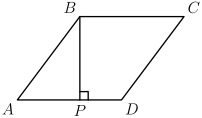
In rhombus point lies on segment so that and What is the area of (Note: the figure is not drawn to scale.)
Pista pequeña:
El lado del rombo es .
The side length of the rhombus is
Pista grande:
En el triángulo rectángulo halla y luego usa área .
In right triangle find then use area
Solución:
El lado es así que En el triángulo rectángulo
Tomando como base y como altura, el área es
Por lo tanto, la respuesta correcta es D.
The side length is so In right triangle
Taking as the base and as the height, the area is
Thus, the correct answer is D.
3.
¿Cuántos de los diez primeros números de la sucesión son primos?
How many of the first ten numbers of the sequence are prime numbers?
Pista pequeña:
Busca una factorización de cada término en dos enteros ambos mayores que .
Look for a factorization of each term into two integers both greater than
Pista grande:
Intenta escribir un término como un repunit por un número de la forma por ejemplo .
Try writing a term as a repunit times a number of the form for example
Solución:
El -ésimo término consta de unos, luego un y luego unos. Se factoriza como un repunit por un número de la forma y en general el -ésimo término es igual a
Para todo ambos factores son mayores que por lo que cada término es compuesto. Ninguno de los diez números es primo.
Por lo tanto, la respuesta correcta es A.
The th term consists of ones, then a then ones. It factors as a repunit times a number of the form and in general the th term equals
For every both factors exceed so every term is composite. None of the ten numbers is prime.
Thus, the correct answer is A.
4.
¿Para cuántos valores de la constante el polinomio tiene dos raíces enteras distintas?
For how many values of the constant will the polynomial have two distinct integer roots?
Pista pequeña:
Si las raíces son y entonces y .
If the roots are and then and
Pista grande:
Cuenta los pares de factores no ordenados de con dos enteros distintos, incluyendo los negativos.
Count the ordered-independent factor pairs of with two distinct integers, including negatives
Solución:
Si las raíces son los enteros y entonces y Las raíces distintas deben tener el mismo signo, así que listamos los pares de factores de con
Los pares positivos son y los pares negativos son El par se excluye porque las raíces deben ser distintas.
Cada uno de estos pares da un valor distinto de
Por lo tanto, la respuesta correcta es B.
If the roots are integers and then and Distinct roots must have the same sign, so we list factor pairs of with
The positive pairs are and the negative pairs are The pair is excluded since the roots must be distinct.
Each of these pairs gives a different value of
Thus, the correct answer is B.
5.
El punto se rota en sentido antihorario alrededor del punto ¿Cuáles son las coordenadas de su nueva posición?
The point is rotated counterclockwise about the point What are the coordinates of its new position?
Pista pequeña:
Traslada de modo que el centro de rotación sea el origen, rota y luego traslada de vuelta.
Translate so the center of rotation is the origin, rotate, then translate back
Pista grande:
Una rotación de en sentido antihorario envía a .
A counterclockwise rotation sends to
Solución:
Respecto al centro el punto está en
Una rotación de en sentido antihorario envía a así que se convierte en
Al trasladar de vuelta se obtiene
Por lo tanto, la respuesta correcta es B.
Relative to the center the point is at
A counterclockwise rotation sends to so becomes
Translating back gives
Thus, the correct answer is B.
6.
Considera los siguientes conjuntos de elementos cada uno:
¿Cuántos de estos conjuntos contienen exactamente dos múltiplos de ?
Consider the following sets of elements each:
How many of these sets contain exactly two multiples of
Pista pequeña:
Un bloque de enteros consecutivos contiene uno o dos múltiplos de .
A block of consecutive integers contains either one or two multiples of
Pista grande:
Cuenta el total de múltiplos de en y luego supón que bloques tienen dos y tienen uno.
Count the total multiples of in then let blocks have two and have one
Solución:
Entre y hay múltiplos de Como cada bloque de enteros consecutivos contiene uno o dos múltiplos de
Si bloques contienen dos y los restantes contienen uno, entonces así que
Por lo tanto, la respuesta correcta es B.
Among to there are multiples of Because each block of consecutive integers contains one or two multiples of
If blocks contain two and the remaining contain one, then so
Thus, the correct answer is B.
7.
Camila escribe cinco enteros positivos. La moda única de estos enteros es mayor que su mediana, y la mediana es mayor que su media aritmética. ¿Cuál es el menor valor posible de la moda?
Camila writes down five positive integers. The unique mode of these integers is greater than their median, and the median is greater than their arithmetic mean. What is the least possible value for the mode?
Pista pequeña:
La moda supera a la mediana, así que solo puede aparecer entre los dos números más grandes.
The mode exceeds the median, so it can only appear among the two largest numbers
Pista grande:
Sea la mediana para que la moda sea única, los dos mayores deben ser ambos iguales a y la suma es .
Let the median be for a unique mode the two largest must both equal and the sum is
Solución:
Ordena los números de forma creciente con mediana La moda es así que solo puede aparecer entre las dos entradas mayores; para que sea la moda única, ambas deben ser iguales a
La media es así que el total es Con los dos mayores iguales a y la mediana los dos menores suman
Los dos menores son enteros positivos distintos, así que lo que da Con la lista funciona, así que la menor moda es
Por lo tanto, la respuesta correcta es D.
List the numbers in increasing order with median The mode is so it can only occur among the two largest entries; for it to be the unique mode, both of them must equal
The mean is so the total is With the two largest equal to and the median the two smallest sum to
The two smallest are distinct positive integers, so giving With the list works, so the least mode is
Thus, the correct answer is D.
8.
¿Cuál es la gráfica de en el plano de coordenadas?
What is the graph of in the coordinate plane?
dos parábolas que se cortan
two intersecting parabolas
dos parábolas que no se cortan
two nonintersecting parabolas
dos circunferencias que se cortan
two intersecting circles
una circunferencia y una hipérbola
a circle and a hyperbola
una circunferencia y dos parábolas
a circle and two parabolas
Pista pequeña:
Pasa todo a un lado para obtener .
Move everything to one side to get
Pista grande:
Factoriza como diferencia de cuadrados, lo que da dos ecuaciones separadas.
Factor as a difference of squares, giving two separate equations
Solución:
Reordenando, así que Esto se factoriza como
Así, o bien que es una hipérbola, o bien que es una circunferencia.
Por lo tanto, la respuesta correcta es D.
Rearranging, so This factors as
Thus either which is a hyperbola, or which is a circle.
Thus, the correct answer is D.
9.
La sucesión es una progresión aritmética estrictamente creciente de enteros positivos tal que ¿Cuál es el mínimo valor posible de ?
The sequence is a strictly increasing arithmetic sequence of positive integers such that What is the minimum possible value of
Pista pequeña:
Divide ambos lados entre para obtener .
Divide both sides by to get
Pista grande:
Después de hallar escribe y haz la diferencia común lo más grande posible.
After finding write and make the common difference as large as possible
Solución:
Al dividir entre necesitamos Por tanto, y donde El lado izquierdo es estrictamente creciente para y funciona, así que de manera única
Con diferencia común tenemos y Para minimizar , maximizamos como la mayor opción es (que da ).
Entonces
Por lo tanto, la respuesta correcta es B.
Dividing by we need Thus and where The left side is strictly increasing for and works, so uniquely
With common difference we have and To minimize we maximize since the largest choice is (giving ).
Then
Thus, the correct answer is B.
10.
El hexágono regular tiene lado Sea el punto medio de y sea el punto medio de ¿Cuál es el perímetro de ?
Regular hexagon has side length Let be the midpoint of and let be the midpoint of What is the perimeter of
Pista pequeña:
Coloca el hexágono en coordenadas con su centro en el origen.
Place the hexagon on coordinates with its center at the origin
Pista grande:
Por simetría, los cuatro lados de son iguales; calcula una distancia con la fórmula de la distancia.
By symmetry all four sides of are equal; compute one distance with the distance formula
Solución:
Coloca el hexágono con centro en el origen:
Entonces y Por simetría, los cuatro lados de son iguales, y
El perímetro es
Por lo tanto, la respuesta correcta es D.
Place the hexagon with center at the origin:
Then and By symmetry all four sides of are equal, and
The perimeter is
Thus, the correct answer is D.
11.
Sea donde ¿Cuánto vale ?
Let where What is
Pista pequeña:
Las dos bases son las raíces cúbicas primitivas de la unidad, y .
The two bases are the primitive cube roots of unity, and
Pista grande:
Entonces reduce el exponente módulo .
Then reduce the exponent modulo
Solución:
Las dos bases son las raíces cúbicas primitivas de la unidad, y su conjugada Así,
Como es múltiplo de así que
Por lo tanto, la respuesta correcta es E.
The two bases are the primitive cube roots of unity, and its conjugate So
Since is a multiple of so
Thus, the correct answer is E.
12.
Kayla lanza cuatro dados justos de caras. ¿Cuál es la probabilidad de que al menos uno de los números que obtiene sea mayor que y al menos dos de los números que obtiene sean mayores que ?
Kayla rolls four fair -sided dice. What is the probability that at least one of the numbers Kayla rolls is greater than and at least two of the numbers she rolls are greater than
Pista pequeña:
Clasifica cada dado en bajo medio o alto cada uno con probabilidad .
Sort each die into low mid or high each with probability
Pista grande:
Necesitas al menos un dado alto y al menos dos dados que no sean bajos; cuenta los patrones de categorías buenos de entre .
You need at least one high die and at least two dice that are not low; count the good category patterns out of
Solución:
Clasifica cada dado en bajo medio o alto cada uno tiene probabilidad así que los patrones de categorías son equiprobables.
Necesitamos al menos un dado alto (un número mayor que ) y al menos dos dados que sean mayores que (medio o alto). Los dos eventos malos son no tener ningún dado alto y tener a lo sumo un dado no bajo.
Hay patrones sin ningún dado alto, patrones con a lo sumo un dado no bajo, y patrones que no tienen ni un dado alto ni dos dados no bajos. Por inclusión-exclusión, el número de patrones buenos es
La probabilidad es
Por lo tanto, la respuesta correcta es D.
Sort each die into low mid or high each has probability so the category patterns are equally likely.
We need at least one high die (a number greater than ) and at least two dice that are greater than (mid or high). The two bad events are having no high die and having at most one non-low die.
There are patterns of the first kind, of the second kind, and in their intersection. By inclusion-exclusion the count of good patterns is
The probability is
Thus, the correct answer is D.
13.
El diagrama de abajo muestra un rectángulo de lados y y un cuadrado de lado Tres vértices del cuadrado están sobre tres lados diferentes del rectángulo, como se muestra. ¿Cuál es el área de la región que está dentro tanto del cuadrado como del rectángulo?
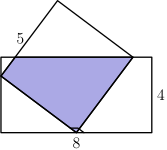
The diagram below shows a rectangle with side lengths and and a square with side length Three vertices of the square lie on three different sides of the rectangle, as shown. What is the area of the region inside both the square and the rectangle?
Pista pequeña:
Establece coordenadas; la inclinación del cuadrado forma triángulos rectángulos -- en las esquinas.
Set up coordinates; the tilt of the square makes -- right triangles at the corners
Pista grande:
Todo el cuadrado está dentro del rectángulo salvo un triángulo que sobresale por el borde superior; resta ese triángulo de .
The whole square lies inside the rectangle except one triangle sticking out past the top edge; subtract that triangle from
Solución:
Coloca el rectángulo como El cuadrado inclinado, usando los triángulos rectángulos --, tiene vértices y
Todo el cuadrado está dentro del rectángulo salvo el triángulo que sobresale por encima del borde superior Ese triángulo tiene vértices y con área
La región que está en ambos es
Por lo tanto, la respuesta correcta es D.
Place the rectangle as The tilted square, using the -- right triangles, has vertices and
The entire square lies inside the rectangle except for the triangle poking above the top edge That triangle has vertices and with area
The region inside both is
Thus, the correct answer is D.
14.
La gráfica de corta al eje en los puntos y y al eje en el punto ¿Cuánto vale ?
The graph of intersects the -axis at points and and the -axis at point What is
Pista pequeña:
Factoriza para hallar las intersecciones: y en el eje , en el eje .
Factor to find the intercepts: and on the -axis, on the -axis
Pista grande:
Con los vectores y usa .
With vectors and use
Solución:
Factorizando, así que y y la intersección con el eje es
Entonces y Usando los productos vectorial y escalar,
Por lo tanto, la respuesta correcta es E.
Factoring, so and and the -intercept is
Then and Using the cross and dot products,
Thus, the correct answer is E.
15.
Uno de los siguientes números no es divisible por ningún número primo menor que ¿Cuál es?
One of the following numbers is not divisible by any prime number less than Which is it?
Pista pequeña:
Los cinco números son impares, así que prueba la divisibilidad solo por y .
All five numbers are odd, so test divisibility only by and
Pista grande:
Usa los ciclos de módulo por ejemplo cuando es par.
Use the cycles of modulo for example when is even
Solución:
Toda opción es impar, así que solo hay que verificar los primos .
Opción A: así que es divisible por Opción B: así que es divisible por Opción D: así que es divisible por Opción E: módulo
Para es y (ya que y ) Así que no es divisible por ningún primo menor que
Por lo tanto, la respuesta correcta es C.
Every option is odd, so only the primes need checking.
Option A: so is divisible by Option B: so is divisible by Option D: so is divisible by Option E: modulo
For it is and (since and ) So it is not divisible by any prime below
Thus, the correct answer is C.
16.
Supón que e son números reales positivos tales que
y
¿Cuál es el mayor valor posible de ?
Suppose and are positive real numbers such that
and
What is the greatest possible value of
Pista pequeña:
Sea y toma de ambas ecuaciones.
Let and take of both equations
Pista grande:
Obtienes y combínalas para formar una ecuación cuadrática en .
You get and combine to form a quadratic in
Solución:
Sea y Tomando de se obtiene es decir,
Tomando de la segunda ecuación se obtiene así que Sustituyendo, así que es decir,
Así, y el mayor valor de es
Por lo tanto, la respuesta correcta es C.
Let and Taking of gives i.e.
Taking of the second equation gives so Substituting, so i.e.
Thus and the greatest value of is
Thus, the correct answer is C.
17.
¿Cuántos arreglos cuyas entradas son y hay tales que las sumas de filas (la suma de las entradas de cada fila) sean y en algún orden, y las sumas de columnas (la suma de las entradas de cada columna) sean también y en algún orden? Por ejemplo, el arreglo satisface la condición.
How many arrays whose entries are s and s are there such that the row sums (the sum of the entries in each row) are and in some order, and the column sums (the sum of the entries in each column) are also and in some order? For example, the array satisfies the condition.
Pista pequeña:
La fila de suma es toda de y la columna de suma es toda de .
The row of sum is all s and the column of sum is all s
Pista grande:
Elimina la columna de suma ; el arreglo restante tiene sumas de filas y sumas de columnas .
Delete the sum- column; the remaining array has row sums and column sums
Solución:
La fila de suma es toda de y la columna de suma es toda de . Hay maneras de asignar las sumas de filas a las cuatro filas, y opciones para cuál columna tiene suma
Elimina esa columna. El arreglo restante tiene sumas de filas y debe tener sumas de columnas Las filas todo-cero y todo-uno quedan forzadas; las filas de suma reducida y se pueden colocar de maneras para producir sumas de columnas en algún orden.
El total es
Por lo tanto, la respuesta correcta es D.
The row with sum is all s and the column with sum is all s. There are ways to assign the row sums to the four rows, and choices for which column has sum
Delete that column. The remaining array has row sums and must have column sums The all-zero and all-one rows are forced; the rows of reduced sum and can be placed in ways to produce column sums in some order.
The total is
Thus, the correct answer is D.
18.
Cada casilla de una cuadrícula está llena o vacía, y tiene hasta ocho casillas vecinas adyacentes, donde las casillas vecinas comparten un lado o una esquina. La cuadrícula se transforma según las siguientes reglas:
Toda casilla llena con dos o tres vecinas llenas permanece llena. Toda casilla vacía con exactamente tres vecinas llenas se convierte en llena. Todas las demás casillas permanecen vacías o se vuelven vacías.
En la figura de abajo se muestra una transformación de ejemplo.
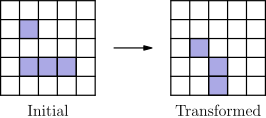
Supón que la cuadrícula tiene un borde de casillas vacías que rodea una subcuadrícula . ¿Cuántas configuraciones iniciales llevan a una cuadrícula transformada que consiste en una sola casilla llena en el centro tras una única transformación? (Las rotaciones y reflexiones de la misma configuración se consideran diferentes.)
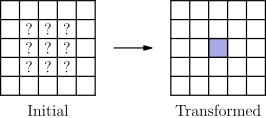
Each square in a grid is either filled or empty, and has up to eight adjacent neighboring squares, where neighboring squares share either a side or a corner. The grid is transformed by the following rules:
Any filled square with two or three filled neighbors remains filled. Any empty square with exactly three filled neighbors becomes a filled square. All other squares remain empty or become empty.
A sample transformation is shown in the figure below.
Suppose the grid has a border of empty squares surrounding a subgrid. How many initial configurations will lead to a transformed grid consisting of a single filled square in the center after a single transformation? (Rotations and reflections of the same configuration are considered different.)
Pista pequeña:
Solo la interior puede llenarse; para que el centro quede lleno necesita exactamente vecinas llenas (si estaba vacío) o - (si estaba lleno).
Only the inner can be filled; the center becoming filled needs exactly filled neighbors (if it was empty) or - (if it was filled)
Pista grande:
La restricción determinante es que ninguna casilla del borde gane exactamente tres vecinas llenas; verifica que toda configuración válida tiene exactamente tres casillas llenas.
The binding constraint is that no border square gains exactly three filled neighbors; check that every valid configuration has exactly three filled cells
Solución:
Solo las casillas de la interior pueden comenzar llenas. Para que el centro quede lleno después, si empezó vacío necesita exactamente vecinas llenas, y si empezó lleno necesita o
Toda otra casilla debe terminar vacía. La restricción clave es que ninguna casilla del borde puede adquirir exactamente tres vecinas llenas, lo que descarta llenar las tres casillas a lo largo de un borde exterior de la
Si el centro empieza vacío, exactamente de sus vecinas deben estar llenas. Al revisar estas ternas salvo simetrías del cuadrado quedan cuatro tipos. Con coordenadas del anillo centradas en los representantes son Los tamaños de sus órbitas de simetría son lo que da configuraciones.
Si el centro empieza lleno, la misma revisión de vecinas deja solo las dos configuraciones en las que las otras casillas llenas son vecinas de esquinas opuestas. Por lo tanto, el total es
Por lo tanto, la respuesta correcta es C.
Only the inner squares can start filled. For the center to be filled afterward, if it began empty it needs exactly filled neighbors, and if it began filled it needs or
Every other square must end empty. The key restriction is that no border square may acquire exactly three filled neighbors, which rules out filling all three squares along an outer edge of the
If the center starts empty, exactly of its neighbors must be filled. Checking these triples up to square symmetry leaves four types. With ring coordinates centered at representatives are Their symmetry-orbit sizes are giving configurations.
If the center starts filled, the same neighbor check leaves only the two configurations in which the other filled cells are opposite corner neighbors. Hence the total is
Thus, the correct answer is C.
19.
En las medianas y se cortan en y es equilátero. Entonces se puede escribir como donde y son enteros positivos primos entre sí y es un entero positivo no divisible por el cuadrado de ningún primo. ¿Cuánto vale ?
In medians and intersect at and is equilateral. Then can be written as where and are relatively prime positive integers and is a positive integer not divisible by the square of any prime. What is
Pista pequeña:
El baricentro divide de modo que y además .
The centroid splits so and also
Pista grande:
Iguala las tres y usa la fórmula de la longitud de la mediana para relacionar los lados, y luego aplica la ley de los cosenos.
Set all three equal and use the median-length formula to relate the sides, then apply the law of cosines
Solución:
Sea Como es el punto medio de El baricentro da y donde son las medianas desde y
Que sea equilátero significa De obtenemos que junto con da De obtenemos lo que da
Resolviendo, y Tomando se obtiene así que
Entonces
Por lo tanto, la respuesta correcta es A.
Let Since is the midpoint of The centroid gives and where are the medians from and
Equilateral means From we get which with gives From we get giving
Solving, and Taking gives so
Then
Thus, the correct answer is A.
20.
Sea un polinomio con coeficientes racionales tal que, cuando se divide entre el polinomio el residuo es y cuando se divide entre el polinomio el residuo es Existe un único polinomio de menor grado con estas dos propiedades. ¿Cuál es la suma de los cuadrados de los coeficientes de ese polinomio?
Let be a polynomial with rational coefficients such that when is divided by the polynomial the remainder is and when is divided by the polynomial the remainder is There is a unique polynomial of least degree with these two properties. What is the sum of the squares of the coefficients of that polynomial?
Pista pequeña:
El polinomio de menor grado es cúbico; escríbelo como .
The least-degree polynomial is a cubic; write
Pista grande:
Reduce esa expresión módulo usando e iguálala a .
Reduce that expression modulo using and match it to
Solución:
Ningún polinomio lineal puede tener los dos residuos distintos. Si fuera cuadrático, al comparar sus residuos se obtendrían simultáneamente y una contradicción. Por tanto, el menor grado posible es Escribamos que tiene residuo al dividir entre
Al reducir módulo (de modo que ) se obtiene el residuo Al igualarlo a , se obtiene y
Entonces y la suma de los cuadrados de los coeficientes es
Así, la respuesta correcta es E.
No linear polynomial can have the two different remainders. If were quadratic, comparing its remainders would give both and a contradiction. Thus the least possible degree is Write which has remainder upon division by
Reducing modulo (so ) gives remainder Setting this equal to gives and
Then and the sum of the squares of the coefficients is
Thus, the correct answer is E.
21.
Sea el conjunto de circunferencias del plano de coordenadas que son tangentes a cada una de las tres circunferencias de ecuaciones y ¿Cuál es la suma de las áreas de todas las circunferencias de ?
Let be the set of circles in the coordinate plane that are tangent to each of the three circles with equations and What is the sum of the areas of all circles in
Pista pequeña:
Una circunferencia tangente a las dos circunferencias concéntricas (radios y ) tiene radio o radio .
A circle tangent to both concentric circles (radii and ) has radius or radius
Pista grande:
Las circunferencias de radio tienen centros sobre la circunferencia de radio las de radio sobre la circunferencia de radio Cuenta cuántas de cada una son también tangentes a la tercera circunferencia.
The radius- circles have centers on the circle of radius the radius- circles on the circle of radius Count how many of each are also tangent to the third circle
Solución:
Los dos primeros círculos son concéntricos y tienen radios y Un círculo tangente a ambos tiene radio y su centro está a distancia del origen, o tiene radio y su centro está a distancia del origen.
El tercer círculo tiene centro y radio Para cada radio candidato la tangencia exige que la distancia de su centro a sea o Cada uno de estos dos círculos de distancias corta al lugar geométrico correspondiente de los centros en dos puntos simétricos. Por tanto, funcionan exactamente cuatro círculos de radio y cuatro de radio .
La suma de sus áreas es
Así, la respuesta correcta es E.
The first two circles are concentric with radii and A circle tangent to both either has radius with center at distance from the origin, or radius with center at distance from the origin.
The third circle has center and radius For each candidate radius tangency requires the center’s distance from to be or Each of these two distance circles intersects the appropriate center-locus in two symmetric points. Hence exactly four radius- circles and four radius- circles work.
The sum of the areas is
Thus, the correct answer is E.
22.
La hormiga Amelia comienza en la recta numérica en y se arrastra de la siguiente manera. Para Amelia elige una duración de tiempo y un incremento de forma independiente y uniforme al azar del intervalo Durante el -ésimo paso del proceso, Amelia se mueve unidades en la dirección positiva, empleando minutos. Si el tiempo total transcurrido ha superado minuto durante el -ésimo paso, se detiene al final de ese paso; de lo contrario, continúa con el siguiente paso, dando a lo sumo pasos en total. ¿Cuál es la probabilidad de que la posición de Amelia cuando se detenga sea mayor que ?
Ant Amelia starts on the number line at and crawls in the following manner. For Amelia chooses a time duration and an increment independently and uniformly at random from the interval During the th step of the process, Amelia moves units in the positive direction, using up minutes. If the total elapsed time has exceeded minute during the th step, she stops at the end of that step; otherwise, she continues with the next step, taking at most steps in all. What is the probability that Amelia’s position when she stops will be greater than
Pista pequeña:
Como cada siempre da al menos dos pasos; da exactamente dos si y solo si .
Since each she always takes at least two steps; she takes exactly two iff
Pista grande:
Los tiempos son independientes de los incrementos; usa y .
The times are independent of the increments; use and
Solución:
Como cada Amelia siempre completa al menos dos pasos. Se detiene tras exactamente dos pasos cuando lo que ocurre con probabilidad de lo contrario da los tres pasos.
Los incrementos son independientes de los tiempos. Si da dos pasos, su posición es y Si da tres, su posición es y
La respuesta es
Por lo tanto, la respuesta correcta es C.
Because each Amelia always completes at least two steps. She stops after exactly two steps when which happens with probability otherwise she takes all three steps.
The increments are independent of the times. If she takes two steps, her position is and If she takes three, her position is and
The answer is
Thus, the correct answer is C.
23.
Sea una sucesión de números, donde cada es o Para cada entero positivo define Supón que para todo ¿Cuál es el valor de la suma
Let be a sequence of numbers, where each is either or For each positive integer define Suppose for all What is the value of the sum
Pista pequeña:
es el número formado por los bits bajos; la condición dice .
is the number formed by the low bits; the condition says
Pista grande:
Así, los bits son los dígitos binarios (2-ádicos) de halla su patrón periódico.
So the bits are the binary (2-adic) digits of find their repeating pattern
Solución:
Como es el entero formado por los bits bajos, la condición significa para todo Así, los dígitos son los dígitos en base de como número -ádico.
La división larga en base da los dígitos y a partir de ahí el bloque se repite con periodo para exactamente cuando es divisible por y en caso contrario.
Como y son ambos divisibles por mientras que y obtenemos La suma es
Por lo tanto, la respuesta correcta es A.
Since is the integer formed by the low bits, the condition means for every Thus the digits are the base- digits of as a -adic number.
Long division in base gives digits and thereafter the block repeats with period for exactly when is divisible by and otherwise.
Since and are both divisible by while and we get The sum is
Thus, the correct answer is A.
24.
La figura de abajo representa un -gono regular inscrito en una circunferencia unitaria.
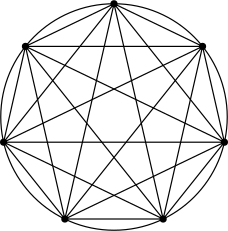
¿Cuál es la suma de las -ésimas potencias de las longitudes de las aristas y diagonales?
The figure below depicts a regular -gon inscribed in a unit circle.
What is the sum of the th powers of the lengths of all of its edges and diagonals?
Pista pequeña:
Una cuerda entre vértices separados tiene longitud al cuadrado hay de cada tipo .
A chord between vertices apart has squared length there are of each type
Pista grande:
Usa para evaluar .
Use to evaluate
Solución:
Una cuerda que une dos vértices separados pasos tiene longitud al cuadrado y hay cuerdas para cada La suma buscada es
Usando y la suma interior se expande a
Por lo tanto, el total es
Por lo tanto, la respuesta correcta es C.
A chord joining two vertices steps apart has squared length and there are chords for each of The required sum is
Using and the inner sum expands to
Therefore the total is
Thus, the correct answer is C.
25.
Cuatro hexágonos regulares rodean un cuadrado de lado cada uno compartiendo una arista con el cuadrado, como se muestra en la figura de abajo. El área del polígono exterior no convexo de lados resultante se puede escribir como donde y son enteros y no es divisible por el cuadrado de ningún primo. ¿Cuánto vale ?
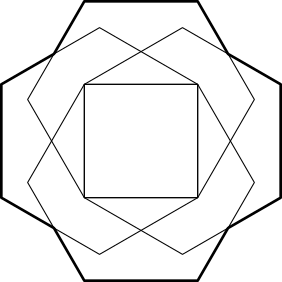
Four regular hexagons surround a square with a side length each one sharing an edge with the square, as shown in the figure below. The area of the resulting -sided outer nonconvex polygon can be written as where and are integers and is not divisible by the square of any prime. What is
Pista pequeña:
Cada hexágono comparte una arista con el cuadrado y se extiende hasta el lado opuesto; establece coordenadas con el cuadrado centrado en el origen.
Each hexagon shares an edge with the square and reaches across to the far side; set up coordinates with the square centered at the origin
Pista grande:
La frontera exterior tiene aristas planas a distancia y muescas entrantes donde se cruzan las aristas de hexágonos adyacentes, en .
The outer boundary has flat edges at distance and reflex notches where adjacent hexagons’ edges cross, at
Solución:
Centra el cuadrado en el origen con vértices Cada hexágono comparte una arista con el cuadrado y se extiende hasta el lado opuesto; el hexágono del borde inferior, por ejemplo, tiene su arista lejana (superior) desde hasta
La frontera exterior es un -gono con aristas planas a distancia del centro, vértices convexos como y cuatro muescas entrantes donde se encuentran las aristas inclinadas de hexágonos adyacentes, en y sus imágenes simétricas.
Aplicando la fórmula del cordón de zapato a estos vértices se obtiene el área así que y
Por lo tanto, la respuesta correcta es B.
Center the square at the origin with vertices Each hexagon shares one edge with the square and extends across to the opposite side; the hexagon on the bottom edge, for instance, has its far (top) edge from to
The outer boundary is a -gon with flat edges at distance from the center, convex vertices such as and four reflex notches where adjacent hexagons’ slanted edges meet, at and its symmetric images.
Applying the shoelace formula to these vertices gives area so and
Thus, the correct answer is B.