
Soluciones del 2025 AMC 10A
Desplázate hacia abajo para ver las soluciones preparadas profesionalmente de LIVE by Po-Shen Loh, imprime las soluciones en PDF, consulta la clave de respuestas, o haz el examen cronometrado completo.
Todos los problemas se usan con el permiso legal oficial de la Mathematical Association of America (MAA).
1.
Andy y Betsy viven ambos en Mathville. Andy sale de Mathville en su bicicleta a la viajando hacia el norte a una velocidad constante de millas por hora. Betsy sale en su bicicleta desde el mismo punto a las viajando hacia el este a una velocidad constante de millas por hora. ¿En qué momento estarán exactamente a la misma distancia de su punto de partida común?
Andy and Betsy both live in Mathville. Andy leaves Mathville on his bicycle at traveling due north at a steady miles per hour. Betsy leaves on her bicycle from the same point at traveling due east at a steady miles per hour. At what time will they be exactly the same distance from their common starting point?
Pista pequeña:
Sea el número de horas desde que Andy salió; Andy ha recorrido millas y Betsy millas.
Let be the hours since Andy started; Andy has gone miles and Betsy miles
Pista grande:
Iguala las dos distancias y despeja .
Set the two distances equal and solve for
Solución:
Sea el número de horas desde la Andy ha recorrido millas hacia el norte. Betsy sale una hora después, así que ha recorrido millas hacia el este. Queremos que sean iguales: Esto da por lo que Tres horas después de la son las Por lo tanto, E es la respuesta correcta.
Let be the hours since Andy has gone miles north. Betsy starts an hour later, so she’s gone miles east. We want these equal: That gives so Three hours past is Thus, E is the correct answer.
2.
Una caja contiene libras de una mezcla de frutos secos que es por ciento cacahuetes, por ciento anacardos y por ciento almendras. Se añade a la caja una segunda mezcla de frutos secos que contiene por ciento cacahuetes, por ciento anacardos y por ciento almendras, resultando en una nueva mezcla que es por ciento cacahuetes. ¿Cuántas libras de anacardos hay ahora en la caja?
A box contains pounds of a nut mix that is percent peanuts, percent cashews, and percent almonds. A second nut mix containing percent peanuts, percent cashews, and percent almonds is added to the box resulting in a new nut mix that is percent peanuts. How many pounds of cashews are now in the box?
Pista pequeña:
La caja empieza con libras de cacahuetes y libras de anacardos.
The box starts with pounds of peanuts and pounds of cashews
Pista grande:
Si se añaden libras de la segunda mezcla, los cacahuetes pasan a ser de un total de iguala esta fracción a .
If pounds of the second mix is added, peanuts become out of set this fraction to
Solución:
La mezcla inicial de libras contiene libras de cacahuetes y libras de anacardos. Añade libras de la segunda mezcla, que es cacahuetes. Queremos que la nueva fracción de cacahuetes sea así que Esto significa que lo que da Esas libras aportan libras más de anacardos, por lo que la caja tiene ahora Por lo tanto, la respuesta es B.
The starting -pound mix holds pounds of peanuts and pounds of cashews. Add pounds of the second mix, which is peanuts. We want the new peanut fraction to be so This means giving Those pounds bring more pounds of cashews, so the box now has Therefore, the answer is B.
3.
¿Cuántos triángulos isósceles hay con área positiva cuyas longitudes de lado son todos enteros positivos y cuyo lado más largo tiene longitud ?
How many isosceles triangles are there with positive area whose side lengths are all positive integers and whose longest side has length
Pista pequeña:
Divide en el caso en que dos lados son iguales a y el caso en que es el único lado más largo.
Split into the case where two sides equal and the case where is the unique longest side
Pista grande:
En el segundo caso, los dos lados iguales satisfacen y .
In the second case the two equal sides satisfy and
Solución:
Divide en dos casos. Supón que dos lados son iguales a Entonces el tercer lado puede ser cualquier entero desde hasta lo que da triángulos. Ahora supón que es el único lado más largo. Los dos lados iguales deben satisfacer por la desigualdad triangular, y Así que va desde hasta lo que da triángulos. Sumando, Por lo tanto, D es la respuesta correcta.
Split into two cases. Say two sides both equal Then the third side can be any integer from to which is triangles. Now suppose is the unique longest side. The two equal legs must satisfy by the triangle inequality, and So runs from to giving triangles. Adding up, Thus, D is the correct answer.
4.
Un equipo de estudiantes va a competir contra un equipo de profesores en un concurso de preguntas. El número total de estudiantes y profesores es Ash, primo de uno de los estudiantes, quiere unirse al concurso. Si Ash juega con los estudiantes, la edad promedio de ese equipo aumentará de a Si Ash juega con los profesores, la edad promedio de ese equipo disminuirá de a ¿Cuántos años tiene Ash?
A team of students is going to compete against a team of teachers in a trivia contest. The total number of students and teachers is Ash, a cousin of one of the students, wants to join the contest. If Ash plays with the students, the average age on that team will increase from to If Ash plays with the teachers, the average age on that team will decrease from to How old is Ash?
Pista pequeña:
Sea el número de estudiantes; sus edades suman y las de los profesores .
Let be the number of students; their ages sum to and the teachers’ to
Pista grande:
La edad de Ash es y también iguala ambas.
Ash’s age is and also set them equal
Solución:
Sea el número de estudiantes. Si Ash se une a ellos, su edad es Si en cambio se une a los profesores (hay de ellos), su edad es Ambas describen al mismo Ash, así que Esto da y Ash tiene Por lo tanto, la respuesta es A.
Let be the number of students. If Ash joins them, his age is If he joins the teachers instead (there are of them), his age is Both describe the same Ash, so That gives and Ash is Therefore, the answer is A.
5.
Considera la sucesión de enteros positivos
¿Cuál es el término número de esta sucesión?
Consider the sequence of positive integers
What is the th term in this sequence?
Pista pequeña:
La sucesión sube desde hasta un pico y vuelve a bajar; agrúpala en bloques según el valor del pico.
The sequence rises from up to a peak and falls back; group it into blocks by peak value
Pista grande:
El bloque cuyo pico es tiene términos y termina en la posición acumulada .
The block that peaks at has terms and ends at cumulative position
Solución:
Agrupa la sucesión en bloques. El bloque es que tiene términos y termina en Así que después del bloque hemos usado términos. Observa que Eso es exactamente el final del bloque cuyo último término es Por lo tanto, E es la respuesta correcta.
Group the sequence into blocks. Block reads which is terms and ends on So after block we’ve used terms. Notice That’s exactly the end of block whose last term is Thus, E is the correct answer.
6.
En un triángulo equilátero, cada ángulo interior es trisecado por un par de rayos. La intersección de los interiores del ángulo central de en cada vértice es el interior de un hexágono convexo. ¿Cuál es la medida en grados del ángulo más pequeño de este hexágono?
In an equilateral triangle each interior angle is trisected by a pair of rays. The intersection of the interiors of the middle -angle at each vertex is the interior of a convex hexagon. What is the degree measure of the smallest angle of this hexagon?
Pista pequeña:
Cada ángulo de vértice de se divide en tres partes de ; considera los triángulos formados por los trisectores de dos vértices sobre un mismo lado.
Each vertex angle splits into three pieces; consider triangles formed by trisectors from two vertices on one side
Pista grande:
Usa la suma de los ángulos de un triángulo en las intersecciones, donde los pares de ángulos de base son y
Use the triangle angle sum at the intersections with base-angle pairs and
Solución:
Etiqueta el triángulo equilátero como Cada ángulo de se divide en tres partes de . Toma los trisectores más externos desde y : se encuentran formando ángulos de base así que el vértice del hexágono ahí tiene ángulo Los trisectores más internos desde y se encuentran formando ángulos de base dando ápice y por ángulos opuestos por el vértice ese es el ángulo opuesto del hexágono. Así que los seis ángulos alternan y El más pequeño es Por lo tanto, la respuesta es C.
Label the equilateral triangle Each angle splits into three pieces. Take the outermost trisectors from and : they meet at base angles so the hexagon vertex there has angle The innermost trisectors from and meet at base angles giving apex and by vertical angles that’s the opposite hexagon angle. So the six angles alternate and The smallest is Therefore, the answer is C.
7.
Supón que y son números reales. Cuando el polinomio se divide entre el resto es Cuando el polinomio se divide entre el resto es ¿Cuánto vale ?
Suppose and are real numbers. When the polynomial is divided by the remainder is When the polynomial is divided by the remainder is What is
Pista pequeña:
Por el teorema del resto, evalúa el polinomio en y .
By the Remainder Theorem, evaluate the polynomial at and
Pista grande:
Esto da y .
This gives and
Solución:
Por el teorema del resto, basta con sustituir. Obtenemos así que Y así que Resta la primera de la segunda: de donde Entonces Por lo tanto, E es la respuesta correcta.
By the Remainder Theorem, just plug in. We get so And so Subtract the first from the second: hence Then Thus, E is the correct answer.
8.
Agnes escribe las siguientes cuatro afirmaciones en una hoja de papel en blanco.
• Al menos una de estas afirmaciones es verdadera.
• Al menos dos de estas afirmaciones son verdaderas.
• Al menos dos de estas afirmaciones son falsas.
• Al menos una de estas afirmaciones es falsa.
Cada afirmación es verdadera o falsa. ¿Cuántas afirmaciones falsas escribió Agnes en el papel?
Agnes writes the following four statements on a blank piece of paper.
• At least one of these statements is true.
• At least two of these statements are true.
• At least two of these statements are false.
• At least one of these statements is false.
Each statement is either true or false. How many false statements did Agnes write on the paper?
Pista pequeña:
Prueba la suposición de que la tercera afirmación (“al menos dos son falsas”) es verdadera y busca una contradicción.
Test the assumption that the third statement (“at least two are false”) is true and look for a contradiction
Pista grande:
Luego comprueba si tener exactamente una afirmación falsa es totalmente consistente.
Then check whether exactly one false statement is fully consistent
Solución:
Numerémoslas: al menos una verdadera, al menos dos verdaderas, al menos dos falsas, al menos una falsa. Supón que es verdadera. Entonces al menos dos afirmaciones son falsas. Pero entonces y resultan todas verdaderas, lo que deja como máximo una afirmación falsa. Eso es una contradicción, así que debe ser falsa. Ahora y son todas verdaderas, y cada una coincide con la realidad al haber solo una afirmación falsa. Así que exactamente afirmación es falsa. Por lo tanto, la respuesta es B.
Number them: at least one true, at least two true, at least two false, at least one false. Suppose is true. Then at least two statements are false. But then and all read as true, which leaves at most one false statement. That’s a contradiction, so must be false. Now and are all true, and each matches reality with just one false statement. So exactly statement is false. Therefore, the answer is B.
9.
Sea ¿Para cuántos números reales la gráfica de pasa por el punto ?
Let For how many real numbers does the graph of pass through the point
más de
more than
Pista pequeña:
La gráfica de pasa por exactamente cuando .
The graph of passes through exactly when
Pista grande:
Factoriza y cuenta las soluciones de ; observa que supera .
Factor and count solutions of ; note that exceeds
Solución:
La gráfica pasa por exactamente cuando Sea de modo que contamos las soluciones de Factoriza con raíces En la función es positiva y así que la continuidad da una raíz a cada lado de En la función es negativa, mientras que para crece desde hasta infinito, dando una raíz más. Una ecuación cúbica tiene a lo sumo raíces reales, así que estas son todas las soluciones. Cada una da un por lo que hay valores. Por lo tanto, C es la respuesta correcta.
The graph passes through exactly when Let so we count solutions of Factor with roots On the function is positive and so continuity gives one root on each side of On the function is negative, while for it increases from to infinity, giving one more root. A cubic equation has at most real roots, so these are all the solutions. Each gives one so there are values. Thus, C is the correct answer.
10.
Un semicírculo tiene diámetro y una cuerda de longitud paralela a Del semicírculo mayor se recorta un semicírculo más pequeño con diámetro sobre y tangente a , como se muestra abajo.
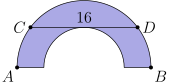
¿Cuál es el área de la figura resultante, mostrada sombreada?
A semicircle has diameter and chord of length parallel to A smaller semicircle with diameter on and tangent to is cut from the larger semicircle, as shown below.
What is the area of the resulting figure, shown shaded?
Pista pequeña:
Con radio grande y radio pequeño el área sombreada es .
With large radius and small radius the shaded area is
Pista grande:
Sea el centro y el punto medio de entonces y así que .
Let be the center and the midpoint of then and so
Solución:
Sea el centro sobre y el punto medio de la cuerda Toma como el radio pequeño y como el grande. Como el teorema de Pitágoras en el triángulo da El área sombreada es el semicírculo grande menos el pequeño: Por lo tanto, la respuesta es C.
Let be the center on and the midpoint of chord Set for the small radius and for the large one. Since the Pythagorean theorem in triangle gives The shaded area is the big semicircle minus the small one: Therefore, the answer is C.
11.
La sucesión es aritmética. La sucesión es geométrica. Ambas sucesiones son estrictamente crecientes y contienen solo enteros, y es lo más pequeño posible. ¿Cuál es el valor de ?
The sequence is arithmetic. The sequence is geometric. Both sequences are strictly increasing and contain only integers, and is as small as possible. What is the value of
Pista pequeña:
Escribe a partir de la sucesión aritmética y a partir de la geométrica.
Write from the arithmetic sequence and from the geometric one
Pista grande:
Como prueba razones enteras crecientes hasta que .
Since test increasing integer ratios until
Solución:
A partir de la sucesión aritmética, así que A partir de la geométrica, para alguna razón entera Queremos el menor así que probamos Solo funciona, ya que Eso obliga a y las sucesiones son y Así que Por lo tanto, E es la respuesta correcta.
From the arithmetic sequence, so From the geometric one, for some integer ratio We want the smallest such so test Only works, since That forces and the sequences are and So Thus, E is the correct answer.
12.
Carlos usa un código de dígitos para desbloquear su computadora. En su código, exactamente un dígito es par, exactamente un dígito (posiblemente distinto) es primo, y ningún dígito es ¿Cuántos códigos de dígitos satisfacen estas condiciones?
Carlos uses a -digit passcode to unlock his computer. In his passcode, exactly one digit is even, exactly one (possibly different) digit is prime, and no digit is How many -digit passcodes satisfy these conditions?
Pista pequeña:
Coloca el único dígito par en una de las posiciones y multiplica por los otros tres dígitos son impares.
Place the single even digit in one of positions and multiply by the other three digits are odd
Pista grande:
Divide según si el único dígito primo es el par () o uno impar ( o ).
Split on whether the one prime digit is the even one () or an odd one ( or )
Solución:
Ningún dígito es así que los dígitos van de a Por ahora coloca el único dígito par en la primera casilla y multiplica por al final para ubicarlo. Divide según ese dígito par. Si es el primo entonces los tres dígitos impares deben ser todos no primos, así que cada uno es o dando formas. En caso contrario el dígito par es u ( opciones), y exactamente uno de los dígitos impares es primo, valiendo o ( opciones) en una de las posiciones impares, mientras que los otros dos impares provienen de ( formas). Eso es En total, Por lo tanto, la respuesta es D.
No digit is so digits run from to Put the single even digit in the first slot for now and multiply by at the end to place it. Split on that even digit. If it’s the prime then the three odd digits all have to be non-prime, so each is or giving ways. Otherwise the even digit is or ( choices), and exactly one of the odd digits is prime, worth or ( choices) in one of the odd positions, while the other two odds come from ( ways). That’s Altogether, Therefore, the answer is D.
13.
En la figura de abajo, el cuadrado exterior contiene infinitos cuadrados, cada uno con el mismo centro y lados paralelos al cuadrado exterior. La razón entre la longitud del lado de un cuadrado y la longitud del lado del siguiente cuadrado interior es donde Los espacios entre cuadrados están sombreados de forma alternada, como se muestra en la figura (que no está necesariamente dibujada a escala).

El área de la porción sombreada de la figura es el del área del cuadrado original. ¿Cuánto vale ?
In the figure below, the outside square contains infinitely many squares, each of them with the same center and sides parallel to the outside square. The ratio of the side length of a square to the side length of the next inner square is where The spaces between squares are alternately shaded, as shown in the figure (which is not necessarily drawn to scale).
The area of the shaded portion of the figure is of the area of the original square. What is
Pista pequeña:
Toma el lado exterior como los lados de los cuadrados son y el área sombreada es .
Take the outer side to be the square sides are and the shaded area is
Pista grande:
Suma esta serie geométrica de razón e iguálala a .
Sum this geometric series with ratio and set it equal to
Solución:
Sea el lado exterior Los cuadrados tienen lados y los anillos sombreados se alternan, así que el área sombreada es Nos dicen que esto es igual a así que Entonces lo que da Por lo tanto, D es la respuesta correcta.
Let the outer side be The squares have sides and the shaded rings alternate, so the shaded area is We’re told this equals so Then giving Thus, D is the correct answer.
14.
Seis sillas están dispuestas alrededor de una mesa redonda. Dos estudiantes y dos profesores eligen al azar cuatro de las sillas para sentarse. ¿Cuál es la probabilidad de que los dos estudiantes se sienten en dos sillas adyacentes y los dos profesores también se sienten en dos sillas adyacentes?
Six chairs are arranged around a round table. Two students and two teachers randomly select four of the chairs to sit in. What is the probability that the two students will sit in two adjacent chairs and the two teachers will also sit in two adjacent chairs?
Pista pequeña:
Sienta a un estudiante; la probabilidad de que el otro estudiante ocupe una de las dos sillas adyacentes es .
Seat one student; the probability the other student takes one of the two adjacent chairs is
Pista grande:
Dado que los estudiantes son adyacentes, cuenta cuántas de las formas de sentar a los profesores son adyacentes.
Given the students are adjacent, count how many of the teacher seatings are adjacent
Solución:
Sienta al primer estudiante en cualquier lugar. El segundo estudiante queda junto a él con probabilidad ya que dos de las cinco sillas restantes son adyacentes. Ahora los profesores ocupan dos de las cuatro sillas sobrantes. De las formas de hacerlo, exactamente son pares adyacentes. Así que la probabilidad es Por lo tanto, la respuesta es B.
Seat the first student anywhere. The second student lands next to them with probability since two of the remaining five chairs are adjacent. Now the teachers fill two of the four leftover chairs. Of the ways to do that, exactly are adjacent pairs. So the probability is Therefore, the answer is B.
15.
En la figura de abajo, es un rectángulo, y ¿Cuál es el área de ?
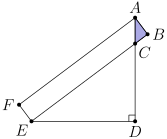
In the figure below, is a rectangle, and What is the area of
Pista pequeña:
Sea Entonces y .
Let Then and
Pista grande:
Usa para plantear una proporción y luego despeja .
Use to set up a proportion, then solve for
Solución:
Sea Como es un rectángulo con y y obtenemos y Los triángulos y son semejantes, así que Quita denominadores y eleva al cuadrado para obtener que se factoriza como La raíz positiva es Así que el área es Por lo tanto, A es la respuesta correcta.
Let Since is a rectangle with and and we get and The triangles and are similar, so Clear denominators and square to get which factors as The positive root is So the area is Thus, A is the correct answer.
16.
Hay tres frascos. Cada una de tres monedas se coloca en uno de los tres frascos, elegido al azar e independientemente de las colocaciones de las otras monedas. ¿Cuál es el número esperado de monedas en un frasco con más monedas?
There are three jars. Each of three coins is placed in one of the three jars, chosen at random and independently of the placements of the other coins. What is the expected number of coins in a jar with the most coins?
Pista pequeña:
Hay colocaciones igualmente probables; clasifica cada una según cómo se distribuyen las monedas.
There are equally likely placements; classify each by how the coins are distributed
Pista grande:
Cuenta las colocaciones con máximo (todas en un frasco), máximo (una por frasco) y máximo (el resto).
Count placements with max (all in one jar), max (one per jar), and max (the rest)
Solución:
Hay colocaciones igualmente probables. De estas, amontonan todas las monedas en un frasco (máximo ), y ponen una moneda en cada frasco (máximo ). Las otras se reparten - (máximo ). Así que el máximo esperado es Por lo tanto, la respuesta es D.
There are equally likely placements. Of these, pile all coins into one jar (max ), and put one coin in each jar (max ). The other split - (max ). So the expected maximum is Therefore, the answer is D.
17.
Sea el único entero positivo tal que al dividir entre queda un resto de y al dividir entre queda un resto de ¿Cuál es la cifra de las decenas de ?
Let be the unique positive integer such that dividing by leaves a remainder of and dividing by leaves a remainder of What is the tens digit of
Pista pequeña:
Tanto como son múltiplos de .
Both and are multiples of
Pista grande:
También lo es su diferencia; redúcela restando más múltiplos, y recuerda que ya que el resto es .
So is their difference; reduce it by subtracting further multiples, and remember since the remainder is
Solución:
Resta los restos. Tanto como son múltiplos de así que su diferencia también lo es. Ahora lo que hace que también sea múltiplo de . El resto significa que y el único divisor de mayor que es mismo. Así que y su cifra de las decenas es Por lo tanto, E es la respuesta correcta.
Subtract off the remainders. Both and are multiples of so their difference is too. Now which makes a multiple of as well. The remainder means and the only divisor of bigger than is itself. So and its tens digit is Thus, E is the correct answer.
18.
La media armónica de un conjunto de números es el recíproco de la media aritmética de los recíprocos de los números del conjunto. Por ejemplo, la media armónica de y es
¿Cuál es la media armónica de todas las raíces reales del siguiente polinomio de grado ?
The harmonic mean of a collection of numbers is the reciprocal of the arithmetic mean of the reciprocals of the numbers in the collection. For example, the harmonic mean of and is
What is the harmonic mean of all the real roots of the th degree polynomial
Pista pequeña:
Para cada factor Vieta da suma de raíces y producto así que la suma de los recíprocos es su cociente.
For each factor Vieta gives root sum and product so the reciprocal-sum is their quotient
Pista grande:
La media armónica es el número de raíces dividido entre la suma total de los recíprocos.
The harmonic mean is the number of roots divided by the total sum of reciprocals
Solución:
Consideremos un factor Su discriminante es positivo, así que tiene dos raíces reales distintas. Las raíces de factores diferentes también son distintas: una raíz común para los índices y satisfaría pero Por Vieta, la suma de los recíprocos de las dos raíces de un factor es Al sumar sobre los factores, los recíprocos suman Hay raíces reales en total, de modo que la media armónica es Por lo tanto, la respuesta es B.
Look at one factor Its discriminant is positive, so it has two distinct real roots. Roots from different factors are also distinct: a common root for indices and would satisfy but By Vieta, the two reciprocals from one factor sum to Summing over all factors, the reciprocals total There are real roots in all, so the harmonic mean is Therefore, the answer is B.
19.
Un arreglo de números se construye empezando con los números en la fila superior. Cada par de números adyacentes se suma para producir un número en la fila siguiente. Cada fila comienza y termina con los números y respectivamente. Las primeras tres filas se muestran abajo.
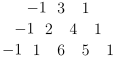
Si el proceso continúa, una de las filas sumará En esa fila, ¿cuál es el tercer número desde la izquierda?
An array of numbers is constructed beginning with the numbers in the top row. Each adjacent pair of numbers is summed to produce a number in the next row. Each row will begin and end with the numbers and respectively. The first three rows are shown below.
If the process continues, one of the rows will sum to In that row, what is the third number from the left?
Pista pequeña:
Cada entrada interior alimenta dos sumas de abajo, así que el total de cada fila se duplica; la fila superior suma .
Each interior entry feeds two sums below, so each row’s total doubles; the top row sums to
Pista grande:
Sigue la tercera diagonal desde la izquierda, que acumula la segunda diagonal .
Track the third diagonal from the left, which accumulates the second diagonal
Solución:
Cada entrada interior alimenta dos entradas de abajo, y los valores de los extremos y se cancelan en la suma. Así que el total de cada fila duplica el de la de arriba. La fila superior suma y así que esta es la fila número (contando la superior como la fila ). Sigue las diagonales desde la izquierda. La segunda diagonal es disminuyendo por fila. La tercera diagonal las va sumando: para vale Sustituye : Por lo tanto, A es la respuesta correcta.
Each interior entry feeds two entries below, and the end values and cancel in the sum. So every row’s total doubles the one above. The top row sums to and so this is the th row (counting the top as row ). Track the diagonals from the left. The second diagonal is dropping by each row. The third diagonal adds these up: for it equals Plug in : Thus, A is the correct answer.
20.
Un silo (cilindro circular recto) de diámetro metros se alza en un campo. MacDonald está ubicado metros al oeste y metros al sur del centro del silo. McGregor está ubicado metros al este y metros al sur del centro del silo. La línea de visión entre MacDonald y McGregor es tangente al silo. El valor de se puede escribir como donde y son enteros positivos, no es divisible por el cuadrado de ningún primo, y es primo relativo con el máximo común divisor de y ¿Cuánto vale ?
A silo (right circular cylinder) with diameter meters stands in a field. MacDonald is located meters west and meters south of the center of the silo. McGregor is located meters east and meters south of the center of the silo. The line of sight between MacDonald and McGregor is tangent to the silo. The value of can be written as where and are positive integers, is not divisible by the square of any prime, and is relatively prime to the greatest common divisor of and What is
Pista pequeña:
Pon el centro del silo en el origen; la línea de visión es tangente al círculo de radio .
Put the silo’s center at the origin; the line of sight is tangent to the circle of radius
Pista grande:
A lo largo de la recta tangente donde cada uno de y es la longitud de la tangente desde un punto al círculo.
Along the tangent line where each of and is a tangent length from a point to the circle
Solución:
Pon el centro del silo en el origen con radio Entonces MacDonald está en y McGregor en La longitud de la tangente desde es y desde es El punto de tangencia está entre los dos hombres, así que Pero además Eleva al cuadrado dos veces y simplifica: Su raíz positiva, que satisface la ecuación original de longitudes de tangente, es Así que Por lo tanto, la respuesta es A.
Put the silo’s center at the origin with radius Then MacDonald is at and McGregor at The tangent length from is and from it is The tangent point sits between the two men, so But also Squaring twice and simplifying gives Its positive root, which satisfies the original tangent-length equation, is Therefore Thus, A is the correct answer.
21.
Un conjunto de números se llama libre de sumas si cada vez que y son elementos (no necesariamente distintos) del conjunto, no es un elemento del conjunto. Por ejemplo, y el conjunto vacío son libres de sumas, pero no lo es. ¿Cuál es el mayor número posible de elementos de un subconjunto libre de sumas de ?
A set of numbers is called sum-free if whenever and are (not necessarily distinct) elements of the set, is not an element of the set. For example, and the empty set are sum-free, but is not. What is the greatest possible number of elements in a sum-free subset of
Pista pequeña:
Tanto como son libres de sumas, cada uno con elementos.
Both and are sum-free, each with elements
Pista grande:
Si es el mayor elemento, empareja hasta como cada par aporta como máximo un elemento.
If is the largest element, pair to as each pair contributes at most one element
Solución:
Podemos llegar a Los impares son libres de sumas, ya que dos impares suman un par. También lo es ya que cualesquiera dos de ellos suman más de Cada uno tiene elementos. Ahora sea el mayor elemento de un subconjunto libre de sumas cualquiera. Para a lo sumo se puede elegir un elemento de , porque los dos suman Si es par, tampoco se puede elegir , ya que puede usarse dos veces y Así, además de hay a lo sumo elementos elegidos, para un total de a lo sumo Por lo tanto, el mayor tamaño posible es Así, C es la respuesta correcta.
We can reach The odds are sum-free, since two odds sum to an even. So is since any two of those sum past Each has elements. Now let be the largest element of any sum-free subset. For at most one member of can be chosen, because the two sum to If is even, cannot be chosen either, since it can be used twice and Thus besides there are at most chosen elements, for a total of at most Therefore the greatest possible size is Thus, C is the correct answer.
22.
Un círculo de radio está rodeado por tres círculos, cuyos radios son y todos tangentes exteriormente al círculo interior y entre sí, como se muestra.

¿Cuánto vale ?
A circle of radius is surrounded by three circles, whose radii are and all externally tangent to the inner circle and externally tangent to each other, as shown in the diagram below.
What is
Pista pequeña:
Los centros de los círculos de radio están a distancias mutuas , formando un triángulo rectángulo.
The centers of the radius- circles are pairwise apart, forming a right triangle
Pista grande:
Coloca el ángulo recto en el origen y escribe las ecuaciones de distancia para el centro interior, o aplica la relación de curvaturas de los cuatro círculos.
Place the right angle at the origin and write distance equations for the inner center, or apply the four-circle curvature relation
Solución:
Los tres centros exteriores están a distancias mutuas y , un triángulo rectángulo --. Ahora aplica el Teorema del Círculo de Descartes con curvaturas y todas mutuamente tangentes: Invirtiendo, Por lo tanto, la respuesta es B.
The three outer centers are pairwise and apart, a -- right triangle. Now apply Descartes’ Circle Theorem with curvatures and all mutually tangent: Inverting, Therefore, the answer is B.
23.
El triángulo tiene longitudes de lado y La bisectriz de y la altura sobre el lado se cortan en el punto ¿Cuánto vale ?
Triangle has side lengths and The bisector of and the altitude to side intersect at point What is
Pista pequeña:
Haz que la bisectriz de corte a en el Teorema de la Bisectriz da y .
Let the bisector of meet at the Angle Bisector Theorem gives and
Pista grande:
Muestra que así que es isósceles; luego persigue ángulos para hallar que es isósceles con .
Show so is isosceles; then angle-chase to find isosceles with
Solución:
Sea la intersección de la bisectriz de con Por el teorema de la bisectriz, y como obtenemos y Los triángulos y comparten y los lados adyacentes tienen la razón común así que son semejantes por LAL. Entonces por lo que es isósceles. Sea Como la altura por es perpendicular a tanto como son Así, es isósceles y Como está en tenemos Por lo tanto, D es la respuesta correcta.
Let the bisector of hit at By the Angle Bisector Theorem, and since we get and Triangles and share with adjacent sides in the common ratio so they are similar by SAS. Hence making isosceles. Put Because the altitude through is perpendicular to both and equal Thus is isosceles, so Since lies on we get Thus, D is the correct answer.
24.
Llamamos justo a un entero positivo si ningún dígito se usa más de una vez, no tiene s, y ningún dígito es adyacente a dos dígitos mayores. Por ejemplo, y son justos, pero y no lo son. ¿Cuántos enteros positivos justos hay?
Call a positive integer fair if no digit is used more than once, it has no s, and no digit is adjacent to two greater digits. For example, and are fair, but and are not fair. How many fair positive integers are there?
Pista pequeña:
Los dígitos de un número justo aumentan hasta su dígito más grande y luego disminuyen.
A fair number’s digits increase up to its largest digit and then decrease
Pista grande:
Para dígitos, elige el conjunto de dígitos () y decide cuáles de los dígitos más pequeños van a la izquierda de ().
For digits, choose the digit set () and decide which of the smaller digits go left of ()
Solución:
Las cifras de un número justo deben aumentar hasta su cifra mayor y luego disminuir. En efecto, el primer ascenso después de cualquier descenso comenzaría en una cifra menor que sus dos vecinas. Para cifras, elegimos el conjunto de cifras entre y de maneras. Cada una de las cifras menores que se coloca independientemente en el lado izquierdo creciente o en el lado derecho decreciente; después, su posición queda determinada. Por tanto, el total es Por lo tanto, la respuesta es C.
A fair number’s digits must increase up to its largest digit and then decrease. Indeed, the first ascent after any descent would begin at a digit smaller than both of its neighbors. For digits, choose the digit set from to in ways. Each of the digits below independently goes on the increasing left side or the decreasing right side, after which its position is forced. Hence the total is Therefore, the answer is C.
25.
Se elige al azar un punto dentro del cuadrado La probabilidad de que no sea ni el lado más corto ni el más largo de se puede escribir como donde y son enteros positivos, y no es divisible por el cuadrado de un primo. ¿Cuánto vale ?
A point is chosen at random inside square The probability that is neither the shortest nor the longest side of can be written as where and are positive integers, and is not divisible by the square of a prime. What is
Pista pequeña:
Toma es la longitud intermedia cuando o .
Set is the middle length when either or
Pista grande:
Las fronteras son el círculo (centrado en ) y la recta vertical usa el sector de donde es equilátero.
The boundaries are the circle (about ) and the vertical line use the sector where is equilateral
Solución:
Coloca y en el cuadrado unitario. es la longitud intermedia cuando o Estas regiones están limitadas por el círculo centrado en de radio (donde ) y la recta (donde ). Sea donde el círculo corta a Entonces es equilátero, así que La región más grande tiene área y la más pequeña tiene área Sumadas dan Así Por lo tanto, A es la respuesta correcta.
Place and on the unit square. is the middle length when or These regions are bounded by the circle centered at with radius (where ) and the line (where ). Let be where the circle meets Then is equilateral, so The larger region has area and the smaller has area They add to Thus Thus, A is the correct answer.