
Soluciones del 2008 AMC 10B
Desplázate hacia abajo para ver las soluciones preparadas profesionalmente de LIVE by Po-Shen Loh, imprime las soluciones en PDF, consulta la clave de respuestas, o haz el examen cronometrado completo.
Todos los problemas se usan con el permiso legal oficial de la Mathematical Association of America (MAA).
1.
Un jugador de baloncesto anotó canastas durante un partido. Cada canasta valía o puntos. ¿Cuántos números diferentes podrían representar el total de puntos anotados por el jugador?
A basketball player made baskets during a game. Each basket was worth either or points. How many different numbers could represent the total points scored by the player?
Pista pequeña:
Si canastas valen puntos, el total es .
If baskets are worth points, the total is
Pista grande:
A medida que va de a , el total aumenta en cada vez.
As runs from to , the total increases by each time
Solución:
Si de las canastas valen puntos y el resto valen el total es
A medida que recorre el total toma cada valor entero desde hasta dando posibilidades.
Por lo tanto, la respuesta correcta es E.
If of the baskets are worth points and the rest worth the total is
As ranges over the total takes every integer value from to giving possibilities.
Thus, the correct answer is E.
2.
Se muestra un bloque de fechas de calendario. Se debe invertir el orden de los números de la segunda fila. Luego se debe invertir el orden de los números de la cuarta fila. Finalmente, se deben sumar los números de cada diagonal. ¿Cuál será la diferencia positiva entre las dos sumas diagonales?
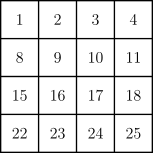
A block of calendar dates is shown. The order of the numbers in the second row is to be reversed. Then the order of the numbers in the fourth row is to be reversed. Finally, the numbers on each diagonal are to be added. What will be the positive difference between the two diagonal sums?
Pista pequeña:
Después de invertir las filas y escribe la nueva cuadrícula.
After reversing rows and write out the new grid
Pista grande:
La diagonal principal es y la otra es .
The main diagonal reads and the other reads
Solución:
Después de invertir la segunda fila a y la cuarta fila a las dos diagonales son y
Sus sumas son y así que la diferencia positiva es
Por lo tanto, la respuesta correcta es B.
After reversing the second row to and the fourth row to the two diagonals are and
Their sums are and so the positive difference is
Thus, the correct answer is B.
3.
Supón que es un número real positivo. ¿Cuál de las siguientes expresiones es equivalente a
Assume that is a positive real number. Which is equivalent to
Pista pequeña:
Escribe .
Write
Pista grande:
Entonces y la raíz cúbica divide el exponente entre .
Then and the cube root divides the exponent by
Solución:
Como tenemos
Al tomar la raíz cúbica se multiplica el exponente por obteniendo
Por lo tanto, la respuesta correcta es D.
Since we have
Taking the cube root multiplies the exponent by giving
Thus, the correct answer is D.
4.
Una liga de béisbol semiprofesional tiene equipos con jugadores cada uno. Las reglas de la liga establecen que a un jugador se le debe pagar al menos y que el total de los salarios de todos los jugadores de cada equipo no puede exceder ¿Cuál es el salario máximo posible, en dólares, para un solo jugador?
A semipro baseball league has teams with players each. League rules state that a player must be paid at least and that the total of all players’ salaries for each team cannot exceed What is the maximum possible salary, in dollars, for a single player?
Pista pequeña:
Para maximizar un salario, paga a todos los demás lo mínimo permitido.
To maximize one salary, pay everyone else as little as allowed
Pista grande:
Los otros jugadores ganan cada uno .
The other players each earn
Solución:
El salario de un jugador es máximo cuando los otros jugadores ganan cada uno el mínimo
Eso deja para el único jugador.
Por lo tanto, la respuesta correcta es C.
One player’s salary is largest when the other players each earn the minimum
That leaves for the single player.
Thus, the correct answer is C.
5.
Para números reales y define ¿Cuánto vale ?
For real numbers and define What is
Pista pequeña:
Compara y .
Compare and
Pista grande:
Una vez que sepas que las dos entradas coinciden, aplica la definición de .
Once you know the two inputs agree, apply the definition of
Solución:
Como las dos entradas son idénticas.
Por lo tanto
Por lo tanto, la respuesta correcta es A.
Since the two inputs are identical.
Therefore
Thus, the correct answer is A.
6.
Los puntos y están sobre La longitud de es veces la longitud de y la longitud de es veces la longitud de ¿Qué fracción de la longitud de representa la longitud de ?
Points and lie on The length of is times the length of and the length of is times the length of The length of is what fraction of the length of
Pista pequeña:
A partir de y halla como fracción de .
From and find as a fraction of
Pista grande:
De igual modo y .
Similarly and
Solución:
Como y obtenemos así que
Como y obtenemos así que
Entonces
Por lo tanto, la respuesta correcta es C.
Since and we get so
Since and we get so
Then
Thus, the correct answer is C.
7.
Un triángulo equilátero de lado se llena por completo con triángulos equiláteros no superpuestos de lado ¿Cuántos triángulos pequeños se necesitan?
An equilateral triangle of side length is completely filled in by non-overlapping equilateral triangles of side length How many small triangles are required?
Pista pequeña:
El área escala con el cuadrado de la longitud del lado.
Area scales with the square of the side length
Pista grande:
El triángulo grande tiene veces el área de uno pequeño.
The big triangle has times the area of a small one
Solución:
El triángulo grande tiene un lado veces mayor que el de un triángulo pequeño, así que su área es veces mayor.
Como los triángulos pequeños lo recubren sin superposición, se necesitan exactamente .
Por lo tanto, la respuesta correcta es C.
The large triangle has side length times that of a small triangle, so its area is times as large.
Since the small triangles tile it without overlap, exactly of them are required.
Thus, the correct answer is C.
8.
Una clase recauda para comprar flores a un compañero que está en el hospital. Las rosas cuestan cada una y los claveles cuestan cada uno. No se usan otras flores. ¿Cuántos ramos diferentes se podrían comprar por exactamente ?
A class collects to buy flowers for a classmate who is in the hospital. Roses cost each, and carnations cost each. No other flowers are to be used. How many different bouquets could be purchased for exactly
Pista pequeña:
Sea el número de rosas; entonces .
Let be the number of roses; then
Pista grande:
Como es par y es par, debe ser par, y .
Since is even and is even, must be even, and
Solución:
Si se compran rosas y claveles, entonces Como y son pares, debe ser par, así que es par.
Además así que Los valores pares dan cada uno un valor válido de lo que son ramos.
Por lo tanto, la respuesta correcta es C.
If roses and carnations are bought, then Because and are even, must be even, so is even.
Also so The even values each give a valid which is bouquets.
Thus, the correct answer is C.
9.
Una ecuación cuadrática tiene dos soluciones reales. ¿Cuál es el promedio de las soluciones?
A quadratic equation has two real solutions. What is the average of the solutions?
Pista pequeña:
Para la suma de las raíces es .
For the sum of the roots is
Pista grande:
El promedio es la mitad de la suma de las raíces.
The average is half the sum of the roots
Solución:
Por las fórmulas de Vieta, la suma de las raíces de es
El promedio es la mitad de esto, es decir
Por lo tanto, la respuesta correcta es A.
By Vieta’s formulas, the sum of the roots of is
The average is half of this, namely
Thus, the correct answer is A.
10.
Los puntos y están en un círculo de radio y El punto es el punto medio del arco menor ¿Cuál es la longitud del segmento ?
Points and are on a circle of radius and Point is the midpoint of the minor arc What is the length of the line segment
Pista pequeña:
La recta desde el centro que pasa por biseca perpendicularmente la cuerda .
The line from the center through perpendicularly bisects chord
Pista grande:
Halla la distancia del centro a la cuerda, réstala de para llegar a luego usa el triángulo rectángulo con cateto .
Find the center-to-chord distance, subtract from to reach then use the right triangle with leg
Solución:
Sea el centro y el punto medio de Entonces con así que
Como es el punto medio del arco menor, son colineales y
Entonces
Por lo tanto, la respuesta correcta es A.
Let be the center and the midpoint of Then with so
Since is the midpoint of the minor arc, are collinear and
Then
Thus, the correct answer is A.
11.
Supón que es una sucesión de números reales que satisface y que y ¿Cuánto vale ?
Suppose that is a sequence of real numbers satisfying and that and What is
Pista pequeña:
Escribe y en términos de y .
Write and in terms of and
Pista grande:
y así que .
and so
Solución:
Usando la recurrencia, y
Al plantear se obtiene así que
Por lo tanto, la respuesta correcta es B.
Using the recurrence, and
Setting gives so
Thus, the correct answer is B.
12.
El cartero Pete tiene un podómetro para contar sus pasos. El podómetro registra hasta pasos y luego, en el siguiente paso, se reinicia a . Pete planea determinar su millaje de un año. El de enero, Pete pone el podómetro en Durante el año, el podómetro pasa de a cuarenta y cuatro veces. El de diciembre el podómetro marca Pete da pasos por milla. ¿Cuál de las siguientes opciones es la más cercana al número de millas que Pete caminó durante el año?
Postman Pete has a pedometer to count his steps. The pedometer records up to steps, then flips over to on the next step. Pete plans to determine his mileage for a year. On January Pete sets the pedometer to During the year, the pedometer flips from to forty-four times. On December the pedometer reads Pete takes steps per mile. Which of the following is closest to the number of miles Pete walked during the year?
Pista pequeña:
Cada reinicio representa pasos.
Each flip represents steps
Pista grande:
El total de pasos es luego divide entre .
Total steps are then divide by
Solución:
Cada reinicio cuenta pasos, así que Pete dio pasos.
Al dividir entre se obtienen unas millas, lo más cercano a
Por lo tanto, la respuesta correcta es A.
Each flip counts steps, so Pete took steps.
Dividing by gives about miles, which is closest to
Thus, the correct answer is A.
13.
Para cada entero positivo la media de los primeros términos de una sucesión es ¿Cuál es el término de la sucesión?
For each positive integer the mean of the first terms of a sequence is What is the th term of the sequence?
Pista pequeña:
La suma de los primeros términos es .
The sum of the first terms is
Pista grande:
El término es .
The th term is
Solución:
Como la media de los primeros términos es su suma es
El término es así que el término es
Por lo tanto, la respuesta correcta es B.
Since the mean of the first terms is their sum is
The th term is so the th term is
Thus, the correct answer is B.
14.
El triángulo tiene y en el primer cuadrante. Además, y Supón que se rota en sentido antihorario alrededor de ¿Cuáles son las coordenadas de la imagen de ?
Triangle has and in the first quadrant. In addition, and Suppose that is rotated counterclockwise about What are the coordinates of the image of
Pista pequeña:
Halla primero: ya que el ángulo recto está en .
Find first: since the right angle is at
Pista grande:
Una rotación de en sentido antihorario lleva a .
A counterclockwise rotation sends to
Solución:
Como el segmento es vertical, así que
Una rotación de en sentido antihorario alrededor del origen lleva a así que la imagen de es
Por lo tanto, la respuesta correcta es B.
Because segment is vertical, so
A counterclockwise rotation about the origin sends to so the image of is
Thus, the correct answer is B.
15.
¿Cuántos triángulos rectángulos tienen catetos de longitudes enteras y y una hipotenusa de longitud donde ?
How many right triangles have integer leg lengths and and a hypotenuse of length where
Pista pequeña:
Plantea y simplifica.
Set and simplify
Pista grande:
Esto da así que es un cuadrado perfecto impar con .
This gives so is an odd perfect square with
Solución:
De obtenemos así que es impar y es un cuadrado perfecto impar.
Como necesitamos y para Los cuadrados impares dan lo que son triángulos.
Por lo tanto, la respuesta correcta es A.
From we get so is odd and is an odd perfect square.
Since we need and for The odd squares give which is triangles.
Thus, the correct answer is A.
16.
Se lanzan dos monedas equilibradas una vez. Por cada cara que salga, se lanza un dado equilibrado. ¿Cuál es la probabilidad de que la suma de los dados sea impar? (Nota que si no se lanza ningún dado, la suma es )
Two fair coins are to be tossed once. For each head that results, one fair die is to be rolled. What is the probability that the sum of the die rolls is odd? (Note that if no die is rolled, the sum is )
Pista pequeña:
Si se lanza al menos un dado, la suma es impar exactamente la mitad de las veces.
If at least one die is rolled, the sum is odd exactly half the time
Pista grande:
Resta la probabilidad de no lanzar ningún dado (ambas monedas cruz), luego toma la mitad del resto.
Subtract the probability of rolling no dice (both coins tails), then take half of the rest
Solución:
Siempre que se lanza al menos un dado, por simetría la suma es impar con probabilidad
No se lanza ningún dado solo cuando ambas monedas son cruz, con probabilidad esa suma es par. Así que la respuesta es
Por lo tanto, la respuesta correcta es A.
Whenever at least one die is rolled, by symmetry the sum is odd with probability
No die is rolled only when both coins are tails, with probability that sum is even. So the answer is
Thus, the correct answer is A.
17.
Una encuesta muestra que el de todos los votantes aprueba el trabajo del alcalde. En tres ocasiones distintas, un encuestador selecciona a un votante al azar. ¿Cuál es la probabilidad de que en exactamente una de estas tres ocasiones el votante apruebe el trabajo del alcalde?
A poll shows that of all voters approve of the mayor’s work. On three separate occasions a pollster selects a voter at random. What is the probability that on exactly one of these three occasions the voter approves of the mayor’s work?
Pista pequeña:
Exactamente una aprobación puede ocurrir de maneras ordenadas.
Exactly one approval can happen in ordered ways
Pista grande:
Cada una de estas disposiciones tiene probabilidad .
Each such arrangement has probability
Solución:
Exactamente una aprobación entre tres ocasiones ocurre de maneras, cada una con probabilidad
El total es
Por lo tanto, la respuesta correcta es B.
Exactly one approval among three occasions arises in ways, each with probability
The total is
Thus, the correct answer is B.
18.
La albañila Brenda tardaría horas en construir una chimenea sola, y el albañil Brandon tardaría horas en construirla solo. Cuando trabajan juntos, hablan mucho, y su producción combinada disminuye en ladrillos por hora. Trabajando juntos, construyen la chimenea en horas. ¿Cuántos ladrillos hay en la chimenea?
Bricklayer Brenda would take hours to build a chimney alone, and bricklayer Brandon would take hours to build it alone. When they work together, they talk a lot, and their combined output is decreased by bricks per hour. Working together, they build the chimney in hours. How many bricks are in the chimney?
Pista pequeña:
Sea el número de ladrillos; sus ritmos en solitario son y .
Let be the number of bricks; their solo rates are and
Pista grande:
Juntos colocan ladrillos por hora durante horas para totalizar .
Together they lay bricks per hour for hours to total
Solución:
Sea el número de ladrillos. Brenda coloca por hora y Brandon así que juntos colocan por hora.
Durante horas esto es igual a Al resolver, lo que da
Por lo tanto, la respuesta correcta es B.
Let be the number of bricks. Brenda lays per hour and Brandon so together they lay per hour.
Over hours this equals Solving, which gives
Thus, the correct answer is B.
19.
Un tanque cilíndrico de radio pies y altura pies está acostado de lado. El tanque está lleno de agua hasta una profundidad de pies. ¿Cuál es el volumen del agua, en pies cúbicos?
A cylindrical tank with radius feet and height feet is lying on its side. The tank is filled with water to a depth of feet. What is the volume of the water, in cubic feet?
Pista pequeña:
La sección transversal del agua es un segmento circular cortado por una cuerda pies por debajo del centro.
The water cross-section is a circular segment cut by a chord feet below the center
Pista grande:
Su área es un sector de menos un triángulo; multiplica por la longitud .
Its area is a sector minus a triangle; multiply by the length
Solución:
La sección transversal sumergida es un segmento circular. La cuerda está pies por debajo del centro, y así que el semiángulo es y el ángulo central es
El área del sector es y el triángulo formado por los dos radios tiene área El área del segmento es
Multiplicando por la longitud se obtiene
Por lo tanto, la respuesta correcta es E.
The submerged cross-section is a circular segment. The chord is feet below the center, and so the half-angle is and the central angle is
The sector area is and the triangle formed by the two radii has area The segment area is
Multiplying by the length gives
Thus, the correct answer is E.
20.
Las caras de un dado cúbico están marcadas con los números y Las caras de un segundo dado cúbico están marcadas con los números y Se lanzan ambos dados. ¿Cuál es la probabilidad de que la suma de los dos números superiores sea o ?
The faces of a cubical die are marked with the numbers and The faces of a second cubical die are marked with the numbers and Both dice are thrown. What is the probability that the sum of the two top numbers will be or
Pista pequeña:
Hay resultados igualmente probables; cuenta los que suman o .
There are equally likely outcomes; count those summing to or
Pista grande:
Recuerda que cada y cada del primer dado aparece en dos caras.
Remember each and each on the first die appears on two faces
Solución:
De los resultados igualmente probables, los pares que dan suma son que son resultados.
La suma proviene de que son y la suma de que son
La probabilidad es
Por lo tanto, la respuesta correcta es B.
Of the equally likely outcomes, the pairs giving sum are which is outcomes.
Sum comes from which is and sum from which is
The probability is
Thus, the correct answer is B.
21.
Diez sillas están espaciadas uniformemente alrededor de una mesa redonda y numeradas en sentido horario del al Cinco parejas casadas van a sentarse en las sillas con hombres y mujeres alternando, y nadie debe sentarse junto a ni directamente enfrente de su cónyuge. ¿Cuántas disposiciones de asientos son posibles?
Ten chairs are evenly spaced around a round table and numbered clockwise from through Five married couples are to sit in the chairs with men and women alternating, and no one is to sit either next to or directly across from his or her spouse. How many seating arrangements are possible?
Pista pequeña:
Sienta primero a las mujeres; cuenta sus disposiciones en los asientos alternados.
Seat the women first; count their arrangements in the alternating seats
Pista grande:
Para una disposición fija de las mujeres, cuenta de cuántas maneras los hombres pueden evitar a sus cónyuges.
For a fixed seating of the women, count how many ways the men can avoid their spouses
Solución:
Sienta primero a las mujeres. La primera mujer puede ocupar cualquiera de las sillas, y como los asientos se alternan, las mujeres restantes llenan sus cuatro asientos de maneras, dando disposiciones.
Fija una mujer en la silla Su cónyuge debe sentarse en la silla o la silla cada elección obliga entonces de forma consistente la ubicación de todos los demás hombres. Así que cada disposición de las mujeres produce exactamente disposiciones válidas de los hombres.
El total es
Por lo tanto, la respuesta correcta es C.
Seat the women first. The first woman may take any of the chairs, and since seats alternate, the remaining women fill their four seats in ways, giving arrangements.
Fix a woman in chair Her spouse must sit in chair or chair each choice then forces the placement of every other man consistently. So each seating of the women yields exactly valid seatings of the men.
The total is
Thus, the correct answer is C.
22.
Tres cuentas rojas, dos cuentas blancas y una cuenta azul se colocan en una fila en orden aleatorio. ¿Cuál es la probabilidad de que no haya dos cuentas vecinas del mismo color?
Three red beads, two white beads, and one blue bead are placed in a line in random order. What is the probability that no two neighboring beads are the same color?
Pista pequeña:
Hay ordenaciones distinguibles.
There are distinguishable orderings
Pista grande:
Primero coloca las tres cuentas rojas de modo que no haya dos adyacentes, luego encaja las cuentas blancas y azul.
First place the three red beads so no two are adjacent, then fit the white and blue beads
Solución:
Hay ordenaciones distinguibles. Las tres rojas deben ocupar posiciones no adyacentes, y las posibles ubicaciones de las rojas son y
Para y los lugares restantes son mutuamente no adyacentes, así que la cuenta azul puede ir en cualquiera de los dando Para y dos lugares restantes son adyacentes, así que la azul debe separar las blancas, dando
Eso son ordenaciones válidas, así que la probabilidad es
Por lo tanto, la respuesta correcta es C.
There are distinguishable orderings. The three reds must occupy non-adjacent positions, and the possible red placements are and
For and the remaining seats are mutually non-adjacent, so the blue bead can go in any of the giving For and two remaining seats are adjacent, so the blue must separate the whites, giving
That is valid orderings, so the probability is
Thus, the correct answer is C.
23.
Un piso rectangular mide pies por pies, donde y son enteros positivos con Un artista pinta un rectángulo en el piso con los lados del rectángulo paralelos a los lados del piso. La parte sin pintar del piso forma un borde de ancho pie alrededor del rectángulo pintado y ocupa la mitad del área de todo el piso. ¿Cuántas posibilidades hay para el par ordenado ?
A rectangular floor measures feet by feet, where and are positive integers with An artist paints a rectangle on the floor with the sides of the rectangle parallel to the sides of the floor. The unpainted part of the floor forms a border of width foot around the painted rectangle and occupies half the area of the entire floor. How many possibilities are there for the ordered pair
Pista pequeña:
El rectángulo pintado mide por y su área es la mitad de .
The painted rectangle measures by and its area is half of
Pista grande:
A partir de reordena a .
From rearrange to
Solución:
El rectángulo pintado es y es la mitad del piso, así que
Al expandir se obtiene y sumando resulta
Con las factorizaciones dan y Así que hay posibilidades.
Por lo tanto, la respuesta correcta es B.
The painted rectangle is and it is half the floor, so
Expanding gives and adding yields
With the factorizations give and So there are possibilities.
Thus, the correct answer is B.
24.
El cuadrilátero tiene y ¿Cuál es la medida en grados de ?
Quadrilateral has and What is the degree measure of
Pista pequeña:
Construye un triángulo equilátero del mismo lado de que .
Build an equilateral triangle on the same side of as
Pista grande:
Muestra que y son isósceles, luego prueba que está sobre .
Show and are isosceles, then prove lies on
Solución:
Sea el punto tal que es equilátero, del mismo lado de que Entonces y
Como y los triángulos y son isósceles, dando y
Entonces así que está sobre y
Por lo tanto, la respuesta correcta es C.
Let be the point with equilateral, on the same side of as Then and
Since and triangles and are isosceles, giving and
Then so lies on and
Thus, the correct answer is C.
25.
Michael camina a razón de pies por segundo por un camino largo y recto. Hay botes de basura ubicados cada pies a lo largo del camino. Un camión de basura viaja a pies por segundo en la misma dirección que Michael y se detiene segundos en cada bote. Cuando Michael pasa por un bote, nota que el camión, delante de él, acaba de salir del siguiente bote. ¿Cuántas veces se encontrarán Michael y el camión?
Michael walks at the rate of feet per second on a long straight path. Trash pails are located every feet along the path. A garbage truck travels at feet per second in the same direction as Michael and stops for seconds at each pail. As Michael passes a pail, he notices the truck ahead of him just leaving the next pail. How many times will Michael and the truck meet?
Pista pequeña:
Numera los botes de modo que Michael empiece en el bote y el camión en el bote rastrea los tiempos de llegada.
Number the pails so Michael starts at pail and the truck at pail track arrival times
Pista grande:
Michael llega al bote a los segundos; el camión sale del bote a los segundos.
Michael reaches pail at seconds; the truck leaves pail at seconds
Solución:
Numera los botes de modo que Michael esté en el bote y el camión en el bote Michael llega al bote a los segundos. El camión sale del bote a los segundos y llega allí a los segundos.
Michael y el camión están juntos en el bote cuando lo que se simplifica a
En el bote se encuentran cuando el camión parte, en los botes y Michael lo pasa, y en el bote se encuentran cuando el camión llega. Entre los botes y el camión debe adelantar a Michael una vez más, así que en total se encuentran veces.
Por lo tanto, la respuesta correcta es B.
Number the pails so Michael is at pail and the truck at pail Michael reaches pail at seconds. The truck leaves pail at seconds and arrives there at seconds.
Michael and the truck are together at pail when which simplifies to
At pail they meet as the truck departs, at pails and Michael passes it, and at pail they meet as the truck arrives. Between pails and the truck must overtake Michael once more, so in total they meet times.
Thus, the correct answer is B.