
Soluciones del 1984 AIME
Desplázate hacia abajo para ver las soluciones preparadas profesionalmente de LIVE by Po-Shen Loh, imprime las soluciones en PDF, consulta la clave de respuestas, o haz el examen cronometrado completo.
Todos los problemas se usan con el permiso legal oficial de la Mathematical Association of America (MAA).
1.
Halla el valor de si forman una progresión aritmética de diferencia común y
Find the value of if is an arithmetic progression with common difference and
Pista pequeña:
Empareja los términos de índice impar con los de índice par
Pair the odd-indexed terms with the even-indexed terms
Pista grande:
Cada término de índice par es mayor que el término de índice impar inmediatamente anterior
Each even-indexed term is greater than the odd-indexed term immediately before it
Solución:
Sean y Hay pares, y de modo que Además, Al sumar las dos ecuaciones se obtiene y por tanto
Let and There are pairs, and so Also Adding the two equations gives and hence
2.
El entero es el menor múltiplo positivo de tal que cada dígito de es o Calcula
The integer is the smallest positive multiple of such that every digit of is either or Compute
Pista pequeña:
La divisibilidad entre determina el último dígito
Divisibility by determines the last digit
Pista grande:
La divisibilidad entre restringe la cantidad de dígitos iguales a
Divisibility by restricts the number of digits equal to
Solución:
Un múltiplo de debe terminar en y tener una suma de dígitos divisible entre Como la cantidad de dígitos debe ser un múltiplo positivo de Por lo tanto, el menor número posible tiene tres seguidos de un a saber, Así,
A multiple of must end in and have digit sum divisible by Because the number of ’s must be a positive multiple of The smallest possible number therefore has three ’s followed by namely Thus
3.
Se elige un punto en el interior de de modo que, al trazar por rectas paralelas a los lados de los triángulos más pequeños y de la figura tienen áreas y respectivamente. Halla el área de
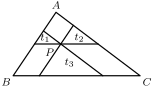
A point is chosen in the interior of so that when lines are drawn through parallel to the sides of the resulting smaller triangles, and in the figure, have areas and respectively. Find the area of
Pista pequeña:
Cada uno de los tres triángulos pequeños es semejante a
Each of the three smaller triangles is similar to
Pista grande:
Convierte cada razón de áreas en una razón de longitudes y suma las tres razones de longitudes
Convert each area ratio into a linear ratio and add the three linear ratios
Solución:
Sea el área de igual a Los tres triángulos pequeños son semejantes a por lo que sus razones de longitudes correspondientes son Cada factor de escala también es la distancia perpendicular de a un lado dividida entre la altura relativa a ese lado. Estas son las tres razones de áreas baricéntricas y cuya suma es Por lo tanto, Así, y
Let the area of be The three small triangles are similar to so their corresponding linear ratios are Each such scale factor is also the perpendicular distance from to one side divided by the altitude to that side. These are the three barycentric area ratios and which add to Hence Therefore and
4.
Sea una lista de enteros positivos, no necesariamente distintos, en la que aparece el número . El promedio (media aritmética) de los números de es Sin embargo, si se elimina , el promedio de los números restantes baja a ¿Cuál es el mayor número que puede aparecer en ?
Let be a list of positive integers—not necessarily distinct—in which the number appears. The average (arithmetic mean) of the numbers in is However, if is removed, the average of the remaining numbers drops to What is the largest number that can appear in
Pista pequeña:
Sea el número de elementos de la lista original
Let be the number of entries in the original list
Pista grande:
Para maximizar un elemento, haz que cada entero positivo sin restricción sea lo más pequeño posible
To maximize one entry, make every unrestricted positive integer as small as possible
Solución:
Si la lista original tiene elementos, entonces de modo que y la suma de los elementos es Además del elemento hacemos que once elementos sean iguales al menor entero positivo, El elemento restante es entonces Esta construcción es válida y ningún elemento mayor es posible.
If the original list has entries, then so and the total of the entries is Besides the entry make eleven entries equal to the least positive integer, The remaining entry is then This construction is valid, and no larger entry is possible.
5.
Determina el valor de si y
Determine the value of if and
Pista pequeña:
Expresa todos los logaritmos en base
Express every logarithm using base
Pista grande:
Haz y para obtener un sistema lineal
Set and to obtain a linear system
Solución:
Sean y Las dos ecuaciones se convierten en De manera equivalente, y de donde y Por lo tanto,
Let and The two equations become Equivalently, and which give and Therefore
6.
Se trazan tres círculos de radio con centros en y Una recta que pasa por tiene la propiedad de que el área total de las partes de los tres círculos a un lado de la recta es igual al área total de las partes al otro lado. ¿Cuál es el valor absoluto de la pendiente de esta recta?
Three circles, each of radius are drawn with centers at and A line passing through is such that the total area of the parts of the three circles to one side of the line is equal to the total area of the parts of the three circles to the other side of it. What is the absolute value of the slope of this line?
Pista pequeña:
La recta ya divide en dos partes iguales el círculo con centro en
The line already bisects the circle centered at
Pista grande:
Para los otros dos círculos iguales, sus distancias dirigidas a la recta deben ser opuestas
For the other two equal circles, their signed distances from the line must be opposites
Solución:
Para un círculo de radio sea la diferencia dirigida entre las áreas a los dos lados de una recta cuando la distancia dirigida del centro a la recta es La función es impar y estrictamente creciente para y solo es constante cuando la recta ya no corta el círculo. El círculo con centro en aporta cero, así que la recta debe separar los otros dos centros.
Sea el punto medio de esos dos centros. Entre las rectas que pasan por y los separan, la menor de las dos distancias de los centros a la recta es máxima cuando las distancias son iguales, es decir, para la recta que pasa por Incluso entonces, la distancia es así que la recta debe cortar al menos uno de los dos círculos. Para que haya equilibrio, debe cortar ambos. El crecimiento estricto de obliga entonces a que las dos distancias dirigidas sean opuestas, así que la recta buscada pasa por Su pendiente es Su valor absoluto es
For a circle of radius let be the signed difference between the areas on the two sides of a line when the center’s signed distance from the line is The function is odd and strictly increasing for and is constant only after the line no longer cuts the circle. The circle centered at contributes zero, so the line must separate the other two centers.
Let be the midpoint of those two centers. Among the lines through that separate them, the smaller of their two distances to the line is largest when the distances are equal, namely for the line through Even then, the distance is so the line must cut at least one of the two circles. Balance then forces it to cut both. The strict increase of therefore forces the two signed distances to be opposites, so the required line passes through Its slope is Its absolute value is
7.
La función está definida sobre el conjunto de los enteros y satisface si y si Halla
The function is defined on the set of integers and satisfies if and if Find
Pista pequeña:
Comienza por evaluar
Start by evaluating
Pista grande:
Usa inducción descendente para hallar un patrón de paridad para cada entero menor que
Use downward induction to find a parity pattern for every integer below
Solución:
Directamente de la definición, Al continuar se obtiene y
Ahora usamos inducción descendente. Si es par, entonces es impar, así que el patrón ya establecido para los enteros mayores que da Por ello, Si es impar, el mismo argumento da Por lo tanto, todo entero par tiene valor Como es par,
Directly from the definition, Continuing gives and
We now use downward induction. If is even, then is odd, so the established pattern above gives Thus If is odd, the same argument gives Thus every even has value Since is even,
8.
La ecuación tiene una raíz compleja cuyo argumento en el plano complejo está entre y . Determina la medida en grados de
The equation has one complex root with argument between and in the complex plane. Determine the degree measure of
Pista pequeña:
Sustituye
Substitute
Pista grande:
Los dos argumentos posibles de son y
The two possible arguments of are and
Solución:
Sea Entonces por lo que tiene argumento o Al tomar raíces cúbicas se obtienen los argumentos posibles El único que está estrictamente entre y es
Let Then so has argument or Taking cube roots gives possible arguments The only one strictly between and is
9.
En el tetraedro la arista mide cm. El área de la cara es y el área de la cara es Estas dos caras forman un ángulo de . Halla el volumen del tetraedro en
In tetrahedron edge has length cm. The area of face is and the area of face is These two faces meet each other at a angle. Find the volume of the tetrahedron in
Pista pequeña:
Halla las alturas desde y hasta la arista común
Find the altitudes from and to the common edge
Pista grande:
Expresa el volumen del tetraedro mediante la arista común, las dos alturas y el seno del ángulo diedro
Express the tetrahedron’s volume using the common edge, the two altitudes, and the sine of the dihedral angle
Solución:
Sean y las distancias perpendiculares de y a A partir de las áreas de las dos caras, El ángulo entre estas dos direcciones perpendiculares es el ángulo diedro de . Por lo tanto, el producto triple escalar da
Let and be the perpendicular distances from and to From the two face areas, The angle between these two perpendicular directions is the dihedral angle. Hence the scalar triple product gives
10.
María le dijo a Juan su puntuación en el Examen Estadounidense de Matemáticas para Escuelas Secundarias (AHSME), que era mayor que A partir de ella, Juan pudo determinar cuántos problemas había resuelto correctamente María. Si la puntuación de María hubiera sido menor, pero todavía mayor que Juan no habría podido determinarlo. ¿Cuál era la puntuación de María? (Recuerda que el AHSME consta de problemas de opción múltiple y que la puntuación se calcula mediante la fórmula donde es la cantidad de respuestas correctas y la cantidad de respuestas incorrectas; no se penalizan los problemas sin responder).
Mary told John her score on the American High School Mathematics Examination (AHSME), which was over From this, John was able to determine the number of problems Mary solved correctly. If Mary’s score had been any lower, but still over John could not have determined this. What was Mary’s score? (Recall that the AHSME consists of multiple-choice problems and that one’s score, is computed by the formula where is the number correct and is the number wrong; students are not penalized for problems left unanswered.)
Pista pequeña:
Para una puntuación fija expresa la cantidad de respuestas incorrectas en términos de y
For a fixed score express the number wrong in terms of and
Pista grande:
Usa y para acotar los posibles valores enteros de
Use and to bound the possible integer values of
Solución:
De obtenemos Las condiciones y dan Al evaluar estos extremos enteros para las puntuaciones desde hasta , siempre quedan por lo menos dos valores posibles de Cuando ambos extremos son iguales a así que Juan puede determinar que Por lo tanto, la primera puntuación mayor que con la propiedad requerida es
From we have The conditions and give Evaluating these integer endpoints for scores through always leaves at least two possible values of At both endpoints equal so John can determine Thus the first score over with the required property is
11.
Un jardinero planta tres arces, cuatro robles y cinco abedules en una fila. Los planta en un orden aleatorio, y todos los órdenes son igualmente probables. Sea , en su mínima expresión, la probabilidad de que no haya dos abedules contiguos. Halla
A gardener plants three maple trees, four oak trees, and five birch trees in a row. He plants them in random order, each arrangement being equally likely. Let in lowest terms be the probability that no two birch trees are next to one another. Find
Pista pequeña:
Elige primero las cinco posiciones ocupadas por los abedules
First choose the five positions occupied by birch trees
Pista grande:
Coloca primero los siete árboles que no son abedules y usa los ocho espacios que los rodean
Place the seven non-birch trees first and use the eight gaps around them
Solución:
Las cinco posiciones de los abedules forman un subconjunto de elementos elegido uniformemente entre las posiciones, así que hay posibilidades. Después de colocar los siete árboles que no son abedules, hay ocho espacios, incluidos los dos de los extremos. Elegir cinco espacios distintos da ordenamientos sin abedules contiguos. Por lo tanto, y
The five birch positions form a uniformly chosen -element subset of the positions, so there are possibilities. After the seven non-birch trees are placed, there are eight gaps, including the two end gaps. Choosing five distinct gaps gives arrangements with no adjacent birches. Therefore and
12.
Una función está definida para todos los números reales y satisface para todo número real Si es una raíz de ¿cuál es el menor número de raíces que debe tener en el intervalo ?
A function is defined for all real numbers and satisfies for all real If is a root of what is the least number of roots must have in the interval
Pista pequeña:
Interpreta las dos identidades como simetrías por reflexión respecto de y
Interpret the two identities as reflection symmetries about and
Pista grande:
La composición de las dos reflexiones produce una traslación de
Composing the two reflections produces a translation by
Solución:
Las identidades hacen que el conjunto de raíces sea invariante bajo las reflexiones respecto de y de Su composición es una traslación de A partir de la raíz estas operaciones obligan a que todo número de sea una raíz. En el intervalo, el primer conjunto aporta raíces y el segundo aporta para un total de
Esta cota se puede alcanzar: define como en este conjunto invariante y como en los demás puntos. Tiene las dos simetrías por reflexión requeridas. Por consiguiente, la menor cantidad posible es
The identities make the root set invariant under reflection about and about Their composition is translation by Starting from the root these operations force every number in to be a root. In the interval, the first set contributes roots and the second contributes for a total of
This bound is attainable: define to be on this invariant set and elsewhere. It has both required reflection symmetries. Hence the least possible number is
13.
Halla el valor de
Find the value of
Pista pequeña:
Usa
Use
Pista grande:
Combina los cuatro ángulos de cotangente inversa de dos en dos, de izquierda a derecha
Combine the four inverse-cotangent angles two at a time from left to right
Solución:
Sea La fórmula de adición de la cotangente da Al combinar el siguiente ángulo se obtiene y al combinar el último se obtiene Al multiplicar por se obtiene
Let The cotangent addition formula gives Combining the next angle gives and combining the last gives Multiplying by yields
14.
¿Cuál es el mayor entero par que no se puede escribir como suma de dos números compuestos impares?
What is the largest even integer that cannot be written as the sum of two odd composite numbers?
Pista pequeña:
Para cada entero par candidato, enumera los compuestos impares que no superan la mitad del candidato
Test candidate even integers by listing the odd composites no greater than half the candidate
Pista grande:
Para un entero par suficientemente grande, trabaja módulo e intenta restar o
For sufficiently large even work modulo and try subtracting or
Solución:
En una representación de el menor de los dos compuestos impares sería a lo sumo Las únicas posibilidades son y cuyos complementos, y son primos. Por lo tanto, no se puede representar.
Ahora sea par. Si escribe Si escribe Si escribe En cada caso, el segundo sumando es un múltiplo impar de mayor que y por tanto es compuesto; el primer sumando fijo también es impar y compuesto. Así, todo entero par mayor que se puede representar, de modo que la mayor excepción es
In a representation of the smaller odd composite would be at most The only possibilities are and whose complements and are prime. Thus is not representable.
Now let be even. If write If write If write In each case the second summand is an odd multiple of greater than hence is composite; the fixed first summand is also odd and composite. Therefore every even integer greater than is representable, so the largest exception is
15.
Determina si
Determine if
Pista pequeña:
Considera los cuatro miembros izquierdos como valores de una misma función racional de
Regard the four left sides as values of one rational function in
Pista grande:
Compara el coeficiente de cuando tiende al infinito
Compare the coefficient of as tends to infinity
Solución:
Define Sea Al usar el denominador común el numerador de tiene coeficiente principal Las cuatro ecuaciones dicen que sus ceros son y Por lo tanto,
Sea Cuando tiende al infinito, la expresión que define la función da Por otro lado, la suma de las cuatro raíces del numerador es mientras que la suma de las cuatro raíces del denominador es así que la expresión factorizada da Por consiguiente,
Define Put With common denominator the numerator of has leading coefficient The four equations say its zeros are and Therefore
Let As tends to infinity, the defining expression gives On the other hand, the sum of the four numerator roots is while the sum of the four denominator roots is so the factored expression gives Hence