
2024 AIME II 真题
计时
3:00:00
1.
在 Aimeville 的 位居民中,有 人拥有钻戒, 人拥有一套高尔夫球杆, 人拥有一把园艺铲。此外,这 位居民每人都拥有一袋心形糖果。有 位居民恰好拥有这些物品中的两样,有 位居民恰好拥有这些物品中的三样。求 Aimeville 中拥有全部四样物品的居民人数。
Among the residents of Aimeville, there are who own a diamond ring, who own a set of golf clubs, and who own a garden spade. In addition, each of the residents owns a bag of candy hearts. There are residents who own exactly two of these things, and residents who own exactly three of these things. Find the number of residents of Aimeville who own all four of these things.
小提示:
每位居民都有心形糖果,所以把四种物品的拥有人数相加,再与 比较
Every resident owns the candy hearts, so add all four ownership counts and compare with
大提示:
按拥有的物品逐件计数时,恰好拥有 、、或 样物品的居民会分别被多计 、、或 次
Counting once per item owned, residents with exactly or items are counted or extra times
解答:
将四种物品的拥有人数相加,得到 次物品拥有记录,来自 位居民。因为每人都有一袋心形糖果,每位居民至少拥有一件物品;若某位居民恰好拥有 件物品,那么除第一次计数外还会多计 次。
设有 位居民拥有全部四样物品,则多出的计数总数为 所以 ,得到 。
Adding the four ownership counts gives item ownerships among the residents. Since everyone owns a bag of candy hearts, every resident owns at least one item, and a resident owning exactly items is counted times beyond the first.
If residents own all four things, the extra counts total so giving
2.
一个正整数列表满足以下性质:
• 列表中各项之和为 。
• 列表的唯一众数是 。
• 列表的中位数是一个正整数,但它本身不出现在列表中。
求列表中所有项的平方和。
A list of positive integers has the following properties:
• The sum of the items in the list is
• The unique mode of the list is
• The median of the list is a positive integer that does not appear in the list itself.
Find the sum of the squares of all the items in the list.
小提示:
奇数长度列表的中位数一定是列表中的一项,所以这个列表有偶数个项。众数 至少出现两次
An odd-length list has its median as a member, so the list has evenly many items. The mode appears at least twice.
大提示:
先尝试四项 ,其中 :中位数 必须是整数,所以 是奇数
Try four items with the median must be a whole number, so is odd
解答:
中位数是整数且不在列表中,所以列表不能有奇数项(否则中位数会是列表中的一项)。唯一众数 至少出现两次。两项 的和为 ,不是 ,所以尝试四项: 以及 ,其中 和 不同(重复会使众数并列),且 。中位数 必须是整数,所以 为奇数,而 迫使 。因此 且 :列表 的中位数为 ,确实没有出现。
更长的列表都不行。若恰有两个 ,六项列表需要另外四个互不相同的值,和为 ,只能是 或 ,但两者的中位数都是 ;八项或更多项不可能,因为六个互不相同的正整数之和已经至少为 。若有三个 ,其余各项之和为 ,每种可能要么使 位于中位数,要么使众数并列。四个 的和已经超过 。
平方和为 。
The median is an integer that is not in the list, so the list cannot have odd length (then the median would be a member). The unique mode appears at least twice. Two items sum to not so try four items together with where and are distinct (a repeat would tie the mode) and The median must be an integer, so is odd, and forces Thus and the list has median which indeed does not appear.
No longer list works. With exactly two s, six items would need four distinct other values summing to namely or but both give median eight or more items are impossible because six distinct positive values already sum to at least With three s the remaining items sum to and every option either puts at the median or ties the mode. Four s already sum to more than
The sum of squares is
3.
求在一个 方格的每个格子中填入一个数字的方法数,使得从左到右读出的两个数之和为 ,从上到下读出的三个数之和为 。下图是这样的一个例子,因为 ,且 。
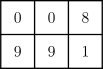
Find the number of ways to place a digit in each cell of a grid so that the sum of the two numbers formed by reading left to right is and the sum of the three numbers formed by reading top to bottom is The grid below is an example of such an arrangement because and
小提示:
在行数之和 中,每一列的两个数字必须恰好相加为 ,且没有任何进位
In the row sum each column’s two digits must add to exactly with no carrying anywhere
大提示:
若顶行三个数字之和为 ,则底行三个数字之和为 ;列的条件 会确定
If the top row’s digits sum to the bottom row’s digits sum to the column condition pins down
解答:
设顶行数字为 ,底行数字为 。两个行数相加时,个位数字满足 ,而由于 ,实际上 ,且没有进位。在十位和百位重复同样的论证,得到 和 。
三个列数之和为 。令 ,底行数字之和为 ,所以 ,从而 。
反过来,任意满足 的数字都会由 、、,确定底行,并且两个条件都成立。非负数字解 的个数为 。
Let the top row hold digits and the bottom row In the sum of the two row numbers, the units digits satisfy and since in fact with no carry. Repeating the argument in the tens and hundreds places gives and
The three column numbers add to Writing the bottom digits sum to so and
Conversely, any digits with determine the bottom row by and both conditions hold. The number of solutions of in nonnegative digits is
4.
设 、、和 为正实数,满足方程组
则 的值为 ,其中 和 是互质正整数。求 。
Let and be positive real numbers that satisfy the following system of equations:
Then the value of is where and are relatively prime positive integers. Find
小提示:
令 、、,把方程组转化为三个线性方程
Set to turn the system into three linear equations
大提示:
将三个方程相加可求出 ,再把它与每个方程结合,逐一求出 、、
Add all three equations to find then combine it with each equation to solve for one at a time
解答:
令 、、。方程变为 、、。三式相加得 。因为 ,所以 从而 ,类似地 ,。
因此 ,所以 ,且 。
Let The equations become Adding all three gives Since we get so and similarly and
Therefore so and
5.
设 是一个凸等边六边形,其中每一对对边都平行。由线段 、、和 所在直线构成的三角形的边长为 ,,和 。求这个六边形的边长。
Let be a convex equilateral hexagon in which all pairs of opposite sides are parallel. The triangle whose sides are extensions of segments and has side lengths and Find the side length of the hexagon.
小提示:
六边形与大三角形之间的每个角落三角形,其三条边都分别平行于大三角形的边,所以它与大三角形相似
Each corner triangle between the hexagon and the big triangle has all three sides parallel to the big triangle’s sides, so it is similar to the big triangle
大提示:
将包含 的那条边写成 加上两个角落小段,会得到
Writing the side containing as plus two corner pieces leads to
解答:
设六边形边长为 ,由直线 、、 构成的三角形在这三条直线上的边长分别为 、、。在直线 与 的交点 处被截下的角落三角形,其第三边为 ,而 ,所以它的三条边都平行于大三角形的边。因此它与大三角形相似,相似比为 ,它在直线 上的边长为 。同理, 处的角落包含 会从 边上截下 。
因而 边分解为角落小段、、角落小段:两边除以 ,得到 ,该式对三边对称。
因此 。
Let be the hexagon’s side length, and let the triangle formed by lines have sides of lengths along those three lines, respectively. The corner triangle cut off at the vertex where lines and meet has third side and since all three of its sides are parallel to sides of the big triangle. So it is similar to the big triangle with ratio and its side along line has length Likewise the corner at contains and cuts off from the -side.
The -side therefore decomposes as corner piece, corner piece: and dividing by gives symmetric in the three sides.
Hence
6.
Alice 选择一个由正整数组成的集合 。然后 Bob 列出所有有限非空正整数集合 ,这些集合满足 的最大元素属于 。Bob 的列表中有 个集合。求 中元素之和。
Alice chooses a set of positive integers. Then Bob lists all finite nonempty sets of positive integers with the property that the maximum element of belongs to Bob’s list has sets. Find the sum of the elements of
小提示:
按 Bob 所列集合的最大元素分类:若最大元素为 ,其余元素可以是 的任意子集
Group Bob’s sets by their maximum: if the maximum is the rest of the set is any subset of
大提示:
因此列表中有 个集合;这种表示唯一,所以把 写成 进制
So the list has sets; binary representations are unique, so write in base
解答:
对固定的 ,最大元素为 的集合 由 连同 的一个任意子集组成,所以共有 个。Bob 列表中的每个集合都会按其最大元素被恰好计数一次。因此
因为 ,且这种表示唯一,所以 。 中元素之和为 。
For a fixed the sets with maximum element consist of together with an arbitrary subset of so there are of them, and every set on Bob’s list is counted exactly once by its maximum. Hence
Since and binary representations are unique, The sum of the elements of is
7.
设 是满足如下性质的最大四位整数:每当把它的某一位数字改为 时,所得数都能被 整除。设 除以 时的商和余数分别为 和 。求 。
Let be the greatest four-digit integer with the property that whenever one of its digits is changed to the resulting number is divisible by Let and be the quotient and remainder, respectively, when is divided by Find
小提示:
把某一位数字改成 会减去 乘以一个 的幂;若数字为 ,则
Changing a digit to subtracts times a power of so for digits
大提示:
令 :此时每一位数字都由模 的条件确定,而 与自身数字的一致性会迫使 只有一个可能值
Let each digit is then determined mod and consistency of with its own digits forces a single value of
解答:
设 的数字为 。把千位数字改成 得到 ,所以 ,其他数位同理。由于 、、且 ,
令 。利用 以及逆元 、,各位数字满足 、、、。但同时 ;代入得到 ,所以 ,即 。
于是 、、、。在每个同余类中取最大数字,得到 (同余类 中没有更大的数字)、、、,所以 。确实 都是 的倍数。最后 、,所以 。
Write with digits Changing the thousands digit to produces so and similarly for the other digits. Since and
Let Using and the inverses the digits satisfy But also substituting gives so and
Then and taking the largest digit in each class gives (the class has no larger digit), Indeed are all multiples of Finally and
8.
环面 是由一个半径为 的圆绕一条轴旋转得到的曲面,这条轴在该圆所在平面内,并且到圆心的距离为 (形状像甜甜圈)。
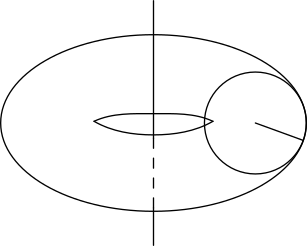
设 是半径为 的球。当 靠在 的内部时,它沿半径为 的圆与 内切;当 靠在 的外部时,它沿半径为 的圆与 外切。差 可写成 ,其中 和 是互质正整数。求 。
Torus is the surface produced by revolving a circle with radius around an axis in the plane of the circle that is a distance from the center of the circle (so like a donut).
Let be a sphere with a radius When rests on the inside of it is internally tangent to along a circle with radius and when rests on the outside of it is externally tangent to along a circle with radius The difference can be written as where and are relatively prime positive integers. Find
小提示:
用经过旋转轴的平面截取:管道截面是半径 的圆,其圆心到轴的距离为 ,球心位于轴上
Slice with a plane through the axis: the tube is a circle of radius centered from the axis, and the sphere’s center lies on the axis
大提示:
相切使管道截面圆心到球心的距离为 或 ;将管道截面圆心到轴的距离按 或 缩放
Tangency puts the tube’s center at distance or from the sphere’s center; scale the tube center’s distance from the axis by or
解答:
由对称性,环面的旋转轴经过球心 。在经过旋转轴的平面中观察:环面显示为一个半径为 的圆(管道截面),其圆心到轴的距离为 ,球显示为以 为圆心、半径为 的圆。两个曲面沿截面相切点旋转出的圆相切;该相切点位于从 经过管道截面圆心的射线上。内切时,管道截面圆心到 的距离为 ;外切时为 。
相切点在这条射线上且到 的距离为 ,所以它是管道截面圆心相对于 按 (或 )缩放得到的点;它到轴的距离也是管道截面圆心到轴距离 的同一倍数:
因此 ,已经是最简分数,所以 。
By symmetry the axis of the torus passes through the center of the sphere. Work in a plane through the axis: there the torus appears as a circle of radius (the tube) whose center sits at distance from the axis, and the sphere appears as a circle of radius centered at The two surfaces are tangent along the circle swept by the tangency point of these cross-sections, which lies on the ray from through the tube’s center. For internal tangency the tube’s center is at distance from for external tangency,
The tangency point lies at distance from along that ray, so it is the tube center scaled by (resp. ) from and its distance from the axis is the same multiple of the tube center’s distance
Then which is in lowest terms, so
9.
有 枚不可区分的白色筹码和 枚不可区分的黑色筹码。求把其中若干枚筹码放入一个 方格中的方法数,使得:
• 每个格子至多含一枚筹码
• 同一行中的所有筹码颜色相同,且同一列中的所有筹码颜色相同,并且
• 再向方格中放入任何一枚筹码,都会违反前两个条件中的一个或多个。
There is a collection of indistinguishable white chips and indistinguishable black chips. Find the number of ways to place some of these chips in a grid such that:
• each cell contains at most one chip
• all chips in the same row and all chips in the same column have the same color, and
• any additional chip placed on the grid would violate one or more of the previous two conditions.
小提示:
一个极大的摆放没有空行或空列:总可以在空行中加入一枚与所在列颜色匹配的筹码
A maximal placement has no empty row or column: a chip matching the column’s color could always be added inside an empty row
大提示:
因此每一行和每一列都有一种颜色;筹码恰好填在行色与列色相同的格子中,并且行和列必须使用同一组颜色
So every row and column carries a color, chips fill exactly the cells where the two colors agree, and rows and columns must use the same set of colors
解答:
在一个合法摆放中,每个非空行只有一种颜色,每个非空列也同理。如果某一行为空,任选其中一个格子:可以放入一枚与该格所在列颜色相同的筹码(若该列也为空,则任选颜色),这与第三个条件矛盾。所以每一行和每一列都非空,我们可以谈论它们的颜色。
某格有筹码会迫使其行颜色与列颜色相同;反过来,若一行和一列颜色相同但它们交叉的格子为空,就可以加入一枚该颜色的筹码。因此筹码恰好占据行颜色等于列颜色的格子。为了让每一行非空,每个行颜色必须出现在列颜色中,反之亦然,即行与列使用同一组颜色。任何这样的染色反过来都会给出一个合法的极大摆放(每种颜色至多占 个格子,筹码数量足够),且不同染色给出不同摆放。
计数这些染色:所有行列全白、所有行列全黑,或者行和列都使用两种颜色: 。
In a valid placement, each nonempty row has a single color, and likewise each column. If some row were empty, choose any cell of it: a chip of the color of that cell’s column (either color if the column is also empty) could legally be added, contradicting the third condition. So every row and every column is nonempty, and we may speak of its color.
A chip at a cell forces its row and column colors to agree; conversely, if a row and a column share a color but their common cell is empty, a chip of that color could be added. Hence chips occupy exactly the cells whose row color equals the column color. For every row to be nonempty, each row’s color must appear among the column colors, and vice versa — the rows and the columns use the same set of colors. Any such coloring conversely yields a valid maximal placement (at most cells hold chips of each color, so the supply suffices), and distinct colorings give distinct placements.
Counting the colorings: all rows and columns white, all black, or both colors used by the rows and by the columns:
10.
设 的内心为 ,外心为 ,内切圆半径为 ,外接圆半径为 。假设 。求 。
Let have incenter circumcenter inradius and circumradius Suppose that Find
答案:468
小提示:
直角给出 ,而欧拉公式 会把它化为
The right angle gives and Euler’s formula turns this into
大提示:
将 与 、、以及 结合
Combine with and
解答:
因为 ,在三角形 中用勾股定理得 ,而欧拉公式 给出 再与 结合,得到 ,所以 。
于是 ,所以 ,而 。因此半周长为 。
令两个面积公式 相等,得到
Since the Pythagorean theorem in triangle gives and Euler’s formula yields Combining with gives so
Then so while Hence the semiperimeter is
Equating the two area formulas
11.
求满足 且满足下式的非负整数三元组 的个数。
Find the number of triples of nonnegative integers satisfying and
小提示:
当 时,题中给出的和等于
With the given sum equals
大提示:
利用 :展开 :条件恰好说明这个乘积为零
Expand using the condition says exactly that this product vanishes
解答:
左边是对称和 ,其中 ,。所以条件为 。现在展开 其中使用了 。条件成立当且仅当这个乘积为 ,也就是 中至少一个等于 。
若 ,则 ,给出 个三元组; 和 的情况同理。 中被重复计数的三元组有两个变量等于 ,这会迫使第三个变量也为 ;三元组 被计数三次,所以总数为 。
The left side is the symmetric sum where and So the condition is Now expand using The condition holds exactly when this product is that is, when at least one of equals
If then giving triples, and likewise for and A triple counted more than once has two variables equal to which forces the third to be as well; the triple is counted three times, so the total is
12.
设 、、以及 为坐标平面中的点。设 是所有位于第一象限、长度为一的线段 的集合,其中 在 轴上, 在 轴上。在线段 上存在唯一一点 ,它不同于 和 ,并且除 外不属于 中任何其他线段。于是 ,其中 和 是互质正整数。求 。
Let and be points in the coordinate plane. Let be the family of segments of unit length lying in the first quadrant with on the -axis and on the -axis. There is a unique point on distinct from and that does not belong to any segment from other than Then where and are relatively prime positive integers. Find
小提示:
从 到 的线段位于 上; 是 对应的成员
The segment from to lies on is the member
大提示:
令 关于 的导数在 处为零,得到 ;再与 相交
Setting the -derivative of to zero at gives intersect that with
解答:
的成员是从 到 的线段,其中 ,它们位于直线 上;线段 是 的成员。对 上满足 的点 ,令 则该点在角度为 的成员上,当且仅当 。注意在区间 两端 ,且 。若 ,则 会在 的一侧为负,中值定理会在那一侧产生另一个零点,即该点会被另一条线段覆盖。因此 必须满足 。由于 和 在这个区间上都严格凸,所以 也严格凸;于是对这一点, 是 的严格全局最小值,所以没有其他线段包含它。
现在 ,由 得 ,即 。与 相交: 给出 ,所以 ,,这是 的内点。
因此 ,且 。
The members of are the segments from to for lying on the lines the segment is the member with For a point of with let so the point lies on the member for angle exactly when Note at both endpoints of and If then is negative on one side of and the intermediate value theorem produces another zero on that side — the point is covered by another segment. So must satisfy Because both and are strictly convex on this interval, is strictly convex; thus for that point is the strict global minimum of so no other segment contains it.
Now and gives i.e. Intersecting with gives so and an interior point of
Therefore and
13.
设 是一个 次单位根。求除以 的余数。
Let be a th root of unity. Find the remainder when is divided by
小提示:
分解 ,并对全部 次单位根使用
Factor and use over all th roots of unity
大提示:
使 容易计算;整个乘积变为
makes easy to compute; the whole product becomes
解答:
因为 ,乘积中的每个因式都可分解;当 从 变化到 时, 遍历所有 次单位根。由于 ,对任意 有 。因此该乘积等于
因为 ,所以 ,由共轭可得 。所以乘积为 除以 的余数为 。
Since each factor of the product splits, and as runs from to runs over all th roots of unity. Because for any we get Hence the product equals
Since we get and by conjugation So the product is whose remainder upon division by is
14.
设 为整数。若一个正整数 用 进制表示时恰好有两位,且这两位数字之和为 ,则称它为 -eautiful。例如, 是 -eautiful,因为 ,且 。求最小的整数 ,使得存在超过十个 -eautiful 整数。
Let be an integer. Call a positive integer -eautiful if it has exactly two digits when expressed in base and these two digits sum to For example, is -eautiful because and Find the least integer for which there are more than ten -eautiful integers.
小提示:
写成 ,数字和 :于是 ,所以 必须整除
Write with digit sum then so must divide
大提示:
每个满足 且 能被 整除的取值都给出一个 ;模 时有 个这样的剩余类,其中 是 的不同素因子个数
Each for which is divisible by gives one mod there are such residues, where counts the distinct primes of
解答:
一个 进制两位数为 ,其中 且 ,条件说 ,其中 。于是 ,所以 注意 。反过来,对任何满足 且 能被 整除的 ,令 , 可得 且 ,因而恰好给出一个 -eautiful 整数 。所以数量等于满足 的 的个数。
令 。因为 与 互质,整除 的每个素数幂都必须整除 或 ,所以由中国剩余定理,模 有 个解,其中 为 的不同素因子个数。在代表元 中,只有 不在我们的范围内(而 符合),所以数量为 。
我们需要 ,即 。含有四个不同素因子的最小正整数是 ,所以最小的进制为 (此时有 个 -eautiful 整数)。
A two-digit number in base is with and and the condition says where Then so Note Conversely, for any with and divisible by setting and gives and hence exactly one -eautiful integer So the count equals the number of with
Let Since and are coprime, each prime power dividing must divide or so by the Chinese remainder theorem there are solutions modulo where is the number of distinct prime factors of Among the representatives only falls outside our range (and qualifies), so the count is
We need i.e. The smallest positive integer with four distinct prime factors is so the least base is (which has -eautiful integers).
15.
求在一个固定的正十二边形(-边形)内部可以形成多少个矩形,其中矩形的每条边都位于该十二边形的一条边或一条对角线上。下图展示了其中三个这样的矩形。
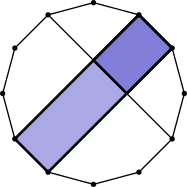
Find the number of rectangles that can be formed inside a fixed regular dodecagon (-gon) where each side of the rectangle lies on either a side or a diagonal of the dodecagon. The diagram below shows three of those rectangles.
小提示:
每条边和对角线都指向 个方向之一,即 的倍数;一个矩形使用两条来自一个方向的弦和两条来自垂直方向的弦
Every side and diagonal points in one of directions, multiples of a rectangle uses two chords from each of two perpendicular directions
大提示:
记录每条平行弦到中心的距离和半长:四个角落都落在弦上,当且仅当每组选出的较大距离不超过另一组较远弦的半长
Record each parallel chord’s distance from center and half-length: the corners fit iff each pair’s larger distance is at most the half-length of the other pair’s farther chord
解答:
将顶点放在单位圆上角度为 的位置。连接顶点 和 的弦方向为 ,所以弦分成 个方向,方向间隔为 ;一个矩形使用两个互相垂直方向中各两条弦。六对垂直方向在旋转下分为两类,每类三对。当 为偶数时,一族平行弦有 条,到中心的距离为 ,对应半长分别为 ;当 为奇数时,一族有 条,距离为 ,对应半长为 。
一个角是来自两个方向的弦的交点,而它沿一条弦的偏移量等于另一条弦到中心的距离。由于半长随距离增大而减小,四个角全都落在四条弦段上,当且仅当设两组选中弦的较大距离为 时,每个 都不超过另一组较远弦的半长。对 -弦族: 的弦对有 对,其半长限制为 , 的弦对有 对,其限制为 ;有效组合给出 个矩形。对 -弦族:对应 的弦对数量分别为 ;有效组合为 ,以及 与 的两个顺序,还有 ,共 个。
每一类方向对出现三次,所以总数为 。
Put the vertices at angles on a unit circle. The chord joining vertices and has direction so chords come in directions spaced apart, and a rectangle uses two chords from each of two perpendicular directions. The six perpendicular direction pairs split into two kinds, three of each, by rotation. When is even, a family of parallel chords has members, at distances from the center with half-lengths respectively; when is odd, a family has members, at distances with half-lengths
A corner is the intersection of one chord from each direction, and its offset along a chord equals the other chord’s distance from the center. Since half-lengths shrink as distance grows, the four corners lie on all four chord segments exactly when, writing for the larger distances of the two chosen pairs, each is at most the half-length of the other pair’s farther chord. For the -chord families: pairs with (there are ) have half-length bound and pairs with (there are ) have bound the valid combinations give rectangles. For the -chord families: there are pairs with and the valid combinations are both orders of and and giving
Each kind of direction pair occurs three times, so the total is