
2017 AIME I 真题
计时
3:00:00
1.
在 上标出十五个互不相同的点: 个顶点 、、;边 上另有 个点;边 上另有 个点;边 上另有 个点。求以这 个点中的点为顶点、面积为正的三角形个数。
Fifteen distinct points are designated on the vertices and other points on side other points on side and other points on side Find the number of triangles with positive area whose vertices are among these points.
小提示:
先数出从 个点中任选 个点的所有方法,再去掉不能形成真正三角形的选法
Count all ways to choose of the points, then throw away the choices that fail to make a real triangle
大提示:
选法失败当且仅当 个点全在同一条边上;三条边上分别有 、 和 个点
A choice fails exactly when all points lie on one side; the sides contain and of the points
解答:
从这些点中选 个点共有 种方法。某种选法不能得到面积为正的三角形,当且仅当这 个点共线;这只会在三点全落在三角形的一条边上时发生。连同端点在内,边 上有 个点, 上有 个点, 上有 个点,所以共线三点组共有 组。
因此三角形的个数为 。
There are ways to choose of the points. A choice fails to give a triangle of positive area exactly when the points are collinear, which happens only when all three lie on one side of the triangle. Including its endpoints, side contains points, contains and contains giving collinear triples.
The number of triangles is
2.
将 、 和 分别除以正整数 时,余数总是同一个正整数 。将 、 和 分别除以正整数 时,余数总是同一个正整数 。求 。
When each of and is divided by the positive integer the remainder is always the positive integer When each of and is divided by the positive integer the remainder is always the positive integer Find
小提示:
如果两个数除以 的余数相同,那么 整除它们的差
If two numbers leave the same remainder when divided by then divides their difference
大提示:
因此 是 和 的公因数,而 是 和 的公因数
So is a common factor of and and is a common factor of and
解答:
除以 余数相同的两个数之差是 的倍数,所以 同时整除 和 。因为 ,且 必须大于正余数 ,所以 ,并且 。
同理, 同时整除 和 ,且 ,所以 ,并且 ,它确实不同于 。
所求和为 。
Numbers leaving equal remainders upon division by differ by multiples of so divides both and Since and must exceed the positive remainder we get and
Similarly divides both and and so and which indeed differs from
The requested sum is
3.
对正整数 ,令 为 的个位数字。求 除以 的余数。
For a positive integer let be the units digit of Find the remainder when is divided by
小提示:
是 的个位数字;寻找这些数字的循环规律
is the units digit of look for a repeating pattern in these digits
大提示:
这些数字以 为周期重复,一个完整的 项周期之和为
The digits repeat with period and one full period of values sums to
解答:
这里 是三角数 的个位数字。因为 是 的倍数,所以序列 以 为周期。计算一个周期:它们的和为 。
因为 ,总和等于 加上周期前 项的和,而前十七项之和为 。总和为 ,所以余数为 。
Here is the units digit of the triangular number Since is a multiple of the sequence is periodic with period Computing one period, which sums to
Since the total is plus the first terms of the period, which sum to The sum is so the remainder is
4.
一个棱锥的底面是边长为 、 和 的三角形。从底面三个顶点到棱锥第四个顶点的三条棱长都为 。该棱锥的体积为 ,其中 和 是正整数,且 不被任何质数的平方整除。求 。
A pyramid has a triangular base with side lengths and The three edges of the pyramid from the three corners of the base to the fourth vertex of the pyramid all have length The volume of the pyramid is where and are positive integers, and is not divisible by the square of any prime. Find
答案:803
小提示:
因为三条侧棱都等于 ,顶点位于底面三角形外心的正上方
Because all three lateral edges equal the apex lies directly above the circumcenter of the base triangle
大提示:
底面积为 ;用 求它的外接圆半径,再用勾股定理求高
The base has area compute its circumradius from then get the height by the Pythagorean theorem
解答:
由于棱锥顶点到底面三个顶点等距,它在底面上的垂足是底面三角形的外心。底面是边长为 、 和 的等腰三角形,到底边 的高为 ,所以面积为 ,外接圆半径为
棱锥的高为 ,所以体积为 。因此 。
Since the apex is equidistant from all three base vertices, its foot is the circumcenter of the base. The base is isosceles with sides and its altitude to the side of length is so its area is and its circumradius is
The height of the pyramid is so the volume is Then
5.
一个以八为底写出的有理数为 ,其中所有数字都非零。同一个数以十二为底表示为 。求按通常十进制写法得到的数 。
A rational number written in base eight is where all digits are nonzero. The same number in base twelve is Find the base-ten number
小提示:
整数部分必须相等:,所以
The integer parts must match: so
大提示:
只有 或 可行;把每种情况代入 ,并记住数字非零且小于
Only or fit; test each in remembering digits are nonzero and less than
解答:
整数部分必须相等:,所以 ,也就是 。因为 和 都是以八为底的非零数字,至多为 ,唯一的可能是 和 。
小数部分也必须相等:,即 。若 ,右边为 ,迫使 ,但不存在两个非零且小于 的数字满足它。若 ,右边为 ,所以 ,得到 且 。
的确,,所求数字 为 。
The integer parts must be equal: so that is Since and are nonzero base-eight digits (at most ), the only options are and
The fractional parts must also match: i.e. For the right side is forcing which has no solution with both digits nonzero and less than For the right side is so giving and
Indeed and the requested number is
6.
一个圆外接于一个等腰三角形,该三角形两个相等角的度数为 。在圆上独立且均匀随机选取两个点,并连接它们作一条弦。该弦与三角形相交的概率为 。求 的最大可能值与最小可能值之差。
A circle is circumscribed around an isosceles triangle whose two congruent angles have degree measure Two points are chosen independently and uniformly at random on the circle, and a chord is drawn between them. The probability that the chord intersects the triangle is Find the difference between the largest and smallest possible values of
小提示:
三个顶点把圆分成度数为 、 和 的弧;弦恰好在两个点落在同一段弧内时避开三角形
The vertices cut the circle into arcs of and degrees, and the chord misses the triangle exactly when both points land in the same arc
大提示:
令 ,不相交的概率给出 ,这是一个有两个有效根的二次方程
With the miss probability gives a quadratic with two valid roots
解答:
三角形的每个圆周角截得一段度数为其两倍的弧,所以三个顶点把圆分成度数为 、 和 的弧。弦不与三角形相交,当且仅当两个随机点落在同一段弧内,其概率为
令 ,得到 ,化简为 ,根为 和 。它们给出 和 ,两者都可以作为等腰三角形的底角。
所求差为 。
Each inscribed angle of the triangle subtends an arc of twice its measure, so the vertices split the circle into arcs of and degrees. The chord fails to intersect the triangle exactly when both random points fall in the same arc, which has probability
Setting this reads which simplifies to with roots and These give and both legitimate base angles of an isosceles triangle.
The requested difference is
7.
对满足 的非负整数 和 ,令 。设 为所有满足 的非负整数 和 对应的 之和。求 除以 的余数。
For nonnegative integers and with let Let denote the sum of all where and are nonnegative integers with Find the remainder when is divided by
小提示:
将 改写为 ,于是令 后,每项变为 ,且
Replace by so with each term becomes with
大提示:
从三个互不相交的 元集合中分别选 、 和 个元素,并让 ,就是在数一个 元集合的 元子集
Choosing and elements from three disjoint -element sets, over all counts the -element subsets of an -element set
解答:
利用对称性 ,令 可将和改写为
每一项表示从一个 元集合中选 个元素、从第二个集合中选 个元素、从第三个集合中选 个元素的方法数。对所有 求和,就数出了从合并后的 元集合中选 个元素的所有方法,所以 。
除以 的余数为 。
By the symmetry substituting turns the sum into
Each term counts the ways to choose elements from one -element set, from a second, and from a third. Summed over all this counts every way to choose elements from the combined -element set, so
The remainder upon division by is
8.
从区间 中独立且均匀随机选取两个实数 和 。设 和 是平面上两个点,且 。点 和 位于直线 的同侧,并满足 和 的度数分别为 和 ,且 和 都是直角。若 的概率等于 ,其中 和 是互质的正整数,求 。
Two real numbers and are chosen independently and uniformly at random from the interval Let and be two points in the plane with Let and be points on the same side of line such that the degree measures of and are and respectively, and and are both right angles. The probability that is equal to where and are relatively prime positive integers. Find
小提示:
和 处的直角使得这两个点都落在以 为直径的圆上,该圆半径为
The right angles at and place both points on the circle with diameter which has radius
大提示:
圆周角 给出 ,所以条件为 ;在 的正方形中求该区域面积
The inscribed angle gives so the condition is find that region’s area in the square
解答:
因为 ,点 和 都在以 为直径的圆上,该圆半径为 。角 是这个圆中的圆周角,所以弦长满足 。因为 ,条件 ,也就是 ,等价于 。
在等可能的 所组成的 正方形中,区域 由两个直角三角形组成,每个三角形的直角边长为 ,所以所求概率为
因此 。
Since both and lie on the circle with diameter whose radius is The angle is an inscribed angle in this circle, so the chord satisfies Because the condition i.e. is equivalent to
In the square of equally likely pairs the region consists of two right triangles with legs so the probability is
Therefore
9.
设 ,且对每个整数 ,令 。求最小的 ,使得 是 的倍数。
Let and for each integer let Find the least such that is a multiple of
小提示:
因为 ,所以 ,可据此判断何时能被该模数整除
Since the recurrence collapses to
大提示:
需要 整除 。这两个因子相差 ,所以不可能都被 整除;按 和 分别整除哪个因子分类。
You need to divide The factors differ by so cannot divide both; split cases by which factor and divide.
解答:
因为 ,递推式给出 ,所以 我们需要 整除 。 和 中有一个是偶数,所以这等价于要求 和 都整除这个乘积。由于这两个因子相差 ,它们不可能都为 的倍数。
因此 必须完全整除其中一个因子,而 整除另一个因子(或者某个因子被 整除)。检查各情况: 整除 最早在 时发生; 整除 最早在 时发生; 整除 且 整除 最早在 时发生; 整除 且 整除 最早在 时发生。
最小值是 ,此时 确实是 的倍数。
Because the recurrence gives so We need to divide One of and is even, so this is the same as requiring and each to divide the product. Since the two factors differ by they cannot both be multiples of
So must divide one factor entirely and the other (or one factor is divisible by ). Checking the cases: divides first at divides first at divides with dividing first at and divides with dividing first at
The least is where is indeed a multiple of
10.
令 、 且 ,其中 。设 是唯一满足以下性质的复数: 为实数,并且 的虚部尽可能大。求 的实部。
Let and where Let be the unique complex number with the properties that is a real number and the imaginary part of is the greatest possible. Find the real part of
小提示:
给出的乘积是交比;它为实数当且仅当 位于经过 、 和 的圆上
The given product is a cross-ratio; it is real exactly when lies on the circle through and
大提示:
圆上虚部最大的点位于圆心正上方,所以求两条垂直平分线的交点即可得到圆心
The point of a circle with greatest imaginary part sits directly above the center, so intersect two perpendicular bisectors to find the center
解答:
的幅角是角 ,而 的幅角是线段 与 之间的角。它们的乘积为实数,当且仅当这些角相等或互补;由圆周角定理,这恰好等价于 、、 和 共圆。因此 位于 、 和 的外接圆上。
从 到 的线段是竖直的,所以它的垂直平分线是水平直线 。从 到 的线段斜率为 ,中点为 ,所以它的垂直平分线是 。令 ,得到 ,因此圆心为 。
圆上虚部最大的点位于圆心正上方,所以 的实部为 。
The argument of is the angle and the argument of is the angle between and Their product is real exactly when these angles are equal or supplementary, which by the inscribed angle theorem happens exactly when and are concyclic. So lies on the circumcircle of and
The segment from to is vertical, so its perpendicular bisector is the horizontal line The segment from to has slope and midpoint so its perpendicular bisector is Setting gives so the center is
The point of the circle with maximal imaginary part is directly above the center, so the real part of is
11.
考虑把 个数 、、、、 排列在一个 方阵中。对每种排列,令 、 和 分别为第 、、 行中三个数的中位数,再令 为集合 的中位数。设 为满足 的排列数。求 除以 的余数。
Consider arrangements of the numbers in a array. For each such arrangement, let and be the medians of the numbers in rows and respectively, and then let be the median of Let be the number of arrangements for which Find the remainder when is divided by
小提示:
将每个小于 的数记为 L,每个大于 的数记为 G。若 ,数字五必须是某一行的中位数,所以它所在行按某种顺序为 L5G。
Rename each number less than as L and each greater as G. For the number must be a row median, so its row reads L5G in some order.
大提示:
另外两行的中位数需要位于 的两侧:可以是 LLL 与 GGG,或 LLG 与 LGG。先数字母模式,再乘以 来填入具体数值。
The other two rows need medians on opposite sides of LLL with GGG, or LLG with LGG. Count letter patterns, then multiply by for actual values.
解答:
将 、、、 各记为 L,将 、、、 各记为 G。如果 不是某一行的中位数,那么没有一行的中位数等于 ,所以 。因此 所在行必须含有一个 L 和一个 G(按某种顺序为 L5G),而另外两行必须提供一个小于 的中位数和一个高于它的中位数。用剩下的三个 L 和三个 G,这两行要么是 LLL 与 GGG,要么是 LLG 与 LGG。
先数字母排列:这三种行类型可以分配给第 、、 行,共 种方法,而 L5G 这一行可以排列成 种。第一种情况中,LLL 和 GGG 各只有 种排列,得到 个模式;第二种情况中,LLG 和 LGG 各有 种排列,得到 个模式。总共有 个字母模式。
最后四个 L 可由 、、、 以 种方式填入,四个 G 可由 、、、 以 种方式填入,所以 ,模 的余数为 。
Rename each of as L and each of as G. If is not a row median, then no row median equals so Thus ’s row must contain one L and one G (reading L5G in some order), and the other two rows must supply one median below and one above. With the remaining three L’s and three G’s, those rows are either LLL and GGG, or LLG and LGG.
Count arrangements of letters: the three row types can be assigned to rows and in ways, and the L5G row can be ordered in ways. In the first case LLL and GGG have ordering each, giving patterns; in the second, LLG and LGG each have orderings, giving patterns. That is letter patterns in all.
Finally the four L’s can be filled with in ways and the four G’s with in ways, so whose remainder mod is
12.
如果集合 中不存在 、、(不要求互不相同)使得 ,就称这个集合为无积集合。例如,空集和集合 是无积集合,而集合 和 不是无积集合。求集合 的无积子集个数。
Call a set product-free if there do not exist (not necessarily distinct) such that For example, the empty set and the set are product-free, whereas the sets and are not product-free. Find the number of product-free subsets of the set
小提示:
绝不能出现,因为 ;如果最小元素至少为 ,任意两个元素的乘积都超过
can never appear (since ), and if the least element is at least every product of two elements exceeds
大提示:
当最小元素为 或 时,只有少数冲突需要处理:,,,以及 。分别处理 和 。
With least element or only a few conflicts matter: and Handle and separately.
解答:
因为 ,任何无积集合都不能含有 。按最小元素 分类。如果 ,任意两个元素的乘积至少为 ,所以 的每个子集都可行:共有 个子集,包括空集。
若 :则 (因为 ),而 和 不受限制(各有 种选择)。在 中,约束 和 只留下 、、、、 这 种选择。在 中,约束 留下 种选择。因此得到 个集合。若 :则 (因为 ),并且可以任意加入 的子集,因为其他乘积都超过 :所以有 个集合。
总共有 个无积子集。
Since no product-free set contains Split by the least element If any product of two elements is at least so every subset of works: subsets, including the empty set.
If then (as ), while and are unrestricted ( choices each). Among the constraints and leave exactly — choices. Among the constraint leaves choices. That gives sets. If then (as ), and any subset of may be added since all other products exceed sets.
In total there are product-free subsets.
13.
对每个 ,令 为具有以下性质的最小正整数:对每个 ,在范围 内总存在一个完全立方数 。求 除以 的余数。
For every let be the least positive integer with the following property: For every there is always a perfect cube in the range Find the remainder when is divided by
小提示:
相邻立方数的比为 ,它随着 增大而减小,所以只有较小的 可能有
The ratio of consecutive cubes is which shrinks as grows, so only small can have
大提示:
对每个 都有 ;对 ,利用像 和 这样的空隙,找出最后一个使区间 跳过立方数的
for every for find the last where the interval skips a cube, using gaps like and
解答:
如果 ,那么只要 ,也就是 ,区间 就含有立方数 。因为对所有 都有 ,所以每个 都有 。
对 : 不满足,因为 中没有立方数;但对 ,区间总满足条件: 覆盖 ,且 覆盖 。所以 。对 : 不满足( 中没有立方数),而 覆盖 ,且 覆盖 ,所以 。对 : 不满足( 中没有立方数),而 覆盖 ,且 覆盖 ,所以 。
因此 余数为 。
If then the interval contains the cube as long as i.e. Since for all every has
For fails since contains no cube, but for the interval works: covers and covers So For fails (no cube in ), while covers and covers so For fails (no cube in ), while covers and covers so
Therefore and the remainder is
14.
设 且 满足 ,并且 。求 除以 的余数。
Let and satisfy and Find the remainder when is divided by
小提示:
两次取指数,把第一个方程化为 ,再令 ,将它改写为
Exponentiate twice to turn the first equation into then rewrite it as for
大提示:
单调递增,所以 ;写 ,得到 ,解得 。然后计算 ,并分别考虑它模 和模 的余数。
is increasing, so writing gives solved by Then compute mod and mod
解答:
对第一个方程两次取指数: 变为 ,所以 ,即 。令 ,右边为 ,左边为 ,由 的严格单调性可得 。写 ,这说明 。该式左边随 增大而增大,且 满足它,因为 。所以 。
第二个方程给出 。这里 ,所以
显然 。由欧拉定理,,所以 ,也就是 的逆元。因为 ,所以 。模 下同时满足模 为 、模 为 的唯一余数是 。
Exponentiating the first equation twice: becomes so i.e. Setting the right side is and the left side is so by the strict monotonicity of we get Writing this says which is increasing in and satisfied by indeed So
The second equation gives Here so
Clearly By Euler’s theorem so the inverse of Since we get The unique residue mod that is mod and mod is
15.
如图,在边长分别为 、 和 的直角三角形中,考虑三个顶点分别落在三条边上的等边三角形。面积最小的一个为 ,其中 、 和 是正整数, 与 互质,且 不被任何质数的平方整除。求 。
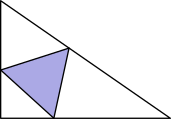
The area of the smallest equilateral triangle with one vertex on each of the sides of the right triangle with side lengths and as shown, is where and are positive integers, and are relatively prime, and is not divisible by the square of any prime. Find
小提示:
将两条直角边放在坐标轴上,并让两条直角边之间的等边三角形边从 到
Put the legs on the axes and let the side between the legs run from to
大提示:
要求第三个顶点落在斜边上,会得到 ;用 最大化括号中的线性组合
Requiring the third vertex to lie on the hypotenuse gives maximize the left combination using
解答:
将直角顶点放在原点 ,另外两个顶点为 和 ,则斜边所在直线为 。设等边三角形位于两条直角边上的那条边的端点为 和 ,其中 是边长。它的中点为 ,沿着垂直于这条边的方向移动 后,第三个顶点为 。
将这个顶点代入斜边方程并化简,得到 分母最大为 ,并且可由某个可行的 取得,所以最小边长满足 。
最小面积为 ,所以 。
Place the right angle at the origin with vertices and so the hypotenuse lies on the line Let the equilateral triangle’s side between the two legs have endpoints and where is the side length. Its midpoint is and moving a distance perpendicular to the side places the third vertex at
Substituting this vertex into the hypotenuse equation and simplifying gives The denominator is at most attained for an admissible so the minimum side length satisfies
The minimum area is so