
2006 AIME I 真题
计时
3:00:00
1.
在四边形 中, 是直角,对角线 垂直于 ,且 、、。求四边形 的周长。
In quadrilateral is a right angle, diagonal is perpendicular to and Find the perimeter of
2.
设集合 含 个元素,且是 的子集;设 为 中元素的和。求 可能取值的个数。
Let set be a -element subset of and let be the sum of the elements of Find the number of possible values of
小提示:
先求最小和最大可能和,再说明两者之间的每个值都能出现
Find the smallest and largest possible sums, then show every value between them occurs
大提示:
如果和还不是最大,则有某个 属于 ,并满足 ;将 换成 会使和恰好增加
If the sum is not maximal, some element of has replacing by raises the sum by exactly
解答:
最小可能和为 ,最大可能和为 。
中间的每个整数也都能出现。假设 的和为 ,令 为 中满足 的最小元素。若 是 ,则 必定是以 结尾的一段连续整数,即 ,其和超过 。因此 ,将 换成 会得到一个含 个元素、和为 的子集。
所以 取遍从 到 的所有值,共有 个可能值。
The smallest possible sum is and the largest is
Every integer in between also occurs. Suppose has sum and let be the smallest element of with If were then would be a block of consecutive integers ending at namely whose sum exceeds So and replacing by produces a -element subset with sum
Hence takes every value from to for possible values.
3.
求最小的正整数,使得删去它最左边的数字后,所得整数是原整数的 。
Find the least positive integer such that when its leftmost digit is deleted, the resulting integer is of the original integer.
小提示:
若最左边数字 在 位,删去后剩下 ,则
If the leftmost digit sits in the place and remains after deleting it, then
大提示:
强制 能被 整除,所以 且
forces to be divisible by so and
解答:
设 为最左边的数字, 为删去它后剩下的整数,则原整数为 ,其中 为某个正整数。条件给出 ,所以 。
因为 能被 整除但 不能,数字 必须是 的倍数,所以 。于是 ,得 ,这要求 。最小情形为 ,。
最小的这样的整数是 ,且确实有 。
Let be the leftmost digit and the integer that remains after deleting it, so the original integer is for some positive integer The condition says so
Since is divisible by but is not, the digit must be a multiple of so Then giving which requires The smallest case is
The least such integer is and indeed
4.
令 为乘积 的十进制写法末尾连续 的个数。求 除以 的余数。
Let be the number of consecutive ’s at the right end of the decimal representation of the product Find the remainder when is divided by
小提示:
计算因子 的个数:整数 恰好作为因子出现在 个阶乘中
Count factors of the integer appears as a factor in exactly of the factorials
大提示:
先求 在所有 的倍数处的和;再对 的倍数额外加同样的和,计入它们的第二个因子
Sum over all multiples of then add the same sum over multiples of for their second factor of
解答:
因子 非常充足,所以 是该乘积中因子 的指数。每个整数 ,只要满足 ,就恰好作为因子出现在 个阶乘中,即 。
每个 的倍数每出现一次就贡献一个因子 ,每个 的倍数还要再贡献一个。对 ,出现次数总和为 ,对 ,出现次数总和为 。
因此 ,除以 的余数为 。
Factors of are plentiful, so is the exponent of in the product. Each integer with appears as a factor in exactly of the factorials, namely
Every multiple of contributes one factor of per appearance, and every multiple of contributes one more. Over the appearances total and over they total
Hence and the remainder upon division by is
5.
数 可以写成 ,其中 、、 为正整数。求 。
The number can be written as where and are positive integers. Find
小提示:
将 平方,并比较 、 和 的系数
Square and match the coefficients of and
大提示:
,因此不需要分别求出 、、
so you never need individually
解答:
将 平方得到 比较系数可得 、、,即 、、,同时 。
于是 所以 。作为检验,、、,并且 符合要求。
因此 。
Squaring gives Matching coefficients yields that is along with
Then so As a check, and as required.
Therefore
6.
设 为所有能表示成循环小数 的实数组成的集合,其中 、、 是互不相同的数字。求 中所有元素的和。
Let be the set of real numbers that can be represented as repeating decimals of the form where are distinct digits. Find the sum of the elements of
小提示:
,且共有 个元素要相加
and there are elements to add
大提示:
由对称性,数字 到 中每一个在三个位置上都恰好出现 次
By symmetry each digit through appears exactly times in each of the three positions
解答:
每个元素等于 ,互异数字的有序三元组共有 个。由对称性,数字 到 中每一个在三个位置上都恰好出现 次。
因此分子总和为 所以所有元素的和为 。
Each element equals and there are ordered triples of distinct digits. By symmetry, each digit through appears in each of the three positions exactly times.
The numerators therefore total so the sum of the elements is
7.
如图,在一组等距平行线上画出一个角。阴影区域 的面积与阴影区域 的面积之比为 。求阴影区域 的面积与阴影区域 的面积之比。
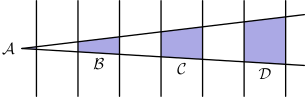
An angle is drawn on a set of equally spaced parallel lines as shown. The ratio of the area of shaded region to the area of shaded region is Find the ratio of the area of shaded region to the area of shaded region
小提示:
令平行线间距为一,每个区域都是相似三角形面积之差,所以面积随到顶点距离的平方缩放
With unit spacing, every region is a difference of similar triangles, so areas scale as squares of distances from the vertex
大提示:
若 是顶点到第一条线的距离,则 可确定
If is the vertex’s distance to the first line, then determines
解答:
取相邻平行线的间距为单位长度,令 为角的顶点到第一条线的距离。第 条线截出的三角形与 相似,相似比为 ,所以其面积与 成正比,而第 条线与第 条线之间的条带面积与 成正比。
区域 、、 分别是从第 、、 条线开始的条带,面积分别与 、、 成正比。已知比值得 ,所以 ,从而 。
因为 的面积与 成正比,所求比值为 。
Take the spacing between consecutive lines as the unit, and let be the distance from the vertex of the angle to the first line. The triangle cut off by the th line is similar to triangle with ratio so its area is proportional to and the strip between lines and has area proportional to
Regions and are the strips beginning at lines and with areas proportional to and The given ratio yields so and
Since has area proportional to the requested ratio is
8.
如图,六边形 被分成五个菱形 、、、 和 。菱形 、、 和 全等,每个面积都是 。令 为菱形 的面积。已知 是正整数,求 可能取值的个数。
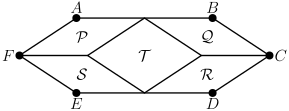
Hexagon is divided into five rhombuses, and as shown. Rhombuses and are congruent, and each has area Let be the area of rhombus Given that is a positive integer, find the number of possible values for
小提示:
五个菱形有相同的边长,并且沿 相接的三个角之和为
All five rhombuses share the same side length, and the three angles meeting along add to
大提示:
若每个全等菱形的面积为 ,则 ;判断它能等于哪些正整数
If each congruent rhombus has area then find which positive integers this can equal
解答:
因为 与其余每个菱形都共用一条边,五个菱形都有相同边长 。设 为 在 上的顶点,并令 为 在 处的角。则每个全等菱形的面积为 。、 和 在 处的角排在直线 上,且由对称性 在该处的角也等于 ,所以 的角为 。因此
当 在 中变化时, 取遍 中的所有值,所以 取遍 中的所有值。因为 ,可能的正整数值为 ,共有 个。
Since shares a side with each of the other rhombuses, all five have the same side length Let be the vertex of on and let be the angle of at Then each congruent rhombus has area The angles of and at lie along the line and by symmetry ’s angle there also equals so ’s angle is Hence
As ranges over the value takes every value in so takes every value in Since the possible positive integer values are there are of them.
9.
数列 、、 是等比数列,,公比为 ,其中 和 都是正整数。已知 ,求有序数对 的可能个数。
The sequence is geometric with and common ratio where and are positive integers. Given that find the number of possible ordered pairs
小提示:
合并对数:前十二项的乘积为 ,它必须等于
Combine the logs: the product of the twelve terms is which must equal
大提示:
写 、,并数出 的非负整数解;奇偶性迫使 为奇数
Write and count nonnegative solutions of parity forces odd
解答:
对数之和为 ,所以 ,从而 。
因此 和 都是 的幂:写 ,,其中整数 且 。因为 是偶数而 是奇数, 必须为奇数,设 ,其中 。则 当且仅当 。
每个 给出一个数对,所以有 个有序数对 。
The sum of the logarithms is so which gives
Thus and are powers of write and with integers and Since is even and is odd, must be odd, say for Then exactly when
Each gives one pair, so there are ordered pairs
10.
如图,八个直径为 的圆被摆放在坐标平面的第一象限中。设区域 为这八个圆形区域的并集。直线 的斜率为 ,并将 分成面积相等的两部分。直线 的方程可写成 ,其中 、、 是最大公因数为 的正整数。求 。
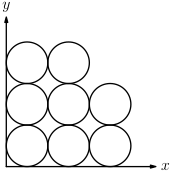
Eight circles of diameter are packed in the first quadrant of the coordinate plane as shown. Let region be the union of the eight circular regions. Line with slope divides into two regions of equal area. Line ’s equation can be expressed in the form where and are positive integers whose greatest common divisor is Find
小提示:
任何经过两个全等圆相切点的直线,都会把这对圆的总面积平分
Any line through the point where two congruent circles touch splits that pair’s area evenly
大提示:
经过 和 的直线斜率为 ,且两侧各留下两个完整的圆
The line through and has slope and leaves two whole circles on each side
解答:
这些圆的半径为 ,圆心分别为 、、、、、、 和 。在 相切的那对圆关于 对称,所以任何经过 的直线都会平分这对圆的面积;同理,在 相切的那对圆也是如此。直线 的斜率为 。
直线 完全不经过其余四个圆,并且这四个圆恰有两个在它的每一侧,所以它把 分成面积相等的两部分。平移一条斜率为 的直线会严格地把面积从一侧移到另一侧,所以 必定就是这条直线。
其方程为 ,即 。由于 ,答案为 。
The circles have radius and centers at and The pair of circles tangent at is symmetric about so any line through bisects that pair’s area; similarly for the pair tangent at The line has slope
Line misses the remaining four circles entirely, and exactly two of them lie on each side of it, so it divides into two regions of equal area. Sliding a slope- line strictly shifts area from one side to the other, so must be this line.
Its equation is that is, With the answer is
11.
一组 个立方体中,对每个整数 ,都恰有一个棱长为 的立方体,其中 。要按照以下规则用全部 个立方体搭成一座塔:
• 任何立方体都可以作为塔底的立方体。
• 紧放在棱长为 的立方体上方的立方体,其棱长至多为 。
设 为可以搭成的不同塔的数量。求 除以 的余数。
A collection of cubes consists of one cube with edge-length for each integer A tower is to be built using all cubes according to the rules:
• Any cube may be the bottom cube in the tower.
• The cube immediately on top of a cube with edge-length must have edge-length at most
Let be the number of different towers that can be constructed. What is the remainder when is divided by
小提示:
通过把最大的立方体插入一个由较小立方体组成的合法塔,来构造由 号立方体组成的塔
Build towers of the cubes by inserting the largest cube into a legal tower of the smaller ones
大提示:
当 时,立方体 可以放在塔底、放在立方体 上、或放在立方体 上,数量每步乘以三
For cube can go on the bottom, on cube or on cube — the count triples at each step
解答:
令 为使用棱长 的立方体搭成合法塔的数量。给定一个由 个立方体组成的合法塔,立方体 恰好可以插入三个位置:塔底、紧放在立方体 上方、或紧放在立方体 上方(若放在其他位置,它会压在棱长至多为 的立方体上,违反规则)。每种插入后仍然合法,因为最后位于立方体 上方的立方体棱长至多为 。反过来,从一个由 个立方体组成的合法塔中删去立方体 后仍是合法塔:原来在它上方的立方体棱长至多为 会落到一个棱长至少为 的立方体上。
因此 对 成立。因为 (两个立方体任意一个都可以在上面),所以 ,余数为 。
Let be the number of legal towers using the cubes of edge-lengths Given a legal tower of cubes, cube can be inserted in exactly three places: at the bottom, immediately on top of cube or immediately on top of cube (anywhere else it would rest on a cube of edge-length at most violating the rule). Each insertion stays legal, because the cube that ends up on top of cube has edge-length at most Conversely, deleting cube from a legal tower of cubes leaves a legal tower: the cube that was above it, of edge-length at most lands on a cube of edge-length at least
Hence for Since (either of the two cubes may be on top), we get and the remainder is
12.
求 的所有取值之和,其中 ,且 以度为单位并满足 。
Find the sum of the values of such that where is measured in degrees and
小提示:
积化和差:,所以方程变为
Product-to-sum: so the equation reads
大提示:
,所以 、、 中至少一个必须为零
so one of must vanish
解答:
由积化和差恒等式,,所以右边为 。令 ,,方程变为 ,而 ,所以它成立当且仅当 或
对 (单位为度): 给出 ; 给出 、、; 给出 、;而 在该区间内无解。
和为
By the product-to-sum identity, so the right side is Setting and the equation becomes and since it holds exactly when or
For in degrees: gives gives gives and gives no solutions in the interval.
The sum is
13.
对每个正偶数 ,令 表示能整除 的最大 的幂。例如,,且 。对每个正整数 ,令 。求小于 且使 为完全平方数的最大整数 。
For each even positive integer let denote the greatest power of that divides For example, and For each positive integer let Find the greatest integer less than such that is a perfect square.
小提示:
是函数 在 上的值之和;这些数中恰有 个满足
sums over exactly of these numbers have
大提示:
,所以 必须为奇数,且 必须是完全平方数
so must be odd and must be a perfect square
解答:
是函数 在偶数 上的值之和。在这 个数中,恰有 个数能被 整除但不能被 整除(所以 ),这里 ;另有唯一的数 满足 。因此
若 为偶数,则 为奇数,而指数 为奇数,因此 中含有奇数个因子 ,不可能是完全平方数。若 为奇数,则 已经是完全平方数,所以 是完全平方数当且仅当 是完全平方数。
对奇数 ,数 为偶数。不超过 的最大偶完全平方数是 。因此,满足 的最大有效整数是 。
is the sum of over the even numbers Among these numbers, exactly are divisible by but not (so have ) for each and the single number has Hence
If is even, then is odd and the exponent is odd, so has an odd number of factors of and cannot be a perfect square. If is odd, then is already a perfect square, so is a perfect square exactly when is.
For odd the number is even, and the greatest even perfect square at most is Thus the greatest valid is
14.
一个三脚架有三条腿,每条长 英尺。三脚架架好时,任意两条腿之间的角都相等,并且三脚架顶部离地面 英尺。架设三脚架时,一条腿的下端 英尺折断脱落。设折断后的三脚架架好时,顶部离地面的高度为 英尺。则 可写成 ,其中 和 是正整数,且 不被任何质数的平方整除。求 。(记号 表示小于或等于 的最大整数。)
A tripod has three legs each of length feet. When the tripod is set up, the angle between any pair of legs is equal to the angle between any other pair, and the top of the tripod is feet from the ground. In setting up the tripod, the lower foot of one leg breaks off. Let be the height in feet of the top of the tripod from the ground when the broken tripod is set up. Then can be written in the form where and are positive integers and is not divisible by the square of any prime. Find (The notation denotes the greatest integer that is less than or equal to )
小提示:
建立坐标:顶部在 ,三个脚端距原点 ;断腿的新端点在从顶部到原脚端的路程的 处
Set coordinates: top at and feet from the origin; the broken leg now ends of the way from top to old foot
大提示:
由对称性, 是 -平面中的二维距离:从 到经过断腿端点和另外两个脚端中点的直线的距离
By symmetry is a 2D distance in the -plane: from to the line through the broken tip and the midpoint of the other two feet
解答:
将顶部放在 。每条腿长 ,所以每个脚端距原点 :、、。断腿长度变为 ,所以它的端点为 。现在三脚架站在平面 上,而 等于从 到该平面的距离。
平面 包含 ,它平行于 -轴并经过中点 ,所以从 到该平面的距离可在 -平面中测量:也就是从 到经过 和 的直线的距离,该直线方程为 。因此
此时 ,且 不含平方因子。由于 ,可得 。
Place the top at Each leg has length so each foot is from the origin: The broken leg has length so its tip is and the tripod now stands on the plane with equal to the distance from to that plane.
The plane contains which is parallel to the -axis and passes through the midpoint so its distance from can be measured in the -plane: it is the distance from to the line through and whose equation is Therefore
Here and is squarefree. Since we get
15.
已知一个数列满足 ,且等式 对所有整数 都成立。求 的最小可能值。
Given that a sequence satisfies and for all integers find the minimum possible value of
小提示:
将递推式平方:。对 求和时各项会裂项相消,得到关于 的公式。
Square the recurrence: Summing over telescopes into a formula for
大提示:
每个 都是 的倍数,且奇偶性与 相同,所以选择 ,使它的平方尽量接近
Each is a multiple of with the parity of so choose with square as close as possible to
解答:
将递推式平方得 。对 到 求和,各项裂项相消:所以由 ,
归纳可知每个 都是 的倍数,且奇偶性与 相同,所以 是 的奇数倍。要使 最小,应在 的奇数倍中取平方最接近 的数,即 。其中 ,得到 (相邻的 和 分别给出 和 )。
这个值可以达到:对 取 ;此后令 (当 为偶数),并令 (当 为奇数)。于是 ,和为 。所以最小值为 。
Squaring the recurrence gives Summing for to telescopes: so with
Induction shows each is a multiple of whose parity matches that of so is an odd multiple of To minimize take the odd multiple of whose square is nearest that is with giving (the neighbors and give and ).
This value is attained: take for and thereafter alternate for even and for odd then and the sum is So the minimum is