
2000 AIME I Problem 4
Attempt Problem 4 of the 2000 AIME I below, then check your answer against the professionally curated solution from LIVE by Po-Shen Loh. You can also try the full timed exam, view all 2000 AIME I solutions, or check the answer key.
All problems are used with official legal permission of the Mathematical Association of America (MAA).
4.
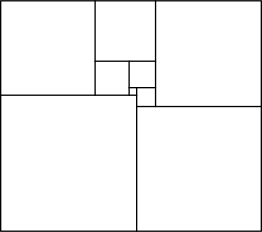
The diagram shows a rectangle that has been dissected into nine non-overlapping squares. Given that the width and the height of the rectangle are relatively prime positive integers, find the perimeter of the rectangle.
Answer: 260
Small Hint:
Let the two smallest squares have sides and and express every other square’s side in terms of them
Big Hint:
Equate the two expressions for the rectangle’s height (left side versus right side) to get
Solution:
Let the tiniest square (in the middle) have side and the small square just below and to its right have side Chasing edge lengths through the figure, the remaining squares have sides then then then (the top-left square). The tall square on the right spans the previous three along its left edge minus overlaps, giving side the bottom-right square has side and the bottom-left square has side
Measuring the rectangle’s height along its left and right sides, which simplifies to Taking the smallest positive integers, and the nine squares have sides and the rectangle is These dimensions are relatively prime (any common scaling would break that), and the areas check: equals the sum of the nine squares’ areas.
The perimeter is
Problem 4 in Other Years
1983 AIME · 1984 AIME · 1985 AIME · 1986 AIME · 1987 AIME · 1988 AIME · 1989 AIME · 1990 AIME · 1991 AIME · 1992 AIME · 1993 AIME · 1994 AIME · 1995 AIME · 1996 AIME · 1997 AIME · 1998 AIME · 1999 AIME · 2000 AIME II · 2001 AIME I · 2001 AIME II · 2002 AIME I · 2002 AIME II · 2003 AIME I · 2003 AIME II · 2004 AIME I · 2004 AIME II · 2005 AIME I · 2005 AIME II · 2006 AIME I · 2006 AIME II · 2007 AIME I · 2007 AIME II · 2008 AIME I · 2008 AIME II · 2009 AIME I · 2009 AIME II · 2010 AIME I · 2010 AIME II · 2011 AIME I · 2011 AIME II · 2012 AIME I · 2012 AIME II · 2013 AIME I · 2013 AIME II · 2014 AIME I · 2014 AIME II · 2015 AIME I · 2015 AIME II · 2016 AIME I · 2016 AIME II · 2017 AIME I · 2017 AIME II · 2018 AIME I · 2018 AIME II · 2019 AIME I · 2019 AIME II · 2020 AIME I · 2020 AIME II · 2021 AIME I · 2021 AIME II · 2022 AIME I · 2022 AIME II · 2023 AIME I · 2023 AIME II · 2024 AIME I · 2024 AIME II · 2025 AIME I · 2025 AIME II · 2026 AIME I · 2026 AIME II