
Soluciones del 2021 AMC 12A Fall
Desplázate hacia abajo para ver las soluciones preparadas profesionalmente de LIVE by Po-Shen Loh, imprime las soluciones en PDF, consulta la clave de respuestas, o haz el examen cronometrado completo.
Todos los problemas se usan con el permiso legal oficial de la Mathematical Association of America (MAA).
1.
¿Cuál es el valor de
What is the value of
Pista pequeña:
.
Pista grande:
, y .
and
Solución:
Como y la fracción es
Por lo tanto, la respuesta correcta es C.
Since and the fraction is
Thus, the correct answer is C.
2.
Menkara tiene una tarjeta de fichas de . Si acorta la longitud de uno de los lados de esta tarjeta en pulgada, la tarjeta tendría un área de pulgadas cuadradas. ¿Cuál sería el área de la tarjeta en pulgadas cuadradas si en cambio acorta la longitud del otro lado en pulgada?
Menkara has a index card. If she shortens the length of one side of this card by inch, the card would have area square inches. What would the area of the card be in square inches if instead she shortens the length of the other side by inch?
Pista pequeña:
Acortar un lado en para obtener área significa así que el lado de pulgadas fue el que se redujo
Shortening a side by to get area means so the -inch side was the one reduced
Pista grande:
En cambio, reduce el lado de pulgadas en obteniendo
Instead reduce the -inch side by giving
Solución:
La tarjeta original es Acortar un lado en pulgada da área lo que requiere así que el lado reducido fue el de pulgadas.
Acortar en cambio el otro lado en pulgada da pulgadas cuadradas.
Por lo tanto, la respuesta correcta es E.
The original card is Shortening a side by inch gives area which requires so the reduced side was the -inch side.
Shortening the other side by inch instead gives square inches.
Thus, the correct answer is E.
3.
El señor Lopez puede elegir entre dos rutas para ir al trabajo. La ruta A mide millas de largo, y su velocidad promedio en esta ruta es de millas por hora. La ruta B mide millas de largo, y su velocidad promedio en esta ruta es de millas por hora, salvo en un tramo de milla en una zona escolar donde su velocidad promedio es de millas por hora. ¿Por cuántos minutos es la ruta B más rápida que la ruta A?
Mr. Lopez has a choice of two routes to get to work. Route A is miles long, and his average speed along this route is miles per hour. Route B is miles long, and his average speed along this route is miles per hour, except for a -mile stretch in a school zone where his average speed is miles per hour. By how many minutes is Route B quicker than Route A?
Pista pequeña:
La ruta A toma hora; conviértelo a minutos
Route A takes hour; convert to minutes
Pista grande:
La ruta B se divide en millas a mph y milla a mph
Route B splits into miles at mph and mile at mph
Solución:
La ruta A toma hora minutos.
La ruta B tiene millas a mph y milla a mph, tomando hora minutos.
La diferencia es minutos.
Por lo tanto, la respuesta correcta es B.
Route A takes hour minutes.
Route B has miles at mph and mile at mph, taking hour minutes.
The difference is minutes.
Thus, the correct answer is B.
4.
El número de seis dígitos es primo para un solo dígito ¿Cuánto vale ?
The six-digit number is prime for only one digit What is
Pista pequeña:
El número es un par lo hace par, y lo hace múltiplo de
The number is even makes it even, and makes it a multiple of
Pista grande:
Para y la suma de dígitos es múltiplo de y .
For and the digit sum is a multiple of and
Solución:
El número es Cualquier par lo hace par, y lo hace divisible entre así que debe ser impar y distinto de
Para la suma de dígitos es (divisible entre ); para la suma de dígitos es (divisible entre ); y Solo supera todas las pruebas, y es primo.
Por lo tanto, la respuesta correcta es E.
The number is Any even makes it even, and makes it divisible by so must be odd and not
For the digit sum is (divisible by ); for the digit sum is (divisible by ); and Only survives all tests, and it is prime.
Thus, the correct answer is E.
5.
El emú Elmer da zancadas iguales para caminar entre postes de teléfono consecutivos en un camino rural. El avestruz Oscar puede cubrir la misma distancia en saltos iguales. Los postes de teléfono están espaciados uniformemente, y el poste número a lo largo de este camino está exactamente a una milla ( pies) del primer poste. ¿Cuánto más largo, en pies, es el salto de Oscar que la zancada de Elmer?
Elmer the emu takes equal strides to walk between consecutive telephone poles on a rural road. Oscar the ostrich can cover the same distance in equal leaps. The telephone poles are evenly spaced, and the st pole along this road is exactly one mile ( feet) from the first pole. How much longer, in feet, is Oscar’s leap than Elmer’s stride?
Pista pequeña:
Desde el primer poste hasta el poste número hay intervalos, así que cada intervalo mide pies
From the first pole to the st pole there are gaps, so each gap is feet
Pista grande:
La zancada de Elmer es un intervalo dividido entre el salto de Oscar es un intervalo dividido entre .
Elmer’s stride is one gap divided by Oscar’s leap is one gap divided by
Solución:
Hay intervalos entre el primer poste y el poste número , así que cada intervalo mide pies.
La zancada de Elmer es pies y el salto de Oscar es pies, una diferencia de pies.
Por lo tanto, la respuesta correcta es B.
There are gaps between the first and st poles, so each gap is feet.
Elmer’s stride is feet and Oscar’s leap is feet, a difference of feet.
Thus, the correct answer is B.
6.
Como se muestra en la figura de abajo, el punto está en el semiplano opuesto determinado por la recta respecto al punto , de modo que El punto está en de modo que y es un cuadrado. ¿Cuál es la medida en grados de ?
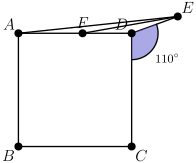
As shown in the figure below, point lies on the opposite half-plane determined by line from point so that Point lies on so that and is a square. What is the degree measure of
Pista pequeña:
Alrededor del punto el ángulo del triángulo es menos
Around point the triangle’s angle is minus
Pista grande:
El triángulo es isósceles con así que sus dos ángulos base son iguales
Triangle is isosceles with so its two base angles are equal
Solución:
Como es un cuadrado, Dado que y están en lados opuestos de la recta el rayo queda girado más allá de así que el ángulo del triángulo en (con en ) es
Como el triángulo es isósceles con ángulos base
Como son colineales,
Por lo tanto, la respuesta correcta es D.
Because is a square, Since and lie on opposite sides of line ray is swung past so the angle of triangle at (with on ) is
Since triangle is isosceles with base angles
As are collinear,
Thus, the correct answer is D.
7.
Una escuela tiene estudiantes y profesores. En el primer período, cada estudiante toma una clase, y cada profesor enseña una clase. Las inscripciones en las clases son y Sea el valor promedio obtenido si se elige un profesor al azar y se anota el número de estudiantes en su clase. Sea el valor promedio obtenido si se elige un estudiante al azar y se anota el número de estudiantes en su clase, incluido el estudiante. ¿Cuánto vale ?
A school has students and teachers. In the first period, each student is taking one class, and each teacher is teaching one class. The enrollments in the classes are and Let be the average value obtained if a teacher is picked at random and the number of students in their class is noted. Let be the average value obtained if a student was picked at random and the number of students in their class, including the student, is noted. What is
Pista pequeña:
es un promedio simple sobre las clases: .
is a plain average over the classes:
Pista grande:
Para cada clase de tamaño se cuenta veces: .
For each class of size is counted times:
Solución:
El promedio de los profesores es
El promedio de los estudiantes pondera el tamaño de cada clase por cuántos estudiantes hay en ella:
Así que
Por lo tanto, la respuesta correcta es B.
The teacher average is
The student average weights each class size by how many students are in it:
So
Thus, the correct answer is B.
8.
Sea el mínimo común múltiplo de todos los enteros de a inclusive. Sea el mínimo común múltiplo de y ¿Cuál es el valor de ?
Let be the least common multiple of all the integers through inclusive. Let be the least common multiple of and What is the value of
Pista pequeña:
ya contiene y todos los primos hasta verifica qué añaden a
already contains and all primes up to check what – add
Pista grande:
eleva la potencia de y es un nuevo primo; nada más es nuevo
raises the power of and is a new prime; nothing else is new
Solución:
contiene (de ), (de ), (de ), y todo primo hasta
Entre las únicas contribuciones nuevas son que eleva la potencia de de a y el nuevo primo Todo lo demás se factoriza en primos y potencias que ya están en
Por lo tanto
Por lo tanto, la respuesta correcta es D.
contains (from ), (from ), (from ), and every prime up to
Among the only new contributions are which raises the power of from to and the new prime Everything else factors into primes and powers already in
Therefore
Thus, the correct answer is D.
9.
Un prisma rectangular recto cuya área de superficie y volumen son numéricamente iguales tiene longitudes de arista y ¿Cuánto vale ?
A right rectangular prism whose surface area and volume are numerically equal has edge lengths and What is
Pista pequeña:
Con aristas la ecuación se divide para dar
With edges the equation divides to
Pista grande:
.
Solución:
Sea Que el área de superficie sea igual al volumen da Dividiendo entre
Como etcétera, la suma es Así por lo que lo que significa y
Por lo tanto, la respuesta correcta es E.
Let Surface area equals volume gives Dividing by
Since etc., the sum is Thus so meaning and
Thus, the correct answer is E.
10.
La representación en base nueve del número es ¿Cuál es el residuo cuando se divide entre ?
The base-nine representation of the number is What is the remainder when is divided by
Pista pequeña:
así que
so
Pista grande:
Toma la suma alternada de los dígitos en base nueve (desde la derecha)
Take the alternating sum of the base-nine digits (from the right)
Solución:
Como cada potencia así que es congruente con la suma alternada de sus dígitos en base nueve.
Los dígitos no nulos, con sus posiciones desde la derecha, son (posición ), (posición ), (posición ), (posición ), y (posición ). La suma alternada es
Por lo tanto, la respuesta correcta es D.
Since each power so is congruent to the alternating sum of its base-nine digits.
The nonzero digits, with their positions from the right, are (position ), (position ), (position ), (position ), and (position ). The alternating sum is
Thus, the correct answer is D.
11.
Considera dos círculos concéntricos de radio y El círculo más grande tiene una cuerda, de la cual la mitad queda dentro del círculo más pequeño. ¿Cuál es la longitud de la cuerda en el círculo más grande?
Consider two concentric circles of radius and The larger circle has a chord, half of which lies inside the smaller circle. What is the length of the chord in the larger circle?
Pista pequeña:
Sea la cuerda a distancia del centro. Su semilongitud es y la parte dentro del círculo pequeño tiene semilongitud .
Let the chord be at distance from the center. Its half-length is and the part inside the small circle has half-length
Pista grande:
“La mitad queda dentro” significa que la porción interior es igual a la mitad de toda la cuerda: .
“Half lies inside” means the inside portion equals half the whole chord:
Solución:
Sea la cuerda a distancia del centro común. Su longitud total es y la porción dentro del círculo más pequeño tiene longitud
Como la mitad de la cuerda queda dentro, Elevando al cuadrado da así que y
La longitud de la cuerda es
Por lo tanto, la respuesta correcta es E.
Let the chord lie at distance from the common center. Its total length is and the portion inside the smaller circle has length
Since half the chord lies inside, Squaring gives so and
The chord length is
Thus, the correct answer is E.
12.
¿Cuál es el número de términos con coeficientes racionales entre los términos en la expansión de
What is the number of terms with rational coefficients among the terms in the expansion of
Pista pequeña:
El término de índice lleva la racionalidad requiere que sea múltiplo de y que sea múltiplo de .
The term for index carries rationality needs to be a multiple of and to be a multiple of
Pista grande:
Esto obliga a y par, es decir, .
These force and even, i.e.
Solución:
El término general es cuyo coeficiente contiene y Esto es racional exactamente cuando es múltiplo de y es par.
Como necesitamos y par, lo que se combina en Los valores válidos suman
Por lo tanto, la respuesta correcta es C.
The general term is whose coefficient contains and This is rational exactly when is a multiple of and is even.
Since we need and even, which combine to The valid values number
Thus, the correct answer is C.
13.
La bisectriz del ángulo agudo formado en el origen por las gráficas de las rectas y tiene ecuación ¿Cuánto vale ?
The angle bisector of the acute angle formed at the origin by the graphs of the lines and has equation What is
Pista pequeña:
Una dirección de la bisectriz es la suma de los vectores unitarios a lo largo de las dos rectas:
A bisector direction is the sum of unit vectors along the two lines:
Pista grande:
es el cociente (segunda componente)/(primera componente); racionaliza el resultado
is the ratio (second component)/(first component); rationalize the result
Solución:
La bisectriz apunta a lo largo de la suma de los vectores unitarios de las dos rectas: Su pendiente es
Multiplicando numerador y denominador por da
Por lo tanto, la respuesta correcta es A.
The bisector points along the sum of the unit vectors of the two lines: Its slope is
Multiplying numerator and denominator by gives
Thus, the correct answer is A.
14.
En la figura, el hexágono equilátero tiene tres ángulos interiores agudos no adyacentes que miden cada uno El área encerrada del hexágono es ¿Cuál es el perímetro del hexágono?
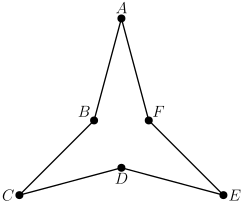
In the figure, equilateral hexagon has three nonadjacent acute interior angles that each measure The enclosed area of the hexagon is What is the perimeter of the hexagon?
Pista pequeña:
Sea el lado Las tres puntas de son triángulos isósceles con catetos se apoyan en los lados del triángulo interior formado por los tres vértices reflejos
Let the side be The three tips are isosceles triangles with legs they sit on the sides of the inner triangle formed by the three reflex vertices
Pista grande:
Cada punta tiene área y el triángulo equilátero interior tiene lado .
Each tip has area and the inner equilateral triangle has side
Solución:
Sea la longitud del lado común Los tres vértices agudos son las puntas de triángulos isósceles con dos lados y ápice cada uno tiene área
Los tres vértices reflejos forman un triángulo equilátero interior con lado cuya área es Usando el área total es
Igualando da así que y el perímetro es
Por lo tanto, la respuesta correcta es E.
Let the common side length be The three acute vertices are the tips of isosceles triangles with two sides and apex each has area
The three reflex vertices form an inner equilateral triangle with side whose area is Using the total area is
Setting gives so and the perimeter is
Thus, the correct answer is E.
15.
Recuerda que el conjugado del número complejo donde y son números reales e es el número complejo Para cualquier número complejo sea El polinomio tiene cuatro raíces complejas: y Sea el polinomio cuyas raíces son y donde los coeficientes y son números complejos. ¿Cuánto vale ?
Recall that the conjugate of the complex number where and are real numbers and is the complex number For any complex number let The polynomial has four complex roots: and Let be the polynomial whose roots are and where the coefficients and are complex numbers. What is
Pista pequeña:
Las funciones simétricas elementales de son los conjugados de las de todos los coeficientes de son reales, así que esas sumas simétricas son reales
The elementary symmetric functions of are the conjugates of those of all of ’s coefficients are real, so those symmetric sums are real
Pista grande:
, y
and
Solución:
Por Vieta en y ambos reales, así que sus conjugados también son y
Las raíces de son Entonces es la suma de los productos de pares: Y
Así que
Por lo tanto, la respuesta correcta es D.
By Vieta on and both real, so their conjugates are also and
The roots of are Then is the sum of products of pairs: And
So
Thus, the correct answer is D.
16.
Una organización tiene empleados, de los cuales tienen una computadora de la marca A mientras que los otros tienen una computadora de la marca B. Por seguridad, las computadoras solo pueden conectarse entre sí y solo mediante cables. Los cables solo pueden conectar una computadora de la marca A con una computadora de la marca B. Los empleados pueden comunicarse entre sí si sus computadoras están directamente conectadas por un cable o transmitiendo mensajes a través de una serie de computadoras conectadas. Inicialmente, ninguna computadora está conectada a otra. Un técnico selecciona arbitrariamente una computadora de cada marca e instala un cable entre ellas, siempre que no haya ya un cable entre ese par. El técnico se detiene una vez que todos los empleados pueden comunicarse entre sí. ¿Cuál es el número máximo posible de cables usados?
An organization has employees, of whom have a brand A computer while the other have a brand B computer. For security, the computers can only be connected to each other and only by cables. The cables can only connect a brand A computer to a brand B computer. Employees can communicate with each other if their computers are directly connected by a cable or by relaying messages through a series of connected computers. Initially, no computer is connected to any other. A technician arbitrarily selects one computer of each brand and installs a cable between them, provided there is not already a cable between that pair. The technician stops once every employee can communicate with each other. What is the maximum possible number of cables used?
Pista pequeña:
Para retrasar la conectividad, mantén el grafo desconectado el mayor tiempo posible, y luego un cable final une todo
To delay connectivity, keep the graph disconnected as long as possible, then one final cable joins everything
Pista grande:
La mayor cantidad de aristas estando aún desconectado es un grafo bipartito completo sobre de la marca A y de la marca B, dejando aislada una computadora de la marca A
The most edges while still disconnected is a complete bipartite graph on brand A and brand B, leaving one brand A computer isolated
Solución:
El técnico sigue agregando cables hasta que el grafo se vuelve conexo. Para maximizar la cuenta, mantén la red desconectada el mayor tiempo posible: deja aislada una sola computadora de la marca A y conecta completamente las computadoras restantes de la marca A con las computadoras de la marca B.
Eso usa cables estando aún desconectado. El siguiente cable conecta la última computadora de la marca A, uniendo a todos, para un total de
Por lo tanto, la respuesta correcta es B.
The technician keeps adding cables until the graph becomes connected. To maximize the count, keep the network disconnected for as long as possible: leave a single brand A computer isolated and fully connect the remaining brand A computers to all brand B computers.
That uses cables while still disconnected. The next cable connects the last brand A computer, joining everyone, for a total of
Thus, the correct answer is B.
17.
¿Para cuántos pares ordenados de enteros positivos ni ni tienen dos soluciones reales distintas?
For how many ordered pairs of positive integers does neither nor have two distinct real solutions?
Pista pequeña:
“Sin dos soluciones reales distintas” significa que cada discriminante es y .
“No two distinct real solutions” means each discriminant is and
Pista grande:
Multiplicando da así que prueba enteros positivos pequeños
Multiplying gives so test small positive integers
Solución:
Ninguna cuadrática tiene dos raíces reales distintas exactamente cuando ambos discriminantes son no positivos: y
Al combinar con , obtenemos así que Comprobando: da da da y da
Estos son : pares ordenados.
Por tanto, la respuesta correcta es B.
Neither quadratic has two distinct real roots exactly when both discriminants are nonpositive: and
Combining with gives so Checking: gives gives gives and gives
That is — ordered pairs.
Thus, the correct answer is B.
18.
Cada una de pelotas se lanza independientemente y al azar a uno de recipientes. Sea la probabilidad de que algún recipiente termine con pelotas, otro con pelotas, y los otros tres con pelotas cada uno. Sea la probabilidad de que cada recipiente termine con pelotas. ¿Cuánto vale ?
Each of balls is tossed independently and at random into one of bins. Let be the probability that some bin ends up with balls, another with balls, and the other three with balls each. Let be the probability that every bin ends up with balls. What is
Pista pequeña:
Ambas probabilidades comparten el mismo denominador , así que es un cociente de conteos
Both probabilities share the same denominator, so is a ratio of counts
Pista grande:
usa usa elecciones de los recipientes especiales por
uses uses choices of the special bins times
Solución:
Ambas probabilidades se dividen entre así que es un cociente de conteos de disposiciones.
Para todos los recipientes tienen Para elige cuál recipiente tiene y cuál tiene de maneras, por Por lo tanto
Por lo tanto, la respuesta correcta es E.
Both probabilities divide by so is a ratio of arrangement counts.
For all bins have For choose which bin has and which has in ways, times Therefore
Thus, the correct answer is E.
19.
Sea el menor número real mayor que tal que donde los argumentos están en grados. ¿Cuánto vale redondeado hacia arriba al entero más cercano?
Let be the least real number greater than such that where the arguments are in degrees. What is rounded up to the closest integer?
Pista pequeña:
requiere o para un entero
requires or for an integer
Pista grande:
El menor proviene de (con )
The smallest comes from (with )
Solución:
Senos iguales requieren o para algún entero
La familia supera por primera vez en dando La familia con da así que que es menor.
Redondeado hacia arriba,
Por lo tanto, la respuesta correcta es B.
Equal sines require or for some integer
The family first exceeds at giving The family with gives so which is smaller.
Rounded up,
Thus, the correct answer is B.
20.
Para cada entero positivo sea el doble del número de divisores enteros positivos de y para sea ¿Para cuántos valores de se cumple ?
For each positive integer let be twice the number of positive integer divisors of and for let For how many values of is
Pista pequeña:
así que es un punto fijo; es otro
so is a fixed point; is another
Pista grande:
Después de suficientes pasos, cada cae en o cuenta aquellos cuya órbita llega a
After enough steps every lands on or count those whose orbit reaches
Solución:
Tanto como son puntos fijos. Para el primer valor es a lo sumo Al revisar los valores pares hasta , una órbita llega a exactamente cuando su primer valor es o Por tanto, necesitamos o
Los números no mayores que con divisores son el único con divisores es y el único con divisores es Estos valores llegan todos al punto fijo
Por lo tanto, la respuesta correcta es D.
Both and are fixed. For the first value is at most Checking the even values through shows that an orbit reaches exactly when its first value is or Thus we need or
The numbers at most with divisors are the only one with divisors is and the only one with divisors is These values all reach the fixed point
Thus, the correct answer is D.
21.
Sea un trapecio isósceles con y Los puntos y están en la diagonal con entre y como se muestra en la figura. Supón que y ¿Cuál es el área de ?
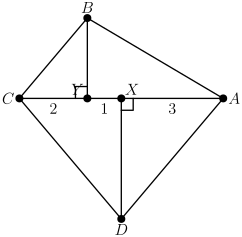
Let be an isosceles trapezoid with and Points and lie on diagonal with between and as shown in the figure. Suppose and What is the area of
Pista pequeña:
Coloca en una recta horizontal con Entonces está verticalmente debajo de y verticalmente arriba de
Place on a horizontal line with Then is vertically below and vertically above
Pista grande:
Usa y para relacionar las alturas de y luego aplica la fórmula del cordón de zapato
Use and to relate the heights of and then apply the shoelace formula
Solución:
Pon Los ángulos rectos dan y en lados opuestos de
El paralelismo obliga a y da así que Sustituyendo se obtiene
La fórmula del cordón de zapato da área
Por lo tanto, la respuesta correcta es C.
Put The right angles give and on opposite sides of
Parallelism forces and gives so Substituting yields
The shoelace formula gives area
Thus, the correct answer is C.
22.
Azar y Carl juegan una partida de tres en raya. Azar coloca una en una de las casillas de un arreglo de casillas de por , luego Carl coloca una en una de las casillas restantes. Después de eso, Azar coloca una en una de las casillas restantes, y así sucesivamente hasta que las casillas estén llenas o uno de los jugadores tenga de sus símbolos en una línea (horizontal, vertical o diagonal), lo que ocurra primero, en cuyo caso ese jugador gana la partida. Supón que los jugadores hacen sus jugadas al azar, en lugar de intentar seguir una estrategia racional, y que Carl gana la partida cuando coloca su tercera ¿De cuántas maneras puede verse el tablero después de que la partida termina?
Azar and Carl play a game of tic-tac-toe. Azar places an in one of the boxes in a -by- array of boxes, then Carl places an in one of the remaining boxes. After that, Azar places an in one of the remaining boxes, and so on until all boxes are filled or one of the players has of their symbols in a row — horizontal, vertical, or diagonal — whichever comes first, in which case that player wins the game. Suppose the players make their moves at random, rather than trying to follow a rational strategy, and that Carl wins the game when he places his third How many ways can the board look after the game is over?
Pista pequeña:
El tablero final tiene tres formando una línea y tres que no deben formar ellas mismas una línea
The final board has three s forming a line and three s that must not themselves form a line
Pista grande:
Divide en casos según si la línea de es una fila/columna o una diagonal, ya que eso cambia cuántas colocaciones de hacen accidentalmente una fila
Split into cases by whether ’s line is a row/column or a diagonal, since that changes how many placements accidentally make a row
Solución:
Carl gana con su tercera así que el tablero tiene tres formando una de las líneas y tres en las otras seis casillas. Las no deben formar una línea (de lo contrario, Azar habría ganado primero).
Si la línea de es una fila o columna ( opciones), las seis casillas restantes contienen dos líneas completas, así que las colocaciones válidas de suman Si la línea de es una diagonal ( opciones), las seis casillas restantes no contienen ninguna línea completa, dando
El total es
Por lo tanto, la respuesta correcta es D.
Carl wins on his third so the board has three s forming one of the lines and three s in the other six cells. The s must not form a line (else Azar would have won first).
If the line is a row or column ( choices), the remaining six cells contain two full lines, so valid placements number If the line is a diagonal ( choices), the remaining six cells contain no full line, giving
The total is
Thus, the correct answer is D.
23.
Un polinomio cuadrático con coeficientes reales y coeficiente principal se llama irrespetuoso si la ecuación se satisface por exactamente tres números reales. Entre todos los polinomios cuadráticos irrespetuosos, hay un único polinomio para el cual la suma de las raíces es máxima. ¿Cuánto vale ?
A quadratic polynomial with real coefficients and leading coefficient is called disrespectful if the equation is satisfied by exactly three real numbers. Among all the disrespectful quadratic polynomials, there is a unique such polynomial for which the sum of the roots is maximized. What is
Pista pequeña:
Si tiene raíces entonces significa o tener exactamente tres raíces requiere que una de estas tenga una raíz doble
If has roots then means or exactly three roots requires one of these to have a double root
Pista grande:
Con y tomando maximiza .
With and letting maximize
Solución:
Sea con raíces y Entonces se divide en y con discriminantes y Tener exactamente tres raíces reales significa que un discriminante es y el otro es positivo.
Tomemos y sea Entonces y el otro discriminante es así que Además, que alcanza su máximo en dando y
Por tanto, y
Por lo tanto, la respuesta correcta es A.
Let have roots and Then splits into and with discriminants and Exactly three real roots means one discriminant is and the other positive.
Take and set Then and the other discriminant is so Also maximized at giving and
So and
Thus, the correct answer is A.
24.
El cuadrilátero convexo tiene y En algún orden, las longitudes de los cuatro lados forman una progresión aritmética, y el lado es un lado de longitud máxima. La longitud de otro lado es ¿Cuál es la suma de todos los valores posibles de ?
Convex quadrilateral has and In some order, the lengths of the four sides form an arithmetic progression, and side is a side of maximum length. The length of another side is What is the sum of all possible values of
Pista pequeña:
Como es el máximo, los cuatro lados son coloca y en el ángulo
With the maximum, the four sides are place and at angle
Pista grande:
Para cada asignación de las tres longitudes menores a impón que sea horizontal y despeja incluye también el rombo degenerado
For each assignment of the three smaller lengths to impose that is horizontal and solve for also include common difference
Solución:
Como es el mayor, los cuatro lados son Tomemos y con y sean y Entonces así que
Escribamos para Al sustituir las permutaciones de por , se obtienen los candidatos no nulos respectivamente. La positividad de exige dejando solo y El caso también da un rombo válido.
Así, los conjuntos de lados son y
Los posibles valores de un lado distinto de son cuya suma es
Por lo tanto, la respuesta correcta es E.
Since is the largest, the four sides are Placing and with let and Then so
Write for Substituting the permutations of for gives the nonzero candidates respectively. Positivity of requires leaving only and The case also gives a valid rhombus.
Thus the side sets are and
The possible values of a non- side length are whose sum is
Thus, the correct answer is E.
25.
Sea un entero impar, y sea el número de cuádruplas de enteros distintos con para todo tal que divide a Existe un polinomio tal que para todos los enteros impares ¿Cuánto vale ?
Let be an odd integer, and let denote the number of quadruples of distinct integers with for all such that divides There is a polynomial such that for all odd integers What is
Pista pequeña:
Primero cuenta todas las cuádruplas ordenadas de residuos cuya suma sea y luego usa inclusión-exclusión sobre las coordenadas iguales
First count all ordered residue quadruples summing to then use inclusion-exclusion on equal coordinates
Pista grande:
Agrupa los patrones de coincidencia en un par, dos pares, una terna o los cuatro iguales; si es impar, multiplicar por o por es invertible
Group collision patterns as one pair, two pairs, a triple, or all four equal; odd makes multiplication by and invertible
Solución:
Consideremos como el conjunto completo de residuos módulo Sin la condición de que sean distintos, las tres primeras entradas son arbitrarias y la cuarta queda determinada, lo que da cuádruplas ordenadas.
La inclusión-exclusión sobre las particiones con coordenadas iguales da los términos restantes. Hay maneras de elegir un par igual, y cada una deja soluciones, lo que aporta Las particiones en dos pares aportan Las particiones en una terna y un elemento suelto tienen coeficiente de inclusión-exclusión y aportan Por último, la partición con los cuatro iguales tiene coeficiente y una sola solución. (Aquí, al ser impar, y son invertibles módulo ) Por lo tanto Así,
Por lo tanto, la respuesta correcta es E.
Regard as all residues modulo Without the distinctness condition, the first three entries are arbitrary and the fourth is determined, giving ordered quadruples.
Inclusion-exclusion over equal-coordinate partitions gives the remaining terms. There are choices of one equal pair, each leaving solutions, for The two-pair partitions contribute The triple-and-single partitions have inclusion-exclusion coefficient and contribute Finally, the all-equal partition has coefficient and one solution. (Here odd makes and invertible modulo ) Therefore Hence
Thus, the correct answer is E.