
Soluciones del 2008 AMC 12B
Desplázate hacia abajo para ver las soluciones preparadas profesionalmente de LIVE by Po-Shen Loh, imprime las soluciones en PDF, consulta la clave de respuestas, o haz el examen cronometrado completo.
Todos los problemas se usan con el permiso legal oficial de la Mathematical Association of America (MAA).
1.
Un jugador de baloncesto encestó canastas durante un partido. Cada canasta valía o puntos. ¿Cuántos números diferentes podrían representar el total de puntos anotados por el jugador?
A basketball player made baskets during a game. Each basket was worth either or points. How many different numbers could represent the total points scored by the player?
Pista pequeña:
El total es mínimo con todas las canastas de puntos y máximo con todas las de puntos.
The total is smallest with all -point baskets and largest with all -point baskets
Pista grande:
Todo entero entre y es alcanzable.
Every integer between and is attainable
Solución:
El total va desde (todas de dos puntos) hasta (todas de tres puntos). Cambiar una canasta de dos puntos por una de tres aumenta el total exactamente en así que todo entero intermedio aparece.
Los totales posibles son que son valores.
Por lo tanto, la respuesta correcta es E.
The total ranges from (all two-pointers) to (all three-pointers). Swapping one two-pointer for a three-pointer raises the total by exactly so every integer in between occurs.
The possible totals are which is values.
Thus, the correct answer is E.
2.
Se muestra un bloque de fechas de calendario. Se invertirá el orden de los números de la segunda fila. Luego se invertirá el orden de los números de la cuarta fila. Finalmente, se sumarán los números de cada diagonal. ¿Cuál será la diferencia positiva entre las dos sumas diagonales?

A block of calendar dates is shown. The order of the numbers in the second row is to be reversed. Then the order of the numbers in the fourth row is to be reversed. Finally, the numbers on each diagonal are to be added. What will be the positive difference between the two diagonal sums?
Pista pequeña:
Tras invertir las filas y las filas quedan .
After reversing rows and the rows become
Pista grande:
Una diagonal es y la otra es .
One diagonal reads and the other reads
Solución:
Al invertir la segunda y la cuarta filas, el arreglo tiene las filas y
La diagonal principal suma y la otra diagonal suma
La diferencia positiva es
Por lo tanto, la respuesta correcta es B.
Reversing the second and fourth rows gives the array with rows and
The main diagonal sums to and the other diagonal sums to
The positive difference is
Thus, the correct answer is B.
3.
Una liga de béisbol semiprofesional tiene equipos con jugadores cada uno. Las reglas de la liga establecen que a un jugador se le debe pagar al menos y que el total de los salarios de todos los jugadores de cada equipo no puede exceder ¿Cuál es el máximo salario posible, en dólares, para un solo jugador?
A semipro baseball league has teams with players each. League rules state that a player must be paid at least and that the total of all players’ salaries for each team cannot exceed What is the maximum possible salary, in dollars, for a single player?
Pista pequeña:
Para que un salario sea lo más grande posible, se paga a los otros jugadores el mínimo permitido.
To make one salary as large as possible, pay the other players the minimum allowed
Pista grande:
El máximo es menos el total de salarios mínimos.
The maximum is minus the total of minimum salaries
Solución:
Un jugador gana lo máximo cuando los otros jugadores reciben cada uno el salario mínimo de
Así, el salario máximo es
Por lo tanto, la respuesta correcta es C.
One player earns the most when the other players each receive the minimum salary of
Thus the maximum salary is
Thus, the correct answer is C.
4.
En el círculo los puntos y están en el mismo lado del diámetro y ¿Cuál es la razón entre el área del sector menor y el área del círculo?
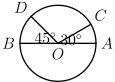
On circle points and are on the same side of diameter and What is the ratio of the area of the smaller sector to the area of the circle?
Pista pequeña:
y juntos forman el ángulo llano sobre .
and together make the straight angle
Pista grande:
La fracción del círculo que ocupa un sector es su ángulo central dividido entre .
A sector’s fraction of the circle is its central angle divided by
Solución:
Como y llenan el ángulo llano sobre el diámetro
La parte del círculo que ocupa el sector es
Por lo tanto, la respuesta correcta es D.
Since and fill the straight angle over diameter
The sector’s share of the circle is
Thus, the correct answer is D.
5.
Una clase reúne para comprar flores a un compañero que está en el hospital. Las rosas cuestan cada una y los claveles cuestan cada uno. No se usarán otras flores. ¿Cuántos ramos diferentes se podrían comprar por exactamente ?
A class collects to buy flowers for a classmate who is in the hospital. Roses cost each, and carnations cost each. No other flowers are to be used. How many different bouquets could be purchased for exactly
Pista pequeña:
Si hay rosas y claveles, entonces .
If there are roses and carnations, then
Pista grande:
Como y son pares, es par, así que debe ser par; halla cuántos pares funcionan.
Since and are even, is even, so must be even; find how many even work
Solución:
Sea el número de rosas y el número de claveles, de modo que con
Como y son pares, debe ser par, lo que obliga a que sea par. El mayor posible es (ya que ), así que
Eso da valores de cada uno determinando un ramo.
Por lo tanto, la respuesta correcta es C.
Let be the number of roses and the number of carnations, so with
Because and are even, must be even, forcing to be even. The largest possible is (since ), so
That gives values of each determining a bouquet.
Thus, the correct answer is C.
6.
El cartero Pete tiene un podómetro para contar sus pasos. El podómetro registra hasta pasos, luego se reinicia a en el siguiente paso. Pete planea determinar su kilometraje del año. El de enero Pete pone el podómetro en Durante el año, el podómetro pasa de a cuarenta y cuatro veces. El de diciembre el podómetro marca Pete da pasos por milla. ¿Cuál de las siguientes opciones es la más cercana al número de millas que Pete caminó durante el año?
Postman Pete has a pedometer to count his steps. The pedometer records up to steps, then flips over to on the next step. Pete plans to determine his mileage for a year. On January Pete sets the pedometer to During the year, the pedometer flips from to forty-four times. On December the pedometer reads Pete takes steps per mile. Which of the following is closest to the number of miles Pete walked during the year?
Pista pequeña:
Cada vuelta del podómetro representa pasos; suma la lectura final de .
Each flip of the pedometer represents steps; add the final reading of
Pista grande:
Divide el número total de pasos entre para convertir a millas.
Divide the total number of steps by to convert to miles
Solución:
Cada vuelta cuenta pasos, así que el total de pasos del año es
A pasos por milla, el kilometraje es que es lo más cercano a
Por lo tanto, la respuesta correcta es A.
Each flip counts steps, so the year’s steps total
At steps per mile, the mileage is which is closest to
Thus, the correct answer is A.
7.
Para números reales y se define ¿Cuánto vale ?
For real numbers and define What is
Pista pequeña:
Observa que .
Note that
Pista grande:
Entonces la expresión es con y .
So the expression is with and
Solución:
Como ambas entradas de la operación son el mismo valor
Por lo tanto
Por lo tanto, la respuesta correcta es A.
Since both inputs to the operation are the same value
Therefore
Thus, the correct answer is A.
8.
Los puntos y están sobre La longitud de es veces la longitud de y la longitud de es veces la longitud de ¿La longitud de es qué fracción de la longitud de ?
Points and lie on The length of is times the length of and the length of is times the length of The length of is what fraction of the length of
Pista pequeña:
De y se obtiene .
From and get
Pista grande:
De forma similar y .
Similarly and
Solución:
Como y tenemos así que
Del mismo modo con da
Como y se miden ambos desde
Por lo tanto, la respuesta correcta es C.
Since and we have so
Likewise with gives
Because and both measure from
Thus, the correct answer is C.
9.
Los puntos y están en un círculo de radio y El punto es el punto medio del arco menor ¿Cuál es la longitud del segmento ?
Points and are on a circle of radius and Point is the midpoint of the minor arc What is the length of the line segment
Pista pequeña:
El radio que pasa por el punto medio del arco biseca perpendicularmente la cuerda cortándola en con .
The radius through the arc midpoint perpendicularly bisects chord meeting it at with
Pista grande:
Halla la distancia del centro a la cuerda luego y aplica el teorema de Pitágoras al .
Find the center-to-chord distance then and apply the Pythagorean theorem to
Solución:
Sea el centro y el punto donde corta a Como es el punto medio del arco es la mediatriz de la cuerda, así que
En el triángulo rectángulo así que
Luego en el triángulo rectángulo
Por lo tanto, la respuesta correcta es A.
Let be the center and the point where meets Since is the midpoint of arc is the perpendicular bisector of the chord, so
In right triangle so
Then in right triangle
Thus, the correct answer is A.
10.
La albañil Brenda tardaría horas en construir una chimenea sola, y el albañil Brandon tardaría horas en construirla solo. Cuando trabajan juntos, hablan mucho, y su producción combinada disminuye en ladrillos por hora. Trabajando juntos, construyen la chimenea en horas. ¿Cuántos ladrillos hay en la chimenea?
Bricklayer Brenda would take hours to build a chimney alone, and bricklayer Brandon would take hours to build it alone. When they work together, they talk a lot, and their combined output is decreased by bricks per hour. Working together, they build the chimney in hours. How many bricks are in the chimney?
Pista pequeña:
Si la chimenea tiene ladrillos, Brenda coloca por hora y Brandon coloca por hora.
If the chimney has bricks, Brenda lays per hour and Brandon lays per hour
Pista grande:
Juntos colocan ladrillos por hora, y horas de esto es igual a .
Together they lay bricks per hour, and hours of this equals
Solución:
Sea el número de ladrillos. Sola, Brenda coloca ladrillos por hora y Brandon coloca Juntos, su ritmo es
Trabajar horas completa la chimenea: Desarrollando, así que lo que da
Por lo tanto
Por lo tanto, la respuesta correcta es B.
Let be the number of bricks. Alone, Brenda lays bricks per hour and Brandon lays Together, their rate is
Working for hours completes the chimney: Expanding, so giving
Hence
Thus, the correct answer is B.
11.
Una montaña con forma de cono tiene su base en el fondo del océano y una altura de pies. El superior del volumen de la montaña está sobre el agua. ¿Cuál es la profundidad del océano en la base de la montaña, en pies?
A cone-shaped mountain has its base on the ocean floor and has a height of feet. The top of the volume of the mountain is above water. What is the depth of the ocean at the base of the mountain, in feet?
Pista pequeña:
La parte sobre el agua es un cono más pequeño semejante a toda la montaña.
The above-water part is a smaller cone similar to the whole mountain
Pista grande:
La razón de volúmenes es el cubo de la razón de alturas; la profundidad es la altura total menos la altura del cono sobre el agua.
The volume ratio is the cube of the height ratio; the depth is the total height minus the above-water cone’s height
Solución:
La parte sobre el agua es un cono semejante a toda la montaña, con volumen del total. Como el volumen escala como el cubo de la longitud, la altura del cono sobre el agua es de la altura completa.
Así que la altura sobre el agua es pies.
La profundidad del océano en la base es la altura sumergida, pies.
Por lo tanto, la respuesta correcta es A.
The part above the water is a cone similar to the whole mountain, with volume of the total. Since volume scales as the cube of length, the above-water cone’s height is of the full height.
So the above-water height is feet.
The ocean depth at the base is the submerged height, feet.
Thus, the correct answer is A.
12.
Para cada entero positivo la media de los primeros términos de una sucesión es ¿Cuál es el término de la sucesión?
For each positive integer the mean of the first terms of a sequence is What is the th term of the sequence?
Pista pequeña:
Si la media de los primeros términos es entonces su suma es .
If the mean of the first terms is then their sum is
Pista grande:
El término es igual a la suma de los primeros menos la suma de los primeros .
The th term equals the sum of the first minus the sum of the first
Solución:
Como la media de los primeros términos es su suma es
El término es la diferencia de sumas consecutivas,
Para el término es
Por lo tanto, la respuesta correcta es B.
Since the mean of the first terms is their sum is
The th term is the difference of consecutive sums,
For the term is
Thus, the correct answer is B.
13.
El vértice del equilátero está en el interior del cuadrado unitario Sea la región formada por todos los puntos dentro de y fuera de cuya distancia a está entre y ¿Cuál es el área de ?
Vertex of equilateral is in the interior of unit square Let be the region consisting of all points inside and outside whose distance from is between and What is the area of
Pista pequeña:
Toma como un lado del cuadrado; “distancia a entre y ” es una franja vertical de ancho y área .
Take as a side of the square; “distance from between and ” is a vertical strip of width and area
Pista grande:
De esa área de la franja resta la parte de la franja que queda dentro del .
From that strip’s area subtract the part of the strip that lies inside
Solución:
Coloca de modo que está sobre el eje y la distancia a es la coordenada . La región está en la franja que dentro del cuadrado tiene área
El equilátero tiene con el lado sobre y el lado sobre El área del triángulo dentro de la franja es
Por lo tanto
Por lo tanto, la respuesta correcta es B.
Place so lies along the -axis and distance from is the -coordinate. The region lies in the strip which within the square has area
Equilateral has with side on and side on The area of the triangle inside the strip is
Therefore
Thus, the correct answer is B.
14.
Un círculo tiene un radio de y una circunferencia de ¿Cuánto vale ?
A circle has a radius of and a circumference of What is
Pista pequeña:
La circunferencia es igual a por el radio.
Circumference equals times the radius
Pista grande:
Usa y luego forma .
Use and then form
Solución:
La circunferencia es por el radio, así que
Reescribiendo, por lo que
Por lo tanto
Por lo tanto, la respuesta correcta es C.
The circumference is times the radius, so
Rewriting, hence
Therefore
Thus, the correct answer is C.
15.
Sobre cada lado de un cuadrado unitario se construye un triángulo equilátero de lado . Sobre cada nuevo lado de cada triángulo equilátero se construye otro triángulo equilátero de lado . Los interiores del cuadrado y de los triángulos no tienen puntos en común. Sea la región formada por la unión del cuadrado y todos los triángulos, y sea el menor polígono convexo que contiene a ¿Cuál es el área de la región que está dentro de pero fuera de ?
On each side of a unit square, an equilateral triangle of side length is constructed. On each new side of each equilateral triangle, another equilateral triangle of side length is constructed. The interiors of the square and the triangles have no points in common. Let be the region formed by the union of the square and all the triangles, and let be the smallest convex polygon that contains What is the area of the region that is inside but outside
Pista pequeña:
El hueco entre y son cuatro triángulos pequeños, uno en cada esquina del cuadrado.
The gap between and is four small triangles, one at each corner of the square
Pista grande:
Cada triángulo del hueco tiene dos lados de longitud que se encuentran en un ángulo usa .
Each gap triangle has two sides of length meeting at angle use
Solución:
La envolvente convexa difiere de solo cerca de las cuatro esquinas del cuadrado, donde se forma un pequeño hueco triangular. Cada triángulo del hueco tiene dos lados de longitud (los bordes exteriores de triángulos adyacentes).
El ángulo entre esos dos lados es así que cada hueco tiene área
El área total es
Por lo tanto, la respuesta correcta es C.
The convex hull differs from only near the four corners of the square, where a small triangular gap forms. Each gap triangle has two sides of length (outer edges of adjacent triangles).
The angle between those two sides is so each gap has area
The total area is
Thus, the correct answer is C.
16.
Un piso rectangular mide pies por pies, donde y son enteros positivos con Un artista pinta un rectángulo en el piso con los lados del rectángulo paralelos a los lados del piso. La parte sin pintar del piso forma un borde de ancho pie alrededor del rectángulo pintado y ocupa la mitad del área de todo el piso. ¿Cuántas posibilidades hay para el par ordenado ?
A rectangular floor measures feet by feet, where and are positive integers with An artist paints a rectangle on the floor with the sides of the rectangle parallel to the sides of the floor. The unpainted part of the floor forms a border of width foot around the painted rectangle and occupies half the area of the entire floor. How many possibilities are there for the ordered pair
Pista pequeña:
El rectángulo pintado es y es igual a la mitad del piso, así que .
The painted rectangle is and equals half the floor, so
Pista grande:
Reordena a y cuenta los pares de factores con .
Rearrange to and count factor pairs with
Solución:
El rectángulo pintado mide por y tiene la mitad del área del piso, así que
Desarrollando se obtiene y sumando resulta
Con los únicos pares de factores válidos de son y que dan y
Hay posibilidades.
Por lo tanto, la respuesta correcta es B.
The painted rectangle measures by and has half the area of the floor, so
Expanding gives and adding yields
With the only valid factor pairs of are and giving and
There are possibilities.
Thus, the correct answer is B.
17.
Sean y tres puntos distintos en la gráfica de tales que la recta es paralela al eje y es un triángulo rectángulo de área ¿Cuál es la suma de los dígitos de la coordenada de ?
Let and be three distinct points on the graph of such that line is parallel to the -axis and is a right triangle with area What is the sum of the digits of the -coordinate of
Pista pequeña:
Escribe y como tienen coordenadas distintas, el ángulo recto está en .
Write and since have distinct -coordinates, the right angle is at
Pista grande:
Los catetos perpendiculares y obligan a la altura sobre obtén del área, luego .
Perpendicular legs and force the height above get from the area, then
Solución:
Como es horizontal, tomemos y y sea El ángulo recto no puede estar en ni en (eso exigiría ), así que está en
Sea El producto punto de y da Los puntos son distintos, así que por tanto, Este valor es la altura del triángulo sobre
El área es así que y la coordenada de es
Su suma de dígitos es
Por lo tanto, la respuesta correcta es C.
Since is horizontal, take and and let The right angle cannot be at or (that would need ), so it is at
Put Taking the dot product of and gives The points are distinct, so hence This value is the height of the triangle above
The area is so and the -coordinate of is
Its digit sum is
Thus, the correct answer is C.
18.
Una pirámide tiene una base cuadrada y vértice El área del cuadrado es y las áreas de y son y respectivamente. ¿Cuál es el volumen de la pirámide?
A pyramid has a square base and vertex The area of square is and the areas of and are and respectively. What is the volume of the pyramid?
Pista pequeña:
La base tiene lado las áreas dadas de los triángulos dan las distancias oblicuas y a los lados y .
The base has side the given triangle areas give slant distances and to sides and
Pista grande:
El triángulo tiene lados y es perpendicular a la base; su altura hacia es la altura de la pirámide.
Triangle has sides and stands perpendicular to the base; its altitude to is the pyramid’s height
Solución:
El cuadrado tiene lado Sean y los pies de las perpendiculares desde a y Entonces y
El triángulo está en un plano perpendicular a la base, así que su altura hacia es la altura de la pirámide. Por la fórmula de Herón con su área es así que la altura hacia es
El volumen es
Por lo tanto, la respuesta correcta es E.
The square has side Let and be the feet of the perpendiculars from to and Then and
Triangle lies in a plane perpendicular to the base, so its altitude to is the pyramid’s height. By Heron’s formula with its area is so the altitude to is
The volume is
Thus, the correct answer is E.
19.
Una función se define por para todos los números complejos donde y son números complejos e Supón que y son ambos reales. ¿Cuál es el menor valor posible de ?
A function is defined by for all complex numbers where and are complex numbers and Suppose that and are both real. What is the smallest possible value of
Pista pequeña:
Escribe y exigir que y sean reales da dos condiciones lineales.
Write and requiring and to be real gives two linear conditions
Pista grande:
Obligan a y así que minimiza sobre .
They force and so minimize over
Solución:
Sea y Entonces y
Que ambos sean reales obliga a y es decir y
Por lo tanto que es mínimo cuando dando
Por lo tanto, la respuesta correcta es B.
Let and Then and
Both being real forces and i.e. and
Hence which is smallest when giving
Thus, the correct answer is B.
20.
Michael camina a una velocidad de pies por segundo en un camino recto y largo. Hay botes de basura cada pies a lo largo del camino. Un camión de basura viaja a pies por segundo en la misma dirección que Michael y se detiene segundos en cada bote. Cuando Michael pasa un bote, nota que el camión adelante acaba de salir del siguiente bote. ¿Cuántas veces se encontrarán Michael y el camión?
Michael walks at the rate of feet per second on a long straight path. Trash pails are located every feet along the path. A garbage truck travels at feet per second in the same direction as Michael and stops for seconds at each pail. As Michael passes a pail, he notices the truck ahead of him just leaving the next pail. How many times will Michael and the truck meet?
Pista pequeña:
Numera los botes de modo que Michael comience en el bote y el camión en el bote Michael llega al bote en el tiempo segundos.
Number the pails so Michael starts at pail and the truck at pail Michael reaches pail at time seconds
Pista grande:
El camión sale del bote en y llega en halla los botes donde coinciden, luego verifica si hay un cruce mientras el camión se mueve entre ellos.
The truck leaves pail at and arrives at find the pails where they coincide, then check for a crossing while the truck moves between them
Solución:
Numera los botes de modo que Michael esté en el bote y el camión en el bote en el tiempo Michael llega al bote en segundos. El camión pasa segundos entre botes y detenido, así que sale del bote en segundos y (para ) llega en
Michael está en el bote mientras el camión también está ahí exactamente cuando lo que se simplifica a Así que se encuentran en el bote (en cuando el camión parte), el bote (), el bote (), y el bote ( cuando el camión llega).
Entre los botes y el camión (que se mueve a pies/s) se adelanta y luego es alcanzado por Michael una vez más, añadiendo un cruce. En total, se encuentran veces.
Por lo tanto, la respuesta correcta es B.
Number the pails so Michael is at pail and the truck at pail at time Michael reaches pail at seconds. The truck spends seconds between pails and stopped, so it leaves pail at seconds and (for ) arrives at
Michael is at pail while the truck is there exactly when which simplifies to So they meet at pail (at as the truck departs), pail (), pail (), and pail ( as the truck arrives).
Between pails and the truck (moving at ft/s) pulls ahead of and is then overtaken by Michael once more, adding one crossing. In all, they meet times.
Thus, the correct answer is B.
21.
Se van a construir dos círculos de radio de la siguiente manera. El centro del círculo se elige de manera uniforme y al azar del segmento que une con El centro del círculo se elige de manera uniforme y al azar, e independientemente de la primera elección, del segmento que une con ¿Cuál es la probabilidad de que los círculos y se intersequen?
Two circles of radius are to be constructed as follows. The center of circle is chosen uniformly and at random from the line segment joining to The center of circle is chosen uniformly and at random, and independently of the first choice, from the line segment joining to What is the probability that circles and intersect?
Pista pequeña:
Con centros y los círculos se intersecan si y solo si es decir .
With centers and the circles intersect iff i.e.
Pista grande:
En el cuadrado de área halla el área con quitando los dos triángulos de las esquinas donde .
In the square of area find the area with by removing the two corner triangles where
Solución:
Sean los centros y con Los círculos (de radio cada uno) se intersecan si y solo si la distancia entre centros es a lo sumo
Los pares llenan el cuadrado de área La región de fallo son dos triángulos rectángulos, cada uno con catetos de área total
Así que el área favorable es y la probabilidad es
Por lo tanto, la respuesta correcta es E.
Let the centers be and with The circles (radius each) intersect iff the distance between centers is at most
The pairs fill the square of area The failing region is two right triangles, each with legs of total area
So the favorable area is and the probability is
Thus, the correct answer is E.
22.
Un estacionamiento tiene una fila de espacios. Doce autos llegan, cada uno requiere un espacio, y sus conductores eligen sus espacios al azar entre los espacios disponibles. Luego Auntie Em llega en su SUV, que requiere espacios adyacentes. ¿Cuál es la probabilidad de que ella pueda estacionar?
A parking lot has spaces in a row. Twelve cars arrive, each of which requires one parking space, and their drivers choose their spaces at random from among the available spaces. Auntie Em then arrives in her SUV, which requires adjacent spaces. What is the probability that she is able to park?
Pista pequeña:
Los espacios vacíos tienen la misma probabilidad de ser cualesquiera de los ella falla exactamente cuando no hay dos vacíos adyacentes.
The empty spaces are equally likely to be any of the she fails exactly when no two empties are adjacent
Pista grande:
El número de formas de elegir espacios vacíos entre sin dos adyacentes es resta esa probabilidad de .
The number of ways to choose empty spaces among with no two adjacent is subtract that probability from
Solución:
Después de que los autos estacionan, espacios quedan vacíos, con la misma probabilidad de ser cualesquiera de los para conjuntos igualmente probables.
Auntie Em falla exactamente cuando no hay dos espacios vacíos adyacentes. El número de formas de colocar vacíos no adyacentes entre es
Así que la probabilidad de que pueda estacionar es
Por lo tanto, la respuesta correcta es E.
After the cars park, spaces are empty, equally likely to be any of the for equally likely sets.
Auntie Em fails exactly when no two empty spaces are adjacent. The number of ways to place non-adjacent empties among is
So the probability she can park is
Thus, the correct answer is E.
23.
La suma de los logaritmos en base de los divisores de es ¿Cuánto vale ?
The sum of the base- logarithms of the divisors of is What is
Pista pequeña:
La suma de los logaritmos de los divisores es igual al logaritmo del producto de todos los divisores.
The sum of the logs of the divisors equals the log of the product of all divisors
Pista grande:
tiene divisores, y el producto de los divisores de es esto da .
has divisors, and the product of the divisors of is this gives
Solución:
La suma de los logaritmos en base de los divisores es el logaritmo de su producto. Un número con divisores tiene producto de divisores
Aquí tiene divisores, así que el producto es y su logaritmo es
Por lo tanto dando
Por lo tanto, la respuesta correcta es A.
The sum of the base- logs of the divisors is the log of their product. A number with divisors has divisor product
Here has divisors, so the product is and its log is
Thus giving
Thus, the correct answer is A.
24.
Sea Puntos distintos están en el eje , y puntos distintos están en la gráfica de Para todo entero positivo es un triángulo equilátero. ¿Cuál es el menor para el cual la longitud ?
Let Distinct points lie on the -axis, and distinct points lie on the graph of For every positive integer is an equilateral triangle. What is the least for which the length
Pista pequeña:
Si el ápice está a una altura sobre el punto medio; al estar en se obtiene .
If the apex sits at height above the midpoint; lying on gives
Pista grande:
Restar relaciones consecutivas da así que y .
Subtracting consecutive relations yields so and
Solución:
Sea y la base del -ésimo triángulo equilátero. Su ápice está sobre el punto medio a una altura y al estar en se obtiene es decir
Escribir la misma relación para el triángulo anterior y restar da y con obtenemos Sumando,
Necesitamos es decir Como y el menor es
Por lo tanto, la respuesta correcta es C.
Let and be the base of the th equilateral triangle. Its apex lies above the midpoint at height and being on gives i.e.
Writing the same relation for the previous triangle and subtracting gives and with we get Summing,
We need i.e. Since and the least such is
Thus, the correct answer is C.
25.
Sea un trapecio con y Las bisectrices de y se cortan en y las bisectrices de y se cortan en ¿Cuál es el área del hexágono ?
Let be a trapezoid with and Bisectors of and meet at and bisectors of and meet at What is the area of hexagon
Pista pequeña:
así que sus bisectrices se cortan en ángulo recto, y el punto medio de equidista de .
so their bisectors meet at right angles, and the midpoint of is equidistant from
Pista grande:
Esto pone sobre la línea media con obtén la altura del ( lados ).
This puts on the midline with get the height from ( sides )
Solución:
Como así que las bisectrices de y se cortan en ángulo recto: El punto medio de es entonces el circuncentro del triángulo rectángulo de modo que Así, donde la última igualdad usa la bisectriz en Por tanto, El mismo argumento da para el punto medio de Así, son colineales sobre la línea media.
La línea media mide mientras que y Por tanto,
Trazando con sobre , obtenemos y En así que y la altura del trapecio es
El segmento está a media altura, por lo que el hexágono se divide en dos trapecios y
Por lo tanto, la respuesta correcta es B.
Because so the bisectors of and meet at right angles, Then the midpoint of is the circumcenter of right triangle giving Thus where the last equality uses the angle bisector at Therefore The same argument gives for the midpoint of Hence are collinear on the midline.
The midline has length while and Hence
Drawing with on gives and In so and the trapezoid’s height is
The segment sits at half the height, so the hexagon splits into two trapezoids and
Thus, the correct answer is B.