
Soluciones del 2006 AMC 12A
Desplázate hacia abajo para ver las soluciones preparadas profesionalmente de LIVE by Po-Shen Loh, imprime las soluciones en PDF, consulta la clave de respuestas, o haz el examen cronometrado completo.
Todos los problemas se usan con el permiso legal oficial de la Mathematical Association of America (MAA).
1.
Los sándwiches en Joe’s Fast Food cuestan cada uno y los refrescos cuestan cada uno. ¿Cuántos dólares costará comprar sándwiches y refrescos?
Sandwiches at Joe’s Fast Food cost each and sodas cost each. How many dollars will it cost to purchase sandwiches and sodas?
Pista pequeña:
Multiplica cada precio por su cantidad.
Multiply each price by its quantity
Pista grande:
El total es .
The total is
Solución:
Cinco sándwiches cuestan dólares y ocho refrescos cuestan dólares. Juntos cuestan dólares.
Por lo tanto, la respuesta correcta es A.
Five sandwiches cost dollars and eight sodas cost dollars. Together they cost dollars.
Thus, the correct answer is A.
2.
Se define ¿Cuánto vale ?
Define What is
Pista pequeña:
Evalúa primero el interior.
Evaluate the inner first
Pista grande:
luego aplica una vez más.
then apply once more
Solución:
Por la definición, Entonces
Por lo tanto, la respuesta correcta es C.
By the definition, Then
Thus, the correct answer is C.
3.
La razón entre la edad de Mary y la edad de Alice es Alice tiene años. ¿Cuántos años tiene Mary?
The ratio of Mary’s age to Alice’s age is Alice is years old. How old is Mary?
Pista pequeña:
La edad de Mary es de la edad de Alice.
Mary’s age is of Alice’s age
Pista grande:
Calcula .
Compute
Solución:
La edad de Mary es de la de Alice, así que Mary tiene años.
Por lo tanto, la respuesta correcta es B.
Mary’s age is of Alice’s, so Mary is years old.
Thus, the correct answer is B.
4.
Un reloj digital muestra horas y minutos con AM y PM. ¿Cuál es la mayor suma posible de los dígitos en la pantalla?
A digital watch displays hours and minutes with AM and PM. What is the largest possible sum of the digits in the display?
Pista pequeña:
Maximiza por separado los dígitos de los minutos y los dígitos de la hora.
Maximize the minutes digits and the hour digits separately
Pista grande:
Los dos dígitos de los minutos suman a lo más la mejor hora es el único dígito .
The two minutes digits sum to at most the best hour is the single digit
Solución:
Los dos dígitos de los minutos suman a lo más a los minutos pasada la hora. Para la hora, un solo dígito da una suma de dígitos lo cual supera a cualquier hora de dos dígitos dan a lo más
El total mayor es que ocurre a las
Por lo tanto, la respuesta correcta es E.
The two minutes digits sum to at most at minutes past the hour. For the hour, a single digit gives digit sum which beats any two-digit hour give at most
The largest total is occurring at
Thus, the correct answer is E.
5.
Doug y Dave compartieron una pizza con porciones del mismo tamaño. Doug quería una pizza sencilla, pero Dave quería anchoas en la mitad de la pizza. El costo de una pizza sencilla era y había un costo adicional de por poner anchoas en una mitad. Dave se comió todas las porciones de pizza con anchoas y una porción sencilla. Doug se comió el resto. Luego cada uno pagó por lo que había comido. ¿Cuántos dólares más pagó Dave que Doug?
Doug and Dave shared a pizza with equally-sized slices. Doug wanted a plain pizza, but Dave wanted anchovies on half of the pizza. The cost of a plain pizza was and there was an additional cost of for putting anchovies on one half. Dave ate all the slices of anchovy pizza and one plain slice. Doug ate the remainder. Each then paid for what he had eaten. How many more dollars did Dave pay than Doug?
Pista pequeña:
La pizza sencilla cuesta por porciones, así que cada porción sencilla cuesta .
The plain pizza is for slices, so each plain slice costs
Pista grande:
Reparte el recargo de por anchoas entre las porciones con anchoas, luego suma el costo de cada persona.
Spread the anchovy surcharge over the anchovy slices, then total each person’s cost
Solución:
Cada porción sencilla cuesta El cargo de por anchoas se reparte entre las porciones con anchoas, agregando a cada una, así que una porción con anchoas cuesta
Dave comió porciones con anchoas y porción sencilla: Doug comió las porciones sencillas restantes: Dave pagó más.
Por lo tanto, la respuesta correcta es D.
Each plain slice costs The anchovy charge is spread over the anchovy slices, adding each, so an anchovy slice costs
Dave ate anchovy slices and plain slice: Doug ate the remaining plain slices: Dave paid more.
Thus, the correct answer is D.
6.
El rectángulo se corta en dos hexágonos congruentes, como se muestra, de modo que los dos hexágonos pueden reposicionarse sin superponerse para formar un cuadrado. ¿Cuánto vale ?
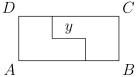
The rectangle is cut into two congruent hexagons, as shown, in such a way that the two hexagons can be repositioned without overlap to form a square. What is
Pista pequeña:
Los dos hexágonos se reensamblan en un cuadrado de área .
The two hexagons reassemble into a square of area
Pista grande:
El corte en escalera divide el ancho en tres partes horizontales iguales que suman .
The staircase splits the width into three equal horizontal pieces that sum to
Solución:
Los dos hexágonos forman un cuadrado de área así que el cuadrado tiene lado
El corte en escalera divide el ancho en tres partes horizontales iguales de longitud que juntas abarcan todo el ancho: así que (Los dos escalones verticales suben cada uno construyendo la altura adicional del cuadrado.)
Por lo tanto, la respuesta correcta es A.
The two hexagons form a square of area so the square has side
The staircase cut splits the width into three equal horizontal pieces of length which together span the full width: so (The two vertical steps each rise building the extra height of the square.)
Thus, the correct answer is A.
7.
Mary es mayor que Sally, y Sally es menor que Danielle. La suma de sus edades es años. ¿Cuántos años cumplirá Mary en su próximo cumpleaños?
Mary is older than Sally, and Sally is younger than Danielle. The sum of their ages is years. How old will Mary be on her next birthday?
Pista pequeña:
Sea la edad de Danielle igual a luego expresa las edades de Sally y Mary en términos de .
Let Danielle’s age be then express Sally’s and Mary’s ages in terms of
Pista grande:
Sally y Mary las edades suman .
Sally and Mary the ages sum to
Solución:
Sea Danielle de años. Entonces Sally tiene y Mary tiene
La suma da Así Mary tiene años, y en su próximo cumpleaños cumplirá
Por lo tanto, la respuesta correcta es B.
Let Danielle be years old. Then Sally is and Mary is
The sum gives So Mary is years old, and on her next birthday she will be
Thus, the correct answer is B.
8.
¿Cuántos conjuntos de dos o más enteros positivos consecutivos tienen suma ?
How many sets of two or more consecutive positive integers have a sum of
Pista pequeña:
Una sucesión de enteros consecutivos suma veces su valor central.
A run of consecutive integers sums to times its middle value
Pista grande:
Prueba más allá de la menor suma posible ya supera .
Test beyond the smallest possible sum already exceeds
Solución:
La suma de enteros consecutivos es igual a veces su mediana. Para una suma de da da y da
Una sucesión de cuatro enteros consecutivos suma un número par, y más de cinco términos ya superan Así que hay conjuntos.
Por lo tanto, la respuesta correcta es C.
The sum of consecutive integers equals times their median. For a sum of gives gives and gives
A run of four consecutive integers sums to an even number, and more than five terms already exceed So there are sets.
Thus, the correct answer is C.
9.
Oscar compra lápices y borradores por Un lápiz cuesta más que un borrador, y ambos artículos cuestan un número entero de centavos. ¿Cuál es el costo total, en centavos, de un lápiz y un borrador?
Oscar buys pencils and erasers for A pencil costs more than an eraser, and both items cost a whole number of cents. What is the total cost, in cents, of one pencil and one eraser?
Pista pequeña:
Agrupa en conjuntos de un lápiz y un borrador, más lápices adicionales.
Group as sets of one pencil and one eraser, plus extra pencils
Pista grande:
Si es el costo de un lápiz más un borrador, entonces así que es un múltiplo de .
If is the cost of one pencil plus one eraser, then so is a multiple of
Solución:
Sea el costo de un lápiz y el costo de un lápiz más un borrador, en centavos. Entonces así que es un múltiplo de menor que Por lo tanto con respectivamente.
Como un lápiz cuesta más que un borrador, lo que se cumple solo para (lápiz , borrador ). Así que un lápiz y un borrador cuestan centavos.
Por lo tanto, la respuesta correcta es A.
Let be a pencil’s cost and the cost of one pencil plus one eraser, in cents. Then so is a multiple of less than Hence with respectively.
Since a pencil costs more than an eraser, which holds only for (pencil eraser ). So one pencil and one eraser cost cents.
Thus, the correct answer is A.
10.
¿Para cuántos valores reales de es un entero?
For how many real values of is an integer?
Pista pequeña:
Haz para un entero no negativo .
Set for a nonnegative integer
Pista grande:
Se necesita y cada válido da un distinto.
Need and each valid gives a distinct
Solución:
Sea un entero. Entonces y así que
Cada uno de estos da y por ende un valor distinto Eso da valores.
Por lo tanto, la respuesta correcta es E.
Let be an integer. Then and so
Each such gives hence a distinct value That is values.
Thus, the correct answer is E.
11.
¿Cuál de las siguientes opciones describe la gráfica de la ecuación ?
Which of the following describes the graph of the equation
el conjunto vacío
the empty set
un punto
one point
dos rectas
two lines
una circunferencia
a circle
todo el plano
the entire plane
Pista pequeña:
Desarrolla y simplifica.
Expand and simplify
Pista grande:
La ecuación se reduce a .
The equation reduces to
Solución:
Al desarrollar, así que es decir
Esto es la unión de los dos ejes de coordenadas, un par de rectas.
Por lo tanto, la respuesta correcta es C.
Expanding, so i.e.
This is the union of the two coordinate axes, a pair of lines.
Thus, the correct answer is C.
12.
Varios anillos enlazados, cada uno de cm de grosor, cuelgan de un gancho. El anillo superior tiene un diámetro exterior de cm. El diámetro exterior de cada uno de los otros anillos es cm menor que el del anillo que está encima. El anillo inferior tiene un diámetro exterior de cm. ¿Cuál es la distancia, en cm, desde la parte superior del anillo superior hasta la parte inferior del anillo inferior?
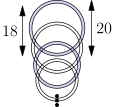
A number of linked rings, each cm thick, are hanging on a peg. The top ring has an outside diameter of cm. The outside diameter of each of the other rings is cm less than that of the ring above it. The bottom ring has an outside diameter of cm. What is the distance, in cm, from the top of the top ring to the bottom of the bottom ring?
Pista pequeña:
El anillo superior abarca cm; cada anillo inferior agrega su diámetro exterior menos por la superposición.
The top ring spans cm; each lower ring adds its outside diameter minus for the overlap
Pista grande:
Total .
Total
Solución:
El anillo superior abarca cm. Cada anillo de abajo se superpone con el anillo de arriba en cm (dos veces el grosor de cm), así que agrega su diámetro exterior menos
Los anillos inferiores tienen diámetros exteriores que aportan Así, la distancia total es
Por lo tanto, la respuesta correcta es B.
The top ring spans cm. Each ring below overlaps the ring above by cm (twice the -cm thickness), so it adds its outside diameter minus
The lower rings have outside diameters contributing Thus the total distance is
Thus, the correct answer is B.
13.
Los vértices de un triángulo rectángulo –– son los centros de tres circunferencias tangentes exteriormente entre sí, como se muestra. ¿Cuál es la suma de las áreas de estas circunferencias?
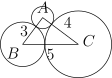
The vertices of a –– right triangle are the centers of three mutually externally tangent circles, as shown. What is the sum of the areas of these circles?
Pista pequeña:
Los radios en dos vértices adyacentes suman la longitud del lado entre ellos.
The radii at two adjacent vertices sum to the side length between them
Pista grande:
Resuelve .
Solve
Solución:
Si son los radios en los vértices, entonces Sumando las tres da así que
La suma de las áreas es
Por lo tanto, la respuesta correcta es E.
If are the radii at the vertices, then Adding all three gives so
The sum of the areas is
Thus, the correct answer is E.
14.
Dos granjeros acuerdan que los cerdos valen y que las cabras valen Cuando un granjero le debe dinero al otro, paga la deuda con cerdos o cabras, recibiendo “cambio” en forma de cabras o cerdos según sea necesario. (Por ejemplo, una deuda de podría pagarse con dos cerdos, recibiendo una cabra de cambio.) ¿Cuál es el monto de la menor deuda positiva que puede saldarse de esta manera?
Two farmers agree that pigs are worth and that goats are worth When one farmer owes the other money, he pays the debt in pigs or goats, with “change” received in the form of goats or pigs as necessary. (For example, a debt could be paid with two pigs, with one goat received in change.) What is the amount of the smallest positive debt that can be resolved in this way?
Pista pequeña:
Una deuda saldable tiene la forma para enteros .
A resolvable debt has the form for integers
Pista grande:
Todo valor de ese tipo es un múltiplo de .
Every such value is a multiple of
Solución:
Una deuda es saldable si y solo si para enteros Así, es un múltiplo de por lo que ninguna deuda positiva menor funciona.
Una deuda de es alcanzable ya que es decir, se entregan cabras y se reciben cerdos de cambio.
Por lo tanto, la respuesta correcta es C.
A debt is resolvable if and only if for integers Thus is a multiple of so no smaller positive debt works.
A debt of is achievable since i.e. give goats and receive pigs in change.
Thus, the correct answer is C.
15.
Supón que y ¿Cuál es el menor valor positivo posible de ?
Suppose and What is the smallest possible positive value of
Pista pequeña:
significa que es un múltiplo impar de .
means is an odd multiple of
Pista grande:
significa que minimiza .
means minimize
Solución:
Como tenemos Como tenemos
En el círculo unitario, la menor separación angular positiva entre un múltiplo impar de y un ángulo congruente con es Se alcanza tomando y lo que da
Por lo tanto, la respuesta correcta es A.
Since we have Since we have
On the unit circle, the smallest positive angular separation between an odd multiple of and an angle congruent to is It is attained by taking and which gives
Thus, the correct answer is A.
16.
Las circunferencias con centros y tienen radios y respectivamente. Una tangente interna común corta a las circunferencias en y respectivamente. Las rectas y se cortan en y ¿Cuánto vale ?
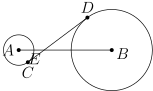
Circles with centers and have radii and respectively. A common internal tangent intersects the circles at and respectively. Lines and intersect at and What is
Pista pequeña:
Los radios y son perpendiculares a la tangente, así que .
Radii and are perpendicular to the tangent, so
Pista grande:
y .
and
Solución:
Los radios cumplen y Por el teorema de Pitágoras,
Como obtenemos así que Entonces
Por lo tanto, la respuesta correcta es B.
The radii satisfy and By the Pythagorean theorem,
Since we get so Then
Thus, the correct answer is B.
17.
El cuadrado tiene lado una circunferencia con centro tiene radio y y son ambos racionales. La circunferencia pasa por y está sobre El punto está en la circunferencia, del mismo lado de que El segmento es tangente a la circunferencia, y ¿Cuánto vale ?
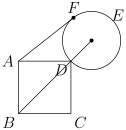
Square has side length a circle centered at has radius and and are both rational. The circle passes through and lies on Point lies on the circle, on the same side of as Segment is tangent to the circle, and What is
Pista pequeña:
La longitud de la tangente cumple .
The tangent length satisfies
Pista grande:
Coloca en el origen; entonces e iguala las partes racional e irracional.
Place at the origin; then and match rational and irrational parts
Solución:
Pon de modo que está sobre el rayo
Como es tangente a la circunferencia, Al calcular y simplificar se obtiene
Como y son racionales, las partes racional e irracional coinciden: y Así y
Por lo tanto, la respuesta correcta es B.
Set so that lies on ray
Since is tangent to the circle, Computing and simplifying gives
Because and are rational, the rational and irrational parts match: and Thus and
Thus, the correct answer is B.
18.
La función tiene la propiedad de que para cada número real en su dominio, también está en su dominio y ¿Cuál es el mayor conjunto de números reales que puede estar en el dominio de ?
The function has the property that for each real number in its domain, is also in its domain and What is the largest set of real numbers that can be in the domain of
Pista pequeña:
Sustituye en lugar de para obtener una segunda ecuación.
Substitute in place of to get a second equation
Pista grande:
Comparar las dos ecuaciones obliga a que .
Comparing the two equations forces
Solución:
Al reemplazar por se obtiene Junto con esto exige así que
Ambos valores son consistentes, con y Así que el mayor dominio posible es
Por lo tanto, la respuesta correcta es E.
Replacing by gives Together with this requires so
Both values are consistent, with and So the largest possible domain is
Thus, the correct answer is E.
19.
Las circunferencias con centros y tienen radios y respectivamente. La ecuación de una tangente externa común a las circunferencias puede escribirse en la forma con ¿Cuánto vale ?
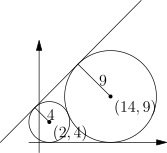
Circles with centers and have radii and respectively. The equation of a common external tangent to the circles can be written in the form with What is
Pista pequeña:
Cada circunferencia es tangente al eje , así que el eje es una tangente externa común.
Each circle is tangent to the -axis, so the -axis is one common external tangent
Pista grande:
Las dos tangentes externas se cortan en la recta que pasa por los centros, cuya pendiente es la otra tangente tiene pendiente .
The two external tangents meet on the line through the centers, whose slope is the other tangent has slope
Solución:
El radio de cada circunferencia es igual a la coordenada de su centro, así que ambas son tangentes al eje , que es una tangente externa común. Las dos tangentes externas se cortan en la intersección con el eje de la recta que pasa por los centros.
Esa recta tiene pendiente y pasa por cortando al eje en
La otra tangente forma un ángulo con el eje , así que su pendiente es Entonces
Por lo tanto, la respuesta correcta es E.
Each circle’s radius equals its center’s -coordinate, so both are tangent to the -axis, which is a common external tangent. The two external tangents meet at the -intercept of the line through the centers.
That line has slope and passes through meeting the -axis at
The other tangent makes angle with the -axis, so its slope is Then
Thus, the correct answer is E.
20.
Un insecto parte de un vértice de un cubo y se mueve a lo largo de las aristas del cubo según la siguiente regla. En cada vértice, el insecto elige recorrer una de las tres aristas que salen de ese vértice. Cada arista tiene la misma probabilidad de ser elegida, y todas las elecciones son independientes. ¿Cuál es la probabilidad de que, después de siete movimientos, el insecto haya visitado cada vértice exactamente una vez?
A bug starts at one vertex of a cube and moves along the edges of the cube according to the following rule. At each vertex the bug will choose to travel along one of the three edges emanating from that vertex. Each edge has equal probability of being chosen, and all choices are independent. What is the probability that after seven moves the bug will have visited every vertex exactly once?
Pista pequeña:
Hay recorridos de movimientos igualmente probables; cuenta los que visitan los vértices.
There are equally likely -move walks; count those visiting all vertices
Pista grande:
Hay opciones para el primer movimiento y para el segundo, tras lo cual el camino queda casi forzado.
There are choices for the first move and for the second, after which the path is nearly forced
Solución:
Desde el inicio hay recorridos de movimientos igualmente probables. Considera un recorrido que visita los vértices: hay opciones para el primer movimiento y para el segundo, ya que no puede volver al vértice de partida.
Etiqueta los vértices del cubo con cadenas de tres bits. Por simetría, tras fijar esos dos primeros movimientos podemos tomar los primeros tres vértices como Una revisión de las ramificaciones da exactamente estas tres continuaciones: Por lo tanto hay recorridos de este tipo.
La probabilidad es
Por lo tanto, la respuesta correcta es C.
From the start there are equally likely -move walks. For a walk visiting all vertices, there are choices for the first move and for the second, since it cannot return to the starting vertex.
Label cube vertices by three-bit strings. By symmetry, after fixing those first two moves we may take the first three vertices to be A branch check gives exactly these three completions: Thus there are such walks.
The probability is
Thus, the correct answer is C.
21.
Sea
y
¿Cuál es la razón entre el área de y el área de ?
Let
and
What is the ratio of the area of to the area of
Pista pequeña:
Para reescribe la condición como .
For rewrite the condition as
Pista grande:
Completa el cuadrado para obtener discos, luego compara sus radios al cuadrado.
Complete the square to get disks, then compare their squared radii
Solución:
Para la condición se convierte en es decir,
Son discos con radios al cuadrado para y para
Los logaritmos exigen Para cada disco, el cuadrado de la distancia de su centro a la recta es que es mayor que el radio al cuadrado. Por tanto, ambos discos están completamente en así que no se añadieron puntos al reescribir las desigualdades. La razón de áreas es
Por lo tanto, la respuesta correcta es E.
For the condition becomes i.e.
These are disks with squared radii for and for
The logarithms require For each disk, the squared distance from its center to the line is which is more than the squared radius. Hence both disks lie entirely in so no points were added when the inequalities were rewritten. The area ratio is
Thus, the correct answer is E.
22.
Una circunferencia de radio es concéntrica y exterior a un hexágono regular de lado La probabilidad de que tres lados completos del hexágono sean visibles desde un punto elegido al azar en la circunferencia es ¿Cuánto vale ?
A circle of radius is concentric with and outside a regular hexagon of side length The probability that three entire sides of the hexagon are visible from a randomly chosen point on the circle is What is
Pista pequeña:
Los arcos complementarios, desde los cuales solo se ven dos lados completos, suman la mitad de la circunferencia; por simetría cada uno mide .
The complementary arcs, from which only two whole sides are visible, total half the circle; by symmetry each measures
Pista grande:
La distancia del centro a un lado (la apotema) es y .
The distance from the center to a side (the apothem) is and
Solución:
Coloquemos el hexágono en el centro del círculo. A cada vértice le corresponde un arco desde el cual solo se ven por completo los dos lados que se encuentran allí. Estos seis arcos congruentes forman la probabilidad complementaria así que cada arco mide
Tomemos el arco centrado en el rayo del centro al vértice y sea su extremo superior. Entonces y en un tercer lado acaba de hacerse visible, así que está en la recta que contiene ese lado. Su distancia a es la apotema
Por tanto, lo que da
Por lo tanto, la respuesta correcta es D.
Place the hexagon at the center of the circle. Corresponding to each vertex is an arc from which only the two sides meeting there are entirely visible. These six congruent arcs make up the complementary probability so each arc measures
Take the arc centered on the ray from the center through a vertex and let be its upper endpoint. Then and at a third side is just becoming visible, so lies on that side’s supporting line. Its distance from is the apothem
Hence giving
Thus, the correct answer is D.
23.
Dada una sucesión finita de números reales, sea la sucesión de números reales. Se define y, para cada entero se define Supón que y sea Si entonces ¿cuánto vale ?
Given a finite sequence of real numbers, let be the sequence of real numbers. Define and, for each integer define Suppose and let If then what is
Pista pequeña:
Aplicar repetidamente introduce coeficientes binomiales; tiene un único término.
Applying repeatedly introduces binomial coefficients; has a single term
Pista grande:
Ese término es .
That term is
Solución:
Cada aplicación de promedia términos adyacentes, así que después de pasos el único término restante es
Igualando esto a se obtiene así que Como obtenemos
Por lo tanto, la respuesta correcta es B.
Each application of averages adjacent terms, so after steps the single remaining term is
Setting this equal to gives so Since we get
Thus, the correct answer is B.
24.
La expresión
se simplifica desarrollándola y combinando términos semejantes. ¿Cuántos términos hay en la expresión simplificada?
The expression
is simplified by expanding it and combining like terms. How many terms are in the simplified expression?
Pista pequeña:
Un monomio sobrevive solo cuando es par; los términos con impar se cancelan.
A monomial survives only when is even; the odd- terms cancel
Pista grande:
Para cada par desde hasta cuenta los posibles valores de .
For each even from to count the possible values of
Solución:
Un término sobrevive solo cuando es par, ya que los términos con impar se cancelan entre los dos desarrollos.
Para cada par con el exponente toma valores y queda entonces determinado. Al sumar sobre los valores pares de la suma de los primeros enteros positivos impares, que es
Por lo tanto, la respuesta correcta es D.
A term survives only when is even, since terms with odd cancel between the two expansions.
For each even with the exponent ranges over values and is then determined. Summing over even the sum of the first odd positive integers, which is
Thus, the correct answer is D.
25.
¿Cuántos subconjuntos no vacíos de tienen las siguientes dos propiedades?
Ningún par de enteros consecutivos pertenece a
Si contiene elementos, entonces no contiene ningún número menor que
How many non-empty subsets of have the following two properties?
No two consecutive integers belong to
If contains elements, then contains no number less than
Pista pequeña:
Un conjunto válido de elementos es un -subconjunto de sin dos consecutivos.
A -element valid set is a -subset of with no two consecutive
Pista grande:
Tales conjuntos están en biyección con los -subconjuntos de un conjunto de elementos, contados por .
Such sets biject with -subsets of a -element set, counted by
Solución:
Por la propiedad un conjunto válido de elementos es un -subconjunto de sin dos elementos consecutivos.
Al colapsar los huecos entre los elementos elegidos, estos corresponden biyectivamente a los -subconjuntos de un conjunto de elementos, contados por Esto es distinto de cero solo para así que el total es
Por lo tanto, la respuesta correcta es E.
By property a valid -element set is a -subset of with no two consecutive elements.
Collapsing the gaps between chosen elements, these correspond bijectively to -subsets of a -element set, counted by This is nonzero only for so the total is
Thus, the correct answer is E.