
Soluciones del 2004 AMC 12A
Desplázate hacia abajo para ver las soluciones preparadas profesionalmente de LIVE by Po-Shen Loh, imprime las soluciones en PDF, consulta la clave de respuestas, o haz el examen cronometrado completo.
Todos los problemas se usan con el permiso legal oficial de la Mathematical Association of America (MAA).
1.
Alicia gana por hora, de los cuales se deduce el para pagar impuestos locales. ¿Cuántos centavos por hora del salario de Alicia se usan para pagar impuestos locales?
Alicia earns per hour, of which is deducted to pay local taxes. How many cents per hour of Alicia’s wages are used to pay local taxes?
Pista pequeña:
Convierte a centavos antes de calcular el porcentaje.
Convert into cents before taking the percentage
Pista grande:
centavos, y el impuesto es el de esa cantidad.
cents, and of that is the tax
Solución:
Como son centavos, el impuesto es de centavos por hora.
Por lo tanto, la respuesta correcta es E.
Since is cents, the tax is cents per hour.
Thus, the correct answer is E.
2.
En el AMC cada respuesta correcta vale puntos, cada respuesta incorrecta vale puntos, y cada problema sin responder vale puntos. Si Charlyn deja de los problemas sin responder, ¿cuántos de los problemas restantes debe responder correctamente para obtener al menos ?
On the AMC each correct answer is worth points, each incorrect answer is worth points, and each problem left unanswered is worth points. If Charlyn leaves of the problems unanswered, how many of the remaining problems must she answer correctly in order to score at least
Pista pequeña:
Los espacios en blanco ya aportan puntos.
The blanks already contribute points
Pista grande:
Halla el menor número de respuestas correctas cuyos puntos cada una cubran los puntos restantes.
Find the smallest number of correct answers whose points each cover the remaining points
Solución:
Los problemas sin responder valen puntos, así que Charlyn necesita al menos puntos más de respuestas correctas.
Cada respuesta correcta vale puntos, y el menor múltiplo de que es al menos es Así que necesita al menos respuestas correctas.
Por lo tanto, la respuesta correcta es C.
The unanswered problems are worth points, so Charlyn needs at least more points from correct answers.
Each correct answer is worth points, and the smallest multiple of that is at least is So she needs at least correct answers.
Thus, the correct answer is C.
3.
¿Para cuántos pares ordenados de enteros positivos se cumple ?
For how many ordered pairs of positive integers is
Pista pequeña:
Despeja en términos de .
Solve for in terms of
Pista grande:
debe ser positivo, lo que acota qué tan grande puede ser el entero positivo .
must be positive, which bounds how large the positive integer can be
Solución:
Escribiendo el valor de es un entero positivo precisamente cuando es un entero positivo con
Esto da pares ordenados válidos.
Por lo tanto, la respuesta correcta es B.
Writing the value of is a positive integer precisely when is a positive integer with
This gives valid ordered pairs.
Thus, the correct answer is B.
4.
Bertha tiene hijas y ningún hijo. Algunas de sus hijas tienen hijas cada una, y las demás no tienen ninguna. Bertha tiene en total hijas y nietas, y ninguna bisnieta. ¿Cuántas de las hijas y nietas de Bertha no tienen hijas?
Bertha has daughters and no sons. Some of her daughters have daughters, and the rest have none. Bertha has a total of daughters and granddaughters, and no great-granddaughters. How many of Bertha’s daughters and granddaughters have no daughters?
Pista pequeña:
Primero cuenta las nietas, luego determina cuántas hijas tienen descendencia.
First count the granddaughters, then determine how many daughters have children
Pista grande:
Toda mujer que tiene hijas tiene exactamente .
Every woman with daughters has exactly of them
Solución:
Bertha tiene nietas, ninguna de las cuales tiene hijas.
Estas nietas son hijas de de las hijas de Bertha, así que exactamente mujeres tienen hijas.
Por lo tanto, el número de mujeres sin hijas es
Por lo tanto, la respuesta correcta es E.
Bertha has granddaughters, none of whom have daughters.
These granddaughters are the children of of Bertha’s daughters, so exactly women have daughters.
Therefore the number of women with no daughters is
Thus, the correct answer is E.
5.
Se muestra la gráfica de una recta . ¿Cuál de las siguientes afirmaciones es verdadera?

The graph of a line is shown. Which of the following is true?
Pista pequeña:
Lee por separado el signo y el tamaño de la pendiente y la intersección con el eje .
Read the sign and size of the slope and the -intercept separately
Pista grande:
Tanto como tienen valor absoluto menor que pero signos opuestos.
Both and have absolute value less than but opposite signs
Solución:
La intersección con el eje de la recta está entre y así que
La pendiente es negativa y poco pronunciada, entre y así que
Por lo tanto, el producto es negativo y tiene valor absoluto menor que lo que da
Por lo tanto, la respuesta correcta es B.
The -intercept of the line is between and so
The slope is negative and shallow, between and so
The product is therefore negative with absolute value less than giving
Thus, the correct answer is B.
6.
Sean y ¿Cuál de los siguientes es el mayor?
Let and Which of the following is largest?
Pista pequeña:
Factoriza cada diferencia para escribirla como un múltiplo de una potencia de .
Factor each difference to write it as a multiple of a power of
Pista grande:
mientras que todas las demás opciones son múltiplos del menor .
while every other choice is a multiple of the smaller
Solución:
Calcula cada diferencia factorizando:
y
Como supera a todos los demás, ninguno de los cuales alcanza la diferencia es la mayor.
Por lo tanto, la respuesta correcta es A.
Compute each difference by factoring:
and
Since exceeds each of the others, none of which reaches the difference is the largest.
Thus, the correct answer is A.
7.
Se juega un juego con fichas según la siguiente regla. En cada ronda, el jugador con más fichas da una ficha a cada uno de los otros jugadores y además coloca una ficha en una pila de descarte. El juego termina cuando algún jugador se queda sin fichas. Los jugadores y comienzan con y fichas, respectivamente. ¿Cuántas rondas tendrá el juego?
A game is played with tokens according to the following rule. In each round, the player with the most tokens gives one token to each of the other players and also places one token into a discard pile. The game ends when some player runs out of tokens. Players and start with and tokens, respectively. How many rounds will there be in the game?
Pista pequeña:
Sigue el conteo de fichas durante un ciclo completo de tres rondas.
Track the token counts over one full cycle of three rounds
Pista grande:
Cada tres rondas cada jugador pierde exactamente una ficha, así que halla cuándo el líder llega a .
Every three rounds each player loses exactly one token, so find when the leader hits
Solución:
Después de tres rondas los jugadores y tienen y fichas, respectivamente. Cada tres rondas siguientes reducen en una ficha la reserva de cada jugador.
Después de rondas tienen y fichas. En la ronda , el jugador que tiene más, regala las tres de sus fichas y se queda sin ninguna, terminando el juego.
Por lo tanto, la respuesta correcta es B.
After three rounds the players and have and tokens, respectively. Every subsequent three rounds reduces each player’s supply by one token.
After rounds they have and tokens. In the th round player who has the most, gives away all three of their tokens and runs out, ending the game.
Thus, the correct answer is B.
8.
En la figura, y son ángulos rectos, y y se cortan en ¿Cuál es la diferencia entre las áreas de y ?

In the figure, and are right angles, and and intersect at What is the difference between the areas of and
Pista pequeña:
Suma el triángulo común a cada uno de los dos triángulos.
Add the shared triangle to each of the two triangles
Pista grande:
La diferencia es igual a .
The difference equals
Solución:
Sean y las áreas de y respectivamente.
Entonces tiene área y tiene área
La diferencia buscada es
Por lo tanto, la respuesta correcta es B.
Let and be the areas of and respectively.
Then has area and has area
The requested difference is
Thus, the correct answer is B.
9.
Una compañía vende mantequilla de maní en frascos cilíndricos. La investigación de mercado sugiere que usar frascos más anchos aumentará las ventas. Si el diámetro de los frascos se aumenta en un sin alterar el volumen, ¿en qué porcentaje debe disminuirse la altura?
A company sells peanut butter in cylindrical jars. Marketing research suggests that using wider jars will increase sales. If the diameter of the jars is increased by without altering the volume, by what percent must the height be decreased?
Pista pequeña:
El área de la base escala con el cuadrado del diámetro.
The base area scales with the square of the diameter
Pista grande:
Multiplicar el diámetro por multiplica el área de la base por .
Multiplying the diameter by multiplies the base area by
Solución:
Multiplicar el diámetro por multiplica el área de la base por
Para mantener el volumen fijo, la altura debe multiplicarse por Eso es una disminución de es decir,
Por lo tanto, la respuesta correcta es C.
Multiplying the diameter by multiplies the base area by
To keep the volume fixed, the height must be multiplied by That is a decrease of or
Thus, the correct answer is C.
10.
La suma de enteros consecutivos es ¿Cuál es su mediana?
The sum of consecutive integers is What is their median?
Pista pequeña:
Para enteros consecutivos la mediana es igual a la media.
For consecutive integers the median equals the mean
Pista grande:
La mediana es la suma dividida entre el número de términos, .
The median is the sum divided by the number of terms,
Solución:
La suma de un conjunto de enteros consecutivos es igual al número de términos por su media, y para enteros consecutivos la media es igual a la mediana.
Así que la mediana es
Por lo tanto, la respuesta correcta es C.
The sum of a set of consecutive integers equals the number of terms times their mean, and for consecutive integers the mean equals the median.
So the median is
Thus, the correct answer is C.
11.
El valor promedio de todas las monedas de un centavo, cinco centavos, diez centavos y veinticinco centavos en el bolso de Paula es de centavos. Si tuviera una moneda de veinticinco centavos más, el valor promedio sería de centavos. ¿Cuántas monedas de diez centavos tiene en su bolso?
The average value of all the pennies, nickels, dimes, and quarters in Paula’s purse is cents. If she had one more quarter, the average value would be cents. How many dimes does she have in her purse?
Pista pequeña:
Sea el número actual de monedas y escribe el valor total de dos maneras después de agregar una moneda de veinticinco centavos.
Let be the current number of coins and write the total value two ways after adding a quarter
Pista grande:
Resuelve para luego averigua qué monedas suman centavos.
Solve for then figure out which coins total cents
Solución:
Si Paula tiene monedas, su valor total es de centavos. Agregar una moneda de veinticinco centavos da monedas que valen centavos, lo que también debe ser igual a centavos.
Así que lo que da
Cuatro monedas que suman centavos deben ser tres monedas de veinticinco centavos y una de cinco centavos, así que el número de monedas de diez centavos es
Por lo tanto, la respuesta correcta es A.
If Paula has coins, their total value is cents. Adding a quarter gives coins worth cents, which must also equal cents.
So giving
Four coins totalling cents must be three quarters and one nickel, so the number of dimes is
Thus, the correct answer is A.
12.
Sean y Los puntos y están sobre la recta y y se cortan en ¿Cuál es la longitud de ?
Let and Points and are on the line and and intersect at What is the length of
Pista pequeña:
Halla las ecuaciones de las rectas y luego interseca cada una con .
Find the equations of lines and then intersect each with
Pista grande:
y ambos están sobre así que cada uno tiene coordenadas iguales.
and both lie on so each has equal coordinates
Solución:
La recta pasa por con pendiente así que su ecuación es Al hacer se obtiene
La recta pasa por con pendiente así que Al hacer se obtiene
Entonces
Por lo tanto, la respuesta correcta es B.
Line passes through with slope so its equation is Setting gives
Line passes through with slope so Setting gives
Then
Thus, the correct answer is B.
13.
Sea el conjunto de puntos en el plano coordenado, donde cada uno de y puede ser o ¿Cuántas rectas distintas pasan por al menos dos elementos de ?
Let be the set of points in the coordinate plane, where each of and may be or How many distinct lines pass through at least two members of
Pista pequeña:
Comienza con los pares de puntos, cada uno de los cuales determina una recta.
Start from the pairs of points, each of which determines a line
Pista grande:
Algunas rectas pasan por tres puntos colineales y se cuentan veces.
Some lines pass through three collinear points and get counted times
Solución:
Hay pares de puntos, y cada par determina una recta.
Sin embargo, hay tres rectas horizontales, tres verticales y dos diagonales que cada una pasa por tres puntos colineales de Cada una de esas rectas se cuenta veces, un exceso de por recta.
Con rectas de este tipo, el número de rectas distintas es
Por lo tanto, la respuesta correcta es B.
There are pairs of points, and each pair determines a line.
However, there are three horizontal, three vertical, and two diagonal lines that each pass through three collinear points of Each such line is counted times, an overcount of per line.
With such lines, the number of distinct lines is
Thus, the correct answer is B.
14.
Una sucesión de tres números reales forma una progresión aritmética con primer término Si se suma al segundo término y se suma al tercer término, los tres números resultantes forman una progresión geométrica. ¿Cuál es el menor valor posible del tercer término de la progresión geométrica?
A sequence of three real numbers forms an arithmetic progression with a first term of If is added to the second term and is added to the third term, the three resulting numbers form a geometric progression. What is the smallest possible value for the third term of the geometric progression?
Pista pequeña:
Escribe los términos aritméticos como .
Write the arithmetic terms as
Pista grande:
En una progresión geométrica el cuadrado del término medio es igual al producto de los términos extremos.
In a geometric progression the middle term squared equals the product of the outer terms
Solución:
La progresión aritmética es Después de las sumas, la progresión geométrica es
La condición geométrica da que se simplifica a así que o
Los terceros términos correspondientes son y así que el menor valor posible es
Por lo tanto, la respuesta correcta es A.
The arithmetic progression is After the additions, the geometric progression is
The geometric condition gives which simplifies to so or
The corresponding third terms are and so the smallest possible value is
Thus, the correct answer is A.
15.
Brenda y Sally corren en direcciones opuestas sobre una pista circular, partiendo de puntos diametralmente opuestos. Se encuentran por primera vez después de que Brenda ha corrido metros. Se encuentran de nuevo después de que Sally ha corrido metros más allá de su primer punto de encuentro. Cada una corre a velocidad constante. ¿Cuál es la longitud de la pista en metros?
Brenda and Sally run in opposite directions on a circular track, starting at diametrically opposite points. They first meet after Brenda has run meters. They next meet after Sally has run meters past their first meeting point. Each girl runs at a constant speed. What is the length of the track in meters?
Pista pequeña:
Para el primer encuentro las dos juntas han recorrido la mitad de la pista.
By the first meeting the two together have covered half the track
Pista grande:
Entre el primer y el segundo encuentro juntas recorren una pista completa, así que Brenda corre el doble de su primer tramo.
Between the first and second meetings they together cover a full track, so Brenda runs twice her first leg
Solución:
Partiendo de extremos opuestos, cuando se encuentran por primera vez juntas han corrido la mitad de la pista. Entre el primer y el segundo encuentro, juntas corren una longitud completa de pista.
Como Brenda corre a velocidad constante y recorrió metros antes del primer encuentro, recorre metros entre los dos encuentros.
Sumando los metros de Sally durante ese mismo intervalo da una longitud de pista de metros.
Por lo tanto, la respuesta correcta es C.
Starting at opposite ends, when they first meet they have together run half the track. Between the first and second meetings, they together run a full track length.
Since Brenda runs at a constant speed and covered meters before the first meeting, she covers meters between the two meetings.
Adding Sally’s meters over that same interval gives a track length of meters.
Thus, the correct answer is C.
16.
El conjunto de todos los números reales para los cuales está definido es ¿Cuál es el valor de ?
The set of all real numbers for which is defined is What is the value of
Pista pequeña:
Trabaja de afuera hacia adentro: cada logaritmo requiere que su argumento sea positivo.
Work from the outside in: each logarithm requires its argument to be positive
Pista grande:
está definido solo cuando es decir, cuando el siguiente argumento excede .
is defined only when i.e. the next argument exceeds
Solución:
La expresión está definida si y solo si es decir,
Esto se cumple si y solo si lo que equivale a
Por consiguiente,
Por lo tanto, la respuesta correcta es B.
The expression is defined if and only if that is,
This holds if and only if which is equivalent to
Therefore
Thus, the correct answer is B.
17.
Sea una función con las siguientes propiedades:
(i) y
(ii) para cualquier entero positivo
¿Cuál es el valor de ?
Let be a function with the following properties:
(i) and
(ii) for any positive integer
What is the value of
Pista pequeña:
Aplica la regla repetidamente con para desenrollar .
Apply the rule repeatedly with to unwind
Pista grande:
El exponente se acumula como .
The exponent accumulates as
Solución:
Aplicando con obtenemos
Desenrollando desde los exponentes se acumulan:
Por lo tanto,
Por consiguiente, la respuesta correcta es D.
Applying with we get
Unwinding from the exponents accumulate:
Therefore
Thus, the correct answer is D.
18.
El cuadrado tiene lado Se construye un semicírculo con diámetro dentro del cuadrado, y la tangente al semicírculo desde corta al lado en ¿Cuál es la longitud de ?
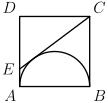
Square has side length A semicircle with diameter is constructed inside the square, and the tangent to the semicircle from intersects side at What is the length of
Pista pequeña:
Dos segmentos tangentes desde un punto exterior común a una circunferencia son iguales.
Two tangent segments from a common external point to a circle are equal
Pista grande:
Con las longitudes de las tangentes dan luego aplica el teorema de Pitágoras al .
With the tangent lengths give then apply the Pythagorean theorem to
Solución:
Sea el punto donde toca el semicírculo. Como y son ambas tangentes desde tenemos De manera similar, con las tangentes desde dan
Así que En el triángulo rectángulo donde y
Al desarrollar se obtiene así que y
Por lo tanto, la respuesta correcta es D.
Let be the point where touches the semicircle. Since and are both tangents from we have Similarly, with the tangents from give
Thus In right triangle where and
Expanding gives so and
Thus, the correct answer is D.
19.
Las circunferencias y son tangentes externamente entre sí y tangentes internamente a la circunferencia Las circunferencias y son congruentes. La circunferencia tiene radio y pasa por el centro de ¿Cuál es el radio de la circunferencia ?

Circles and are externally tangent to each other and internally tangent to circle Circles and are congruent. Circle has radius and passes through the center of What is the radius of circle
Pista pequeña:
Como pasa por el centro de y es tangente internamente, la circunferencia tiene radio .
Since passes through the center of and is internally tangent, circle has radius
Pista grande:
Coloca el centro de en el origen; usa los triángulos rectángulos formados por los centros y el eje de simetría.
Place the center of at the origin; use right triangles formed by the centers and the axis of symmetry
Solución:
La circunferencia tiene radio y pasa por el centro de mientras es tangente internamente a así que tiene radio
Coloca el centro de en el origen, con centrada en Por simetría, tiene centro y radio con su imagen especular respecto al eje horizontal, así que las dos circunferencias congruentes se tocan sobre ese eje y
La tangencia interna a da y la tangencia externa a da
Restando y usando se obtiene y El radio de la circunferencia es
Por lo tanto, la respuesta correcta es D.
Circle has radius and passes through the center of while being internally tangent to so has radius
Place the center of at the origin, with centered at By symmetry, has center and radius with its mirror image across the horizontal axis, so the two congruent circles touch on that axis and
Internal tangency to gives and external tangency to gives
Subtracting and using yields and The radius of circle is
Thus, the correct answer is D.
20.
Selecciona números y entre y de manera independiente y al azar, y sea su suma. Sean y los resultados cuando y respectivamente, se redondean al entero más cercano. ¿Cuál es la probabilidad de que ?
Select numbers and between and independently and at random, and let be their sum. Let and be the results when and respectively, are rounded to the nearest integer. What is the probability that
Pista pequeña:
Modela como un punto aleatorio en el cuadrado unitario y divide según si cada uno de está por debajo de .
Model as a random point in the unit square and split by whether each of is below
Pista grande:
La condición falla solo cuando pero o pero .
The condition fails only when but or but
Solución:
Representemos las elecciones como un punto del cuadrado unitario. Cada uno de y se redondea a si es menor que , y a en caso contrario, mientras que se redondea según y
La ecuación falla exactamente en dos regiones. Si falla cuando este es un triángulo rectángulo de área Si falla cuando este es otro triángulo rectángulo de área Cuando exactamente uno de es al menos la ecuación siempre se cumple.
Así, la probabilidad de que falle es y la probabilidad pedida es
Por tanto, la respuesta correcta es E.
Represent the choices as a point in the unit square. Each of and rounds to if below and to otherwise, while rounds based on and
The equation fails in exactly two regions. If it fails when this is a right triangle of area If it fails when this is another right triangle of area When exactly one of is at least the equation always holds.
Thus the failure probability is so the requested probability is
Thus, the correct answer is E.
21.
Si ¿cuál es el valor de ?
If what is the value of
Pista pequeña:
La serie es geométrica con razón .
The series is geometric with ratio
Pista grande:
Suma para obtener luego usa .
Sum to get then use
Solución:
La serie es geométrica con primer término y razón así que su suma es
Así que y
Por lo tanto, la respuesta correcta es D.
The series is geometric with first term and ratio so its sum is
Thus and
Thus, the correct answer is D.
22.
Tres esferas mutuamente tangentes de radio descansan sobre un plano horizontal. Una esfera de radio descansa sobre ellas. ¿Cuál es la distancia desde el plano hasta la parte superior de la esfera más grande?
Three mutually tangent spheres of radius rest on a horizontal plane. A sphere of radius rests on them. What is the distance from the plane to the top of the larger sphere?
Pista pequeña:
Los tres centros pequeños forman un triángulo equilátero de lado a una altura .
The three small centers form an equilateral triangle of side at height
Pista grande:
El centro grande está sobre el baricentro del triángulo; usa la distancia entre centros para hallar su altura.
The big center lies above the triangle’s centroid; use the distance between centers to find its height
Solución:
Sean los centros de las tres esferas unitarias, que forman un triángulo equilátero de lado a una altura sobre el plano, y sea el centro de la esfera grande directamente sobre el baricentro de
La distancia desde un vértice al baricentro es y así que
Como está unidad sobre el plano y la parte superior de la esfera grande está unidades sobre la altura total es
Por lo tanto, la respuesta correcta es B.
Let the centers of the three unit spheres be forming an equilateral triangle of side at height above the plane, and let be the center of the large sphere directly above the centroid of
The distance from a vertex to the centroid is and so
Since is unit above the plane and the top of the large sphere is units above the total height is
Thus, the correct answer is B.
23.
Un polinomio tiene coeficientes reales con y ceros complejos distintos con y reales, y ¿Cuál de las siguientes cantidades puede ser un número distinto de cero?
A polynomial has real coefficients with and distinct complex zeros with and real, and Which of the following quantities can be a nonzero number?
Pista pequeña:
Como es una raíz, las raíces no reales vienen en pares conjugados.
Since is a root, nonreal roots come in conjugate pairs
Pista grande:
que no está obligado a ser cero; verifica que cada una de las otras opciones debe anularse.
which is not forced to be zero; check each other option must vanish
Solución:
Como es una raíz,
Los ceros no reales ocurren en pares conjugados, así que y la hipótesis entonces obliga a El coeficiente es igual a por la suma de las raíces así que
Como el grado es par, al menos uno de es real, haciendo que un así que Por lo tanto, (A) a (D) todos deben ser
Por otro lado, y un polinomio válido como cumple Así que solo puede ser distinto de cero.
Por lo tanto, la respuesta correcta es E.
Since is a root,
The nonreal zeros occur in conjugate pairs, so and the hypothesis then forces The coefficient equals times the sum of the roots so
Because the degree is even, at least one of is real, making one so Thus (A) through (D) all must be
On the other hand, and a valid polynomial such as has So only can be nonzero.
Thus, the correct answer is E.
24.
Un plano contiene puntos y con Sea la unión de todos los discos de radio en el plano que cubren ¿Cuál es el área de ?
A plane contains points and with Let be the union of all disks of radius in the plane that cover What is the area of
Pista pequeña:
Un disco de radio cubre exactamente cuando su centro está a distancia menor o igual a de y de .
A radius- disk covers exactly when its center lies within of both and
Pista grande:
Halla esa región en forma de lente de centros, luego es todos los puntos a distancia menor o igual a de .
Find that lens-shaped region of centers, then is all points within of
Solución:
Un disco de radio cubre el segmento exactamente cuando su centro está a distancia menor o igual a de y de Esa región es la lente donde se solapan las dos circunferencias unitarias centradas en y .
Cada circunferencia unitaria pasa por el centro de la otra, así que la lente está delimitada por dos arcos de . Dos sectores de de área se solapan en dos triángulos equiláteros de área total lo que da a un área de
El conjunto consiste en todos los puntos a distancia menor o igual a de Más allá de mismo, esto añade dos sectores de de radio (cada uno de área ) y dos coronas de de radio exterior y radio interior (cada una de área ).
Por lo tanto, el área de es
Por lo tanto, la respuesta correcta es C.
A radius- disk covers segment exactly when its center is within of both and That region is the lens where the two unit circles centered at and overlap.
Each unit circle passes through the other’s center, so the lens is bounded by two arcs. Two sectors of area overlap in two equilateral triangles of total area giving area
The set consists of all points within of Beyond itself, this adds two sectors of radius (each area ) and two annuli of outer radius and inner radius (each area ).
Therefore the area of is
Thus, the correct answer is C.
25.
Para cada entero sea el número en base dado por El producto puede expresarse como donde y son enteros positivos y es tan pequeño como sea posible. ¿Cuál es el valor de ?
For each integer let denote the base- number The product can be expressed as where and are positive integers and is as small as possible. What is the value of
Pista pequeña:
Una fracción periódica en base igual a vale .
A repeating base- fraction equals
Pista grande:
Nota que lo que hace que el producto se telescope.
Note which makes the product telescope
Solución:
Como obtenemos
Escribiendo y el producto se telescopa a
Esto se simplifica a Si reescribir esta fracción con denominador exigiría que dividiera a lo cual no ocurre. Así, el menor posible es y
Por lo tanto, la respuesta correcta es E.
Since we get
Writing and the product telescopes to
This simplifies to If then rewriting this fraction with denominator would require to divide which it does not. Hence the smallest possible is and
Thus, the correct answer is E.