
Soluciones del 1985 AMC 12
Desplázate hacia abajo para ver las soluciones preparadas profesionalmente de LIVE by Po-Shen Loh, imprime las soluciones en PDF, consulta la clave de respuestas, o haz el examen cronometrado completo.
Todos los problemas se usan con el permiso legal oficial de la Mathematical Association of America (MAA).
1.
Si entonces
If then
Pista pequeña:
Resuelve primero la ecuación dada para hallar
First solve the given equation for
Pista grande:
Sustituye en
Substitute into
Solución:
La ecuación dada implica de modo que Por lo tanto,
Así, la respuesta correcta es A.
The given equation gives so Therefore
Thus the correct answer is A.
2.
En un juego de arcade, el “monstruo” es el sector sombreado de un círculo de radio cm, como se muestra en la figura. La parte que falta (la boca) tiene un ángulo central de ¿Cuál es el perímetro del monstruo en centímetros?
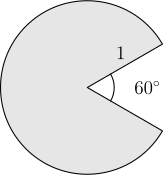
In an arcade game, the “monster” is the shaded sector of a circle of radius cm, as shown in the figure. The missing piece (the mouth) has central angle What is the perimeter of the monster in cm?
Pista pequeña:
El arco circular restante tiene un ángulo central de
The remaining circular arc has central angle
Pista grande:
Suma la longitud de ese arco y la de los dos radios expuestos
Add the length of that arc to the two exposed radii
Solución:
La parte curva es de una circunferencia unitaria, así que su longitud es Los dos lados rectos de la boca son radios de longitud total Por tanto, el perímetro es
Así, la respuesta correcta es E.
The curved part is of a unit circle, so its length is The two straight sides of the mouth are radii of total length Hence the perimeter is
Thus the correct answer is E.
3.
En el triángulo rectángulo , cuyos catetos miden y se trazan arcos de círculos: uno con centro y radio y el otro con centro y radio Intersecan la hipotenusa en y Entonces la longitud de es
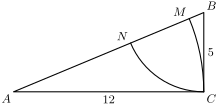
In right with legs and arcs of circles are drawn, one with center and radius the other with center and radius They intersect the hypotenuse in and Then has length
Pista pequeña:
Halla primero la hipotenusa del triángulo rectángulo -
First find the hypotenuse of the --right triangle
Pista grande:
Mide desde las posiciones de las dos intersecciones con los arcos
Measure the positions of both arc intersections from
Solución:
La hipotenusa mide Como el punto está a unidades de Además, por lo que Por tanto,
Así, la respuesta correcta es D.
The hypotenuse has length Since point is units from Also so Therefore
Thus the correct answer is D.
4.
Una bolsa grande contiene monedas de un centavo, diez centavos y veinticinco centavos. Hay el doble de monedas de diez centavos que de un centavo, y el triple de monedas de veinticinco centavos que de diez centavos. Una cantidad de dinero que podría haber en la bolsa es
A large bag of coins contains pennies, dimes and quarters. There are twice as many dimes as pennies and three times as many quarters as dimes. An amount of money which could be in the bag is
Pista pequeña:
Sea la cantidad de monedas de un centavo
Let the number of pennies be
Pista grande:
Expresa el valor total en centavos como múltiplo de
Express the total value in cents as a multiple of
Solución:
Si hay monedas de un centavo, hay monedas de diez centavos y de veinticinco centavos. Su valor total es centavos. De las cantidades dadas en dólares, es posible centavos.
Así, la respuesta correcta es C.
If there are pennies, there are dimes and quarters. Their total value is cents. Of the listed dollar amounts, cents is possible.
Thus the correct answer is C.
5.
¿Qué términos deben eliminarse de la suma para que la suma de los términos restantes sea ?
Which terms must be removed from the sum if the sum of the remaining terms is to equal
y
and
y
and
y
and
y
and
y
and
Pista pequeña:
Calcula cuánto excede de la suma completa
Compute how much larger the full sum is than
Pista grande:
Usa un denominador común de para comparar los pares candidatos
Use a common denominator of to compare the candidate pairs
Solución:
La suma completa es Por lo tanto, los términos eliminados deben sumar Como esos son los términos requeridos.
Así, la respuesta correcta es E.
The full sum is The removed terms must therefore total Since those are the required terms.
Thus the correct answer is E.
6.
Se elegirá un estudiante de una clase de niños y niñas para representar a la clase. Cada estudiante tiene la misma probabilidad de ser elegido, y la probabilidad de elegir a un niño es de la probabilidad de elegir a una niña. La razón entre la cantidad de niños y el total de estudiantes es
One student in a class of boys and girls is to be chosen to represent the class. Each student is equally likely to be chosen and the probability that a boy is chosen is of the probability that a girl is chosen. The ratio of the number of boys to the total number of boys and girls is
Pista pequeña:
La misma probabilidad para cada estudiante hace que las probabilidades de selección sean proporcionales a las cantidades de estudiantes
Equal likelihood makes the selection probabilities proportional to the class counts
Pista grande:
Una razón de niños a niñas de tiene cinco partes iguales en total
A boys-to-girls ratio of uses five equal parts in all
Solución:
Como cada estudiante tiene la misma probabilidad de ser elegido, la cantidad de niños es de la cantidad de niñas. Así, la razón entre niños y niñas es y los niños constituyen de la clase.
Así, la respuesta correcta es B.
Because every student is equally likely to be selected, the number of boys is of the number of girls. Thus the boys-to-girls ratio is and boys make up of the class.
Thus the correct answer is B.
7.
En algunos lenguajes de programación (como APL), cuando una expresión algebraica no contiene paréntesis, las operaciones se agrupan de derecha a izquierda. Así, en esos lenguajes significa lo mismo que en la notación algebraica usual. Si se evalúa en uno de esos lenguajes, el resultado en la notación algebraica usual sería
In some computer languages (such as APL), when there are no parentheses in an algebraic expression, the operations are grouped from right to left. Thus, in such languages means the same as in ordinary algebraic notation. If is evaluated in such a language, the result in ordinary algebraic notation would be
Pista pequeña:
Comienza con la operación situada más a la derecha,
Begin with the rightmost operation,
Pista grande:
Después resta ese resultado de y solo entonces divide
Next subtract that result from and only then divide
Solución:
Al agrupar primero desde la derecha se obtiene Al restar este resultado de se obtiene Finalmente, al dividir entre esa cantidad se obtiene
Así, la respuesta correcta es E.
Grouping from the right first gives Subtracting this result from gives Finally, dividing by that quantity gives
Thus the correct answer is E.
8.
Sean números reales, con y distintos de cero. La solución de es menor que la solución de si y solo si
Let be real numbers with and nonzero. The solution to is less than the solution to if and only if
Pista pequeña:
Escribe la solución de cada ecuación sin multiplicar en cruz
Write each equation’s solution without cross-multiplying
Pista grande:
Multiplicar una desigualdad por invierte su sentido
Multiplying an inequality by reverses its direction
Solución:
Las dos soluciones son y Por tanto, la comparación dada es Al multiplicar ambos lados por , se invierte la desigualdad y se obtiene equivalentemente, No es válido multiplicar por la cantidad , cuyo signo se desconoce.
Así, la respuesta correcta es E.
The two solutions are and Thus the given comparison is Multiplying both sides by reverses the inequality and gives equivalently No multiplication by the unknown-sign quantity is valid.
Thus the correct answer is E.
9.
Los enteros positivos impares se disponen en cinco columnas siguiendo el patrón mostrado. Contando desde la izquierda, la columna en la que aparece es la
The odd positive integers, are arranged in five columns continuing with the pattern shown. Counting from the left, the column in which appears is the
primera
first
segunda
second
tercera
third
cuarta
fourth
quinta
fifth
Pista pequeña:
Observa los elementos que comienzan cada fila de izquierda a derecha
Look at the entries that begin each left-to-right row
Pista grande:
Relaciona con un múltiplo cercano de
Relate to a nearby multiple of
Solución:
El último número de cada fila que va de derecha a izquierda es y la fila siguiente comienza con en la segunda columna. Como comienza una fila de ese tipo y está en la segunda columna.
Así, la respuesta correcta es B.
The last number in each right-to-left row is and the next row begins with in the second column. Since it begins such a row and lies in the second column.
Thus the correct answer is B.
10.
Un círculo arbitrario puede intersecar la gráfica de en
An arbitrary circle can intersect the graph of in
a lo sumo puntos
at most points
a lo sumo puntos
at most points
a lo sumo puntos
at most points
a lo sumo puntos
at most points
más de puntos
more than points
Pista pequeña:
Considera un círculo tangente al eje en el origen
Consider a circle tangent to the -axis at the origin
Pista grande:
Un radio muy grande mantiene el arco inferior cerca del eje a lo largo de muchas ondas sinusoidales
A very large radius keeps the lower arc close to the axis across many sine waves
Solución:
Toma un círculo tangente al eje en el origen, con su centro muy por encima del eje. Al crecer su radio, el arco inferior se mantiene positivo pero arbitrariamente cerca del eje en un intervalo arbitrariamente largo. En cada arco positivo de la curva seno vale en los extremos y se eleva muy por encima del arco circular entre ellos, lo que produce dos intersecciones. Por lo tanto, un radio suficientemente grande produce más de intersecciones.
Así, la respuesta correcta es E.
Take a circle tangent to the -axis at the origin with its center high above the axis. As its radius grows, its lower arc stays positive but arbitrarily close to the -axis over an arbitrarily long interval. On each positive arch of the sine curve is at the endpoints and rises well above this circular arc in between, producing two crossings. Choosing a sufficiently large radius therefore produces more than intersections.
Thus the correct answer is E.
11.
¿Cuántos reordenamientos distinguibles de las letras de CONTEST tienen las dos vocales al principio? (Por ejemplo, OETCNST es uno de ellos, pero OTETSNC no).
How many distinguishable rearrangements of the letters in CONTEST have both the vowels first? (For instance, OETCNST is one such arrangement, but OTETSNC is not.)
Pista pequeña:
Ordena las dos vocales en las dos primeras posiciones
Order the two vowels in the first two positions
Pista grande:
Permuta las cinco letras restantes teniendo en cuenta la repetida
Permute the remaining five letters while accounting for the repeated
Solución:
Las vocales pueden ocupar primero órdenes. Las letras restantes se pueden ordenar de formas distinguibles porque las dos son iguales. El total es
Así, la respuesta correcta es B.
The vowels can be ordered first in ways. The remaining letters can be arranged in distinguishable ways because the two ’s agree. The total is
Thus the correct answer is B.
12.
Sean y números primos distintos, donde no se considera primo. ¿Cuál de los siguientes es el menor cubo perfecto positivo que tiene a como divisor?
Let and be distinct prime numbers, where is not considered a prime. Which of the following is the smallest positive perfect cube having as a divisor?
Pista pequeña:
Todo exponente primo de un cubo perfecto es múltiplo de
Every prime exponent in a perfect cube is a multiple of
Pista grande:
Eleva los exponentes y a los menores múltiplos de que no sean inferiores
Raise the exponents and to the least larger multiples of
Solución:
Un cubo perfecto tiene exponentes primos divisibles entre Los menores múltiplos de que son al menos y son y respectivamente. Por tanto, el menor cubo posible es La respuesta correcta es D.
A perfect cube has prime exponents divisible by The least multiples of that are at least and are and respectively. Thus the smallest possible cube is Therefore the correct answer is D.
13.
Se colocan clavijas en un tablero separadas unidad tanto horizontal como verticalmente. Una banda elástica se estira sobre clavijas como en la figura y forma un cuadrilátero. Su área en unidades cuadradas es
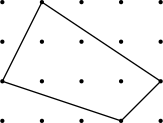
Pegs are put in a board unit apart both horizontally and vertically. A rubber band is stretched over pegs as shown in the figure, forming a quadrilateral. Its area in square units is
Pista pequeña:
Asigna coordenadas enteras a las cuatro clavijas de los vértices
Assign integer coordinates to the four corner pegs
Pista grande:
Aplica la fórmula del cordón a y
Use the shoelace formula on and
Solución:
Tomando la clavija inferior izquierda como los vértices del cuadrilátero en orden son y La fórmula del cordón da Por lo tanto, la respuesta correcta es E.
With the lower-left peg as the quadrilateral’s vertices in order are and The shoelace formula gives Therefore the correct answer is E.
14.
Exactamente tres de los ángulos interiores de un polígono convexo son obtusos. ¿Cuál es la cantidad máxima de lados de tal polígono?
Exactly three of the interior angles of a convex polygon are obtuse. What is the maximum number of sides of such a polygon?
Pista pequeña:
Acota los tres ángulos obtusos por y cada otro ángulo por
Bound the three obtuse angles by and every other angle by
Pista grande:
Compara esa cota superior con la suma de ángulos interiores
Compare that upper bound with the interior-angle sum
Solución:
Para un -gono, los tres ángulos obtusos suman menos de mientras que los otros ángulos suman a lo sumo Por tanto, lo que se simplifica a Seis lados son posibles, por ejemplo, con ángulos interiores y Así, el máximo es
La respuesta correcta es C.
For an -gon, the three obtuse angles have total less than while the other angles have total at most Hence which simplifies to Six sides are attainable, for example with interior angles and Thus the maximum is
Therefore the correct answer is C.
15.
Si y son números positivos tales que y entonces el valor de es
If and are positive numbers such that and then the value of is
Pista pequeña:
Sustituye en
Substitute into
Pista grande:
Como toma la raíz -ésima positiva y simplifica
Because take the -th root and simplify
Solución:
La sustitución da Al tomar la raíz -ésima positiva se obtiene así que Por tanto,
Así, la respuesta correcta es E.
Substitution gives Taking the positive -th root yields so Therefore
Thus the correct answer is E.
16.
Si y entonces el valor de es
If and then the value of is
ninguna de las anteriores
none of these
Pista pequeña:
Usa en la fórmula de adición de la tangente
Use in the tangent addition formula
Pista grande:
Expresa en términos de
Express in terms of
Solución:
Como por lo que Entonces La respuesta correcta es B.
Because so Therefore Thus the correct answer is B.
17.
La diagonal del rectángulo está dividida en tres segmentos de longitud por las rectas paralelas y , que pasan por y y son perpendiculares a El área de redondeada a una cifra decimal, es
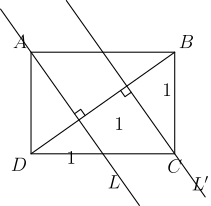
Diagonal of rectangle is divided into three segments of length by parallel lines and that pass through and and are perpendicular to The area of rounded to one decimal place, is
Pista pequeña:
Sean las longitudes de los lados del rectángulo; entonces su diagonal mide
Let the rectangle’s side lengths be then its diagonal has length
Pista grande:
Proyecta los lados vertical y horizontal sobre la diagonal para obtener y
Project the vertical and horizontal sides onto the diagonal to obtain and
Solución:
Sean y Como tenemos La proyección de sobre mide y el primer segmento marcado mide así que Del mismo modo, la proyección de llega al segundo punto de división, por lo que y El área es que se redondea a
La respuesta correcta es B.
Let and Since we have The projection of onto has length and the first marked segment has length so Similarly, the projection of reaches the second division point, so and Hence the area is which rounds to
Therefore the correct answer is B.
18.
Seis bolsas contienen y canicas, respectivamente. Una bolsa contiene únicamente canicas astilladas. Las otras no contienen ninguna. Jane toma tres bolsas y George toma dos de las restantes. Solo queda la bolsa de canicas astilladas. Si Jane recibe el doble de canicas que George, ¿cuántas canicas astilladas hay?
Six bags of marbles contain and marbles, respectively. One bag contains chipped marbles only. The other bags contain no chipped marbles. Jane takes three of the bags and George takes two of the others. Only the bag of chipped marbles remains. If Jane gets twice as many marbles as George, how many chipped marbles are there?
Pista pequeña:
Suma los tamaños de las seis bolsas y luego resta la bolsa de canicas astilladas
Add all six bag sizes, then remove the chipped bag
Pista grande:
Los totales de Jane y George están en razón así que su total combinado es divisible entre
Jane’s and George’s totals are in the ratio so their combined total is divisible by
Solución:
Las seis bolsas suman Si la bolsa de canicas astilladas contiene , las otras bolsas suman tres veces la cantidad de George, así que es divisible entre Entre las opciones, solo cumple esta condición. Se puede lograr: George toma mientras Jane toma
Así, la respuesta correcta es D.
The six bags total If the chipped bag contains marbles, then the other bags total three times George’s amount, so is divisible by Of the choices, only has this property. It is attainable: George can take while Jane takes
Thus the correct answer is D.
19.
Considera las gráficas de y donde es una constante positiva y y son variables reales. ¿En cuántos puntos se intersecan las dos gráficas?
Consider the graphs of and where is a positive constant and and are real variables. In how many points do the two graphs intersect?
exactamente
exactly
exactamente
exactly
al menos pero la cantidad varía con los valores positivos de
at least but the number varies for different positive values of
para al menos un valor positivo de
for at least one positive value of
ninguna de las anteriores
none of these
Pista pequeña:
Usa para eliminar
Use to eliminate
Pista grande:
Demuestra que la cuadrática resultante tiene dos raíces positivas y distintas
Show that the resulting quadratic has two distinct positive -roots
Solución:
Al sustituir en la segunda ecuación se obtiene Su discriminante es Sus raíces tienen producto positivo y suma positiva así que ambas son positivas y distintas. Para cada raíz la ecuación da dos valores distintos de Por lo tanto, hay exactamente cuatro puntos de intersección.
La respuesta correcta es A.
Substituting into the second equation gives Its discriminant is Its roots have positive product and positive sum so both roots are positive and distinct. For each root the equation gives two distinct values of Thus there are exactly four intersection points.
Therefore the correct answer is A.
20.
Un cubo de madera de arista unidades, donde es un entero , está pintado completamente de negro. Mediante cortes paralelos a sus caras, se divide en cubos pequeños de arista unitaria. Si la cantidad de cubos pequeños con exactamente una cara pintada de negro es igual a la de cubos pequeños sin pintura, ¿cuál es ?
A wooden cube with edge length units (where is an integer ) is painted black all over. By slices parallel to its faces, the cube is cut into smaller cubes each of unit edge length. If the number of smaller cubes with just one face painted black is equal to the number of smaller cubes completely free of paint, what is
ninguna de las anteriores
none of these
Pista pequeña:
Cuenta los cubos sin pintar en el cubo interior de arista
Count the unpainted cubes in the interior cube of side length
Pista grande:
En cada cara, exactamente cubos no tocan las aristas
On each face, exactly cubes avoid the edges
Solución:
Hay cubos completamente sin pintar. Cada una de las seis caras aporta cubos con exactamente una cara pintada, así que la igualdad da Como al dividir entre se obtiene y por tanto
La respuesta correcta es D.
There are completely unpainted cubes. Each of the six faces contributes cubes with exactly one painted face, so equality gives Since division by gives hence
Therefore the correct answer is D.
21.
¿Cuántos enteros satisfacen la ecuación
How many integers satisfy the equation
ninguna de las anteriores
none of these
Pista pequeña:
Una potencia entera puede ser si la base es si la base es y el exponente es par, o si una base no nula tiene exponente
An integer power can equal when the base is when the base is with even exponent, or when a nonzero base has exponent
Pista grande:
Resuelve los tres casos por separado y comprueba cada candidato
Solve those three cases separately and check every candidate
Solución:
Si la base es entonces lo que da y Si la base es entonces solo hace que el exponente sea par. Si el exponente es entonces y su base es así que también funciona. Las cuatro soluciones son y
La respuesta correcta es C.
If the base is then giving and If the base is then only makes the exponent even. If the exponent is then and its base is so it also works. Thus the four solutions are and
Therefore the correct answer is C.
22.
En un círculo con centro es un diámetro, es una cuerda, y Entonces la longitud de es
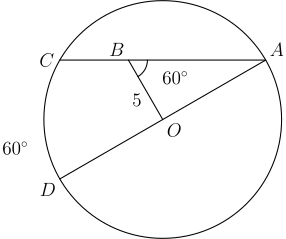
In a circle with center is a diameter, is a chord, and Then the length of is
ninguna de las anteriores
none of the above
Pista pequeña:
El arco de hace que
The arc makes
Pista grande:
Usa los triángulos -- resultantes para comparar y
Use the resulting -- triangles to compare and
Solución:
El arco da Como son colineales y son colineales, Junto con el triángulo es un triángulo -- Como obtenemos y
Además, porque es un diámetro. En el triángulo de -- la hipotenusa es así que Por tanto,
Así, la respuesta correcta es D.
Arc gives Since are collinear and are collinear, With triangle is a -- triangle. Because we get and
Also because is a diameter. In the -- triangle the hypotenuse is so Therefore
Thus the correct answer is D.
23.
Si donde ¿cuál de las siguientes afirmaciones no es correcta?
If where then which of the following is not correct?
Pista pequeña:
Reconoce y como las dos raíces cúbicas no reales de la unidad
Recognize and as the two nonreal cube roots of unity
Pista grande:
Sus potencias dependen únicamente del exponente módulo
Their powers depend only on the exponent modulo
Solución:
Los números son las dos raíces cúbicas no reales de la unidad, por lo que Esto es cuando no es divisible por pero es cuando es divisible por De los exponentes dados, solo es divisible entre así que su ecuación es la que no es correcta.
La respuesta correcta es C.
The numbers are the two nonreal cube roots of unity, so This equals when is not divisible by but equals when is divisible by Of the listed exponents, only is divisible by so its displayed equation is the one that is not correct.
Therefore the correct answer is C.
24.
Se elige un dígito no nulo de modo que la probabilidad de elegir el dígito sea La probabilidad de elegir el dígito es exactamente de la probabilidad de que el dígito elegido pertenezca al conjunto
A non-zero digit is chosen in such a way that the probability of choosing digit is The probability that the digit is chosen is exactly the probability that the digit chosen is in the set
Pista pequeña:
El doble de la probabilidad del dígito es
Twice the probability of digit is
Pista grande:
Suma las probabilidades de un conjunto consecutivo telescopando sus logaritmos
Sum the probabilities over a consecutive set by telescoping its logarithms
Solución:
La probabilidad de es así que el doble es Para los dígitos del al la suma se telescopa: Por tanto, ese conjunto tiene exactamente el doble de la probabilidad del dígito
Así, la respuesta correcta es C.
The probability of is so twice that probability is For the digits through the sum telescopes: Therefore that set has exactly twice the probability of digit
Thus the correct answer is C.
25.
El volumen de cierto prisma rectangular es su área superficial total es y sus tres dimensiones están en progresión geométrica. La suma de las longitudes en centímetros de todas las aristas es
The volume of a certain rectangular solid is its total surface area is and its three dimensions are in geometric progression. The sum of the lengths in cm of all the edges of this solid is
Pista pequeña:
Escribe las tres dimensiones como
Write the three dimensions as
Pista grande:
Usa el volumen para hallar y luego el área superficial para hallar
Use the volume to find then use the surface area to find
Solución:
Escribe las dimensiones como ya que su producto es La mitad del área superficial es la suma de los tres productos por pares, así que de donde La suma de las dimensiones es Como cada dimensión aparece en cuatro aristas, la suma de todas las longitudes es
Así, la respuesta correcta es B.
Write the dimensions as since their product is Half the surface area is the sum of the three pairwise products, so giving The sum of the dimensions is Since each dimension occurs on four edges, the sum of all edge lengths is
Thus the correct answer is B.
26.
Halla el menor entero positivo para el cual es una fracción reducible no nula.
Find the least positive integer for which is a non-zero reducible fraction.
ninguna de las anteriores
none of these
Pista pequeña:
Todo divisor común de y también divide una combinación lineal adecuada
Any common divisor of and also divides a suitable linear combination
Pista grande:
Calcula
Compute
Solución:
El algoritmo de Euclides da Como es primo, la fracción no nula es reducible exactamente cuando es un múltiplo no nulo de La menor posibilidad positiva es que no está entre las cuatro opciones numéricas.
Así, la respuesta correcta es E.
Euclid’s algorithm gives Since is prime, the nonzero fraction is reducible exactly when is a nonzero multiple of The least positive possibility is which is not among the four numerical choices.
Thus the correct answer is E.
27.
Considera una sucesión definida por y, en general, para ¿Cuál es el menor valor de para el que es un entero?
Consider a sequence defined by and in general for What is the smallest value of for which is an integer?
Pista pequeña:
Sea y sigue el exponente de
Let and track the exponent of
Pista grande:
Demuestra que y examina los primeros cuatro términos
Show that and examine the first four terms
Solución:
Sea Al aplicar repetidamente la recurrencia se obtiene de modo que Falta descartar los tres primeros términos. La sucesión es estrictamente creciente. Además, así que Finalmente, Como tenemos mientras que da Por tanto, no son enteros, y el primer término entero es
La respuesta correcta es C.
Let Repeated application of the recurrence gives so It remains to rule out the first three terms. The sequence is strictly increasing. Also so Finally Since we have while gives Thus are not integers, and the first integral term is
Therefore the correct answer is C.
28.
En tenemos y ¿Cuál es ?
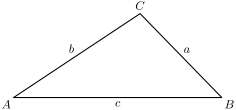
In we have and What is
no está determinado de manera única
not uniquely determined
Pista pequeña:
Usa la ley de los senos para escribir
Use the sine law to write
Pista grande:
Después de hallar usa y
After finding use and
Solución:
Por la ley de los senos y la identidad del ángulo triple, Por tanto, Como y entonces Además, así que otra aplicación de la ley de los senos da La respuesta correcta es B.
By the sine law and the triple-angle identity, Hence Since and therefore Also so another application of the sine law gives Thus the correct answer is B.
29.
En sus representaciones en base , el entero consta de una secuencia de ochos y el entero de una secuencia de cincos. ¿Cuál es la suma de los dígitos de la representación en base del entero ?
In their base representations, the integer consists of a sequence of eights and the integer consists of a sequence of fives. What is the sum of the digits of the base representation of the integer
Pista pequeña:
Escribe una cadena de dígitos iguales usando
Write a string of identical digits using
Pista grande:
Después de quitar el cero final, expresa el producto como una cadena de cuatros menos una cadena de ochos
After removing the terminal zero, express the product as a string of fours minus a string of eights
Solución:
Sean y Entonces y termina en Quitar ese cero no cambia la suma de dígitos y deja Así, es una cadena de cuatros menos una cadena de ochos. La resta produce cuatros, luego después cincos y finalmente Su suma de dígitos es La respuesta correcta es C.
Let and Then and ends in Removing that zero does not change the digit sum and leaves Thus is a string of fours minus a string of eights. The subtraction produces fours, then then fives, then Its digit sum is Therefore the correct answer is C.
30.
Sea el mayor entero menor o igual que Entonces el número de soluciones reales de es
Let be the greatest integer less than or equal to Then the number of real solutions to is
Pista pequeña:
Haz y resuelve la ecuación para
Set and solve the equation for
Pista grande:
Impón para determinar qué valores enteros de funcionan
Enforce to determine which integer values of work
Solución:
Sea Una solución debe ser positiva y satisfacer La desigualdad inferior equivale a así que La desigualdad superior equivale a Entre esto se cumple exactamente para Cada intervalo aporta una raíz, así que hay cuatro soluciones reales.
La respuesta correcta es E.
Let A solution must be positive and satisfy The lower inequality is equivalent to so The upper inequality is equivalent to Among this holds exactly for Each interval contributes one root, so there are four real solutions.
Therefore the correct answer is E.