
Soluciones del 1965 AMC 12
Desplázate hacia abajo para ver las soluciones preparadas profesionalmente de LIVE by Po-Shen Loh, imprime las soluciones en PDF, consulta la clave de respuestas, o haz el examen cronometrado completo.
Todos los problemas se usan con el permiso legal oficial de la Mathematical Association of America (MAA).
1.
El número de valores reales de que satisfacen la ecuación es:
The number of real values of satisfying the equation is:
más de
more than
Pista pequeña:
Una base positiva distinta de tiene valor únicamente cuando el exponente es
A positive base other than has value only at exponent
Pista grande:
Resuelve
Solve
Solución:
Como la base es el exponente debe ser cero. Al factorizar se obtiene Por tanto, o lo que da dos valores reales.
Por lo tanto, la respuesta correcta es C.
Since the base is the exponent must be zero. Factoring gives Thus or giving two real values.
Therefore, the correct answer is C.
2.
Un hexágono regular está inscrito en un círculo. La razón entre la longitud de un lado del hexágono y la longitud del menor de los arcos interceptados por ese lado es:
A regular hexagon is inscribed in a circle. The ratio of the length of a side of the hexagon to the length of the shorter of the arcs intercepted by the side is:
Pista pequeña:
Cada lado de un hexágono regular inscrito es igual al radio del círculo
Each side of an inscribed regular hexagon equals the circle’s radius
Pista grande:
El arco menor es la sexta parte de la circunferencia
The shorter arc is one sixth of the circumference
Solución:
Si el radio es el lado del hexágono es El arco menor que intercepta tiene longitud La razón es
Por lo tanto, la respuesta correcta es D.
If the radius is the hexagon side is Its intercepted minor arc has length The ratio is
Therefore, the correct answer is D.
3.
La expresión tiene el mismo valor que:
The expression has the same value as:
Pista pequeña:
Evalúa primero el exponente
Evaluate the exponent first
Pista grande:
Escribe como
Write as
Solución:
Como
Por lo tanto, la respuesta correcta es B.
Since
Therefore, the correct answer is B.
4.
La recta corta a la recta y la recta es paralela a Las tres rectas son distintas y están en un mismo plano. El número de puntos equidistantes de las tres rectas es:
Line intersects line and line is parallel to The three lines are distinct and lie in a plane. The number of points equidistant from all three lines is:
Pista pequeña:
Los puntos equidistantes de las dos rectas paralelas están sobre la paralela situada a igual distancia de ambas
Points equidistant from the two parallel lines lie on their midway parallel
Pista grande:
Interseca esa recta intermedia con las dos bisectrices de los ángulos formados por y
Intersect that midway line with the two angle bisectors of and
Solución:
Los puntos equidistantes de las rectas paralelas y están sobre la única recta paralela situada a igual distancia de ambas. Los puntos equidistantes de las rectas secantes y están sobre una de sus dos bisectrices. Cada bisectriz corta una vez a la paralela intermedia, lo que da dos puntos.
Por lo tanto, la respuesta correcta es C.
Points equidistant from parallel lines and lie on the unique line midway between them. Points equidistant from intersecting lines and lie on either of their two angle bisectors. Each angle bisector meets the midway parallel once, giving two points.
Therefore, the correct answer is C.
5.
Cuando el decimal periódico se escribe como fracción irreducible, la suma del numerador y el denominador es:
When the repeating decimal is written in simplest fractional form, the sum of the numerator and denominator is:
Pista pequeña:
Multiplica el decimal por y resta el número original
Multiply the decimal by and subtract the original number
Pista grande:
Simplifica
Simplify
Solución:
Sea Entonces por lo que La suma pedida es
Por lo tanto, la respuesta correcta es A.
Let Then so The requested sum is
Therefore, the correct answer is A.
6.
Si entonces es igual a:
If then equals:
Pista pequeña:
Usa
Use
Pista grande:
Resuelve la ecuación lineal resultante
Solve the resulting linear equation
Solución:
La exponencial y el logaritmo se cancelan, de modo que Así, y se obtiene
Por lo tanto, la respuesta correcta es B.
The exponential and logarithm cancel, so Thus giving
Therefore, the correct answer is B.
7.
La suma de los recíprocos de las raíces de la ecuación es:
The sum of the reciprocals of the roots of the equation is:
Pista pequeña:
Si las raíces son entonces
If the roots are then
Pista grande:
Usa y
Use and
Solución:
Por las fórmulas de Vieta, y Por tanto,
Así, la respuesta correcta es E.
By Vieta’s formulas, and Therefore
Thus, the correct answer is E.
8.
Un lado de cierto triángulo mide pulgadas. Dentro del triángulo se traza un segmento paralelo a este lado, formando un trapecio cuya área es un tercio de la del triángulo. La longitud de este segmento, en pulgadas, es:
One side of a given triangle is inches. Inside the triangle a line segment is drawn parallel to this side forming a trapezoid whose area is one-third of that of the triangle. The length of this segment, in inches, is:
Pista pequeña:
El triángulo menor situado sobre el segmento tiene dos tercios del área original
The smaller triangle above the segment has two-thirds of the original area
Pista grande:
Los factores de escala lineales son las raíces cuadradas de los factores de escala de área
Linear scale factors are square roots of area scale factors
Solución:
El trapecio ocupa un tercio del área, así que el triángulo menor semejante ocupa dos tercios. Su factor de escala lineal es Por tanto, el segmento paralelo tiene longitud
Por lo tanto, la respuesta correcta es A.
The trapezoid occupies one third of the area, so the smaller similar triangle occupies two thirds. Its linear scale factor is Hence the parallel segment has length
Therefore, the correct answer is A.
9.
El vértice de la parábola será un punto del eje si el valor de es:
The vertex of the parabola will be a point on the -axis if the value of is:
Pista pequeña:
Completa el cuadrado en
Complete the square in
Pista grande:
La coordenada del vértice debe ser igual a
The vertex’s -coordinate must equal
Solución:
Al completar el cuadrado se obtiene El vértice es por lo que está sobre el eje cuando
Por lo tanto, la respuesta correcta es E.
Completing the square gives The vertex is so it lies on the -axis when
Therefore, the correct answer is E.
10.
La afirmación equivale a la afirmación:
The statement is equivalent to the statement:
y
and
o
or
Pista pequeña:
Factoriza
Factor
Pista grande:
Una cuadrática con coeficiente principal positivo es negativa entre sus dos raíces
A positive-leading quadratic is negative between its two roots
Solución:
Tenemos Este producto es negativo exactamente entre sus raíces, de modo que
Por lo tanto, la respuesta correcta es A.
We have This product is negative exactly between its roots, so
Therefore, the correct answer is A.
11.
Considera las afirmaciones:
y
De ellas, son incorrectas:
Consider the statements:
and
Of these the following are incorrect:
ninguna
none
solo
only
solo
only
solo
only
solo y
and only
Pista pequeña:
La regla del producto de raíces cuadradas requiere radicandos reales no negativos
The product rule for square roots requires nonnegative real radicands
Pista grande:
Evalúa directamente las afirmaciones II y III
Evaluate statements II and III directly
Solución:
La afirmación I aplica indebidamente a radicandos negativos; sobre los reales su lado izquierdo no está definido, y con raíces complejas principales es igual a no a Las afirmaciones II y III se simplifican correctamente a Por tanto, solo I es incorrecta.
Por lo tanto, la respuesta correcta es B.
Statement I improperly applies to negative radicands; over the reals its left side is undefined, and with principal complex roots it equals not Statements II and III both correctly simplify to Thus only I is incorrect.
Therefore, the correct answer is B.
12.
Se inscribe un rombo en el triángulo de modo que uno de sus vértices sea y dos de sus lados estén sobre y Si pulgadas, pulgadas y pulgadas, el lado del rombo, en pulgadas, es:
A rhombus is inscribed in triangle in such a way that one of its vertices is and two of its sides lie along and If inches, inches, and inches, the side of the rhombus, in inches, is:
Pista pequeña:
Sea el lado del rombo; sus vértices adyacentes están a una fracción del recorrido desde el vértice común sobre y sobre
Let the rhombus side be , with adjacent vertices of the way along and along
Pista grande:
El vértice opuesto del rombo está sobre , así que sus dos coeficientes afines suman
The opposite rhombus vertex lies on , so its two affine coefficients sum to
Solución:
Toma como origen y sean los vectores desde el origen hacia Si el lado del rombo es su vértice opuesto es Un punto está sobre cuando estos coeficientes suman Así, de donde
Por lo tanto, la respuesta correcta es D.
Use as the origin and let the vectors to be If the rhombus side is its opposite vertex is A point lies on when these coefficients sum to Thus giving
Therefore, the correct answer is D.
13.
Sea el número de pares que satisfacen y Entonces es:
Let be the number of number-pairs which satisfy and Then is:
mayor que dos, pero finito
more than two, but finite
mayor que cualquier número finito
greater than any finite number
Pista pequeña:
La desigualdad describe el disco de radio centrado en el origen
The inequality describes the disk of radius centered at the origin
Pista grande:
Compara la distancia de la recta al origen con
Compare the line’s distance from the origin with
Solución:
La distancia de la recta al origen es Por ello atraviesa el interior del disco en un segmento que contiene infinitos puntos.
Así, la respuesta correcta es E.
The line’s distance from the origin is It therefore crosses the interior of the disk in a segment containing infinitely many points.
Thus, the correct answer is E.
14.
La suma de los coeficientes numéricos en el desarrollo completo de es:
The sum of the numerical coefficients in the complete expansion of is:
Pista pequeña:
Iguala ambas variables a para obtener la suma de los coeficientes
Set both variables equal to to obtain the coefficient sum
Pista grande:
La expresión dentro de la séptima potencia se convierte en
The expression inside the seventh power becomes
Solución:
Al tomar , cada monomio vale así que el valor es la suma de los coeficientes numéricos. Es
Por lo tanto, la respuesta correcta es A.
Setting makes every monomial equal so the value is the sum of the numerical coefficients. It is
Therefore, the correct answer is A.
15.
El símbolo representa un número de dos cifras en base Si el número es el doble del número entonces es:
The symbol represents a two-digit number in the base If the number is double the number then is:
Pista pequeña:
Expresa como y como
Translate as and as
Pista grande:
Resuelve
Solve
Solución:
En notación ordinaria, y Así, de donde
Por lo tanto, la respuesta correcta es B.
In ordinary notation, and Thus so
Therefore, the correct answer is B.
16.
Sea la recta perpendicular a la recta Une con el punto medio de y une con el punto medio de Si y se cortan en el punto y pulgadas, entonces el área del triángulo en pulgadas cuadradas, es:
Let line be perpendicular to line Connect to the midpoint of and connect to the midpoint of If and intersect in point and inches, then the area of triangle in square inches, is:
Pista pequeña:
Como son puntos medios y ambos catetos perpendiculares miden
Since are midpoints and both perpendicular legs have length
Pista grande:
Usa las coordenadas y ; las dos medianas se cortan en el baricentro
Use coordinates and ; the two medians meet at the centroid
Solución:
Toma y Entonces y Las rectas y son medianas del triángulo así que se cortan en el baricentro El segmento mide y está unidades por encima de su recta. Por tanto,
Así, la respuesta correcta es C.
Put and Then and Lines and are medians of triangle so they meet at the centroid Segment has length and is units above its line. Therefore
Thus, the correct answer is C.
17.
Dada la afirmación verdadera: El pícnic del domingo no se celebrará solo si no hace buen tiempo. Podemos concluir que:
Given the true statement: The picnic on Sunday will not be held only if the weather is not fair. We can then conclude that:
Si se celebra el pícnic, sin duda el domingo hará buen tiempo.
If the picnic is held, Sunday’s weather is undoubtedly fair.
Si no se celebra el pícnic, es posible que el domingo no haga buen tiempo.
If the picnic is not held, Sunday’s weather is possibly unfair.
Si el domingo no hace buen tiempo, no se celebrará el pícnic.
If it is not fair Sunday, the picnic will not be held.
Si el domingo hace buen tiempo, puede celebrarse el pícnic.
If it is fair Sunday, the picnic may be held.
Si el domingo hace buen tiempo, se celebrará el pícnic.
If it is fair Sunday, the picnic will be held.
Pista pequeña:
Traduce « solo si » como
Translate “ only if ” as
Pista grande:
Toma la contrapositiva de «no celebrado implica mal tiempo»
Take the contrapositive of “not held implies not fair”
Solución:
La afirmación dice que, si no se celebra el pícnic, entonces no hace buen tiempo. Su contrapositiva es que, si hace buen tiempo, entonces se celebrará el pícnic.
Por lo tanto, la respuesta correcta es E.
The statement says: if the picnic is not held, then the weather is not fair. Its contrapositive is: if the weather is fair, then the picnic will be held.
Therefore, the correct answer is E.
18.
Si se usa como aproximación del valor de con la razón entre el error cometido y el valor correcto es:
If is used as an approximation to the value of the ratio of the error made to the correct value is:
Pista pequeña:
Resta la aproximación del valor correcto
Subtract the approximation from the correct value
Pista grande:
Divide ese error entre
Divide that error by
Solución:
El error es Al dividirlo entre el valor correcto , se obtiene la razón
Por lo tanto, la respuesta correcta es B.
The error is Dividing by the correct value gives the ratio
Therefore, the correct answer is B.
19.
Si es divisible exactamente por el valor de es:
If is exactly divisible by the value of is:
Pista pequeña:
El cociente debe ser mónico y lineal
The quotient must be monic and linear
Pista grande:
Resta y compara coeficientes
Subtract and compare coefficients
Solución:
Los términos principales obligan a que el cociente sea Al desarrollar, Así, de modo que y
Por lo tanto, la respuesta correcta es C.
The leading terms force quotient Expanding, Thus so and
Therefore, the correct answer is C.
20.
Para todo , la suma de términos de una progresión aritmética es El término -ésimo es:
For every the sum of terms of an arithmetic progression is The th term is:
Pista pequeña:
El término -ésimo es igual a
The th term equals
Pista grande:
Calcula la diferencia de las dos expresiones cuadráticas
Compute the difference of the two quadratic expressions
Solución:
El término -ésimo es la diferencia de dos sumas parciales consecutivas. Al sustituir y simplificar se obtiene
Por lo tanto, la respuesta correcta es C.
The th term is the difference of consecutive partial sums. Substitution and simplification give
Therefore, the correct answer is C.
21.
Es posible elegir de modo que el valor de
sea:
It is possible to choose in such a way that the value of
is:
negativo
negative
cero
zero
uno
one
menor que cualquier número positivo que se especifique
smaller than any positive number that might be specified
mayor que cualquier número positivo que se especifique
greater than any positive number that might be specified
Pista pequeña:
Combina los logaritmos para obtener
Combine the logarithms into
Pista grande:
Haz que crezca sin límite
Let grow without bound
Solución:
La expresión es Siempre es positiva, pero tiende a cuando crece. Por tanto, puede hacerse menor que cualquier número positivo especificado.
Así, la respuesta correcta es D.
The expression is It is always positive, but tends to as grows. Therefore it can be made smaller than any specified positive number.
Thus, the correct answer is D.
22.
Si y son las raíces de entonces la igualdad
se cumple:
If and are the roots of then the equality
holds:
para todos los valores de si
for all values of
para todos los valores de
for all values of
solo cuando
only when
solo cuando o
only when or
solo cuando o si
only when or
Pista pequeña:
El lado derecho requiere que ambas raíces sean distintas de cero
The right side requires both roots to be nonzero
Pista grande:
Usa para comparar los coeficientes principales
Use to compare the leading coefficients
Solución:
Si entonces y que es el polinomio original para todo Si al menos un denominador del lado derecho es cero.
Por lo tanto, la respuesta correcta es A.
If then and which is the original polynomial for every If at least one denominator on the right is zero.
Therefore, the correct answer is A.
23.
Si escribimos para todo tal que el menor valor que podemos usar para es:
If we write for all such that the smallest value we can use for is:
Pista pequeña:
Factoriza
Factor
Pista grande:
La mayor cota unilateral se alcanza cuando se aproxima a
The larger one-sided bound occurs as approaches
Solución:
Para Los valores de arbitrariamente próximos a hacen que la expresión se aproxime arbitrariamente a por lo que ninguna cota menor sirve.
Por lo tanto, la respuesta correcta es D.
For Values with arbitrarily close to make the expression arbitrarily close to so no smaller bound works.
Therefore, the correct answer is D.
24.
Dada la sucesión el menor valor de para el cual el producto de los primeros términos de esta sucesión excede es:
Given the sequence the smallest value of such that the product of the first members of this sequence exceeds is:
Pista pequeña:
Suma los exponentes del producto
Add the exponents in the product
Pista grande:
Exige que
Require
Solución:
El producto es Para exceder necesitamos Para hay igualdad, mientras que la supera.
Por lo tanto, la respuesta correcta es E.
The product is To exceed we need At equality holds, while exceeds it.
Therefore, the correct answer is E.
25.
Sea un cuadrilátero en el que se prolonga hasta de modo que Se trazan y para formar el ángulo Para que este ángulo sea recto, es necesario que el cuadrilátero tenga:
Let be a quadrilateral with extended to so that Lines and are drawn to form angle For this angle to be a right angle it is necessary that quadrilateral have:
todos los ángulos iguales
all angles equal
todos los lados iguales
all sides equal
dos pares de lados iguales
two pairs of equal sides
un par de lados iguales
one pair of equal sides
un par de ángulos iguales
one pair of equal angles
Pista pequeña:
Como el punto es el punto medio de
Because point is the midpoint of
Pista grande:
En un triángulo rectángulo, el punto medio de la hipotenusa equidista de los tres vértices
In a right triangle, the midpoint of the hypotenuse is equidistant from all three vertices
Solución:
Si entonces es la hipotenusa del triángulo rectángulo Su punto medio equidista de Así, por lo que el cuadrilátero tiene necesariamente al menos un par de lados iguales. No se deduce ninguna condición sobre .
Por lo tanto, la respuesta correcta es D.
If then is the hypotenuse of right triangle Its midpoint is equidistant from Thus so quadrilateral necessarily has at least one pair of equal sides. No condition involving follows.
Therefore, the correct answer is D.
26.
Para los números , define como la media aritmética de los cinco números; como la media aritmética de y como la media aritmética de y y como la media aritmética de y Entonces, sin importar cómo se elijan , siempre tendremos:
For the numbers define to be the arithmetic mean of all five numbers; to be the arithmetic mean of and to be the arithmetic mean of and and to be the arithmetic mean of and Then, no matter how are chosen, we shall always have:
ninguna de estas
none of these
Pista pequeña:
Expresa en función de las medias de los subgrupos y
Express in terms of the subgroup means and
Pista grande:
Compara con
Compare with
Solución:
Tenemos y de modo que Esta diferencia puede ser positiva, cero o negativa según los números elegidos. Ninguna de las primeras cuatro relaciones se cumple siempre.
Por lo tanto, la respuesta correcta es E.
We have and so This difference may be positive, zero, or negative depending on the chosen numbers. None of the first four relations always holds.
Therefore, the correct answer is E.
27.
Al dividir entre , el cociente es y el residuo es Al dividir entre , el cociente es y el residuo es Si entonces es:
When is divided by the quotient is and the remainder is When is divided by the quotient is and the remainder is If then is:
una constante indeterminada
an undetermined constant
Pista pequeña:
Usa el teorema del residuo en y
Use the remainder theorem at and
Pista grande:
Iguala
Set
Solución:
El teorema del residuo da y La igualdad implica
Por lo tanto, la respuesta correcta es A.
The remainder theorem gives and Equality implies
Therefore, the correct answer is A.
28.
Una escalera mecánica con peldaños uniformes visibles en todo momento desciende a velocidad constante. Dos chicos, y bajan de manera constante mientras la escalera se mueve; recorre el doble de peldaños por minuto que llega al final después de dar pasos, mientras que llega después de dar pasos. Entonces es:
An escalator (moving staircase) of uniform steps visible at all times descends at constant speed. Two boys, and walk down the escalator steadily as it moves, negotiating twice as many escalator steps per minute as reaches the bottom after taking steps while reaches the bottom after taking steps. Then is:
Pista pequeña:
Sea la cadencia de pasos de y la velocidad de la escalera
Let ’s stepping rate be and the escalator rate be
Pista grande:
Iguala y
Equate and
Solución:
Sea el número de pasos por minuto que da , de modo que da y sea el número de peldaños por minuto que aporta la escalera. Sus tiempos de recorrido son y Así, Esto da y luego
Por lo tanto, la respuesta correcta es B.
Let take steps per minute, so takes and let the escalator contribute steps per minute. Their travel times are and Thus This gives and then
Therefore, the correct answer is B.
29.
De estudiantes que cursan al menos una asignatura, el número que cursa solo Matemáticas e Inglés es igual al que cursa solo Matemáticas. Ningún estudiante cursa solo Inglés ni solo Historia, y seis estudiantes cursan Matemáticas e Historia, pero no Inglés. El número que cursa solo Inglés e Historia es cinco veces el número que cursa las tres asignaturas. Si el número que cursa las tres es par y distinto de cero, el número que cursa solo Inglés y Matemáticas es:
Of students taking at least one subject the number taking Mathematics and English only equals the number taking Mathematics only. No student takes English only or History only, and six students take Mathematics and History, but no English. The number taking English and History only is five times the number taking all three subjects. If the number taking all three subjects is even and non-zero, the number taking English and Mathematics only is:
Pista pequeña:
Sea el número que cursa las tres y tanto el que cursa solo Matemáticas como el que cursa solo Matemáticas e Inglés
Let be the all-three count and both the Math-only and Math-English-only count
Pista grande:
El total se convierte en
The total becomes
Solución:
Sea el número que cursa las tres asignaturas y el número que cursa solo Matemáticas e Inglés, que también es igual al que cursa solo Matemáticas. El total de las regiones disjuntas es por lo que Como es positivo y par, es el único valor que da una cantidad no negativa, y
Por lo tanto, la respuesta correcta es A.
Let be the number taking all three and the number taking Mathematics and English only, which also equals the Mathematics-only count. The disjoint-region total is so Since is positive and even, is the only value giving a nonnegative listed count, and
Therefore, the correct answer is A.
30.
Sea , lado del triángulo rectángulo , el diámetro de un círculo que corta la hipotenusa en En se traza una tangente que corta el cateto en Esta información no es suficiente para demostrar que:
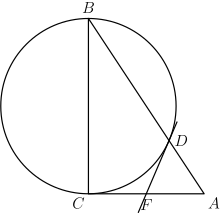
Let of right triangle be the diameter of a circle intersecting hypotenuse in At a tangent is drawn cutting leg in This information is not sufficient to prove that:
biseca
bisects
biseca
bisects
Pista pequeña:
Usa las coordenadas
Use coordinates
Pista grande:
La tangente corta en su punto medio; comprueba la afirmación sobre la bisectriz con el teorema de la bisectriz
The tangent meets at its midpoint; test the angle-bisector claim with the angle-bisector theorem
Solución:
Toma y La segunda intersección de con el círculo de diámetro es La tangente en corta en Por tanto, biseca además, por la igualdad de los segmentos tangentes desde lo que proporciona las opciones C y E, y los ángulos del círculo y del triángulo rectángulo proporcionan la opción D.
Si bisecara el teorema de la bisectriz en el triángulo exigiría El lado izquierdo es mientras que que no tiene por qué ser Por tanto, la opción B no puede demostrarse.
Por lo tanto, la respuesta correcta es B.
Put and The second intersection of with the circle of diameter is The tangent at meets at Hence bisects also by equal tangents from which supplies choices C and E, and the circle/right-triangle angles supply choice D.
If bisected the angle-bisector theorem in triangle would require The left side is while which need not be Thus choice B is not provable.
Therefore, the correct answer is B.
31.
El número de valores reales de que satisfacen la igualdad donde y son constantes positivas distintas de es:
The number of real values of satisfying the equality where and are positive constants different from is:
un entero mayor que
an integer greater than
no finito
not finite
Pista pequeña:
Escribe cada logaritmo con logaritmos naturales
Write every logarithm with natural logs
Pista grande:
La ecuación se reduce a
The equation reduces to
Solución:
El cambio de base da Como los denominadores no son cero, Así, o Estos valores son distintos porque por lo que hay dos valores.
Por lo tanto, la respuesta correcta es C.
Change of base gives Since the denominators are nonzero, Thus or These are distinct because so there are two values.
Therefore, the correct answer is C.
32.
Un artículo que cuesta dólares se vende por con una pérdida del por ciento del precio de venta. Luego se revende con una ganancia del por ciento del nuevo precio de venta Si la diferencia entre y es dólares, entonces es:
An article costing dollars is sold for at a loss of percent of the selling price. It is then resold at a profit of percent of the new selling price If the difference between and is dollars, then is:
indeterminado
undetermined
Pista pequeña:
La primera pérdida da
The first loss makes
Pista grande:
La condición de reventa da
The resale condition gives
Solución:
Una pérdida del del precio de venta de significa que En la reventa, por lo que Por tanto, Así, cuya raíz positiva es
Por lo tanto, la respuesta correcta es C.
A loss of of the selling price means On resale, so Therefore Thus whose positive root is
Therefore, the correct answer is C.
33.
Si el número es decir, termina en ceros cuando se expresa en base y en ceros cuando se expresa en base entonces es igual a:
If the number that is, ends with zeros when given to the base and ends with zeros when given to the base then equals:
Pista pequeña:
Cuenta las potencias de y en
Count the powers of and in
Pista grande:
Un cero en base usa , mientras que un cero en base usa
A base- zero uses , while a base- zero uses
Solución:
Las valuaciones primas son Por tanto, en base y en base Así,
Por lo tanto, la respuesta correcta es D.
The prime valuations are Hence in base and in base Thus
Therefore, the correct answer is D.
34.
Para el menor valor de es:
For the smallest value of is:
Pista pequeña:
Toma
Set
Pista grande:
Reescribe la expresión como
Rewrite the expression as
Solución:
Sea Como la expresión es Por la desigualdad media aritmética-media geométrica, esto es al menos con igualdad en que está permitido.
Por lo tanto, la respuesta correcta es B.
Let Since the expression is By AM-GM this is at least with equality at which is allowed.
Therefore, the correct answer is B.
35.
Un rectángulo mide pulgadas de largo y menos de pulgadas de ancho. Se dobla de modo que dos vértices opuestos coincidan. Si la longitud del pliegue es entonces el ancho es:
The length of a rectangle is inches and its width is less than inches. The rectangle is folded so that two diagonally opposite vertices coincide. If the length of the crease is then the width is:
Pista pequeña:
El pliegue es la mediatriz de una diagonal del rectángulo
The crease is the perpendicular bisector of a rectangle diagonal
Pista grande:
Si el ancho es sus intersecciones con los lados largos difieren horizontalmente en
If the width is its intersections with the long sides differ horizontally by
Solución:
Coloca el rectángulo en y El pliegue que lleva a es Como corta los dos lados horizontales. Entre esas intersecciones, el cambio vertical es y el horizontal es Así, Tomando se obtiene de modo que y
Por lo tanto, la respuesta correcta es D.
Place the rectangle at and The crease sending to is Because it meets the two horizontal sides. Between those intersections the vertical change is and the horizontal change is Thus Setting gives so and
Therefore, the correct answer is D.
36.
Sean y dos rectas distintas. Desde un punto de se traza una perpendicular a desde el pie de esta perpendicular se traza una recta perpendicular a Desde el pie de esta segunda perpendicular se traza otra perpendicular a y así sucesivamente de manera indefinida. Las longitudes de la primera y la segunda perpendicular son y respectivamente. La suma de las longitudes de las perpendiculares se aproxima a un límite cuando su número crece sin cota. Este límite es:
Given distinct straight lines and From a point in a perpendicular is drawn to from the foot of this perpendicular a line is drawn perpendicular to From the foot of this second perpendicular a line is drawn perpendicular to and so on indefinitely. The lengths of the first and second perpendiculars are and respectively. Then the sum of the lengths of the perpendiculars approaches a limit as the number of perpendiculars grows beyond all bounds. This limit is:
Pista pequeña:
Los triángulos rectángulos sucesivos formados por las dos rectas fijas son semejantes
Successive right triangles formed by the two fixed lines are similar
Pista grande:
Las longitudes de las perpendiculares forman una sucesión geométrica de primer término y razón
The perpendicular lengths form a geometric sequence with first term and ratio
Solución:
Cada nuevo triángulo rectángulo tiene el mismo ángulo agudo, así que las longitudes de las perpendiculares forman una sucesión geométrica. Como las dos primeras longitudes son la razón común es La convergencia implica y la suma es
Por lo tanto, la respuesta correcta es E.
Each new right triangle has the same acute angle, so the perpendicular lengths form a geometric sequence. Since the first two lengths are the common ratio is Convergence implies and the sum is
Therefore, the correct answer is E.
37.
Se elige el punto sobre el lado del triángulo de modo que y el punto sobre el lado de modo que El punto de intersección de y es Entonces
es:
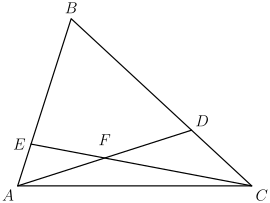
Point is selected on side of triangle in such a way that and point is selected on side so that The point of intersection of and is Then
is:
Pista pequeña:
Asigna las masas y
Assign masses and
Pista grande:
Usa las masas combinadas en y para obtener las dos razones sobre las cevianas
Use the combined masses at and to read the two cevian ratios
Solución:
Las razones de los lados se representan con masas y Entonces y Sobre mientras que sobre Su suma es
Por lo tanto, la respuesta correcta es C.
The side ratios are represented by masses and Then and Along while along Their sum is
Therefore, the correct answer is C.
38.
tarda veces lo que tardan y juntos en realizar un trabajo; tarda veces lo que tardan y juntos; y tarda veces lo que tardan y juntos. Entonces en función de y es:
takes times as long to do a piece of work as and together; takes times as long as and together; and takes times as long as and together. Then in terms of and is:
Pista pequeña:
Sean y las tasas de trabajo de y
Let the work rates of and be and
Pista grande:
Expresa las dos primeras condiciones como y
Translate the first two conditions as and
Solución:
Sean y las tasas de trabajo. Las relaciones de tiempo dan De las dos primeras, y Por tanto,
Por lo tanto, la respuesta correcta es E.
Let the work rates be and The time statements give From the first two, and Hence
Therefore, the correct answer is E.
39.
Un capataz observó a un inspector comprobando un orificio de pulgadas con un tapón de pulgadas y otro de pulgada, y sugirió insertar dos calibradores más para asegurar un ajuste ceñido. Si los nuevos calibradores son iguales, el diámetro de cada uno, redondeado a la centésima de pulgada, es:
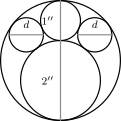
A foreman noticed an inspector checking a -inch hole with a -inch plug and a -inch plug and suggested that two more gauges be inserted to be sure that the fit was snug. If the new gauges are alike, then the diameter of each, to the nearest hundredth of an inch, is:
Pista pequeña:
Usa los radios y y sea el radio de un nuevo calibrador
Use radii and and let a new gauge have radius
Pista grande:
Si su centro es , resta sus tres ecuaciones de distancia por tangencia
If its center is , subtract its three tangency-distance equations
Solución:
Coloca el centro del orificio en el origen. Los centros de los tapones de y pulgadas son y Sea el radio de un nuevo calibrador y su centro. La tangencia con los dos tapones da mientras que la tangencia interna con el orificio da Al restar pares de ecuaciones se obtiene y Así, de modo que
Por lo tanto, la respuesta correcta es B.
Place the hole’s center at the origin. The -inch and -inch plug centers are and Let a new gauge have radius and center Tangency to the two plugs gives while internal tangency to the hole gives Subtracting pairs of equations yields and Thus so
Therefore, the correct answer is B.
40.
Sea el número de valores enteros de tales que es el cuadrado de un entero. Entonces es:
Let be the number of integer values of such that is the square of an integer. Then is:
Pista pequeña:
Reescribe
Rewrite
Pista grande:
Dos cuadrados enteros distintos y difieren al menos en
Distinct integer squares and differ by at least
Solución:
Sea Entonces Para así que un valor funciona.
Si y entonces Dos cuadrados enteros distintos, uno de ellos , difieren al menos en que ya es mayor que una contradicción. Si la cota análoga solo puede cumplirse para La sustitución directa de estos nueve enteros no da ningún cuadrado. Por tanto, es la única solución y
Por lo tanto, la respuesta correcta es D.
Let Then At so one value works.
If and then Distinct integer squares differing from differ by at least which is already greater than a contradiction. If the analogous bound can hold only for Direct substitution for these nine integers gives no square. Hence is the unique solution and
Therefore, the correct answer is D.