
Soluciones del 2010 AMC 10A
Desplázate hacia abajo para ver las soluciones preparadas profesionalmente de LIVE by Po-Shen Loh, imprime las soluciones en PDF, consulta la clave de respuestas, o haz el examen cronometrado completo.
Todos los problemas se usan con el permiso legal oficial de la Mathematical Association of America (MAA).
1.
El estante superior de Mary tiene cinco libros con los siguientes anchos, en centímetros: y
¿Cuál es el ancho promedio de los libros, en centímetros?
Mary’s top book shelf holds five books with the following widths, in centimeters: and
What is the average book width, in centimeters?
Pista pequeña:
Suma los anchos antes de dividir entre el número de libros.
Add the widths before dividing by the number of books
Pista grande:
Calcula .
Compute
Solución:
Al sumar los cinco anchos se obtiene El promedio es
Por lo tanto, D es la respuesta correcta.
Adding the five widths gives The average is
Thus, D is the correct answer.
2.
Cuatro cuadrados idénticos y un rectángulo se colocan juntos para formar un cuadrado grande, como se muestra. ¿Cuántas veces mayor es el largo del rectángulo que su ancho?

Four identical squares and one rectangle are placed together to form one large square as shown. The length of the rectangle is how many times as large as its width?
Pista pequeña:
Sea la longitud del lado de cada cuadrado pequeño.
Let each small square have side length
Pista grande:
El rectángulo mide de largo y es un cuadrado pequeño más corto que el cuadrado grande.
The rectangle is long and one small square shorter than the large square
Solución:
Sin pérdida de generalidad, supongamos que los lados de los cuadrados miden
Esto significa que el largo del rectángulo es También tenemos que el ancho debe ser
La razón buscada es entonces
Por lo tanto, B es la respuesta correcta.
WLOG, let the side lengths of the squares be
This means that the length of the rectangle is We also have that the width must be
The desired ratio is then
Thus, B is the correct answer.
3.
Tyrone tenía canicas y Eric tenía canicas. Luego Tyrone le dio a Eric algunas de sus canicas de modo que Tyrone terminó con el doble de canicas que Eric. ¿Cuántas canicas le dio Tyrone a Eric?
Tyrone had marbles and Eric had marbles. Tyrone then gave some of his marbles to Eric so that Tyrone ended with twice as many marbles as Eric. How many marbles did Tyrone give to Eric?
Pista pequeña:
El número total de canicas permanece fijo.
The total number of marbles stays fixed
Pista grande:
Las cantidades finales están en la razón .
The final amounts are in the ratio
Solución:
Sea el número de canicas con las que termina Eric. Entonces Tyrone termina con
El número total de canicas es así que
Entonces Tyrone termina con canicas. Esto significa que debe regalar canicas.
Por lo tanto, D es la respuesta correcta.
Let be the number of marbles that Eric ends up with. Then Tyrone ends up with
The total number of marbles is so
Then, Tyrone ends up with marbles. This means he has to give away marbles.
Thus, D is the correct answer.
4.
Un libro que se va a grabar en discos compactos tarda minutos en leerse en voz alta. Cada disco puede contener hasta minutos de lectura. Supón que se usa el menor número posible de discos y que cada disco contiene la misma duración de lectura. ¿Cuántos minutos de lectura contendrá cada disco?
A book that is to be recorded onto compact discs takes minutes to read aloud. Each disc can hold up to minutes of reading. Assume that the smallest possible number of discs is used and that each disc contains the same length of reading. How many minutes of reading will each disc contain?
Pista pequeña:
Determina el número mínimo de discos antes de promediar.
Determine the minimum number of discs before averaging
Pista grande:
discos contienen muy poco, mientras que discos son suficientes.
discs hold too little, while discs suffice
Solución:
Nota que y lo que significa que el número mínimo de discos necesarios es
Entonces los minutos de lectura que contiene cada disco son
Por lo tanto, B es la respuesta correcta.
Note that and which means that the minimum number of discs needed is
Then the minutes of reading that each disc contains is
Thus, B is the correct answer.
5.
El área de un círculo cuya circunferencia es es ¿Cuál es el valor de ?
The area of a circle whose circumference is is What is the value of
Pista pequeña:
Usa la circunferencia para hallar primero el radio.
Use the circumference to find the radius first
Pista grande:
A partir de , el buscado es .
From , the desired is
Solución:
Recuerda que la fórmula para la circunferencia de un círculo es Entonces tenemos que
El área de un círculo es así que tenemos
Por lo tanto, E es la respuesta correcta.
Recall that the formula for the circumference of a circle is We then have that
The area of a circle is so we have that
Thus, E is the correct answer.
6.
Para números positivos y , la operación se define como ¿Cuánto vale ?
For positive numbers and the operation is defined as What is
Pista pequeña:
Evalúa primero la expresión interior con .
Evaluate the inner expression first
Pista grande:
, luego usa eso como segundo dato de entrada.
, then use that as the second input
Solución:
Al evaluar la expresión interior, obtenemos Entonces tenemos
Por lo tanto, C es la respuesta correcta.
Evaluating the inner expression, we get Then we have
Thus, C is the correct answer.
7.
Crystal tiene marcada una ruta para su carrera diaria. Comienza esta carrera dirigiéndose hacia el norte por una milla. Luego corre hacia el noreste por una milla, y después hacia el sureste por una milla. La última parte de su carrera la lleva en línea recta de regreso al punto donde comenzó. ¿Qué distancia, en millas, tiene esta última parte de su carrera?
Crystal has a running course marked out for her daily run. She starts this run by heading due north for one mile. She then runs northeast for one mile, then southeast for one mile. The last portion of her run takes her on a straight line back to where she started. How far, in miles, is this last portion of her run?
Pista pequeña:
Las componentes verticales del noreste y del sureste se cancelan.
The northeast and southeast vertical components cancel
Pista grande:
El desplazamiento neto tiene componente norte y componente este .
The net displacement has north component and east component
Solución:
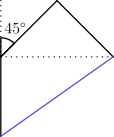
A partir del diagrama, vemos que la distancia recorrida es la hipotenusa de un triángulo rectángulo.
Uno de los catetos es simplemente por correr hacia el norte. El otro cateto es
La distancia final es entonces
Por lo tanto, C es la respuesta correcta.
From the diagram, we see that the distance traveled is the hypotenuse of a right triangle.
One of the legs is just from running due north. The other leg is
The final distance is then
Thus, C is the correct answer.
8.
Tony trabaja horas al día y le pagan por hora por cada año completo de su edad. Durante un período de seis meses Tony trabajó días y ganó ¿Cuántos años tenía Tony al final del período de seis meses?
Tony works hours a day and is paid per hour for each full year of his age. During a six month period Tony worked days and earned How old was Tony at the end of the six month period?
Pista pequeña:
Calcula el total de horas trabajadas y el pago promedio por hora.
Compute the total hours worked and average hourly pay
Pista grande:
Divide el pago promedio por hora entre para obtener la edad promedio.
Divide the average hourly pay by to get the average age
Solución:
Tony trabajó horas, así que su pago medio por hora fue Como su pago por hora es multiplicado por su edad en años cumplidos, su edad media durante los días trabajados fue años. En seis meses su edad puede cambiar como máximo una vez, así que trabajó algunos días con años y otros con Por tanto, tenía años al final del período.
Por lo tanto, D es la respuesta correcta.
Tony worked hours, so his average hourly pay was Because his hourly pay is times his age in full years, his average age on the days he worked was years. During a six-month period his age can change by at most one, so he must have worked some days at age and some at age Thus he was at the end of the period.
Thus, D is the correct answer.
9.
Un palíndromo, como es un número que permanece igual cuando se invierten sus dígitos. Los números y son palíndromos de tres y cuatro dígitos, respectivamente. ¿Cuál es la suma de los dígitos de ?
A palindrome, such as is a number that remains the same when its digits are reversed. The numbers and are three-digit and four-digit palindromes, respectively. What is the sum of the digits of
Pista pequeña:
Acota el palíndromo de cuatro dígitos entre y .
Bound the four-digit palindrome between and
Pista grande:
Encuentra el único palíndromo en ese intervalo, luego resta .
Find the only palindrome in that interval, then subtract
Solución:
Nota que es a lo sumo Esto significa que tiene un máximo de
De manera similar, tenemos que el valor mínimo de es
El único palíndromo en este rango es así que a eso equivale .
Entonces
La suma de los dígitos es entonces
Por lo tanto, E es la respuesta correcta.
Note that is at most This means that has a maximum of
Similarly, we have that the minimum value of is
The only palindrome in this range is so this is what equals.
Then
The sum of the digits is then
Thus, E is the correct answer.
10.
Marvin cumplió años un martes, de mayo, en el año bisiesto ¿En qué año caerá su cumpleaños por primera vez en sábado?
Marvin had a birthday on Tuesday, May in the leap year In what year will his birthday next fall on a Saturday?
Pista pequeña:
Cada año no bisiesto adelanta el día de la semana en .
Each non-leap year shifts the weekday forward by
Pista grande:
Como el de mayo es posterior al día bisiesto, los años bisiestos lo adelantan en .
Since May is after leap day, leap years shift it forward by
Solución:
En un año normal, así que una fecha dada avanza un día de la semana al año siguiente.
En un año bisiesto, el día de la semana se mueve dos hacia adelante ya que hay un día extra.
Entonces en este día cae en miércoles. En cae en jueves.
De manera similar, en cae en viernes. Sin embargo, en como es un año bisiesto, cae en domingo.
Ahora, durante los siguientes tres años, el día avanza uno. Entonces en avanza dos, cayendo en viernes.
Finalmente, en el día de la semana es sábado.
Por lo tanto, E es la respuesta correcta.
Note that on a normal year, we have that which means that for a specific day, it moves to the day after the next year.
On a leap year, the day of the week moves forward two since there is an extra day.
Then in this day falls on a Wednesday. In it falls on a Thursday.
Similarly, in it falls on a Friday. In however, since it is a leap year, it falls on a Sunday.
Now, for the next three years, the day moves forward one. Then in it moves forward two, landing on a Friday.
Finally, in the day of the week is a Saturday.
Thus, E is the correct answer.
11.
La longitud del intervalo de soluciones de la desigualdad es ¿Cuánto vale ?
The length of the interval of solutions of the inequality is What is
Pista pequeña:
Resuelve la desigualdad para los dos extremos de .
Solve the inequality for the two endpoints of
Pista grande:
La longitud del intervalo es .
The interval length is
Solución:
Al dividir la desigualdad en dos y resolver obtenemos y
Por lo tanto, la longitud del intervalo de soluciones satisface que al simplificar da
Por lo tanto, D es la respuesta correcta.
Splitting the inequality into two of them and solving gives us and
The range of the solutions is then which then simplifying gives us
Thus, D is the correct answer.
12.
Logan está construyendo un modelo a escala de su pueblo. La torre de agua de la ciudad mide metros de alto, y la parte superior es una esfera que contiene litros de agua. La torre de agua en miniatura de Logan contiene litros. ¿Qué altura, en metros, debe darle Logan a su torre?
Logan is constructing a scaled model of his town. The city’s water tower stands meters high, and the top portion is a sphere that holds liters of water. Logan’s miniature water tower holds liters. How tall, in meters, should Logan make his tower?
Pista pequeña:
La escala de volumen es el cubo de la escala de longitud.
Volume scale is the cube of length scale
Pista grande:
Compara litros con litros, luego toma una raíz cúbica.
Compare liters to liters, then take a cube root
Solución:
La torre real contiene veces más agua que la torre en miniatura. Como esta es una razón de volúmenes, la razón de las alturas es Por lo tanto, la altura de la torre en miniatura, en metros, es
Por lo tanto, C es la respuesta correcta.
The miniature tower holds times less water than the actual tower. Since this is the ratio for volumes, the ratio of heights is This means that the height of the miniature tower is
Thus, C is the correct answer.
13.
Angelina condujo a una velocidad promedio de km/h y luego se detuvo minutos para cargar gasolina. Después de la parada, condujo a una velocidad promedio de km/h. En total condujo km en un tiempo total de viaje de horas incluyendo la parada. ¿Cuál ecuación podría usarse para hallar el tiempo en horas que condujo antes de su parada?
Angelina drove at an average rate of kph and then stopped minutes for gas. After the stop, she drove at an average rate of kph. Altogether she drove km in a total trip time of hours including the stop. Which equation could be used to solve for the time in hours that she drove before her stop?
Pista pequeña:
Resta la parada de minutos del tiempo total.
Subtract the -minute stop from the total time
Pista grande:
Después de la parada, ella conduce durante horas.
After the stop, she drives for hours
Solución:
Antes de la parada, Angelina condujo km.
La parada dura de hora, así que su tiempo total de conducción es horas; después de la parada, conduce durante horas, recorriendo km.
La ecuación de la distancia total es
Por lo tanto, A es la respuesta correcta.
Before the stop, Angelina drove km.
The stop takes of an hour, so her total driving time is hours. After the stop, she drives for hours, covering km.
The total distance equation is
Thus, A is the correct answer.
14.
El triángulo tiene Sean y puntos en y respectivamente, tales que Sea la intersección de los segmentos y y supón que es equilátero. ¿Cuánto vale ?
Triangle has Let and be on and respectively, such that Let be the intersection of segments and and suppose that is equilateral. What is
Pista pequeña:
Sea .
Let
Pista grande:
Usa para hallar y luego sigue las relaciones entre los ángulos para obtener .
Use to find , then angle-chase
Solución:
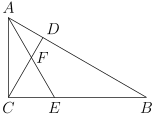
Sea Nota que ya que es equilátero.
Entonces tenemos que
Luego:
De esto obtenemos
Como y tenemos que es un triángulo .
Por lo tanto, C es la respuesta correcta.
Let Note that since is equilateral.
We then have that
Then:
We then get that
Since and we have that is a triangle.
Thus, C is the correct answer.
15.
En un pantano mágico hay dos especies de anfibios parlantes: los sapos, cuyas afirmaciones siempre son verdaderas, y las ranas, cuyas afirmaciones siempre son falsas. Cuatro anfibios, Brian, Chris, LeRoy y Mike, viven juntos en este pantano y hacen las siguientes afirmaciones.
Brian: “Mike y yo somos de especies diferentes.”
Chris: “LeRoy es una rana.”
LeRoy: “Chris es una rana.”
Mike: “De los cuatro, al menos dos somos sapos.”
¿Cuántos de estos cuatro anfibios son ranas?
In a magical swamp there are two species of talking amphibians: toads, whose statements are always true, and frogs, whose statements are always false. Four amphibians, Brian, Chris, LeRoy, and Mike live together in this swamp, and they make the following statements.
Brian: “Mike and I are different species.”
Chris: “LeRoy is a frog.”
LeRoy: “Chris is a frog.”
Mike: “Of the four of us, at least two are toads.”
How many of these four amphibians are frogs?
Pista pequeña:
Chris y LeRoy no pueden ser de la misma especie.
Chris and LeRoy cannot have the same species
Pista grande:
Si Brian fuera un sapo, la afirmación de Mike generaría una contradicción.
If Brian were a toad, Mike’s statement would create a contradiction
Solución:
Chris y LeRoy no pueden ser ambos ranas, porque entonces las dos afirmaciones serían verdaderas. Tampoco pueden ser ambos sapos, porque entonces las dos afirmaciones serían falsas. Por lo tanto, exactamente uno de ellos es un sapo.
Si Brian fuera un sapo, su afirmación haría que Mike fuera una rana. Brian y el sapo entre Chris y LeRoy harían entonces verdadera la afirmación de Mike, lo cual es imposible para una rana. Por lo tanto, Brian es una rana. Su afirmación es falsa, así que Mike también es una rana. Junto con la rana entre Chris y LeRoy, hay ranas.
Por lo tanto, D es la respuesta correcta.
Chris and LeRoy cannot both be frogs, because then both of their statements would be true. They cannot both be toads either, because then both statements would be false. Thus exactly one of them is a toad.
If Brian were a toad, his statement would make Mike a frog. Brian and the one toad among Chris and LeRoy would then make Mike’s statement true, which is impossible for a frog. Therefore Brian is a frog. His statement is false, so Mike is also a frog. Along with the one frog among Chris and LeRoy, there are frogs.
Thus, D is the correct answer.
16.
El triángulo no degenerado tiene longitudes de lado enteras, es una bisectriz de ángulo, y ¿Cuál es el menor valor posible del perímetro?
Nondegenerate has integer side lengths, is an angle bisector, and What is the smallest possible value of the perimeter?
Pista pequeña:
Usa el Teorema de la Bisectriz.
Use the Angle Bisector Theorem
Pista grande:
, y .
, and
Solución:
Usando el Teorema de la Bisectriz, tenemos que
Para que y sean enteros, debemos tener que sea múltiplo de
Para minimizar el perímetro, podemos poner y Sin embargo, esto hace que el triángulo sea degenerado.
Entonces debe ser y Como el perímetro es
Por lo tanto, B es la respuesta correcta.
Using the Angle Bisector Theorem, we have that
For and to be integers, we must have that is a multiple of
To minimize the perimeter, we can set and This, however, makes the triangle degenerate.
must then be and Since the perimeter is
Thus, B is the correct answer.
17.
Un cubo sólido tiene longitud de lado pulgadas. Se corta un agujero cuadrado de pulgadas por pulgadas en el centro de cada cara. Los bordes de cada corte son paralelos a los bordes del cubo, y cada agujero atraviesa por completo el cubo. ¿Cuál es el volumen, en pulgadas cúbicas, del sólido restante?
A solid cube has side length inches. A -inch by -inch square hole is cut into the center of each face. The edges of each cut are parallel to the edges of the cube, and each hole goes all the way through the cube. What is the volume, in cubic inches, of the remaining solid?
Pista pequeña:
Usa inclusión-exclusión para los tres agujeros rectangulares.
Use inclusion-exclusion for the three rectangular holes
Pista grande:
Los tres agujeros se superponen en el cubo central .
The three holes overlap in the central cube
Solución:
Nota que todos los sólidos extraídos se intersecan en el centro del cubo.
Esta región de intersección es un cubo con longitud de lado Entonces el volumen de la región extraída es
Tenemos que restar la región central dos veces ya que está incluida en las regiones.
El volumen restante es entonces
Por lo tanto, A es la respuesta correcta.
Note that all the cut out solids intersect in the middle of the cube.
This region of intersection is a cube with side length Then the volume of the cutout region is
We have to subtract out the center region twice since it is included in all regions.
The remaining volume is then
Thus, A is the correct answer.
18.
Bernardo elige al azar números distintos del conjunto y los ordena de mayor a menor para formar un número de cifras. Silvia elige al azar números distintos del conjunto y también los ordena de mayor a menor para formar un número de cifras. ¿Cuál es la probabilidad de que el número de Bernardo sea mayor que el número de Silvia?
Bernardo randomly picks distinct numbers from the set and arranges them in descending order to form a -digit number. Silvia randomly picks distinct numbers from the set and also arranges them in descending order to form a -digit number. What is the probability that Bernardo’s number is larger than Silvia’s number?
Pista pequeña:
Separa en casos según si Bernardo elige .
Separate cases according to whether Bernardo picks
Pista grande:
Sin un , los dos números son simétricos excepto cuando los conjuntos elegidos coinciden.
Without a , the two numbers are symmetric except when the chosen sets match
Solución:
Hay dos casos: Bernardo elige un o no lo hace.
Caso Bernardo elige un
Como un número está fijo, hay maneras de elegir los otros dos números.
Hay un total de maneras de elegir los tres números. La probabilidad es entonces
Nota que si Bernardo elige un automáticamente tiene un número mayor que Silvia.
Esto significa que Bernardo siempre gana en este caso.
Caso Bernardo no elige un
Hay una probabilidad de de que esto ocurra. Como ambas personas eligen de los mismos números, tienen la misma probabilidad de ganar.
Todavía necesitamos encontrar la probabilidad de que los números sean iguales. La probabilidad de que Silvia elija los mismos números que Bernardo es Por lo tanto, la probabilidad de que Bernardo obtenga un número mayor es
La probabilidad total de que Bernardo obtenga un número mayor es entonces
Por lo tanto, B es la respuesta correcta.
There are two cases: Bernardo picks a or he doesn’t.
Case Bernardo picks a
Since a number is fixed, there are ways to choose the other two numbers.
There are a total of ways to pick all three numbers. The probability is then
Note that if Bernardo picks a he automatically has a greater number than Silvia.
This means that Bernardo always wins in this case.
Case Bernardo doesn’t pick a
There is a chance of this happening. Since both people are choosing from the same numbers, they have an equal chance of winning.
We still need to find the probability that the numbers are the same. There is a chance that Silvia chooses the same numbers as Bernardo. The probability that Bernardo gets a higher number is then
The total probability of Bernardo getting a higher number is then
Thus, B is the correct answer.
19.
El hexágono equiangular tiene longitudes de lado y El área de es el del área del hexágono. ¿Cuál es la suma de todos los valores posibles de ?
Equiangular hexagon has side lengths and The area of is of the area of the hexagon. What is the sum of all possible values of
Pista pequeña:
Divide el hexágono en y tres triángulos en las esquinas.
Split the hexagon into and three corner triangles
Pista grande:
Expresa ambas áreas usando y .
Express both areas using and
Solución:
Nota que es equilátero. Usando la Ley de Cosenos en obtenemos
El área de es entonces
Los tres triángulos de las esquinas y tienen cada uno área
Así, el hexágono tiene área
La condición da así que
Por las fórmulas de Vieta, la suma de los valores posibles de es
Por lo tanto, E es la respuesta correcta.
Note that is equilateral. Using the Law of Cosines in we get
The area of is then
The three corner triangles and each have area
Thus the hexagon has area
The condition gives so
By Vieta’s formulas, the sum of the possible values of is
Thus, E is the correct answer.
20.
Una mosca atrapada dentro de una caja cúbica con longitud de lado metro decide aliviar su aburrimiento visitando cada esquina de la caja. Comenzará y terminará en la misma esquina y visitará cada una de las otras esquinas exactamente una vez. Para ir de una esquina a cualquier otra, volará o se arrastrará en línea recta. ¿Cuál es la longitud máxima posible, en metros, de su trayecto?
A fly trapped inside a cubical box with side length meter decides to relieve its boredom by visiting each corner of the box. It will begin and end in the same corner and visit each of the other corners exactly once. To get from a corner to any other corner, it will either fly or crawl in a straight line. What is the maximum possible length, in meters, of its path?
Pista pequeña:
Cada movimiento tiene longitud o .
Each move has length or
Pista grande:
Solo hay diagonales espaciales, así que los movimientos restantes son a lo sumo diagonales de cara.
There are only space diagonals, so the remaining moves are at most face diagonals
Solución:
Nota que todos los trayectos que la mosca puede tomar tienen longitudes de o
Solo hay diagonales espaciales en el cubo, así que a lo sumo movimientos pueden tener longitud Los otros movimientos tienen longitud a lo sumo
Esta cota superior se puede alcanzar, por ejemplo alternando diagonales espaciales y diagonales de cara alrededor de los vértices.
El trayecto tiene longitud
Por lo tanto, D es la respuesta correcta.
Note that all the paths the fly can take have lengths of or
There are only space diagonals in the cube, so at most moves can have length The other moves have length at most
This upper bound is attainable, for example by alternating space diagonals and face diagonals around the vertices.
The path has length
Thus, D is the correct answer.
21.
El polinomio tiene tres ceros enteros positivos. ¿Cuál es el menor valor posible de ?
The polynomial has three positive integer zeros. What is the smallest possible value of
Pista pequeña:
Las raíces se multiplican para dar y suman .
The roots multiply to and sum to
Pista grande:
Pon solo, luego divide en dos factores con la menor suma.
Put alone, then split into two factors with smallest sum
Solución:
Sean las raíces enteros positivos Por las fórmulas de Vieta, y
Como una raíz debe ser divisible por Si esa raíz es mayor que entonces es al menos lo cual ya es peor que la construcción de abajo.
Así que toma y minimiza con El par de factores con menor suma es y así que
Por lo tanto, A es la respuesta correcta.
Let the roots be positive integers By Vieta’s formulas, and
Since one root must be divisible by If that root is larger than then it is at least which is already worse than the construction below.
Thus take and minimize with The factor pair with smallest sum is and so
Thus, A is the correct answer.
22.
Se eligen ocho puntos en un círculo, y se trazan cuerdas conectando cada par de puntos. No hay tres cuerdas que se intersequen en un solo punto dentro del círculo. ¿Cuántos triángulos con los tres vértices en el interior del círculo se forman?
Eight points are chosen on a circle, and chords are drawn connecting every pair of points. No three chords intersect in a single point inside the circle. How many triangles with all three vertices in the interior of the circle are created?
Pista pequeña:
Elige los seis puntos del círculo que se usan como extremos de las tres cuerdas.
Choose the six circle points used as endpoints of the three chords
Pista grande:
Para seis puntos en orden, solo las tres cuerdas de pares opuestos forman el triángulo interior.
For six points in order, only the three opposite-pair chords make the interior triangle
Solución:
Un triángulo interior se forma por tres cuerdas que se intersecan por pares dentro del círculo. Tal triángulo usa seis extremos distintos en el círculo.
Recíprocamente, para cualesquiera seis puntos elegidos en orden circular, exactamente un conjunto de tres cuerdas empareja extremos opuestos de modo que las tres cuerdas se intersecan por pares dentro del círculo.
Por lo tanto, el número de triángulos es
Por lo tanto, A es la respuesta correcta.
An interior triangle is formed by three chords that pairwise intersect inside the circle. Such a triangle uses six distinct endpoints on the circle.
Conversely, for any six chosen points in circular order, exactly one set of three chords pairs opposite endpoints so that the three chords intersect pairwise inside the circle.
Therefore the number of triangles is
Thus, A is the correct answer.
23.
Cada una de cajas en una fila contiene una sola canica roja, y para la caja en la -ésima posición también contiene canicas blancas. Isabella comienza en la primera caja y sucesivamente extrae una sola canica al azar de cada caja, en orden. Se detiene cuando extrae por primera vez una canica roja. Sea la probabilidad de que Isabella se detenga después de extraer exactamente canicas. ¿Cuál es el menor valor de para el cual ?
Each of boxes in a line contains a single red marble, and for the box in the th position also contains white marbles. Isabella begins at the first box and successively draws a single marble at random from each box, in order. She stops when she first draws a red marble. Let be the probability that Isabella stops after drawing exactly marbles. What is the smallest value of for which
Pista pequeña:
Las primeras extracciones deben ser blancas, luego la -ésima extracción roja.
The first draws must be white, then the th draw red
Pista grande:
Las probabilidades de blanco se telescopan: .
The white probabilities telescope:
Solución:
Como hay canicas en la -ésima caja, hay una probabilidad de de que Isabella extraiga una canica blanca de ella.
La probabilidad de extraer una canica roja es entonces Para detenerse después de extraer la -ésima canica, las primeras canicas deben haber sido blancas.
Esto ocurre con una probabilidad de
Nota que todos los numeradores se cancelan con el denominador adyacente, lo que significa que esta expresión se reduce a
Tenemos que encontrar el menor tal que
Probando y verificando obtenemos que el menor que funciona es
Por lo tanto, A es la respuesta correcta.
Since there are marbles in the th box, there is a chance Isabella draws a white marble from it.
The probability of drawing a red marble is then To stop after drawing the th marble, the first marbles must have been white.
This happens with a probability of
Note that all the numerators cancel with the adjacent denominator, which means that this expression reduces to
We have to find the smallest such that
Guessing and checking gives us that the smallest that works is
Thus, A is the correct answer.
24.
El número obtenido a partir de los últimos dos dígitos distintos de cero de es igual a ¿Cuánto vale ?
The number obtained from the last two nonzero digits of is equal to What is
Pista pequeña:
Elimina los factores que producen los ceros finales, luego trabaja módulo .
Remove the factors making trailing zeroes, then work modulo
Pista grande:
Usa congruencias módulo y módulo para determinar los dos últimos dígitos.
Use congruences modulo and modulo to pin down the last two digits
Solución:
El número de ceros finales en es Sea
Todavía quedan más de dos factores de después de eliminar así que
Sea el producto de los factores de no divisibles entre y sea el producto de los factores divisibles entre Agrupando los residuos módulo se obtiene y
Por lo tanto Como
El número congruente con y es así que los últimos dos dígitos distintos de cero forman
Por lo tanto, A es la respuesta correcta.
The number of trailing zeroes in is Let
There are still more than two factors of left after removing so
Let be the product of factors of not divisible by and let be the product of the factors divisible by Grouping residues modulo gives and
Therefore Since
The number congruent to and is so the last two nonzero digits form
Thus, A is the correct answer.
25.
Jim comienza con un entero positivo y crea una sucesión de números. Cada número sucesivo se obtiene restando el mayor cuadrado entero posible menor o igual al número actual, hasta llegar a cero. Por ejemplo, si Jim comienza con entonces su sucesión contiene números: Sea el menor número para el cual la sucesión de Jim tiene números. ¿Cuál es el dígito de las unidades de ?
Jim starts with a positive integer and creates a sequence of numbers. Each successive number is obtained by subtracting the largest possible integer square less than or equal to the current number until zero is reached. For example, if Jim starts with then his sequence contains numbers: Let be the smallest number for which Jim’s sequence has numbers. What is the units digit of
Pista pequeña:
Construye la menor sucesión posible hacia atrás a partir de .
Build the smallest possible sequence backwards from
Pista grande:
En cada paso inverso, suma el menor cuadrado que la regla voraz restaría.
At each reverse step, add the smallest square that the greedy rule would subtract
Solución:
Podemos trabajar hacia atrás empezando con A partir de esto, podemos sumar para obtener
Podemos sumar de nuevo para obtener Otra vez, sumar nos da
Si sumamos ahora, obtenemos pero entonces no es el mayor cuadrado menor o igual a
Entonces sumar nos da Continuamos hacia atrás hasta que la sucesión directa tenga ocho términos, y obtenemos
Por lo tanto, B es la respuesta correcta.
We can work backwards starting with From this, we can add on to get
We can again add on to get Again, adding on gives us
If we add on now, we get but then is not the greatest square less than or equal to
Then adding on gives us Continuing until there are eight terms in the forward sequence gives
Thus, B is the correct answer.