
Soluciones del 2008 AMC 10A
Desplázate hacia abajo para ver las soluciones preparadas profesionalmente de LIVE by Po-Shen Loh, imprime las soluciones en PDF, consulta la clave de respuestas, o haz el examen cronometrado completo.
Todos los problemas se usan con el permiso legal oficial de la Mathematical Association of America (MAA).
1.
El dueño de una panadería enciende su máquina de donas a las a. m. A las a. m. la máquina ha completado un tercio del trabajo del día. ¿A qué hora terminará la máquina de donas el trabajo?
A bakery owner turns on his doughnut machine at am. At am the machine has completed one third of the day’s job. At what time will the doughnut machine complete the job?
p. m.
pm
p. m.
pm
p. m.
pm
p. m.
pm
p. m.
pm
Pista pequeña:
Halla cuánto tarda un tercio del trabajo, en minutos.
Find how long one third of the job takes, in minutes
Pista grande:
El trabajo completo tarda el triple, contado desde el inicio a las a. m.
The whole job takes three times as long, measured from the am start
Solución:
De las a. m. a las a. m. hay horas y minutos, es decir minutos, para terminar un tercio del trabajo.
Por lo tanto, el trabajo entero tarda minutos, o sea horas.
Ocho horas después de las a. m. son las p. m.
Así, la respuesta correcta es D.
From am to am is hours and minutes, or minutes, to finish one third of the job.
The entire job therefore takes minutes, or hours.
Eight hours after am is pm.
Thus, the correct answer is D.
2.
Se dibuja un cuadrado dentro de un rectángulo. La razón entre el ancho del rectángulo y un lado del cuadrado es La razón entre el largo del rectángulo y su ancho es ¿Qué porcentaje del área del rectángulo está dentro del cuadrado?
A square is drawn inside a rectangle. The ratio of the width of the rectangle to a side of the square is The ratio of the rectangle’s length to its width is What percent of the rectangle’s area is inside the square?
Pista pequeña:
Sea el lado del cuadrado y expresa las dimensiones del rectángulo en términos de .
Let the square have side and express the rectangle’s dimensions in terms of
Pista grande:
El rectángulo mide de ancho y de largo; compara su área con .
The rectangle is wide and long; compare its area to
Solución:
Sea el lado del cuadrado, de modo que su área es
El ancho del rectángulo es y su largo es lo que da un área de
La fracción dentro del cuadrado es
Así, la respuesta correcta es A.
Let the side of the square be so its area is
The width of the rectangle is and its length is giving an area of
The fraction inside the square is
Thus, the correct answer is A.
3.
Para el entero positivo sea la suma de todos los divisores positivos de con excepción del propio Por ejemplo, y ¿Cuánto vale ?
For the positive integer let denote the sum of all the positive divisors of with the exception of itself. For example, and What is
Pista pequeña:
es la suma de los divisores de distintos de
is the sum of the divisors of other than
Pista grande:
Calcula primero ; el resultado vuelve a entrar en la misma operación.
Compute first; the result feeds back into the same operation
Solución:
Los divisores positivos de distintos de son y así que
Como aplicar la operación a de nuevo devuelve obtenemos
(Un número igual a la suma de sus divisores propios se llama número perfecto, y es el más pequeño.)
Así, la respuesta correcta es A.
The positive divisors of other than are and so
Since applying the operation to again returns we get
(A number equal to the sum of its proper divisors is called a perfect number, and is the smallest.)
Thus, the correct answer is A.
4.
Supón que los de plátanos valen tanto como naranjas. ¿Cuántas naranjas valen tanto como la de plátanos?
Suppose that of bananas are worth as much as oranges. How many oranges are worth as much as of bananas?
Pista pequeña:
Halla cuánto vale un solo plátano en naranjas.
Find the worth of a single banana in oranges
Pista grande:
Los de son plátanos, y estos equivalen a naranjas.
of is bananas, and these equal oranges
Solución:
Como los de plátanos son plátanos que valen naranjas, un plátano vale naranjas.
Ahora bien, la de plátanos son plátanos, que valen naranjas.
Así, la respuesta correcta es C.
Since of bananas is bananas worth oranges, one banana is worth oranges.
Now of bananas is bananas, worth oranges.
Thus, the correct answer is C.
5.
¿Cuál de las siguientes opciones es igual al producto
Which of the following is equal to the product
Pista pequeña:
Escribe los primeros factores y busca cancelaciones.
Write out the first few factors and look for cancellation
Pista grande:
Cada numerador cancela el denominador siguiente, dejando .
Each numerator cancels the next denominator, leaving
Solución:
Todos los denominadores salvo el primero se cancelan con el numerador de la fracción anterior, así que el producto entero se telescopa a
Así, la respuesta correcta es B.
Every denominator except the first cancels with the numerator of the previous fraction, so the whole product telescopes to
Thus, the correct answer is B.
6.
Un triatleta compite en un triatlón en el que los segmentos de natación, ciclismo y carrera tienen todos la misma longitud. El triatleta nada a una velocidad de kilómetros por hora, pedalea a kilómetros por hora y corre a kilómetros por hora. ¿Cuál de las siguientes opciones es la más cercana a la velocidad media del triatleta, en kilómetros por hora, para toda la carrera?
A triathlete competes in a triathlon in which the swimming, biking, and running segments are all of the same length. The triathlete swims at a rate of kilometers per hour, bikes at a rate of kilometers per hour, and runs at a rate of kilometers per hour. Which of the following is closest to the triathlete’s average speed, in kilometers per hour, for the entire race?
Pista pequeña:
Sea la longitud de cada segmento y suma los tres tiempos de recorrido.
Let each segment have length and add the three travel times
Pista grande:
La velocidad media es la distancia total dividida entre el tiempo total.
Average speed is the total distance divided by the total time
Solución:
Sea la longitud de cada segmento. El tiempo total es horas para la distancia
La velocidad media es que es la más cercana a
Así, la respuesta correcta es D.
Let each segment have length The total time is hours for the distance
The average speed is which is closest to
Thus, the correct answer is D.
7.
¿A cuál de las siguientes opciones se simplifica la fracción
?
The fraction
simplifies to which of the following?
Pista pequeña:
.
Pista grande:
Factoriza tanto del numerador como del denominador.
Factor out of both the numerator and the denominator
Solución:
Como la fracción es
Factorizando en cada parte se obtiene
Así, la respuesta correcta es E.
Since the fraction is
Factoring from each part gives
Thus, the correct answer is E.
8.
Heather compara el precio de una computadora nueva en dos tiendas distintas. La tienda A ofrece un de descuento sobre el precio de lista seguido de un reembolso de y la tienda B ofrece un de descuento sobre el mismo precio de lista sin reembolso. Heather ahorra al comprar la computadora en la tienda A en lugar de la tienda B. ¿Cuál es el precio de lista de la computadora, en dólares?
Heather compares the price of a new computer at two different stores. Store A offers off the sticker price followed by a rebate, and store B offers off the same sticker price with no rebate. Heather saves by buying the computer at store A instead of store B. What is the sticker price of the computer, in dollars?
Pista pequeña:
Sea el precio de lista y escribe el precio final de cada tienda.
Let be the sticker price and write each store’s final price
Pista grande:
La tienda A cuesta y la tienda B cuesta siendo A más barata por .
Store A costs and store B costs with A cheaper by
Solución:
Sea el precio de lista. Heather paga en la tienda A y en la tienda B.
Como la tienda A es más barata, lo que da así que
Así, la respuesta correcta es A.
Let be the sticker price. Heather pays at store A and at store B.
Since store A is cheaper, which gives so
Thus, the correct answer is A.
9.
Supón que
es un entero. ¿Cuál de las siguientes afirmaciones debe ser verdadera sobre ?
Suppose that
is an integer. Which of the following statements must be true about
Es negativo.
It is negative.
Es par, pero no necesariamente múltiplo de
It is even, but not necessarily a multiple of
Es múltiplo de pero no necesariamente par.
It is a multiple of but not necessarily even.
Es múltiplo de pero no necesariamente múltiplo de
It is a multiple of but not necessarily a multiple of
Es múltiplo de
It is a multiple of
Pista pequeña:
Combina sobre un denominador común.
Combine over a common denominator
Pista grande:
La expresión se simplifica a decide qué obliga sobre el hecho de que esto sea entero.
The expression simplifies to decide what that being an integer forces about
Solución:
Combinando sobre un denominador común,
Para que sea entero, debe ser par.
El ejemplo muestra que no tiene por qué ser múltiplo de y descarta las demás afirmaciones.
Así, la respuesta correcta es B.
Combining over a common denominator,
For to be an integer, must be even.
The example shows that need not be a multiple of and rules out the other statements.
Thus, the correct answer is B.
10.
Cada uno de los lados de un cuadrado con área se biseca, y se construye un cuadrado menor usando los puntos de bisección como vértices. El mismo proceso se realiza sobre para construir un cuadrado aún menor ¿Cuál es el área de ?
Each of the sides of a square with area is bisected, and a smaller square is constructed using the bisection points as vertices. The same process is carried out on to construct an even smaller square What is the area of
Pista pequeña:
El lado de es usa los puntos medios para hallar el lado de .
The side of is use the midpoints to find the side of
Pista grande:
Unir los puntos medios de un cuadrado da un nuevo cuadrado con la mitad del área.
Connecting midpoints of a square gives a new square with half the area
Solución:
El lado de es Por el teorema de Pitágoras, el lado de es así que su área es
Por el mismo razonamiento, tiene la mitad del área de es decir
Así, la respuesta correcta es E.
The side of is By the Pythagorean theorem, the side of is so its area is
By the same reasoning, has half the area of namely
Thus, the correct answer is E.
11.
Mientras Steve y LeRoy pescan a milla de la orilla, su bote sufre una fuga, y el agua entra a un ritmo constante de galones por minuto. El bote se hundirá si entra más de galones de agua. Steve empieza a remar hacia la orilla a un ritmo constante de millas por hora mientras LeRoy achica agua del bote. ¿Cuál es el ritmo más lento, en galones por minuto, al que LeRoy puede achicar si quieren llegar a la orilla sin hundirse?
While Steve and LeRoy are fishing mile from shore, their boat springs a leak, and water comes in at a constant rate of gallons per minute. The boat will sink if it takes in more than gallons of water. Steve starts rowing toward the shore at a constant rate of miles per hour while LeRoy bails water out of the boat. What is the slowest rate, in gallons per minute, at which LeRoy can bail if they are to reach the shore without sinking?
Pista pequeña:
Halla cuántos minutos necesita Steve para remar una milla.
Find how many minutes Steve needs to row one mile
Pista grande:
En ese tiempo entran galones, pero el bote solo puede contener .
In that time gallons enter, but the boat can hold only
Solución:
A millas por hora, Steve rema milla en minutos. Durante ese tiempo entran galones.
Para mantenerse por debajo de galones, LeRoy debe achicar galones en minutos, o sea galones por minuto.
Así, la respuesta correcta es D.
At miles per hour, Steve rows mile in minutes. During that time gallons enter.
To stay under gallons, LeRoy must bail gallons in minutes, or gallons per minute.
Thus, the correct answer is D.
12.
En una colección de canicas rojas, azules y verdes, hay un más de canicas rojas que azules, y hay un más de canicas verdes que rojas. Supón que hay canicas rojas. ¿Cuál es el número total de canicas en la colección?
In a collection of red, blue, and green marbles, there are more red marbles than blue marbles, and there are more green marbles than red marbles. Suppose that there are red marbles. What is the total number of marbles in the collection?
Pista pequeña:
Escribe las cantidades de azules y verdes en términos de .
Write the blue and green counts in terms of
Pista grande:
De obtenemos y .
From we get and
Solución:
Como el número de canicas azules es
El número de canicas verdes es
El total es
Así, la respuesta correcta es C.
Since the number of blue marbles is
The number of green marbles is
The total is
Thus, the correct answer is C.
13.
Doug puede pintar una habitación en horas. Dave puede pintar la misma habitación en horas. Doug y Dave pintan la habitación juntos y hacen una pausa de una hora para almorzar. Sea el tiempo total, en horas, que necesitan para completar el trabajo trabajando juntos, incluyendo el almuerzo. ¿Cuál de las siguientes ecuaciones es satisfecha por ?
Doug can paint a room in hours. Dave can paint the same room in hours. Doug and Dave paint the room together and take a one-hour break for lunch. Let be the total time, in hours, required for them to complete the job working together, including lunch. Which of the following equations is satisfied by
Pista pequeña:
Juntos pintan de la habitación por cada hora de trabajo.
Together they paint of the room each working hour
Pista grande:
En realidad trabajan horas debido a la pausa de una hora para almorzar.
They actually work for hours because of the one-hour lunch break
Solución:
Trabajando juntos, Doug y Dave pintan de la habitación por hora.
Como hacen una pausa de una hora, solo trabajan horas, y esto debe completar toda la habitación:
Así, la respuesta correcta es D.
Working together, Doug and Dave paint of the room per hour.
Because they break for one hour, they work for only hours, and this must complete the whole room:
Thus, the correct answer is D.
14.
Las pantallas de televisión más antiguas tienen una relación de aspecto de Es decir, la razón entre el ancho y el alto es La relación de aspecto de muchas películas no es por lo que a veces se muestran en una pantalla de televisión con franjas negras: se oscurecen franjas de igual altura en la parte superior e inferior de la pantalla, como se muestra. Supón que una película tiene una relación de aspecto de y se muestra en una pantalla de televisión antigua con una diagonal de pulgadas. ¿Cuál es la altura, en pulgadas, de cada franja oscurecida?
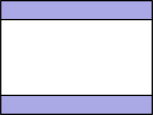
Older television screens have an aspect ratio of That is, the ratio of the width to the height is The aspect ratio of many movies is not so they are sometimes shown on a television screen by “letterboxing” — darkening strips of equal height at the top and bottom of the screen, as shown. Suppose a movie has an aspect ratio of and is shown on an older television screen with a -inch diagonal. What is the height, in inches, of each darkened strip?
Pista pequeña:
Los lados de la pantalla cumplen .
The screen’s sides satisfy
Pista grande:
La región iluminada tiene relación de aspecto así que su altura es la mitad del ancho de la pantalla.
The lit region has aspect ratio so its height is half the screen width
Solución:
Como la pantalla es con una diagonal de pulgadas, lo que da altura y ancho
La región iluminada tiene el ancho completo y altura
Las dos franjas comparten la altura restante, así que cada una tiene altura
Así, la respuesta correcta es D.
Since the screen is with a -inch diagonal, giving height and width
The lit region has the full width and height
The two strips share the remaining height, so each has height
Thus, the correct answer is D.
15.
Ayer Han condujo hora más que Ian a una velocidad media millas por hora mayor que la de Ian. Jan condujo horas más que Ian a una velocidad media millas por hora mayor que la de Ian. Han condujo millas más que Ian. ¿Cuántas millas más que Ian condujo Jan?
Yesterday Han drove hour longer than Ian at an average speed miles per hour faster than Ian. Jan drove hours longer than Ian at an average speed miles per hour faster than Ian. Han drove miles more than Ian. How many more miles did Jan drive than Ian?
Pista pequeña:
Supón que Ian condujo horas a millas por hora.
Let Ian drive hours at miles per hour
Pista grande:
Desarrollar da .
Expanding gives
Solución:
Supón que Ian condujo horas a velocidad y recorrió millas.
Han condujo así que
Jan condujo millas más que Ian.
Así, la respuesta correcta es D.
Let Ian drive hours at rate covering miles.
Han drove so
Jan drove miles more than Ian.
Thus, the correct answer is D.
16.
Los puntos y están sobre una circunferencia centrada en y Un segundo círculo es tangente interiormente al primero y tangente tanto a como a ¿Cuál es la razón entre el área del círculo menor y la del círculo mayor?
Points and lie on a circle centered at and A second circle is internally tangent to the first and tangent to both and What is the ratio of the area of the smaller circle to that of the larger circle?
Pista pequeña:
El centro del círculo pequeño está sobre la bisectriz de .
The small circle’s center lies on the bisector of
Pista grande:
El centro está a de por un triángulo -- y también a de .
The center is from by a -- triangle, and also from
Solución:
Sean y los radios. El centro del círculo pequeño está sobre la bisectriz de por lo que forma un ángulo de con
La perpendicular desde hasta tiene longitud y en el triángulo -- resultante
Como obtenemos así que y la razón de áreas es
Así, la respuesta correcta es B.
Let the radii be and The small circle’s center lies on the bisector of so makes a angle with
The perpendicular from to has length and in the resulting -- triangle
Since we get so and the area ratio is
Thus, the correct answer is B.
17.
Un triángulo equilátero tiene lado ¿Cuál es el área de la región que contiene todos los puntos que están fuera del triángulo y a no más de unidades de algún punto del triángulo?
An equilateral triangle has side length What is the area of the region containing all points that are outside the triangle and not more than units from a point of the triangle?
Pista pequeña:
La región consta de tres rectángulos a lo largo de los lados más tres sectores en las esquinas.
The region is three rectangles along the sides plus three sectors at the corners
Pista grande:
Cada uno de los tres sectores de las esquinas mide y juntos forman un círculo completo de radio .
The three corner sectors are each and together they make one full circle of radius
Solución:
A lo largo de cada uno de los tres lados hay un rectángulo de que aporta
En cada vértice hay un sector de de radio los tres juntos forman un círculo completo de área
El área total es
Así, la respuesta correcta es B.
Along each of the three sides is a rectangle, contributing
At each vertex is a sector of radius the three together form a full circle of area
The total area is
Thus, the correct answer is B.
18.
Un triángulo rectángulo tiene perímetro y área ¿Cuál es la longitud de su hipotenusa?
A right triangle has perimeter and area What is the length of its hypotenuse?
Pista pequeña:
Sean los catetos y la hipotenusa, y anota las relaciones de perímetro, área y Pitágoras.
Let the legs be and the hypotenuse and record perimeter, area, and Pythagorean relations
Pista grande:
Eleva al cuadrado y usa con .
Square and use with
Solución:
Sean los catetos y la hipotenusa. Entonces y
Elevando al cuadrado la segunda ecuación,
Esto da así que
Así, la respuesta correcta es B.
Let the legs be and the hypotenuse Then and
Squaring the second equation,
This gives so
Thus, the correct answer is B.
19.
El rectángulo está en un plano con y El rectángulo se rota en sentido horario alrededor de y luego se rota en sentido horario alrededor del punto al que se movió tras la primera rotación. ¿Cuál es la longitud del camino recorrido por el punto ?
Rectangle lies in a plane with and The rectangle is rotated clockwise about then rotated clockwise about the point that moved to after the first rotation. What is the length of the path traveled by point
Pista pequeña:
El punto traza un arco de cuarto de circunferencia por cada rotación.
Point traces one quarter-circle arc for each rotation
Pista grande:
El primer radio es el segundo radio es el lado de longitud .
The first radius is the second radius is the side of length
Solución:
En la primera rotación, se mueve sobre un cuarto de circunferencia alrededor de con radio La longitud del arco es
En la segunda rotación, se mueve sobre un cuarto de circunferencia alrededor de la nueva posición de con radio La longitud del arco es
La longitud total del camino es
Así, la respuesta correcta es C.
In the first rotation, moves on a quarter circle about with radius The arc length is
In the second rotation, moves on a quarter circle about the new position of with radius The arc length is
The total path length is
Thus, the correct answer is C.
20.
El trapecio tiene bases y y diagonales que se cortan en Supón que y el área de es ¿Cuál es el área del trapecio ?
Trapezoid has bases and and diagonals intersecting at Suppose that and the area of is What is the area of trapezoid
Pista pequeña:
Los triángulos y son semejantes con razón .
Triangles and are similar with ratio
Pista grande:
y tienen áreas iguales; escala los demás a partir de .
and have equal areas; scale the others from
Solución:
Los triángulos y son semejantes con razón
Como y tienen sus bases y sobre la misma recta y comparten la misma altura desde así que De forma análoga
Además El total es
Así, la respuesta correcta es D.
Triangles and are similar with ratio
Since and have bases and on the same line and share the same altitude from so Similarly
Also The total is
Thus, the correct answer is D.
21.
Un cubo con lado es cortado por un plano que pasa por dos vértices diagonalmente opuestos y y por los puntos medios y de dos aristas opuestas que no contienen a ni a como se muestra. ¿Cuál es el área del cuadrilátero ?
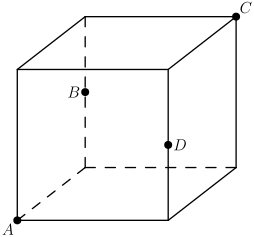
A cube with side length is sliced by a plane that passes through two diagonally opposite vertices and and the midpoints and of two opposite edges not containing or as shown. What is the area of quadrilateral
Pista pequeña:
Los cuatro lados de son iguales, así que es un rombo.
All four sides of are equal, so it is a rhombus
Pista grande:
Sus diagonales son una diagonal espacial y una diagonal de cara .
Its diagonals are a space diagonal and a face diagonal
Solución:
Cada lado de une un vértice del cubo con el punto medio de una arista, así que los cuatro lados son iguales y es un rombo.
Sus diagonales son la diagonal espacial y la diagonal de cara
El área de un rombo es la mitad del producto de sus diagonales:
Así, la respuesta correcta es A.
Each side of joins a vertex of the cube to the midpoint of an edge, so all four sides are equal and is a rhombus.
Its diagonals are the space diagonal and the face diagonal
The area of a rhombus is half the product of its diagonals:
Thus, the correct answer is A.
22.
Jacob usa el siguiente procedimiento para escribir una sucesión de números. Primero elige que el primer término sea Para generar cada término sucesivo, lanza una moneda equilibrada. Si sale cara, duplica el término anterior y le resta Si sale cruz, toma la mitad del término anterior y le resta ¿Cuál es la probabilidad de que el cuarto término de la sucesión de Jacob sea un entero?
Jacob uses the following procedure to write down a sequence of numbers. First he chooses the first term to be To generate each succeeding term, he flips a fair coin. If it comes up heads, he doubles the previous term and subtracts If it comes up tails, he takes half of the previous term and subtracts What is the probability that the fourth term in Jacob’s sequence is an integer?
Pista pequeña:
Construye un árbol de las posibles sucesiones; cada lanzamiento se divide en dos ramas.
Build a tree of the possible sequences; each flip splits into two branches
Pista grande:
Determina cuáles de los cuartos términos son enteros; recuerda que al dividir un número impar entre dos, el resultado deja de ser entero.
Track which fourth terms are integers, remembering that halving an odd number breaks integrality
Solución:
Partiendo de los segundos términos son (cara) y (cruz).
Continuando el árbol, los ocho cuartos términos igualmente probables son
De estos, son enteros, así que la probabilidad es
Así, la respuesta correcta es D.
Starting from the second terms are (heads) and (tails).
Continuing the tree, the eight equally likely fourth terms are
Of these, are integers, so the probability is
Thus, the correct answer is D.
23.
Se deben elegir dos subconjuntos del conjunto de modo que su unión sea y su intersección contenga exactamente dos elementos. ¿De cuántas maneras puede hacerse esto, suponiendo que el orden en que se eligen los subconjuntos no importa?
Two subsets of the set are to be chosen so that their union is and their intersection contains exactly two elements. In how many ways can this be done, assuming that the order in which the subsets are chosen does not matter?
Pista pequeña:
Primero elige los dos elementos que pertenecen a ambos subconjuntos.
First choose the two elements that belong to both subsets
Pista grande:
Cada uno de los elementos restantes va a exactamente un subconjunto; luego divide entre dos, pues el orden del par no importa.
Each of the remaining elements goes to exactly one subset; then correct for the unordered pair
Solución:
Elige los dos elementos comunes de maneras.
Cada uno de los elementos restantes debe estar en exactamente un subconjunto, lo que da asignaciones, para pares ordenados.
Como el orden de los dos subconjuntos no importa, divide entre para obtener
Así, la respuesta correcta es B.
Choose the two common elements in ways.
Each of the remaining elements must lie in exactly one subset, giving assignments, for ordered pairs.
Since the order of the two subsets does not matter, divide by to get
Thus, the correct answer is B.
24.
Sea ¿Cuál es el dígito de las unidades de ?
Let What is the units digit of
Pista pequeña:
Halla primero el dígito de las unidades de .
Find the units digit of first
Pista grande:
termina en y termina en luego determina para tratar .
ends in and ends in then determine to handle
Solución:
El dígito de las unidades de sigue el ciclo así que termina en Además termina en
Por lo tanto termina en así que termina en
Tanto como son múltiplos de así que lo que hace que termine en
El dígito de las unidades de es
Así, la respuesta correcta es D.
The units digit of cycles so ends in Also ends in
Thus ends in so ends in
Both and are multiples of so which makes end in
The units digit of is
Thus, the correct answer is D.
25.
Una mesa redonda tiene radio Sobre la mesa se colocan seis manteles individuales rectangulares. Cada mantel tiene ancho y largo como se muestra. Se colocan de modo que cada mantel tenga dos esquinas en el borde de la mesa, siendo estas dos esquinas los extremos del mismo lado de longitud Además, los manteles se colocan de modo que cada esquina interior toque una esquina interior de un mantel adyacente. ¿Cuánto vale ?
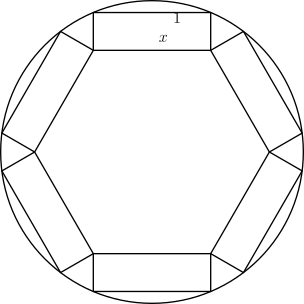
A round table has radius Six rectangular place mats are placed on the table. Each place mat has width and length as shown. They are positioned so that each mat has two corners on the edge of the table, these two corners being end points of the same side of length Further, the mats are positioned so that the inner corners each touch an inner corner of an adjacent mat. What is
Pista pequeña:
Toma un mantel con esquinas exteriores y sea el punto de la circunferencia opuesto a de modo que es rectángulo con hipotenusa .
Take one mat with outer corners and let be the point of the circle opposite so is right-angled with hypotenuse
Pista grande:
Los puntos de contacto entre las esquinas interiores forman triángulos isósceles con ángulo del vértice de lo que da .
The inner corners meet in isosceles triangles, giving
Solución:
Toma un mantel con esquinas exteriores y y sea el punto de la circunferencia diametralmente opuesto a Entonces es rectángulo en con hipotenusa
Las esquinas interiores de manteles adyacentes se encuentran en triángulos isósceles con ángulo en el vértice de y lados cuya base es Junto con los dos anchos de mantel,
Por el teorema de Pitágoras, que se simplifica a
Tomando la raíz positiva,
Así, la respuesta correcta es C.
Pick a mat with outer corners and and let be the point on the circle diametrically opposite Then is right-angled at with hypotenuse
The inner corners of adjacent mats meet in isosceles triangles with vertex angle and sides whose base is Together with the two mat widths,
By the Pythagorean theorem, which simplifies to
Taking the positive root,
Thus, the correct answer is C.