
Soluciones del 2001 AMC 10
Desplázate hacia abajo para ver las soluciones preparadas profesionalmente de LIVE by Po-Shen Loh, imprime las soluciones en PDF, consulta la clave de respuestas, o haz el examen cronometrado completo.
Todos los problemas se usan con el permiso legal oficial de la Mathematical Association of America (MAA).
1.
La mediana de la lista
es ¿Cuál es la media?
The median of the list
is What is the mean?
Pista pequeña:
La lista tiene números, así que la mediana es el º término.
The list has numbers, so the median is the th term
Pista grande:
El º término es así que planteamos .
The th term is so set
Solución:
La lista tiene números en orden creciente, así que la mediana es el º término, Al plantear se obtiene
La suma de los términos es así que la media es
Por lo tanto, la respuesta correcta es E.
The list has numbers in increasing order, so the median is the th term, Setting gives
The sum of the terms is so the mean is
Thus, the correct answer is E.
2.
Un número es más que el producto de su recíproco y su inverso aditivo. ¿En qué intervalo se encuentra el número?
A number is more than the product of its reciprocal and its additive inverse. In which interval does the number lie?
Pista pequeña:
El recíproco de es y el inverso aditivo es .
The reciprocal of is and the additive inverse is
Pista grande:
Su producto es .
Their product is
Solución:
El recíproco de es y su inverso aditivo es Su producto es
Entonces que se encuentra en el intervalo
Por lo tanto, la respuesta correcta es C.
The reciprocal of is and its additive inverse is Their product is
So which lies in the interval
Thus, the correct answer is C.
3.
La suma de dos números es Supongamos que a cada número se le suma y luego cada uno de los números resultantes se duplica. ¿Cuál es la suma de los dos números finales?
The sum of two numbers is Suppose is added to each number and then each of the resulting numbers is doubled. What is the sum of the final two numbers?
Pista pequeña:
Llama a los números y con .
Call the numbers and with
Pista grande:
La suma final es .
The final sum is
Solución:
Sean los números y de modo que Tras sumar a cada uno y duplicar, la suma es
Por lo tanto, la respuesta correcta es E.
Let the numbers be and so After adding to each and doubling, the sum is
Thus, the correct answer is E.
4.
¿Cuál es el número máximo posible de puntos de intersección de un círculo y un triángulo?
What is the maximum number of possible points of intersection of a circle and a triangle?
Pista pequeña:
Una recta puede cortar un círculo en a lo sumo puntos.
A line can cross a circle in at most points
Pista grande:
Un triángulo tiene lados.
A triangle has sides
Solución:
Cada lado del triángulo es un segmento, que puede intersecar un círculo en a lo sumo puntos. Con lados, el máximo es puntos, y esto es alcanzable.
Por lo tanto, la respuesta correcta es E.
Each side of the triangle is a segment, which can intersect a circle in at most points. With sides, the maximum is points, and this is achievable.
Thus, the correct answer is E.
5.
¿Cuántos de los doce pentominós que se muestran a continuación tienen al menos un eje de simetría?
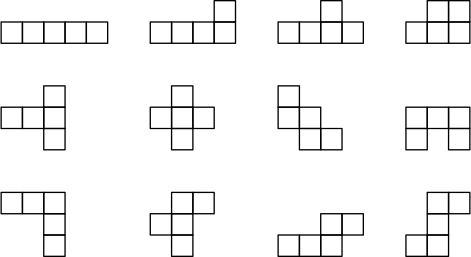
How many of the twelve pentominoes pictured below have at least one line of symmetry?
Pista pequeña:
Un eje de simetría pliega la figura exactamente sobre sí misma.
A line of symmetry folds the shape exactly onto itself
Pista grande:
Revisa cada una de las doce figuras en busca de un eje de plegado horizontal, vertical o diagonal.
Check each of the twelve shapes for a horizontal, vertical, or diagonal fold line
Solución:
Al revisar cada pentominó en busca de un eje de reflexión, exactamente seis tienen al menos uno: la barra recta, la cruz, la forma en , la forma en , la forma en y la forma en . Los seis restantes no tienen ningún eje de simetría.
Por lo tanto, la respuesta correcta es D.
Checking each pentomino for a reflection line, exactly six have at least one: the straight bar, the plus, the -shape, the -shape, the -shape, and the -shape. The remaining six have no line of symmetry.
Thus, the correct answer is D.
6.
Sean y el producto y la suma, respectivamente, de los dígitos del entero Por ejemplo, y Supongamos que es un número de dos dígitos tal que ¿Cuál es el dígito de las unidades de ?
Let and denote the product and the sum, respectively, of the digits of the integer For example, and Suppose is a two-digit number such that What is the units digit of
Pista pequeña:
Escribe donde y son sus dígitos.
Write where and are its digits
Pista grande:
Entonces que se simplifica a .
Then which simplifies to
Solución:
Escribimos Entonces y así que Esto se reduce a y como obtenemos
El dígito de las unidades es Por lo tanto, la respuesta correcta es E.
Write Then and so This reduces to and since we get
The units digit is Thus, the correct answer is E.
7.
Cuando el punto decimal de cierto número decimal positivo se mueve cuatro lugares a la derecha, el nuevo número es cuatro veces el recíproco del número original. ¿Cuál es el número original?
When the decimal point of a certain positive decimal number is moved four places to the right, the new number is four times the reciprocal of the original number. What is the original number?
Pista pequeña:
Mover el punto decimal cuatro lugares a la derecha multiplica por .
Moving the decimal point four places right multiplies by
Pista grande:
Así que lo que da .
So giving
Solución:
Mover el punto decimal cuatro lugares a la derecha multiplica por Así que lo que da
Como tenemos
Por lo tanto, la respuesta correcta es C.
Moving the decimal four places right multiplies by So giving
Since
Thus, the correct answer is C.
8.
Wanda, Darren, Beatrice y Chi son tutores en el laboratorio de matemáticas de la escuela. Su horario es el siguiente: Darren trabaja cada tercer día de clase, Wanda trabaja cada cuarto día de clase, Beatrice trabaja cada sexto día de clase y Chi trabaja cada séptimo día de clase. Hoy todos están trabajando en el laboratorio de matemáticas. ¿Dentro de cuántos días de clase a partir de hoy volverán a estar juntos dando tutoría en el laboratorio?
Wanda, Darren, Beatrice, and Chi are tutors in the school math lab. Their schedule is as follows: Darren works every third school day, Wanda works every fourth school day, Beatrice works every sixth school day, and Chi works every seventh school day. Today they are all working in the math lab. In how many school days from today will they next be together tutoring in the lab?
Pista pequeña:
Halla el mínimo común múltiplo de y .
Find the least common multiple of and
Pista grande:
El mínimo común múltiplo necesita los factores y .
The least common multiple needs the factors and
Solución:
Vuelven a coincidir tras días. Como y el mínimo común múltiplo es
Por lo tanto, la respuesta correcta es B.
They meet again after days. Since and the least common multiple is
Thus, the correct answer is B.
9.
El impuesto estatal sobre la renta donde vive Kristin se aplica a la tasa de sobre los primeros de ingreso anual más de cualquier cantidad que supere los Kristin notó que el impuesto estatal sobre la renta que pagó ascendió a de su ingreso anual. ¿Cuál era su ingreso anual?
The state income tax where Kristin lives is levied at the rate of of the first of annual income plus of any amount above Kristin noticed that the state income tax she paid amounted to of her annual income. What was her annual income?
Pista pequeña:
Sea su ingreso y expresa el impuesto de dos maneras distintas.
Let her income be and write the tax two different ways
Pista grande:
El impuesto satisface .
Solución:
Sea su ingreso anual Entonces
Multiplicando por y desarrollando, todos los términos con se cancelan, quedando Así que y
Por lo tanto, la respuesta correcta es B.
Let her income be Then
Multiplying by and expanding, all the terms cancel, leaving So and
Thus, the correct answer is B.
10.
Si y son positivos con y entonces es
If and are positive with and then is
Pista pequeña:
Divide entre para relacionar y .
Divide by to relate and
Pista grande:
A partir de y despeja .
From and solve for
Solución:
Dividir entre da Entonces así que y
De ahí que Por lo tanto, la respuesta correcta es D.
Dividing by gives Then so and
Hence Thus, the correct answer is D.
11.
Considera el cuadrado oscuro en un arreglo de cuadrados unitarios, del cual se muestra una parte. El primer anillo de cuadrados alrededor de este cuadrado central contiene cuadrados unitarios. El segundo anillo contiene cuadrados unitarios. Si continuamos este proceso, el número de cuadrados unitarios en el º anillo es
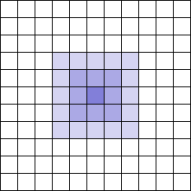
Consider the dark square in an array of unit squares, part of which is shown. The first ring of squares around this center square contains unit squares. The second ring contains unit squares. If we continue this process, the number of unit squares in the th ring is
Pista pequeña:
El º anillo es un cuadrado al que se le quita el cuadrado .
The th ring is a square with the square removed
Pista grande:
Observa que .
Solución:
El º anillo es el borde de un cuadrado que rodea a un cuadrado , así que contiene cuadrados unitarios.
Para eso es Por lo tanto, la respuesta correcta es C.
The th ring is the border of a square surrounding a square, so it contains unit squares.
For that is Thus, the correct answer is C.
12.
Supongamos que es el producto de tres enteros consecutivos y que es divisible entre ¿Cuál de las siguientes opciones no es necesariamente un divisor de ?
Suppose that is the product of three consecutive integers and that is divisible by Which of the following is not necessarily a divisor of
Pista pequeña:
Entre tres enteros consecutivos, uno es par y uno es múltiplo de .
Among three consecutive integers, one is even and one is a multiple of
Pista grande:
Busca una opción que requiera dos factores de tres enteros consecutivos no tienen por qué aportar ambos
Look for a choice requiring two factors of three consecutive integers need not provide both
Solución:
Entre tres enteros consecutivos, al menos uno es par y uno es múltiplo de así que es divisible entre Con el factor dado de es divisible entre y
Pero requiere dos factores de lo cual no está garantizado: es divisible entre pero no entre
Por lo tanto, la respuesta correcta es D.
Among three consecutive integers, at least one is even and one is a multiple of so is divisible by With the given factor of it is divisible by and
But requires two factors of which is not guaranteed: is divisible by but not by
Thus, the correct answer is D.
13.
Un número de teléfono tiene la forma donde cada letra representa un dígito diferente. Los dígitos de cada parte del número están en orden decreciente; es decir, y Además, y son dígitos pares consecutivos; y son dígitos impares consecutivos; y Halla
A telephone number has the form where each letter represents a different digit. The digits in each part of the number are in decreasing order; that is, and Furthermore, and are consecutive even digits; and are consecutive odd digits; and Find
Pista pequeña:
Los cuatro dígitos impares consecutivos deben ser o .
The four consecutive odd digits must be or
Pista grande:
Como usa el dígito impar sobrante, ese dígito impar debe ser .
Since uses the leftover odd digit, that odd digit must be
Solución:
Los dígitos impares consecutivos son o dejando un dígito impar ( o ) para Como el dígito impar allí debe ser así que los dos dígitos pares en suman
Los dígitos pares consecutivos son o dejando pares de dígitos pares o para Solo suma así que y
Por lo tanto, la respuesta correcta es E.
The consecutive odd digits are or leaving one odd digit ( or ) for Since the odd digit there must be so the two even digits in sum to
The consecutive even digits are or leaving even-digit pairs or for Only sums to so and
Thus, the correct answer is E.
14.
Una organización benéfica vende boletos benéficos por un total de Algunos boletos se venden a precio completo (una cantidad entera de dólares), y el resto se venden a mitad de precio. ¿Cuánto dinero recaudan los boletos a precio completo?
A charity sells benefit tickets for a total of Some tickets sell for full price (a whole dollar amount), and the rest sell for half price. How much money is raised by the full-price tickets?
Pista pequeña:
Sea que boletos se venden a precio completo entonces .
Let tickets sell at full price then
Pista grande:
Esto da con .
This gives with
Solución:
Sean boletos a precio completo vendidos a dólares cada uno. Entonces así que
Como el único factor de en ese rango es Así que lo que da y Los boletos a precio completo recaudan dólares.
Por lo tanto, la respuesta correcta es A.
Let full-price tickets sell at dollars each. Then so
Since the only factor of in range is So giving and The full-price tickets raise dollars.
Thus, the correct answer is A.
15.
Una calle tiene bordillos paralelos separados pies. Un cruce peatonal delimitado por dos franjas paralelas atraviesa la calle en ángulo. La longitud del bordillo entre las franjas es pies y cada franja mide pies de largo. Halla la distancia, en pies, entre las franjas.
A street has parallel curbs feet apart. A crosswalk bounded by two parallel stripes crosses the street at an angle. The length of the curb between the stripes is feet and each stripe is feet long. Find the distance, in feet, between the stripes.
Pista pequeña:
El cruce peatonal es un paralelogramo; calcula su área usando el bordillo como base.
The crosswalk is a parallelogram; compute its area using the curb as base
Pista grande:
La misma área es igual a la longitud de la franja por la distancia entre las franjas.
The same area equals stripe length times the distance between the stripes
Solución:
El cruce peatonal es un paralelogramo. Usando el bordillo ( pies) como base y el ancho de la calle ( pies) como altura, su área es pies cuadrados.
Usando una franja ( pies) como base, el área es igual a por la distancia entre las franjas, así que
Por lo tanto, la respuesta correcta es C.
The crosswalk is a parallelogram. Using the curb ( ft) as base and the street width ( ft) as height, its area is square feet.
Using a stripe ( ft) as base, the area equals times the distance between the stripes, so
Thus, the correct answer is C.
16.
La media de tres números es más que el menor de los números y menos que el mayor. La mediana de los tres números es ¿Cuál es su suma?
The mean of three numbers is more than the least of the numbers and less than the greatest. The median of the three numbers is What is their sum?
Pista pequeña:
Sea la media; entonces el menor es y el mayor es .
Let be the mean; then the least is and the greatest is
Pista grande:
La mediana es así que .
The median is so
Solución:
Sea la media. El número menor es y el mayor es con mediana
Como la media de los tres es lo que da
La suma es Por lo tanto, la respuesta correcta es D.
Let be the mean. The least number is and the greatest is with median
Since the mean of the three is which gives
The sum is Thus, the correct answer is D.
17.
¿Cuál de los conos de abajo se puede formar a partir de un sector de de un círculo de radio al alinear los dos lados rectos?
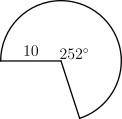
Which of the cones below can be formed from a sector of a circle of radius by aligning the two straight sides?


Pista pequeña:
El radio del sector se convierte en la generatriz del cono.
The sector’s radius becomes the slant height of the cone
Pista grande:
La longitud del arco se convierte en la circunferencia de la base .
The arc length becomes the base circumference
Solución:
Al enrollarse en un cono, el radio del sector se convierte en la generatriz, y la longitud del arco se convierte en la circunferencia de la base.
La longitud del arco es así que da radio de la base El cono tiene generatriz y radio de la base
Por lo tanto, la respuesta correcta es C.
When rolled into a cone, the sector’s radius becomes the slant height, and the arc length becomes the base circumference.
The arc length is so gives base radius The cone has slant height and base radius
Thus, the correct answer is C.
18.
El plano está teselado por cuadrados congruentes y pentágonos congruentes como se indica. El porcentaje del plano que está encerrado por los pentágonos es lo más cercano a
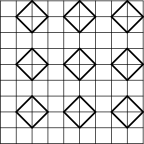
The plane is tiled by congruent squares and congruent pentagons as indicated. The percent of the plane that is enclosed by the pentagons is closest to
Pista pequeña:
Trabaja dentro de un bloque repetido de cuadrados pequeños.
Work within a repeating block of small squares
Pista grande:
De los cuadrados pequeños, quedan fuera de los pentágonos.
Of the small squares, lie outside the pentagons
Solución:
Considera un bloque repetido de formado por nueve cuadrados pequeños. Cuatro de estos nueve cuadrados no forman parte de los pentágonos, así que los pentágonos cubren del área.
Esto es lo más cercano a Por lo tanto, la respuesta correcta es D.
Consider a repeating block of nine small squares. Four of these nine squares are not part of the pentagons, so the pentagons cover of the area.
This is closest to Thus, the correct answer is D.
19.
Pat quiere comprar cuatro donas de un amplio suministro de tres tipos de donas: glaseadas, de chocolate y azucaradas. ¿Cuántas selecciones diferentes son posibles?
Pat wants to buy four donuts from an ample supply of three types of donuts: glazed, chocolate, and powdered. How many different selections are possible?
Pista pequeña:
Cuenta las soluciones enteras no negativas de .
Count nonnegative integer solutions of
Pista grande:
Usa el método de estrellas y barras: .
Use stars and bars:
Solución:
El número de selecciones es el número de soluciones enteras no negativas de Por estrellas y barras, esto es
Por lo tanto, la respuesta correcta es D.
The number of selections is the number of nonnegative integer solutions of By stars and bars, this is
Thus, the correct answer is D.
20.
Se forma un octágono regular cortando un triángulo rectángulo isósceles de cada una de las esquinas de un cuadrado con lados de longitud ¿Cuál es la longitud de cada lado del octágono?
A regular octagon is formed by cutting an isosceles right triangle from each of the corners of a square with sides of length What is the length of each side of the octagon?
Pista pequeña:
Sea cada lado del octágono cada triángulo cortado tiene catetos .
Let each octagon side be each cut triangle has legs
Pista grande:
Dos catetos más un lado abarcan una arista del cuadrado: .
Two legs plus a side span one edge of the square:
Solución:
Sea cada lado del octágono Es la hipotenusa de cada triángulo rectángulo isósceles cortado, cuyos catetos son
A lo largo de un lado del cuadrado, dos catetos y un lado del octágono dan así que y
Por lo tanto, la respuesta correcta es B.
Let each octagon side be It is the hypotenuse of each cut isosceles right triangle, whose legs are
Along one side of the square, two legs and one octagon side give so and
Thus, the correct answer is B.
21.
Un cilindro circular recto cuyo diámetro es igual a su altura está inscrito en un cono circular recto. El cono tiene diámetro y altura y los ejes del cilindro y del cono coinciden. Halla el radio del cilindro.
A right circular cylinder with its diameter equal to its height is inscribed in a right circular cone. The cone has diameter and altitude and the axes of the cylinder and cone coincide. Find the radius of the cylinder.
Pista pequeña:
En una sección axial, el cilindro tiene radio y altura .
In an axial cross-section, the cylinder has radius and height
Pista grande:
Los triángulos semejantes dan .
Similar triangles give
Solución:
Toma una sección axial. El cono tiene radio de la base y altura el cilindro aparece como un rectángulo de ancho y altura
Por triángulos semejantes, así que lo que da y
Por lo tanto, la respuesta correcta es B.
Take an axial cross-section. The cone has base radius and height the cylinder appears as a rectangle of width and height
By similar triangles, so giving and
Thus, the correct answer is B.
22.
En el cuadrado mágico que se muestra, las sumas de los números en cada fila, columna y diagonal son iguales. Cinco de estos números están representados por y Halla

In the magic square shown, the sums of the numbers in each row, column, and diagonal are the same. Five of these numbers are represented by and Find
Pista pequeña:
La primera fila, la primera columna y la diagonal principal contienen .
The first row, first column, and main diagonal all contain
Pista grande:
Así que las sumas de las otras dos entradas de cada una son iguales: .
So the other two entries of each match:
Solución:
Como está en la primera fila, la primera columna y la diagonal principal, las dos entradas restantes de cada una de esas líneas tienen sumas iguales: Así que y
La antidiagonal suma así que la suma mágica es Entonces y
De ahí que Por lo tanto, la respuesta correcta es D.
Since sits in the first row, first column, and main diagonal, the remaining two entries of each of those lines have equal sums: So and
The anti-diagonal sums to so the magic sum is Then and
Hence Thus, the correct answer is D.
23.
Una caja contiene exactamente cinco fichas, tres rojas y dos blancas. Las fichas se retiran al azar una a la vez sin reemplazo hasta que se extraen todas las fichas rojas o todas las fichas blancas. ¿Cuál es la probabilidad de que la última ficha extraída sea blanca?
A box contains exactly five chips, three red and two white. Chips are randomly removed one at a time without replacement until all the red chips are drawn or all the white chips are drawn. What is the probability that the last chip drawn is white?
Pista pequeña:
Imagina extraer las cinco fichas; el juego se detiene cuando se agota un color.
Imagine drawing all five chips; the game stops when one color is exhausted
Pista grande:
La extracción se detiene con una ficha blanca exactamente cuando la última ficha del orden completo de cinco es roja.
The last drawn chip is white exactly when the very last of all five chips is red
Solución:
Imagina extraer las cinco fichas en un orden aleatorio. La extracción se detiene en una ficha blanca exactamente cuando ambas fichas blancas salen antes que las tres rojas, lo que ocurre precisamente cuando la última ficha del orden completo es roja.
Esa probabilidad es Por lo tanto, la respuesta correcta es D.
Imagine drawing all five chips in a random order. The drawing stops on a white chip exactly when both white chips come out before all three reds, which happens precisely when the very last chip in the full ordering is red.
That probability is Thus, the correct answer is D.
24.
En el trapecio y son perpendiculares a con y ¿Cuánto vale ?
In trapezoid and are perpendicular to with and What is
Pista pequeña:
Traza una perpendicular desde hasta en entonces y .
Drop a perpendicular from to at then and
Pista grande:
Usa con .
with
Solución:
Traza una perpendicular desde hasta que la corta en Entonces y Por el teorema de Pitágoras,
Como
El lado izquierdo es igual a así que
Por lo tanto, la respuesta correcta es B.
Drop a perpendicular from to meeting it at Then and By the Pythagorean theorem,
Since
The left side equals so
Thus, the correct answer is B.
25.
¿Cuántos enteros positivos que no excedan son múltiplos de o pero no de ?
How many positive integers not exceeding are multiples of or but not
Pista pequeña:
Cuenta los múltiplos de o luego elimina los que también son múltiplos de .
Count the multiples of or then remove those that are also multiples of
Pista grande:
Usa inclusión-exclusión con los múltiplos de y luego .
Use inclusion-exclusion with multiples of and then
Solución:
Múltiplos de o hasta
Entre estos, elimina los múltiplos de hay múltiplos de y múltiplos de volviendo a sumar los múltiplos de
Así que el conteo es Por lo tanto, la respuesta correcta es B.
Multiples of or up to
Among these, remove the multiples of there are multiples of and multiples of re-adding the multiples of
So the count is Thus, the correct answer is B.