
Soluciones del 2014 AIME I
Desplázate hacia abajo para ver las soluciones preparadas profesionalmente de LIVE by Po-Shen Loh, imprime las soluciones en PDF, consulta la clave de respuestas, o haz el examen cronometrado completo.
Todos los problemas se usan con el permiso legal oficial de la Mathematical Association of America (MAA).
1.
Los ojales para el cordón de una zapatilla están todos sobre un rectángulo, cuatro igualmente espaciados en cada uno de los lados más largos. El rectángulo tiene un ancho de mm y un largo de mm. Hay un ojal en cada vértice del rectángulo. El cordón debe pasar entre los ojales de los vértices a lo largo de un lado corto del rectángulo y luego entrecruzarse entre ojales sucesivos hasta llegar a los dos ojales del otro lado corto del rectángulo, como se muestra. Después de pasar por estos ojales finales, cada uno de los extremos del cordón debe extenderse al menos mm más para poder atar un nudo. Halla la longitud mínima del cordón en milímetros.
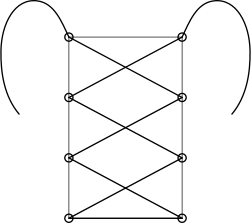
The eyelets for the lace of a sneaker all lie on a rectangle, four equally spaced on each of the longer sides. The rectangle has a width of mm and a length of mm. There is one eyelet at each vertex of the rectangle. The lace itself must pass between the vertex eyelets along a width side of the rectangle and then crisscross between successive eyelets until it reaches the two eyelets at the other width side of the rectangle as shown. After passing through these final eyelets, each of the ends of the lace must extend at least mm farther to allow a knot to be tied. Find the minimum length of the lace in millimeters.
Pista pequeña:
Los ojales dividen cada lado de mm en tres huecos iguales, y el cordón más corto usa solo segmentos rectos
The eyelets divide each mm side into three equal gaps, and the shortest lace uses straight segments only
Pista grande:
Seis segmentos entrecruzados miden cada uno suma un ancho y dos extremos de mm
Six crisscross segments each measure add one width and two mm ends
Solución:
Los cuatro ojales de cada lado de mm están igualmente espaciados con uno en cada vértice, así que ojales consecutivos en un lado distan mm. El cordón consta de un segmento que cruza el ancho de mm, seis piezas entrecruzadas (después del cruce del ancho, cada una de las dos hebras hace tres cruces hasta llegar arriba) y dos extremos libres de al menos mm cada uno. El cordón es más corto cuando cada pieza es un segmento recto.
Cada pieza entrecruzada abarca todo el ancho y sube un hueco, así que su longitud es
La longitud mínima es
The four eyelets on each mm side are equally spaced with one at each vertex, so consecutive eyelets on a side are mm apart. The lace consists of one segment across the mm width, six crisscross pieces (after the width crossing, each of the two strands makes three crossings to reach the top), and two free ends of at least mm each. The lace is shortest when every piece is a straight segment.
Each crisscross piece spans the full width and rises one gap, so its length is
The minimum length is
2.
Una urna contiene bolas verdes y bolas azules. Una segunda urna contiene bolas verdes y bolas azules. Se extrae al azar una sola bola de cada urna. La probabilidad de que ambas bolas sean del mismo color es Halla
An urn contains green balls and blue balls. A second urn contains green balls and blue balls. A single ball is drawn at random from each urn. The probability that both balls are of the same color is Find
Pista pequeña:
Suma las probabilidades de sacar verde-verde y azul-azul
Add the probabilities of green-green and blue-blue draws
Pista grande:
Resuelve para
Solve for
Solución:
Ambas bolas son verdes con probabilidad y ambas son azules con probabilidad La condición es
Al eliminar denominadores, así que lo que da
Both balls are green with probability and both are blue with probability The condition is
Clearing denominators, so giving
3.
Halla la cantidad de números racionales con tales que cuando se escribe como una fracción en su forma irreducible, el numerador y el denominador suman
Find the number of rational numbers such that when is written as a fraction in lowest terms, the numerator and the denominator have a sum of
Pista pequeña:
Escribe en su forma irreducible; entonces con
Write in lowest terms; then with
Pista grande:
así que cuenta los que son coprimos con
so count that are coprime to
Solución:
Escribe en su forma irreducible con como necesitamos Dado que la fracción es irreducible exactamente cuando es coprimo con
Hay enteros en coprimos con y se emparejan como (nótese que no es coprimo con ), así que exactamente de ellos son menores que La respuesta es
Write in lowest terms with since we need Because the fraction is in lowest terms exactly when is coprime to
There are integers in coprime to and they pair up as (note is not coprime to ), so exactly of them are less than The answer is
4.
Jon y Steve montan en bicicleta por un camino paralelo a dos vías de tren contiguas que corren en dirección este/oeste. Jon va hacia el este a millas por hora, y Steve va hacia el oeste a millas por hora. Dos trenes de igual longitud, que viajan en direcciones opuestas a velocidades constantes pero distintas, pasan cada uno junto a los dos ciclistas. Cada tren tarda exactamente minuto en pasar a Jon. El tren que va hacia el oeste tarda veces lo que tarda el tren que va hacia el este en pasar a Steve. La longitud de cada tren es millas, donde y son enteros positivos primos entre sí. Halla
Jon and Steve ride their bicycles on a path that parallels two side-by-side train tracks running in the east/west direction. Jon rides east at miles per hour, and Steve rides west at miles per hour. Two trains of equal length, traveling in opposite directions at constant but different speeds, each pass the two riders. Each train takes exactly minute to go past Jon. The westbound train takes times as long as the eastbound train to go past Steve. The length of each train is miles, where and are relatively prime positive integers. Find
Pista pequeña:
Pasar a Jon en un minuto fuerza las velocidades de ambos trenes: con en millas
Passing Jon in one minute forces both train speeds: with in miles
Pista grande:
Al pasar a Steve, el tiempo del tren hacia el oeste es veces el del tren hacia el este:
Passing Steve, the westbound time is times the eastbound:
Solución:
Sean y las velocidades en millas por hora de los trenes hacia el este y hacia el oeste, y millas su longitud común. Un tren pasa a un ciclista en un tiempo igual a dividido entre la velocidad relativa. Pasar a Jon (que va hacia el este a ) en de hora da así que y
Respecto a Steve (que va hacia el oeste a ), las velocidades relativas son y y el tren hacia el oeste tarda veces más: así que Al sustituir, de modo que y
Como la respuesta es
Let the eastbound and westbound trains have speeds and miles per hour and common length miles. A train passes a rider in time divided by their relative speed. Passing Jon (riding east at ) in hour gives so and
Relative to Steve (riding west at ), the speeds are and and the westbound train takes times as long: so Substituting, so and
Since the answer is
5.
Sea el conjunto formado por los doce vértices de un -ágono regular. Un subconjunto de se llama comunal si existe un círculo tal que todos los puntos de están dentro del círculo, y todos los puntos de que no están en están fuera del círculo. ¿Cuántos subconjuntos comunales hay? (Nótese que el conjunto vacío es un subconjunto comunal.)
Let the set consist of the twelve vertices of a regular -gon. A subset of is called communal if there is a circle such that all points of are inside the circle, and all points of not in are outside of the circle. How many communal subsets are there? (Note that the empty set is a communal subset.)
Pista pequeña:
Un subconjunto puede ser separado por un círculo exactamente cuando sus vértices son consecutivos en el -ágono
A subset can be cut off by a circle exactly when its vertices are consecutive on the -gon
Pista grande:
Para cada tamaño de a hay tramos de vértices consecutivos; no olvides el conjunto vacío y todo
For each size from to there are runs of consecutive vertices; don’t forget the empty set and all of
Solución:
Un subconjunto es comunal exactamente cuando sus vértices son consecutivos alrededor del -ágono. En efecto, un círculo separador corta la circunferencia circunscrita del -ágono en a lo sumo dos puntos, así que los vértices en su interior forman un arco contiguo. Recíprocamente, cualquier tramo de vértices consecutivos puede separarse de los vértices restantes mediante una recta, y un círculo suficientemente grande del lado adecuado de esa recta contiene exactamente ese tramo.
Para cada tamaño con hay tramos de vértices consecutivos (uno que empieza en cada vértice), lo que da subconjuntos, y el conjunto vacío y todo también son comunales. El total es
A subset is communal exactly when its vertices are consecutive around the -gon. Indeed, a separating circle meets the circumcircle of the -gon in at most two points, so the vertices inside it form a contiguous arc. Conversely, any run of consecutive vertices can be separated from the remaining vertices by a line, and a sufficiently large circle on the proper side of that line contains exactly that run.
For each size with there are runs of consecutive vertices (one starting at each vertex), giving subsets, and the empty set and all of are also communal. The total is
6.
Las gráficas y cortan el eje en y respectivamente, y cada gráfica tiene dos intersecciones con el eje que son enteros positivos. Halla
The graphs and have -intercepts of and respectively, and each graph has two positive integer -intercepts. Find
Pista pequeña:
Pon para obtener y entonces las intersecciones con el eje son las raíces de y
Set to get and the -intercepts are then roots of and
Pista grande:
Las raíces enteras positivas se multiplican para dar y y ambos pares deben tener la misma suma
The positive integer roots multiply to and and both pairs must have the same sum
Solución:
Poner da y Al desarrollar, la primera gráfica es cuyas raíces son enteros positivos con suma y producto De forma similar, la segunda es con raíces enteras de suma y producto
El primer par de raíces es o así que o el segundo par es o así que o El único valor común es por lo que lo que en efecto da intersecciones con el eje en y
Setting gives and Expanding, the first graph is whose roots are positive integers with sum and product Similarly the second is with integer roots of sum and product
The first pair of roots is or so or the second pair is or so or The only common value is so which indeed gives -intercepts and
7.
Sean y números complejos tales que y Sea El valor máximo posible de puede escribirse como donde y son enteros positivos primos entre sí. Halla (Nótese que para denota la medida del ángulo que la semirrecta desde hasta forma con el eje real positivo en el plano complejo.)
Let and be complex numbers such that and Let The maximum possible value of can be written as where and are relatively prime positive integers. Find (Note that for denotes the measure of the angle that the ray from to makes with the positive real axis in the complex plane.)
Pista pequeña:
está sobre el círculo de radio centrado en
lies on the circle of radius centered at
Pista grande:
El argumento es extremo cuando la semirrecta desde el origen es tangente a ese círculo, así que el seno del ángulo con el eje real es
The argument is extremal when the ray from the origin is tangent to that circle, so the sine of the angle with the real axis is
Solución:
Como y puede ser cualquier número complejo de módulo el punto recorre el círculo de radio centrado en
Como no cambia cuando se desplaza buscamos el mayor ángulo que una semirrecta desde el origen hasta este círculo forma con el eje real. Las semirrectas extremas son tangentes al círculo, donde
Entonces así que
Since and can be any complex number of modulus the point ranges over the circle of radius centered at
Because is unchanged when shifts by we want the largest angle that a ray from the origin to this circle makes with the real axis. The extreme rays are tangent to the circle, where
Then so
8.
Los enteros positivos y terminan ambos en la misma secuencia de cuatro dígitos cuando se escriben en base donde el dígito no es cero. Halla el número de tres dígitos
The positive integers and both end in the same sequence of four digits when written in base where digit is not zero. Find the three-digit number
Pista pequeña:
La condición dice es decir
The condition says i.e.
Pista grande:
y son coprimos, así que y dividen cada uno a uno de ellos; solo uno de los cuatro casos tiene el dígito inicial distinto de cero
and are coprime, so and each divide one of them; only one of the four cases has nonzero leading digit
Solución:
La condición es es decir, Como los enteros consecutivos son coprimos, divide a uno de y divide a uno de ellos. Esto da cuatro casos módulo (que es módulo y módulo ), y (que es módulo y módulo ).
Los últimos cuatro dígitos deben cumplir lo que descarta y Así que , por ejemplo , y
The condition is that is, Since consecutive integers are coprime, divides one of and divides one of them. This gives four cases modulo (which is mod and mod ), and (which is mod and mod ).
The last four digits must have which rules out and So — for instance — and
9.
Sean las tres raíces reales de la ecuación Halla
Let be the three real roots of the equation Find
Pista pequeña:
Como la cúbica se factoriza como por una cuadrática
Since the cubic factors as times a quadratic
Pista grande:
La cuadrática tiene una raíz negativa y una raíz positiva grande, así que la raíz del medio es
The quadratic has one negative root and one large positive root, so the middle root is
Solución:
Escribe de modo que la ecuación es Se factoriza como como confirma el desarrollo. Así que una raíz es y las otras dos son con producto y suma
Como la raíz del medio es y Por lo tanto
Write so the equation is It factors as as expanding confirms. So one root is and the other two are with product and sum
Since the middle root is and Therefore
10.
Un disco de radio es tangente exteriormente a un disco de radio Sea el punto donde los discos son tangentes, el centro del disco menor, y el centro del disco mayor. Mientras el disco mayor permanece fijo, se deja que el disco menor ruede por el exterior del disco mayor hasta que el disco menor haya girado un ángulo de Es decir, si el centro del disco menor se ha movido al punto y el punto del disco menor que empezó en se ha movido ahora al punto entonces es paralelo a Entonces donde y son enteros positivos primos entre sí. Halla
A disk with radius is externally tangent to a disk with radius Let be the point where the disks are tangent, be the center of the smaller disk, and be the center of the larger disk. While the larger disk remains fixed, the smaller disk is allowed to roll along the outside of the larger disk until the smaller disk has turned through an angle of That is, if the center of the smaller disk has moved to the point and the point on the smaller disk that began at has now moved to point then is parallel to Then where and are relatively prime positive integers. Find
Pista pequeña:
Al rodar por fuera de un círculo de radio , el disco gira en el marco fijo por cada que su centro barre alrededor de así que el centro barre
Rolling outside a radius- circle, the disk turns in the ground frame for each its center sweeps about so the center sweeps
Pista grande:
Después de un giro completo el disco recupera su orientación original, así que coloca en el origen y calcula
After one full turn the disk regains its original orientation, so place at the origin and compute
Solución:
Coloca en el origen con de modo que Cuando un círculo de radio rueda sin deslizar por fuera de un círculo fijo de radio y su centro barre un ángulo alrededor de el contacto de rodadura hace girar el disco respecto de la línea de los centros, y la revolución de esa línea añade más, así que el disco gira en el marco fijo. Girar significa por tanto así que
Tras haber girado el disco está de vuelta en su orientación original, así que el vector desde su centro hasta el punto marcado no cambia: (En particular es paralelo a como afirma el problema.)
La semirrecta es el semieje positivo, así que y
Place at the origin with so When a circle of radius rolls without slipping outside a fixed circle of radius and its center sweeps an angle about the rolling contact turns the disk through relative to the line of centers, and the revolution of that line adds more, so the disk turns in the ground frame. Turning through therefore means so
Having turned through a full the disk is back in its original orientation, so the vector from its center to the marked point is unchanged: (In particular is parallel to as the problem states.)
The ray is the positive -axis, so and
11.
Una ficha parte del punto de una cuadrícula de coordenadas y luego realiza una sucesión de seis movimientos. Cada movimiento es de unidad en una dirección paralela a uno de los ejes coordenados. Cada movimiento se elige al azar entre las cuatro direcciones posibles e independientemente de los demás movimientos. La probabilidad de que la ficha termine en un punto de la gráfica de es donde y son enteros positivos primos entre sí. Halla
A token starts at the point of an -coordinate grid and then makes a sequence of six moves. Each move is unit in a direction parallel to one of the coordinate axes. Each move is selected randomly from the four possible directions and independently of the other moves. The probability that the token ends at a point on the graph of is where and are relatively prime positive integers. Find
Pista pequeña:
Sigue y cada movimiento cambia cada uno de y en de forma independiente y uniforme
Track and each move changes each of and by independently and uniformly
Pista grande:
La ficha termina en cuando o cada uno con probabilidad suma estos y resta el solapamiento
The token ends on when or each with probability add these and subtract the overlap
Solución:
Trabajemos en las coordenadas diagonales y Cada uno de los cuatro movimientos cambia en y en y los cuatro movimientos realizan las cuatro combinaciones de signos con igual frecuencia, de modo que y realizan caminatas independientes de seis pasos con paso cada una. La ficha termina en exactamente cuando es decir, cuando o
Cada uno de y requiere tres y tres , con probabilidad Por independencia e inclusión-exclusión, la probabilidad es
Por lo tanto
Work in the diagonal coordinates and Each of the four moves changes by and by and the four moves realize all four sign combinations equally often — so and perform independent six-step walks. The token ends on exactly when that is, when or
Each of and requires three s and three s, with probability By independence and inclusion-exclusion, the probability is
Thus
12.
Sea y sean y funciones elegidas al azar (no necesariamente distintas) de a La probabilidad de que el rango de y el rango de sean disjuntos es donde y son enteros positivos primos entre sí. Halla
Let and let and be randomly chosen (not necessarily distinct) functions from to The probability that the range of and the range of are disjoint is where and are relatively prime positive integers. Find
Pista pequeña:
Si el rango de tiene elementos, exactamente funciones tienen rango disjunto de él
If the range of has elements, exactly functions have range disjoint from it
Pista grande:
Cuenta las funciones por tamaño del rango: de tamaño de tamaño de tamaño de tamaño
Count functions by range size: with size with size with size with size
Solución:
Condicionemos según el rango de Si tiene elementos, entonces el rango de es disjunto de él exactamente cuando manda a los elementos restantes, lo que ocurre para de las funciones
Cuenta las funciones por tamaño del rango: funciones constantes; con rango de tamaño con rango de tamaño (hay sobreyecciones de cuatro elementos sobre tres); y biyecciones. El número de pares favorables es
La probabilidad es y como es una potencia de mientras que es impar, esto ya está en su forma irreducible. Por lo tanto
Condition on the range of If it has elements, then the range of is disjoint from it exactly when maps into the remaining elements, which happens for of the functions
Count functions by range size: constant functions; with range size with range size (there are surjections from four elements onto three); and bijections. The number of favorable pairs is
The probability is and since is a power of while is odd, this is in lowest terms. Thus
13.
En el cuadrado los puntos y están en los lados y respectivamente, de modo que y Los segmentos y se cortan en un punto y las áreas de los cuadriláteros y están en la razón Halla el área del cuadrado
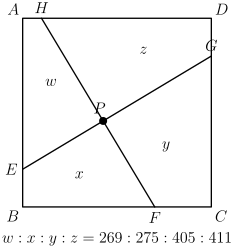
On square points and lie on sides and respectively, so that and Segments and intersect at a point and the areas of the quadrilaterals and are in the ratio Find the area of square
Pista pequeña:
Como el segmento pasa por el centro del cuadrado; trata el trapecio de la misma forma para ubicar
Since segment passes through the center of the square; treat the trapezoid the same way to locate
Pista grande:
Con lado y desnivel de la longitud da y la razón para determina el producto
With side and rise of the length gives and the ratio for pins down the product
Solución:
Coloca con Las regiones y juntas forman el trapecio de área como esto es la mitad de lo que obliga a es decir, pasa por el centro. De igual modo, y forman el trapecio de área así que La perpendicularidad de las direcciones y da Escribiendo obtenemos y da
Al hallar la intersección de las rectas y (y simplificar con ), se obtiene y la fórmula del área por coordenadas sobre da entonces Igualar esto a deja así que
Ahora y así que y son las raíces de que son y Como el área es
Place with The regions and together form the trapezoid of area since this is half of forcing i.e. passes through the center. Likewise and form the trapezoid of area so Perpendicularity of the directions and gives Writing we get and gives
Intersecting lines and (and simplifying with ) yields and the shoelace formula on then gives Setting this equal to leaves so
Now and so and are the roots of which are and Since the area is
14.
Sea la mayor solución real de la ecuación Existen enteros positivos y tales que Halla
Let be the largest real solution to the equation There are positive integers and such that Find
Pista pequeña:
Suma a ambos lados, repartiendo una unidad a cada fracción: cada una se convierte en Luego sustituye
Add to both sides, splitting one unit to each fraction: each becomes Then substitute
Pista grande:
Los pares simétricos se combinan en una ecuación cuadrática en
Symmetric pairs combine to a quadratic in
Solución:
Suma a ambos lados, dando una unidad a cada fracción: como la ecuación se convierte en Aparte de podemos dividir entre y sustituir lo que empareja las fracciones simétricamente:
Aparte de dividir entre da Con eliminar denominadores da es decir así que
La mayor solución es que supera a los demás candidatos y Por lo tanto
Add to both sides, giving one unit to each fraction: since the equation becomes Besides we can divide by and substitute which pairs the fractions symmetrically:
Besides dividing by gives With clearing denominators gives i.e. so
The largest solution is which exceeds the other candidates and Therefore
15.
En y El círculo corta a en y a en y y a en y Dado que y la longitud donde y son enteros positivos primos entre sí, y es un entero positivo no divisible por el cuadrado de ningún primo. Halla
In and Circle intersects at and at and and at and Given that and length where and are relatively prime positive integers, and is a positive integer not divisible by the square of any prime. Find
Pista pequeña:
está inscrito en así que es un diámetro y
is inscribed in so is a diameter and
Pista grande:
Expresa las distancias de y a la recta como múltiplos de usando los ángulos del cuadrilátero cíclico y luego compara con las coordenadas
Express the distances from and to line as multiples of using the angles of cyclic quadrilateral then compare with coordinates
Solución:
Como el ángulo es recto, y como está inscrito en la cuerda es un diámetro. Por tanto De el triángulo es un triángulo rectángulo isósceles, así que y de y obtenemos y En el orden es (tanto como están en el arco opuesto a y supera a así que está más lejos de ).
La recta es la recta así que las distancias de y a ella se deducen de los ángulos del cuadrilátero cíclico En y así que la distancia desde es En así que la distancia desde es
Ahora coloca de modo que la recta y Poniendo las dos fórmulas de distancia quedan y lo que da y Entonces se convierte en así que y Por lo tanto
Since angle is right, and as is inscribed in the chord is a diameter. Hence From triangle is an isosceles right triangle, so and from and we get and On the order is (both and lie on the arc opposite and exceeds so is farther from ).
Line is the line so the distances from and to it follow from the angles of cyclic quadrilateral At and so the distance from is At so the distance from is
Now place so line and Setting the two distance formulas read and which give and Then becomes so and Therefore