
Soluciones del 1985 AIME
Desplázate hacia abajo para ver las soluciones preparadas profesionalmente de LIVE by Po-Shen Loh, imprime las soluciones en PDF, consulta la clave de respuestas, o haz el examen cronometrado completo.
Todos los problemas se usan con el permiso legal oficial de la Mathematical Association of America (MAA).
1.
Sea y para sea Calcula el producto
Let and for let Calculate the product
Pista pequeña:
Multiplica términos consecutivos mediante la recurrencia
Multiply consecutive terms using the recurrence
Pista grande:
Agrupa el producto pedido como
Group the requested product as
Solución:
La recurrencia da Por lo tanto,
The recurrence gives Therefore
2.
Al girar un triángulo rectángulo alrededor de un cateto, el volumen del cono generado es Al girarlo alrededor del otro cateto, el volumen del cono generado es ¿Cuál es la longitud, en centímetros, de la hipotenusa del triángulo?
When a right triangle is rotated about one leg, the volume of the cone produced is When the triangle is rotated about the other leg, the volume of the cone produced is What is the length (in cm) of the hypotenuse of the triangle?
Pista pequeña:
Expresa los dos volúmenes de los conos en función de los catetos y del triángulo
Write the two cone volumes in terms of the triangle’s legs and
Pista grande:
Al dividir las ecuaciones de volumen se obtiene la razón entre los dos catetos
Dividing the volume equations gives the ratio of the two legs
Solución:
Sean los catetos y En un orden adecuado, Su cociente da así que escribimos y La primera ecuación se convierte en de donde Los catetos son y por lo que la hipotenusa es
Let the legs be and In a suitable order, Their ratio gives so write and The first equation becomes hence The legs are and so the hypotenuse is
3.
Halla si y son enteros positivos que satisfacen donde
Find if and are positive integers which satisfy where
Pista pequeña:
Desarrolla e iguala su parte imaginaria a
Expand and set its imaginary part equal to
Pista grande:
La ecuación resultante muestra que el entero positivo divide a
The resulting equation shows that the positive integer divides
Solución:
Al desarrollar y usar que es real se obtiene Como es primo, o La segunda posibilidad exigiría lo cual es imposible. Por tanto, y de donde La parte real es
Expanding and using that is real gives Since is prime, or The latter would require which is impossible. Thus and so The real part is
4.
Se construye un cuadrado pequeño dentro de un cuadrado de área dividiendo cada lado del cuadrado unitario en partes iguales y uniendo después cada vértice con el punto de división más cercano al vértice opuesto, como se muestra. Halla el valor de si el área del cuadrado pequeño (sombreado en la figura) es exactamente
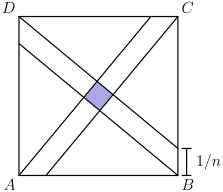
A small square is constructed inside a square of area by dividing each side of the unit square into equal parts, and then connecting the vertices to the division points closest to the opposite vertices, as shown. Find the value of if the area of the small square (shaded in the figure) is exactly
Pista pequeña:
Coloca el cuadrado unitario en un plano de coordenadas y escribe las ecuaciones de dos rectas paralelas de la construcción
Place the unit square on a coordinate plane and write equations for two parallel construction lines
Pista grande:
La distancia entre las rectas paralelas es la longitud del lado del cuadrado pequeño
The distance between the parallel lines is the side length of the small square
Solución:
Sitúa los vértices del cuadrado exterior en Un par de rectas de la construcción tiene ecuaciones El otro par es perpendicular al primero, y ambos pares tienen la misma separación. Así, el cuadrado interior tiene lado y área Por tanto, o bien Su raíz positiva es
Put the outer square at One pair of construction lines has equations The other pair is perpendicular to this pair, and the two pairs have the same separation. Thus the inner square has side length and area Hence or Its positive root is
5.
Se elige una sucesión de enteros tal que para cada ¿Cuál es la suma de los primeros términos si la suma de los primeros términos es y la suma de los primeros términos es ?
A sequence of integers is chosen so that for each What is the sum of the first terms of this sequence if the sum of the first terms is and the sum of the first terms is
Pista pequeña:
Escribe los primeros seis términos en función de y
Write the first six terms in terms of and
Pista grande:
La sucesión se repite cada seis términos, y cada bloque de seis suma
The sequence repeats every six terms, and each six-term block has sum
Solución:
Sean y Los primeros seis términos son tras lo cual la sucesión se repite; estos seis términos suman Como y las ecuaciones dadas son Por tanto, Como la suma pedida es
Put and The first six terms are after which the sequence repeats; these six terms sum to Since and the given equations are Thus Since the requested sum is
6.
Como muestra la figura, el triángulo está dividido en seis triángulos más pequeños por rectas trazadas desde los vértices y que pasan por un mismo punto interior. Se indican las áreas de cuatro de ellos. Halla el área del triángulo
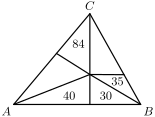
As shown in the figure, triangle is divided into six smaller triangles by lines drawn from the vertices through a common interior point. The areas of four of these triangles are as indicated. Find the area of triangle
Pista pequeña:
Llama al área no rotulada de la parte superior derecha y a la de la parte superior izquierda
Call the upper-right unlabeled area and the upper-left unlabeled area
Pista grande:
Usa razones de áreas de triángulos con la misma altura, junto con el teorema de Ceva
Use equal-altitude area ratios along the sides, together with Ceva’s theorem
Solución:
Sean y respectivamente, las áreas no rotuladas de la parte superior derecha e izquierda. Las tres razones en que se dividen los lados y el teorema de Ceva dan por lo que
La ceviana desde corta a La razón de los dos segmentos de es Al calcular la misma razón mediante los dos triángulos grandes con vértice se obtiene de modo que Al resolver junto con se obtiene y Por lo tanto,
Let the unlabeled upper-right and upper-left areas be and respectively. The three side-division ratios and Ceva’s theorem give so
The cevian from meets The ratio of the two segments of is Computing the same ratio from the two large triangles with vertex gives so Solving with yields and Therefore
7.
Supón que y son enteros positivos tales que y Determina
Assume that and are positive integers such that and Determine
Pista pequeña:
Parametriza las soluciones de y
Parametrize the solutions of and
Pista grande:
Factoriza la diferencia resultante
Factor the resulting difference
Solución:
Al comparar exponentes primos, escribimos para enteros positivos Entonces Como es primo, los factores son y lo que da y Por tanto, y
Comparing prime exponents, write for positive integers Then Since is prime, the factors are and giving and Thus and
8.
La suma de los siguientes siete números es exactamente Se desea sustituir cada por una aproximación entera con de modo que la suma de los también sea y que el máximo de los «errores» sea lo menor posible. Para este valor mínimo de ¿cuánto vale ?
The sum of the following seven numbers is exactly It is desired to replace each by an integer approximation so that the sum of the ’s is also and so that the maximum of the “errors” is as small as possible. For this minimum what is
Pista pequeña:
Partiendo de siete la suma entera debe reducirse en
Starting from seven ’s, the integer sum must be reduced by
Pista grande:
Para minimizar el mayor error, redondea los dos más pequeños hacia abajo a
To minimize the worst error, round the two smallest ’s down to
Solución:
Elige y La suma es y el mayor error es
Si entonces deben ser todos iguales a y solo puede ser o Por tanto, su suma sería al menos una contradicción. Así, el mínimo es y
Choose and The sum is and the largest error is
If then must all equal and can only be or Their sum would therefore be at least a contradiction. Thus the minimum is and
9.
En un círculo, unas cuerdas paralelas de longitudes y determinan ángulos centrales de y radianes, respectivamente, donde Si el número racional positivo se expresa como una fracción irreducible, ¿cuál es la suma de su numerador y su denominador?
In a circle, parallel chords of lengths and determine central angles of and radians, respectively, where If which is a positive rational number, is expressed as a fraction in lowest terms, what is the sum of its numerator and denominator?
Pista pequeña:
Una cuerda que subtiende un ángulo tiene longitud
A chord subtending angle has length
Pista grande:
Sean y y después elimina el radio común
Let and then eliminate the common radius
Solución:
Sean y Los datos de las cuerdas dan La fórmula de adición produce Además, así que Al sustituir se obtiene Por tanto, y la suma pedida es
Put and The chord data give The addition formula yields Also so Substituting gives Hence and the requested sum is
10.
¿Cuántos de los primeros enteros positivos pueden expresarse en la forma donde es un número real y denota el mayor entero menor o igual que ?
How many of the first positive integers can be expressed in the form where is a real number, and denotes the greatest integer less than or equal to
Pista pequeña:
Sustituye y separa en sus partes entera y fraccionaria
Substitute and separate into its integer and fractional parts
Pista grande:
Determina los valores de para
Determine the values of for
Solución:
Sea donde es un entero y La expresión es Al revisar los puntos de ruptura se observa que la contribución de la parte fraccionaria toma exactamente los valores y Así, se pueden obtener exactamente seis clases de residuos módulo Entre los primeros enteros positivos, esto da
Let where is an integer and The expression is Checking the breakpoints shows that the fractional-part contribution takes exactly the values and Thus precisely six residue classes modulo are attainable. Among the first positive integers, this gives
11.
Una elipse tiene focos en y en el plano y es tangente al eje ¿Cuál es la longitud de su eje mayor?
An ellipse has foci at and in the -plane and is tangent to the -axis. What is the length of its major axis?
Pista pequeña:
En el punto de tangencia, la suma constante de distancias es la mínima suma posible para un punto del eje
At tangency, the constant sum of distances is the minimum such sum for a point on the -axis
Pista grande:
Refleja un foco respecto del eje para convertir el camino quebrado en un segmento recto
Reflect one focus across the -axis to turn the broken path into a straight segment
Solución:
Refleja respecto del eje para obtener Para un punto del eje la suma de sus distancias a los focos originales es igual a la longitud del camino quebrado desde pasando por hasta Su mínimo es la distancia en línea recta La tangencia significa que la suma constante de distancias de la elipse es igual a este mínimo. Esa suma es la longitud del eje mayor, así que la respuesta es
Reflect across the -axis to For a point on the -axis, the sum of its distances to the original foci equals the length of a broken path from through to Its minimum is the straight-line distance Tangency means that the ellipse’s constant distance sum equals this minimum. That sum is the major-axis length, so the answer is
12.
Sean y los vértices de un tetraedro regular cuyas aristas miden metro. Un insecto parte del vértice y sigue esta regla: en cada vértice elige, con la misma probabilidad, una de las tres aristas que inciden en él y recorre esa arista hasta el vértice del otro extremo. Sea la probabilidad de que el insecto esté en el vértice después de haber recorrido exactamente metros. Halla
Let and be the vertices of a regular tetrahedron, each of whose edges measures meter. A bug, starting from vertex observes the following rule: at each vertex it chooses one of the three edges meeting at that vertex, each edge being equally likely to be chosen, and crawls along that edge to the vertex at its opposite end. Let be the probability that the bug is at vertex when it has crawled exactly meters. Find the value of
Pista pequeña:
Sea la probabilidad de estar en después de pasos
Let be the probability of being at after steps
Pista grande:
Desde cualquier vértice distinto de la probabilidad de pasar a es
From any vertex other than the probability of moving to is
Solución:
Sea la probabilidad de que el insecto esté en después de pasos. No puede permanecer en mientras que desde cualquier otro vértice pasa a con probabilidad Por tanto, Al resolver esta recurrencia se obtiene Así, por lo que
Let be the probability that the bug is at after steps. It cannot stay at while from any other vertex it moves to with probability Hence Solving this recurrence gives Thus so
13.
Los números de la sucesión tienen la forma donde Para cada sea el máximo común divisor de y Halla el valor máximo de cuando recorre los enteros positivos.
The numbers in the sequence are of the form where For each let be the greatest common divisor of and Find the maximum value of as ranges through the positive integers.
Pista pequeña:
Un divisor común de términos consecutivos también divide su diferencia
A common divisor of consecutive terms also divides their difference
Pista grande:
Combina y para mostrar que el máximo común divisor divide a un primo fijo
Combine and to show that the gcd divides a fixed prime
Solución:
Un divisor común divide a Por tanto, también divide a Como es primo, La igualdad se alcanza cuando pues y Por consiguiente, el máximo es
A common divisor divides It therefore also divides Since is prime, Equality occurs at because and Hence the maximum is
14.
En un torneo, cada participante jugó exactamente una partida contra cada uno de los demás. En cada partida, el ganador recibió punto, el perdedor recibió puntos y, si hubo empate, cada participante recibió punto. Al terminar el torneo, se observó que exactamente la mitad de los puntos de cada participante se habían obtenido contra los diez participantes con menor puntuación. (En particular, cada uno de esos diez participantes obtuvo la mitad de sus puntos contra los otros nueve.) ¿Cuál era el número total de participantes en el torneo?
In a tournament each player played exactly one game against each of the other players. In each game the winner was awarded point, the loser got points, and each of the two players earned point if the game was a tie. After the completion of the tournament, it was found that exactly half of the points earned by each player were earned against the ten players with the least number of points. (In particular, each of the ten lowest-scoring players earned half of her or his points against the other nine of the ten.) What was the total number of players in the tournament?
Pista pequeña:
Suma las puntuaciones de los diez participantes con menor puntuación y cuenta las partidas disputadas entre ellos
Sum the scores of the ten lowest-scoring players and count their internal games
Pista grande:
Sea la cantidad de participantes restantes y cuenta de dos maneras los puntos de las partidas entre los dos grupos
Let be the number of other players and double-count points from games across the two groups
Solución:
Las partidas entre los diez participantes con menor puntuación aportan puntos en total. Estos son la mitad de la puntuación conjunta de esos diez participantes, así que su puntuación conjunta es Por tanto, obtuvieron puntos en partidas contra los otros participantes.
Por tanto, los demás participantes obtuvieron puntos contra los diez de menor puntuación. Según la condición, esto es la mitad de su puntuación conjunta, que es Así, lo que da Si los diez de menor puntuación promedian puntos, mientras que los otros seis promedian solo de modo que estos últimos no podrían estar por encima de los primeros. Por tanto, y el número total de participantes es
The games among the ten lowest players contribute total points. These are half of those ten players’ combined score, so their combined score is Hence they earned points in games against the other players.
The other players therefore earned points against the lowest ten. By the condition, this is half their combined score, which is Thus giving If the lowest ten average points while the other six average only impossible for the latter group to rank above them. Hence and the total number of players is
15.
Como muestra la primera figura, se unen los puntos medios de dos lados adyacentes para cortar cada uno de tres cuadrados de en dos piezas, y Después, estas seis piezas se unen a un hexágono regular, como muestra la segunda figura, para plegarlas y formar un poliedro. ¿Cuál es el volumen, en de este poliedro?
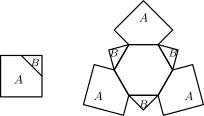
Three squares are each cut into two pieces and as shown in the first figure below, by joining the midpoints of two adjacent sides. These six pieces are then attached to a regular hexagon, as shown in the second figure, so as to fold into a polyhedron. What is the volume (in ) of this polyhedron?
Pista pequeña:
Observa que cada es una cara cuadrada con una esquina recortada y que cada es ese triángulo de la esquina
Recognize each as a square face with one corner cut off and each as that corner triangle
Pista grande:
Un plano que pasa por los puntos medios de seis aristas de un cubo corta un hexágono regular y divide el cubo en dos partes congruentes
A plane through six edge midpoints of a cube cuts a regular hexagon and divides the cube into two congruent parts
Solución:
Considera un cubo de y el plano que pasa por los puntos medios de las seis aristas que unen dos grupos opuestos de tres vértices. En coordenadas este es el plano Su sección transversal es un hexágono regular de lado igual que el borde de corte que une los puntos medios de dos lados adyacentes.
En tres caras del cubo, el plano deja un cuadrado al que se le ha quitado un triángulo de una esquina, exactamente la pieza En las otras tres caras, deja el triángulo rectángulo isósceles complementario de la esquina, exactamente la pieza Así, el desarrollo mostrado es una de las dos partes en que el plano corta el cubo. La simetría central intercambia ambas partes, por lo que cada una tiene la mitad del volumen del cubo:
Consider a cube and the plane through the midpoints of the six edges that join opposite groups of three vertices. In coordinates this is the plane Its cross-section is a regular hexagon with side the same as the cut edge joining adjacent side midpoints.
On three faces of the cube, the plane leaves a square with a corner triangle removed, exactly piece On the other three faces, it leaves the complementary right-isosceles corner triangle, exactly piece Thus the pictured net is one of the two pieces into which this plane cuts the cube. Central symmetry interchanges the two pieces, so each has half the cube’s volume: