
2011 AMC 12B 详解
向下滚动即可查看来自 LIVE by Po-Shen Loh 的精心整理的解答,打印PDF 解答,查看答案,或参加完整限时模拟考试。
所有题目均经美国数学协会(MAA)官方合法授权使用。
1.
下列式子的值是多少?
What is
小提示:
先分别求出两个分子和分母中的和。
Add the terms in each numerator and denominator first
大提示:
原式变为 。
The expression becomes
解答:
两个和分别是 与 ,所以原式等于 。
通分得到
所以正确答案是 C。
The sums are and so the expression equals
Over a common denominator this is
Thus, the correct answer is C.
2.
Josanna 到目前为止的考试成绩是 ,,,,和 。她的目标是在下一次考试后,把平均分至少提高 分。她下一次考试至少需要多少分才能达到目标?
Josanna’s test scores to date are and Her goal is to raise her test average at least points with her next test. What is the minimum test score she would need to accomplish this goal?
小提示:
先求前五次考试的当前平均分。
Find the current average of the five scores
大提示:
六次考试的总分必须等于目标平均分的 倍。
The six scores must total times the target average
解答:
前五次总分为 ,平均分为 。目标是新的平均分至少为 。
六次考试平均 分需要总分 ,因此第六次至少需要 。
所以正确答案是 E。
The five scores sum to giving an average of The goal is a new average of at least
Six tests averaging must total so the sixth score must be at least
Thus, the correct answer is E.
3.
LeRoy 和 Bernardo 一起进行了一周旅行,并约定平摊费用。这一周中,他们分别支付了汽油、租车等共同费用。旅行结束时,LeRoy 共支付了 美元,Bernardo 共支付了 美元,其中 。LeRoy 必须给 Bernardo 多少美元,才能使两人平摊费用?
LeRoy and Bernardo went on a week-long trip together and agreed to share the costs equally. Over the week, each of them paid for various joint expenses such as gasoline and car rental. At the end of the trip it turned out that LeRoy had paid dollars and Bernardo had paid dollars, where How many dollars must LeRoy give to Bernardo so that they share the costs equally?
小提示:
每个人最终应承担 美元。
Each person should end up paying
大提示:
LeRoy 需要补上他已付金额与公平份额之间的差额。
LeRoy must cover the gap between what he paid and his fair share
解答:
总费用为 ,所以每个人的公平份额为 。
LeRoy 已支付 ,少于他应承担的份额,因此他应给 Bernardo
所以正确答案是 C。
The total cost is so each person’s fair share is
LeRoy paid which is less than his share, so he must give Bernardo
Thus, the correct answer is C.
4.
Ron 在计算两个正整数 与 的乘积时,把两位数 的数字顺序颠倒了。他得到的错误乘积是 。 与 的正确乘积是多少?
In multiplying two positive integers and Ron reversed the digits of the two-digit number His erroneous product was What is the correct value of the product of and
小提示:
将 分解质因数。
Factor into primes
大提示:
被颠倒后的 是其中的两位数因数;先把它倒回来再相乘。
The reversed is the two-digit factor; reverse it back before multiplying
解答:
因为 ,唯一的两位数因数是 。这必是 颠倒后的值,所以真正的 是 ,且 。
正确乘积为
所以正确答案是 E。
Since the only two-digit factor is This must be the reversed value of so the true value of is and
The correct product is
Thus, the correct answer is E.
5.
设 是第二小的正整数,它能被所有小于 的正整数整除。 的各位数字之和是多少?
Let be the second smallest positive integer that is divisible by every positive integer less than What is the sum of the digits of
小提示:
求 到 的最小公倍数。
Find the least common multiple of through
大提示:
满足条件的数是这个最小公倍数的倍数;取第二小的正倍数。
The valid numbers are the multiples of that value; take the second one
解答:
能被 到 每个整数整除的数必须是 的倍数。
的第二小正倍数是 ,其数字和为 。
所以正确答案是 A。
A number divisible by every integer from to must be a multiple of
The second smallest positive multiple of is whose digit sum is
Thus, the correct answer is A.
6.
从点 向一个圆作两条切线。切点 与 将圆分成的两段弧长之比为 。 的度数是多少?
Two tangents to a circle are drawn from a point The points of contact and divide the circle into arcs with lengths in the ratio What is the degree measure of
小提示:
两段弧按 分割 。
The two arcs split in the ratio
大提示:
切线与切点处的半径成 ;使用四边形
A tangent meets the radius at its point of contact at ; use quadrilateral
解答:
设 为圆心。两段弧分别为 和 ,且 ,所以 ,小弧 对应的圆心角为 。
到切点 和 的半径垂直于切线,所以 。在四边形 中,
所以正确答案是 C。
Let be the center. The arcs measure and with so and the minor arc gives central angle
The radii to and are perpendicular to the tangents, so In quadrilateral
Thus, the correct answer is C.
7.
和 是两个两位正整数,平均数为 。比值 的最大值是多少?
Let and be two-digit positive integers with mean What is the maximum value of the ratio
小提示:
平均数条件给出 。
The mean condition gives
大提示:
要最大化 ,应使 尽可能大、 尽可能小。
To maximize make as large and as small as allowed
解答:
由 ,得 。要最大化 ,应让 尽可能小。
因为 ,所以 。取 、 可得最大值
所以正确答案是 B。
Since we have To maximize we make small.
Because it follows that Taking and gives the maximum
Thus, the correct answer is B.
8.
Keiko 每天以完全相同的恒定速度绕一条跑道走一圈。跑道两侧是直线,两端是半圆。跑道宽 米,她绕外侧边缘走一圈比绕内侧边缘走一圈多用 秒。Keiko 的速度是多少米每秒?
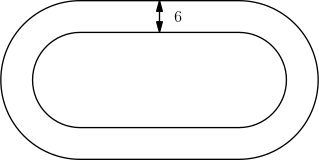
Keiko walks once around a track at exactly the same constant speed every day. The sides of the track are straight, and the ends are semicircles. The track has width meters, and it takes her seconds longer to walk around the outside edge of the track than around the inside edge. What is Keiko’s speed in meters per second?
小提示:
两条直线部分长度相同,所以内外边缘的差只来自弯曲的两端。
The straight portions have the same length on both edges, so only the curved ends differ
大提示:
两端的两个半圆合成整圆,且两个整圆半径相差 。
The two semicircular ends form full circles whose radii differ by
解答:
两条直线部分对两条路线相同,因此长度差只来自两个半圆端。设内侧半径为 ,则外侧多出的长度为
若速度为 米每秒,则多用的时间给出 ,所以 。
所以正确答案是 A。
The straight sides are the same length for both paths, so the difference in length comes only from the two semicircular ends. If the inner radius is those ends combine into a full circle, and the extra length is
If her speed is meters per second, then the extra time gives so
Thus, the correct answer is A.
9.
从区间 中独立随机选取两个实数。它们的乘积大于零的概率是多少?
Two real numbers are selected independently at random from the interval What is the probability that the product of those numbers is greater than zero?
小提示:
乘积为正当且仅当两个数同号。
The product is positive exactly when both numbers share the same sign
大提示:
每个数为负的概率是 ,为正的概率是
Each number is negative with probability and positive with probability
解答:
区间长度为 ,其中负数部分长度为 ,正数部分长度为 。因此每个数为正的概率为 ,为负的概率为 。
乘积为正发生在两数都正或都负:
所以正确答案是 D。
The interval has length with of it negative and of it positive. So each number is positive with probability and negative with probability
The product is positive when both are positive or both are negative:
Thus, the correct answer is D.
10.
长方形 中,,。点 在边 上,且 。 的度数是多少?
Rectangle has and Point is chosen on side so that What is the degree measure of
小提示:
因为 ,所以角 等于 。
Since the angle equals
大提示:
这使 成为等腰三角形,且 ,于是 是 -- 三角形。
That makes isosceles with so is --
解答:
因为 ,所以 。结合 ,可得 ,所以 是等腰三角形,且 。
因此 在 处为直角,斜边 ,直角边 ,所以它是 -- 三角形,且 。
最后 ,所以 ,得 。
所以正确答案是 E。
Because we have Combined with this gives so is isosceles with
Then is right-angled at with hypotenuse and leg so it is a -- triangle with
Finally, so giving
Thus, the correct answer is E.
11.
一只青蛙位于 ,其中 和 都是整数。它连续跳跃,每次跳跃长度为 ,并且总是落在整数坐标点上。若青蛙从 出发,最后到达 ,它至少需要跳多少次?
A frog located at with both and integers, makes successive jumps of length and always lands on points with integer coordinates. Suppose that the frog starts at and ends at What is the smallest possible number of jumps the frog makes?
小提示:
一次跳不可能,因为两点距离是 ,不是 。
One jump is impossible since the distance is not
大提示:
两次跳的中间点必须在 上,而那里没有格点;试着构造三次跳。
A midpoint of two jumps would lie on which has no lattice points; try three jumps
解答:
一次跳不行,因为 与 的距离只有 。两次跳也不行:中间点必须同时距两端 ,只能在垂直平分线 上,而这条线上没有格点。
三次跳可以做到,例如 其中每一步长度都是 。
所以正确答案是 B。
One jump cannot work, since and are only apart. Two jumps also fail: the intermediate point would be at distance from both, forcing it onto the perpendicular bisector which contains no lattice points.
Three jumps suffice, for example where each step has length
Thus, the correct answer is B.
12.
如图,一个飞镖盘是被分成若干区域的正八边形。假设飞镖落在盘内任一点的可能性相同。飞镖落在中心正方形内的概率是多少?
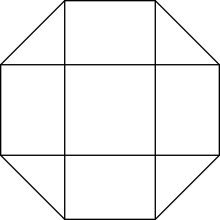
A dart board is a regular octagon divided into regions as shown. Suppose that a dart thrown at the board is equally likely to land anywhere on the board. What is the probability that the dart lands within the center square?
小提示:
设八边形边长为 ,把它分成中心正方形、四个长方形和四个角上的三角形。
Set the octagon’s edge to and split it into the center square, four rectangles, and four corner triangles
大提示:
角上的三角形是直角等腰三角形,直角边长为 。
The corner triangles are right isosceles with legs
解答:
设八边形边长为 。四个角上的三角形是直角等腰三角形,直角边长为 ,每个面积为 。四个长方形尺寸为 乘 ,每个面积为 ,中心正方形面积为 。
总面积为 因此击中中心正方形的概率为
所以正确答案是 A。
Assume the octagon has edge length The four corner triangles are right isosceles with legs and area each. The four rectangles are by with area each, and the center square has area
The total area is The probability of hitting the center square is
Thus, the correct answer is A.
13.
Brian 写下四个整数 ,它们的和是 。这些数两两之间的正差为 ,,,, 和 。 的所有可能值之和是多少?
Brian writes down four integers whose sum is The pairwise positive differences of these numbers are and What is the sum of the possible values for
小提示:
最大差为 ,而最小的正差必须是 。
The largest difference is and the smallest positive difference must be
大提示:
第二大的差 可能是 或 ;分别讨论。
The second largest difference is either or ; handle each case
解答:
最大差为 。对任意一个中间数 ,都有 。所列差值中,和为 的数对只有 和 ,所以剩下的差必为 。
第二大的差 只能是 或 。若 ,四个数是 ,所以 ,得到 。若 ,四个数是 ,所以 ,得到 。
可能的值是 和 ,它们的和为 。
因此,正确答案是 B。
The largest difference is For either interior number we have The only pairs among the listed differences that sum to are and so the remaining difference must be
The second largest difference is either or If the numbers are so and If the numbers are so and
The possible values are and which sum to
Thus, the correct answer is B.
14.
一条线段经过抛物线的焦点 ,且垂直于 ,其中 是抛物线顶点。该线段与抛物线交于 与 。 等于多少?
A segment through the focus of a parabola with vertex is perpendicular to and intersects the parabola in points and What is
小提示:
令 。用焦点-准线性质求 ,再求 。
Let Use the focus-directrix property to find and then
大提示:
先求 ,再用二倍角公式,因为 。
Find then via the double angle formula
解答:
令 ,准线为 。把 与 投影到 上,由焦点与准线的性质可得 ,即 到 的距离。再由勾股定理,
于是 。因为 ,所以
所以正确答案是 D。
Let and let the directrix be Projecting and onto the focus-directrix property gives (the distance from to ), and by the Pythagorean Theorem
Then Since
Thus, the correct answer is D.
15.
有多少个正的两位数因数?
How many positive two-digit integers are factors of
小提示:
反复使用平方差来分解 。
Repeatedly apply the difference of squares to factor
大提示:
质因数分解为 ;列出其中的两位数因数。
The prime factorization is list two-digit products
解答:
分解得 即 。
因为 是三位质数,两位数因数只来自 。它们是 共 个。
所以正确答案是 D。
Factoring, which equals
Since is a three-digit prime, the two-digit factors come from They are for a total of
Thus, the correct answer is D.
16.
菱形 的边长为 ,且 。区域 由菱形内部所有比到其他三个顶点都更靠近顶点 的点组成。 的面积是多少?
Rhombus has side length and Region consists of all points inside the rhombus that are closer to vertex than any of the other three vertices. What is the area of
小提示:
区域 的边界在经过 的两条边的垂直平分线上。
The boundary of lies along the perpendicular bisectors of the sides through
大提示:
是一个五边形,由四个全等的 -- 三角形组成,每个都有一条长为 的直角边。
is a pentagon made of four congruent -- triangles, each with a leg of length
解答:
设 和 分别为 与 的中点。 的垂直平分线经过 与对角线 交于 ; 的垂直平分线经过 与 交于 。区域 是五边形 。
三角形 是 -- 三角形,且 ,所以面积为 。三角形 和 与它全等,而 是等边三角形,可分成另外两个相同的小三角形。
因此 由四个全等三角形组成,面积为 。
所以正确答案是 C。
Let and be the midpoints of and The perpendicular bisector of through meets diagonal at and the perpendicular bisector of through meets at The region is the pentagon
Triangle is a -- triangle with so its area is Triangles and are congruent to it, and is equilateral, splitting into two more copies.
Hence consists of four congruent triangles, giving area
Thus, the correct answer is C.
17.
设 ,,;对整数 ,令 。 的各位数字之和是多少?
Let and for integers What is the sum of the digits of
小提示:
将 化简成一次函数。
Simplify to a linear function
大提示:
迭代后, 是一个数字全为 、末位为 的数。
Iterating gives as a number whose digits are all ’s ending in a
解答:
首先,
迭代可得 。因此 是一个 位整数,个位为 ,其余各位都是 。
当 时,数字和为
所以正确答案是 B。
First,
Iterating, Therefore is an -digit integer whose units digit is and all of whose other digits are
For the digit sum is
Thus, the correct answer is B.
18.
一个四棱锥的底面是边长为 的正方形,侧面都是等边三角形。一个立方体放在该四棱锥内,使它的一个面在四棱锥底面上,而相对的那个面所有边都在四棱锥的侧面上。这个立方体的体积是多少?
A pyramid has a square base with sides of length and has lateral faces that are equilateral triangles. A cube is placed within the pyramid so that one face is on the base of the pyramid and its opposite face has all its edges on the lateral faces of the pyramid. What is the volume of this cube?
小提示:
用经过底面对角线和顶点的平面截四棱锥。
Slice the pyramid through the plane containing a diagonal of the base and the apex
大提示:
该截面是一个斜边为 的等腰直角三角形;立方体在该截面中对应一个高为 、宽为 的长方形
That cross-section is an isosceles right triangle with hypotenuse the cube meets it in a rectangle of height and width
解答:
设顶点为 ,底面正方形为 。于是 ,且 ,所以 是等腰直角三角形。
设立方体边长为 。它与 所在平面的交线是一个高为 、宽为 的长方形,其上方两个顶点在 与 上。因为 与 与底边成 ,长方形外侧的两段 各长 ,所以 得 。
体积为
所以正确答案是 A。
Let the apex be and the base be square Then and so is an isosceles right triangle.
Let the cube have edge length Its intersection with the plane of is a rectangle of height and width whose top corners lie on and Because the legs and meet the base at each portion of outside the rectangle has length so which reduces to
The volume is
Thus, the correct answer is A.
19.
在 -坐标系中,格点是指 中 与 都为整数的点。对所有满足 的 ,直线 都不经过任何满足 的格点。 的最大可能值是多少?
A lattice point in an -coordinate system is any point where both and are integers. The graph of passes through no lattice point with for all such that What is the maximum possible value of
小提示:
对每个 ,找出从 出发、斜率 且能到达该 处格点的最小斜率。
For each find the smallest slope from that reaches a lattice point at that
大提示:
分别比较偶数 与奇数 对应的最小斜率;较小者给出限制
Compare the minimum slopes for even and odd the tighter bound wins
解答:
对 ,在直线 上方最近的格点为:当 为偶数时是 ;当 为奇数时是 。
从 到该点的斜率,偶数 时为 ,奇数 时为 。这些斜率的最小值在偶数 时为 ,在奇数 时为 。
因为 ,直线恰在 时避开所有这些格点,所以最大值为 。
所以正确答案是 B。
For the nearest lattice point above the line is if is even and if is odd.
The slope from to that point is for even and for odd The minimum such slope is for even and for odd
Since the line avoids all these lattice points exactly when so the maximum is
Thus, the correct answer is B.
20.
三角形 中,,,。点 、、 分别是 、、 的中点。设 是 与 的外接圆的另一个交点。 等于多少?
Triangle has and The points and are the midpoints of and respectively. Let be the intersection of the circumcircles of and What is
小提示:
利用中位线平行和圆周角定理,证明 到 、、 距离相等。
Use the parallel midsegments and the Inscribed Angle Theorem to show is equidistant from
大提示:
是外心,所以 ,其中 。
is the circumcenter, so where
解答:
因为 且 ,所以 。由圆周角定理, 且 ,从而 。再由 ,可得 。
此外,。在 中使用弦长公式,得到 ,在 中使用同一公式,得到 。因此 。在 的这一侧,到 和 的距离都等于 的点就是 的外心,所以 。
由海伦公式,-- 三角形的面积是 ,所以 并且 。
因此,正确答案是 C。
Since and we get By the Inscribed Angle Theorem, and so With this forces
Also The chord formula in gives while the same formula in gives Thus The point at distance from both and on this side of is the circumcenter of so
The area of the -- triangle is by Heron’s formula, so and
Thus, the correct answer is C.
21.
两个不同正整数 和 的算术平均数是一个两位整数。 和 的几何平均数等于把这个算术平均数的两位数字颠倒后得到的数。 是多少?
The arithmetic mean of two distinct positive integers and is a two-digit integer. The geometric mean of and is obtained by reversing the digits of the arithmetic mean. What is
小提示:
将算术平均数写成 ,几何平均数写成 。
Write the arithmetic mean as and the geometric mean as
大提示:
计算 ;它可分解为 。
Compute it factors as
解答:
设算术平均数为 ,几何平均数为 ,则 ,且 。
因此 由于对两个不相等的正数,算术平均数大于几何平均数,所以 。令 ,。于是 且 。要使 为完全平方数, 中必须含有奇数次幂的 。因此 ,这是因为 且 。此时 是完全平方数,所以 也是完全平方数。又因为 与 的奇偶性相同,只剩下 或 。后者给出 ,它不是一位数字,所以 ,从而 。
于是 ,所以 。(确实有 。)
所以正确答案是 D。
Let the arithmetic mean be and the geometric mean be Then and
Therefore Since the arithmetic mean exceeds the geometric mean for distinct positive numbers, Put and Then and For to be a square, must contain an odd power of Therefore because and Now is a square, so is a square. Also and have the same parity, leaving or The latter gives not a digit, so and
Then so (Indeed )
Thus, the correct answer is D.
22.
设 是边长为 , 和 的三角形。对 ,若 ,且 、、 分别是 的内切圆与边 、、 的切点,那么若三角形存在, 的边长为 、、。序列 中最后一个三角形的周长是多少?
Let be a triangle with sides and For if and and are the points of tangency of the incircle of to the sides and respectively, then is a triangle with side lengths and if it exists. What is the perimeter of the last triangle in the sequence
小提示:
切线段长度满足 , 与 类似。
The tangent lengths satisfy and similarly for and
大提示:
每个三角形保持 的形式,且 每次减半;当 时不满足三角形不等式。
Each triangle keeps the form with halving; it fails the triangle inequality once
解答:
对边长为 的三角形,切线段长度为 、、。若 的边长为 ,则 的边长为 。
从中间边为 的 开始,中间边每步减半,且 的周长是 周长的 。这种形式的三角形存在当且仅当中间边大于 。
的中间边为 。它在 时第一次不超过 ,所以最后一个有效三角形是 ,其中间边为 ,周长为
所以正确答案是 D。
For a triangle with sides the tangent lengths are and If has sides then has sides
Starting from with middle side the middle side halves each step and the perimeter of is the perimeter of A triangle of this form exists only while its middle side exceeds
The middle side of is This first drops to or below at so the last valid triangle is whose middle side is and whose perimeter is
Thus, the correct answer is D.
23.
一只虫子在坐标平面上移动,只沿着平行于 -轴或 -轴的直线行走。设 、。考虑所有从 到 、长度至多为 的可能路径。有多少个整数坐标点位于至少一条这样的路径上?
A bug travels in the coordinate plane, moving only along the lines that are parallel to the -axis or -axis. Let and Consider all possible paths of the bug from to of length at most How many points with integer coordinates lie on at least one of these paths?
小提示:
点 在某条这样路径上,当且仅当它的出租车距离满足 。
A point lies on such a path iff its taxicab distances satisfy
大提示:
这就是 ;按关于坐标轴的对称性计数。
This is count by symmetry across the axes
解答:
格点 位于某条路径上,当且仅当 该式在 或 时不变,所以先数 、 的点,再乘以 ,并校正坐标轴上的重复计数。
若 且 ,则这 个点全都满足条件。若 且 ,则 ,共给出 个点。若 且 ,则 ,共给出 个点。最后,当 且 时,条件化为 ,共给出 个点。于是第一象限中共有 个点,其中 个位于非负坐标轴上。由对称性,总数为
所以正确答案是 C。
A lattice point lies on some path exactly when This expression is unchanged when or so we count points with multiply by and correct for the axes.
If and all points work. If and then giving points. If and then giving points. Finally, for and the condition is giving points. Thus there are in the first quadrant, including on the nonnegative axes. By symmetry the total is
Thus, the correct answer is C.
24.
设 。在复平面中,以 的所有零点为顶点的 边形中,最小周长是多少?
Let What is the minimum perimeter among all the -sided polygons in the complex plane whose vertices are precisely the zeros of
小提示:
把 看作关于 的二次式,并分解为 。
Treat as a quadratic in and factor as
大提示:
因为 ,八个根分布在两个正方形上;最短边长为 。
Since the eight roots lie on two squares; the shortest edges have length
解答:
按 分解: 第一因子给出根 。又因为 ,且 ,令 ,另四个根为 。
这八个根关于原点对称,并具有 重旋转对称性;任意两个根之间的线段长度至少为 。因此任何这样的八边形周长至少为 ,而依次取顶点 、、、、、、、 时可达到该下界。
所以正确答案是 B。
Factoring in The first factor gives the roots Since and writing the other four roots are
The eight roots are symmetric about the origin with -fold symmetry, and every segment joining two of them has length at least Thus any such polygon has perimeter at least and the polygon with vertices achieves it.
Thus, the correct answer is B.
25.
对任意整数 和 ,其中 为奇数,记 为最接近 的整数。对每个奇整数 ,从区间 中随机选取一个整数 ,并令 为下式成立的概率: 当 遍历区间 内的所有奇整数时, 的最小可能值是多少?
For every and integers with odd, denote by the integer closest to For every odd integer let be the probability that for an integer randomly chosen from the interval What is the minimum possible value of over the odd integers in the interval
小提示:
是否满足条件只取决于 ,且每个剩余类等可能。
Whether works depends only on and each residue class is equally likely
大提示:
写 ,其中 ;则 。
Write with then
解答:
因为 ,所以 是否满足恒等式只取决于 。由于 能被 整除对 成立,每个剩余类等可能。
写 和 ,其中两个余数都取自 。若 ,则不发生进位当且仅当 ;这给出 个剩余类。 的情形同样给出 个剩余类。因此两种情形下都有
要最小化 ,就要最大化 。若 ,则 ,而满足 的最大取值是 的因数 。若 ,则 ;因为 是质数,只有 可能。在其余所有情形中都有 ,所以 而当 时,
所以正确答案是 D。
Because whether satisfies the identity depends only on Since is divisible by for every residue class is equally likely.
Write and choosing both remainders in If no carry occurs precisely when this gives residue classes. The case similarly gives classes. Hence in both cases
To minimize we maximize If then and the largest possible is the divisor of If then because is prime, only is possible. In every remaining case so For
Thus, the correct answer is D.