
2018 AMC 10B 详解
向下滚动即可查看来自 LIVE by Po-Shen Loh 的精心整理的解答,打印PDF 解答,查看答案,或参加完整限时模拟考试。
所有题目均经美国数学协会(MAA)官方合法授权使用。
1.
Kate 烤了一盘 英寸乘 英寸的玉米面包。玉米面包被切成 英寸乘 英寸的小块。这一盘共有多少块玉米面包?
Kate bakes a -inch by -inch pan of cornbread. The cornbread is cut into pieces that measure inches by inches. How many pieces of cornbread does the pan contain?
小提示:
整盘和每一小块都是矩形;比较它们的面积。
The pan and each piece are rectangles; compare their areas
大提示:
用总面积除以一个 小块的面积。
Divide the total area by the area of one piece
解答:
整盘面积为 平方英寸。每小块面积为 平方英寸。因此小块数为 。正确答案是 A。
The whole pan has area square inches. Each piece is square inches. So the number of pieces is Thus, A is the correct answer.
2.
Sam 在 分钟内开了 英里。前 分钟他的平均速度是每小时 英里,第二个 分钟的平均速度是每小时 英里。最后 分钟他的平均速度是每小时多少英里?
Sam drove miles in minutes. His average speed during the first minutes was mph (miles per hour), and his average speed during the second minutes was mph. What was his average speed, in mph, during the last minutes?
小提示:
距离等于速度 时间,每段 分钟是半小时。
Distance = rate time, and each -minute leg is half an hour
大提示:
从 英里中减去前一小时行驶的距离,得到最后一段的距离。
Subtract the distance covered in the first hour from to get the last leg’s distance
解答:
每段都是半小时。第一段行驶 英里,第二段行驶 英里。前两段共 英里,还剩 英里。最后半小时的速度为 英里每小时。因此正确答案是 D。
Each leg is half an hour. In the first, Sam drove miles; in the second, miles. That’s miles so far. That leaves miles for the last half hour, which is a speed of mph. Therefore, the answer is D.
3.
在表达式 中,每个空格要填入数字 、、 或 ,且每个数字恰好使用一次。可以得到多少个不同的值?
In the expression each blank is to be filled in with one of the digits or with each digit being used once. How many different values can be obtained?
小提示:
乘法顺序和最后相加的顺序都不影响结果,所以只需看四个数字怎样分成两对。
Neither multiplication nor the final addition depends on order, so only the way the four digits are split into two pairs matters
大提示:
列出把 分成两对的三种方式。
List the three ways to split into two pairs
解答:
乘积中数字的顺序以及两个乘积相加的顺序都不影响结果,所以只需考虑把四个数字分成两对。有三种分法:、 以及 。因此可以得到 个不同的值。正确答案是 B。
Order inside a product doesn’t matter, and neither does the order we add the two products. So all that matters is how the four digits split into two pairs. There are three splits: and That’s different values. Thus, B is the correct answer.
4.
一个长方体的三条边长为 、 和 ,它的六个面的面积分别为 ,,,, 和 平方单位。求 。
A three-dimensional rectangular box with dimensions and has faces whose surface areas are and square units. What is
小提示:
三种不同的面面积是两两乘积 ,分别为 。
The three distinct face areas are the pairwise products equal to
大提示:
把三个面积相乘得到 ;开方后再除以各个面面积。
Multiplying all three gives take the square root, then divide by each face area
解答:
三种不同的面面积是两两乘积 、、,次序可以互换。三式相乘得 ,所以 。分别除以三个面面积,得到 、 和 ,因此 。正确答案是 B。
The three distinct face areas are the pairwise products in some order. Multiply all three: so Now divide by each face area. We get and so Therefore, the answer is B.
5.
集合 的子集中,有多少个至少包含一个质数?
How many subsets of contain at least one prime number?
小提示:
数不含质数的子集,再从所有子集中减去。
Count the subsets with no prime and subtract from the total number of subsets
大提示:
非质数元素是 ;只由它们组成的任意子集都不含质数。
The non-prime elements are any subset of just those contains no prime
解答:
反过来计数。这个集合共有 个子集。不含任何质数的子集只能从非质数 中选出,共 个。所以至少含一个质数的子集有 个。正确答案是 D。
Count the complement. The set has subsets total. A subset avoids every prime exactly when it sticks to the non-primes and there are of those. So subsets contain at least one prime. Thus, D is the correct answer.
6.
一个盒子里有 个筹码,编号为 、、、 和 。每次随机抽出一个筹码且不放回,直到抽出的编号之和超过 。需要抽 次的概率是多少?
A box contains chips, numbered and Chips are drawn randomly one at a time without replacement until the sum of the values drawn exceeds What is the probability that draws are required?
小提示:
恰好需要第三次抽取,当且仅当前两个筹码的和仍不超过 。
A third draw is needed exactly when the first two chips still sum to at most
大提示:
哪些不同筹码对的和不超过 ?在所有有序前两次抽取中计数。
Which pairs of distinct chips sum to or less? Count them among all ordered first-two-draw outcomes
解答:
恰好需要第三次抽取,当且仅当前两个筹码的和仍不超过 。这样的无序对只有 和 。每一对都可以按两种顺序抽出,所以有利的有序前两次抽取共有 种。
设想事先就把五个筹码的完整随机顺序定好。这样前两个筹码的 种有序结果都是等可能的,即使实际过程会在抽出第一个筹码后就停止也不影响。因此概率为 。正确答案是 D。
We need a third draw exactly when the first two chips still sum to or less. The only such unordered pairs are and Each can be drawn in either order, giving favorable ordered prefixes.
Imagine that a complete random ordering of all five chips is chosen in advance. Then all ordered first-two-chip prefixes are equally likely, even when the actual process would stop after the first chip. Thus the probability is Therefore, the answer is D.
7.
下图中,沿着一个大半圆的直径画了 个全等的小半圆,它们的直径无重叠地覆盖大半圆的直径。设 为这些小半圆面积之和, 为大半圆内部但小半圆外部区域的面积。若 为 ,求 。
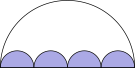
In the figure below, congruent semicircles are drawn along a diameter of a large semicircle, with their diameters covering the diameter of the large semicircle with no overlap. Let be the combined area of the small semicircles and be the area of the region inside the large semicircle but outside the small semicircles. The ratio is What is
小提示:
若每个小半圆半径为 ,则大半圆半径为 。
If each small semicircle has radius the large semicircle has radius
大提示:
证明 ,再令它等于 。
Show then set this equal to
解答:
设每个小半圆半径为 。因为 个小直径覆盖大直径,所以大半圆半径为 。小半圆面积之和为 ,大半圆面积为 ,所以剩余区域面积为 。因此 。令 ,得 。正确答案是 D。
Let each small semicircle have radius The diameters cover the big diameter, so the large radius is Then and the large semicircle has area so the leftover region is This gives Set and Thus, D is the correct answer.
8.
Sara 用牙签搭了如下楼梯:

这是一个 级楼梯,使用了 根牙签。如果一个楼梯使用了 根牙签,它有多少级?
Sara makes a staircase out of toothpicks as shown:
This is a -step staircase and uses toothpicks. How many steps would be in a staircase that used toothpicks?
小提示:
数 级楼梯的牙签数;竖直牙签数为 。
Count the toothpicks in an -step staircase; the vertical ones number
大提示:
水平和竖直牙签数相等,总数为 ;解 。
With equal horizontal and vertical counts the total is solve
解答:
级楼梯中,竖直牙签数为 ,水平牙签数与其相同,因此总数为 。检验可知 时有 根牙签。令 。因式分解得 ,所以 。正确答案是 C。
In an -step staircase the vertical toothpicks number and there are just as many horizontal ones. That’s a total of Check: gives as it should. Now solve This factors as so Therefore, the answer is C.
9.
个标准骰子的每个面分别标有整数 到 。设 为这 个骰子同时掷出时,上方面点数之和为 的概率。还有哪个点数和出现的概率也等于 ?
The faces of each of standard dice are labeled with the integers from to Let be the probability that when all dice are rolled, the sum of the numbers on the top faces is What other sum occurs with the same probability
小提示:
把每个骰子的点数 替换为 ,可把等概率结果一一配对。
Replacing each die value by pairs up equally likely outcomes
大提示:
这个替换会把总和 变为 。
This replacement sends a total of to a total of
解答:
对每个骰子,把点数 替换为 。这会把所有掷骰结果一一配对,且概率不变;原总和为 时,新总和为 。因此总和 与 出现的概率相同。与 配对的是 。正确答案是 D。
Replace each die’s value by This pairs up outcomes one-to-one and keeps their probabilities, and it sends a total of to So the sums and are equally likely. The partner of is Thus, D is the correct answer.
10.
在图示长方体中,、,且 。点 是 的中点。以 为底、 为顶点的棱锥体积是多少?
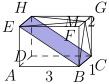
In the rectangular parallelepiped shown, and Point is the midpoint of What is the volume of the rectangular pyramid with base and apex
小提示:
将 放在原点,三条棱沿坐标轴,求矩形 及其面积。
Place at the origin with the edges along the axes; find the rectangle and its area
大提示:
体积 。
Volume
解答:
将 放在原点,并令三条棱沿坐标轴:、、、、、、,所以 。底面 是矩形,且 ,,所以底面积为 。底面所在平面为 ,点 到该平面的距离为 。体积为 。正确答案是 E。
Put at the origin with edges along the axes: so The base is a rectangle with and hence area Its plane is and sits at distance from it. The volume is Therefore, the answer is E.
11.
当 是质数时,下面哪个表达式永远不是质数?
Which of the following expressions is never a prime number when is a prime number?
小提示:
逐一考察这些表达式模 的余数;若质数 ,则 。
Test the expressions modulo for a prime
大提示:
对正确选项,还要单独检查 ,再说明其他质数时它总是 的倍数。
For the correct choice, also check separately, then show it is a multiple of for all other primes
解答:
考虑 。若 ,则它等于 ,不是质数。若 是其他质数,则它不被 整除,所以 ,并且 。无论哪种情况,它都是大于 的 的倍数,因此不是质数。正确答案是 C。
Look at When it’s For any other prime, isn’t divisible by so and Either way it’s a multiple of bigger than hence composite. So it’s never prime. Thus, C is the correct answer.
12.
线段 是一个圆的直径,且 。点 在圆上,但不等于 或 。当 绕圆运动时, 的重心描出一条少了两个点的闭曲线。四舍五入到最接近的正整数,这条曲线围成区域的面积是多少?
Line segment is a diameter of a circle with Point not equal to or lies on the circle. As point moves around the circle, the centroid (center of mass) of traces out a closed curve missing two points. To the nearest positive integer, what is the area of the region bounded by this curve?
小提示:
的重心是 ,而 是圆心的两倍。
The centroid of is and is twice the center
大提示:
当 在半径为 的圆上运动时,重心在半径为其三分之一的圆上运动。
As moves on a circle of radius the centroid moves on a circle of one third the radius
解答:
把圆心 放在原点,则可取 、,而 在半径为 的圆上运动。因为 ,重心为 。当 绕圆运动时, 描出半径为 的圆,少掉 或 时的两个点不影响面积。面积为 。正确答案是 C。
Put the center at the origin, so and while runs over the circle of radius Then so the centroid is As circles, traces a circle of radius (minus the two points where or ). Its area is Therefore, the answer is C.
13.
数列 ,,,, 的前 项中,有多少项能被 整除?
How many of the first numbers in the sequence are divisible by
小提示:
第 项是 ,当 时能被 整除。
The -th term is which is divisible by when
大提示:
因为 ,所以 正好在 时发生。
so exactly when
解答:
第 项为 ,它能被 整除,当且仅当 。因为 ,所以 当且仅当 。因此需要 ,即 。在 中,符合条件的是 ,共有 个。正确答案是 C。
The -th term is which divides iff Notice So exactly when meaning that is Among the values number Thus, C is the correct answer.
14.
一个由 个正整数组成的列表有唯一的众数,且这个众数恰好出现 次。这个列表中最少可能出现多少个不同的值?
A list of positive integers has a unique mode, which occurs exactly times. What is the least number of distinct values that can occur in the list?
小提示:
众数以外的每个值最多出现 次,否则会与众数并列。
Every value other than the mode can appear at most times, to keep the mode unique
大提示:
若有 个不同值,列表最多容纳 项;令它至少为 。
With distinct values the list holds at most entries; make this at least
解答:
众数出现 次。为了让不同值个数尽量少,其余每个值都应尽量多出现,但最多只能出现 次,否则会与众数并列。若共有 个不同值,最多可有 项。需要 ,因此 ,也就是 。正确答案是 D。
The mode shows up times. To keep the number of distinct values small, let every other value repeat as much as the rules allow, which is times each (any more would tie the mode). With distinct values the list holds at most entries. We need so giving Therefore, the answer is D.
15.
一个正方形底面的封闭盒子要用一张正方形包装纸包裹。如左图所示,盒子放在包装纸中央,底面顶点位于正方形纸张的中线上。包装纸的四个角将沿盒子侧面向上折,并在盒子顶面中心、即右图中的点 处相会。盒子底边长为 ,高为 。包装纸的面积是多少?
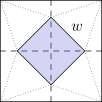
A closed box with a square base is to be wrapped with a square sheet of wrapping paper. The box is centered on the wrapping paper with the vertices of the base lying on the midlines of the square sheet of paper, as shown in the figure on the left. The four corners of the wrapping paper are to be folded up over the sides and brought together to meet at the center of the top of the box, point in the figure on the right. The box has base length and height What is the area of the sheet of wrapping paper?
小提示:
若包装纸边长为 ,从中心到角的距离为 。
If the sheet has side its center-to-corner distance is
大提示:
一个角折到顶部中心时,沿直线依次经过半个底面、盒子高度 ,再经过顶部的半边。
Folding a corner to the top center covers, in a straight line, half the base, then the side of height then the other half of the top
解答:
设包装纸边长为 ,盒子底面边长为 。包装纸中心到一个角的距离为 。盒子底面相对于包装纸旋转了 ,所以从底面中心到一条边的距离为 。一个角折到盒子顶部中心时,依次经过 、高度 和另一个 ,因此 。所以 ,包装纸面积为 。正确答案是 A。
Let the sheet have side The base sits as a square of side turned so the center is from each base edge. A corner of the sheet lies from the center. Folding that corner up to the top center traces a straight line: out to the base edge, then up the side, then across the top. So Then and the area is Thus, A is the correct answer.
16.
设 ,,, 是一个严格递增的正整数数列,且
除以 的余数是多少?
Let be a strictly increasing sequence of positive integers such that
What is the remainder when is divided by
小提示:
,因为 是三个连续整数的乘积。
because is a product of three consecutive integers
大提示:
因此立方和同余于 ;再把它对 取模。
So the sum of cubes is congruent to reduce that modulo
解答:
对任意整数 , 是三个连续整数的乘积,所以能被 整除。因此 。求和得到 。因为 ,而 的幂模 的余数按 交替,指数 为偶数,所以 ,余数为 。正确答案是 E。
For any integer is a product of three consecutive integers, so it’s divisible by That means Summing, Now and powers of mod alternate The exponent is even, so The remainder is Therefore, the answer is E.
17.
在长方形 中,,。点 、 在 上,点 、 在 上,点 、 在 上,点 、 在 上,满足 ,并且凸八边形 是等边的。这个八边形的边长可写成 ,其中 、、 是整数,且 不被任何质数的平方整除。求 。
In rectangle and Points and lie on points and lie on points and lie on and points and lie on so that and the convex octagon is equilateral. The length of a side of this octagon can be expressed in the form where and are integers and is not divisible by the square of any prime. What is
小提示:
四个被切掉的角是全等直角三角形,其在长为 的边上的腿为 ,在长为 的边上的腿为 。
The four cut corners are congruent right triangles with legs (on the sides of length ) and (on the sides of length )
大提示:
等边条件给出 ;先由第一个等式得 ,再代入平方。
The equal sides give the first equality gives then substitute and square
解答:
设八边形的边长为 ,并设 。直角三角形 和 的斜边同为 ,且都有一条长为 的直角边,所以它们全等;记 。因为 ,且长方形两条竖边的长度都为 ,所以 。于是 和 处的直角三角形全等,从而 。因为 ,且 ,这两个相等长度都为 。所以四个被切去的角的两条直角边都是 和 。
八边形各边相等,给出 第一个等式给出 。代入并平方,得到 ,所以满足 的根为 。
边长为 ,所以 。因此正确答案是 B。
Let be the octagon’s side length and let The right triangles and have the same hypotenuse and a leg of length so they are congruent; write Because and the vertical sides of the rectangle both have length it follows that The right triangles at and are then congruent, so Since and each of these equal lengths is Thus all four cut corners have legs and
The equal octagon sides give The first equality gives Substituting and squaring gives so the root with is
The side length is so Thus, B is the correct answer.
18.
来自三个不同家庭的三对年幼兄妹需要乘面包车出行。这六个孩子将坐在车的第二排和第三排,每排有三个座位。为了避免打闹,兄妹不能在同一排相邻而坐,也不能一个正好坐在另一个的正前方。共有多少种座位安排?
Three young brother-sister pairs from different families need to take a trip in a van. These six children will occupy the second and third rows in the van, each of which has three seats. To avoid disruptions, siblings may not sit right next to each other in the same row, and no child may sit directly in front of his or her sibling. How many seating arrangements are possible for this trip?
小提示:
说明每一排必须恰好有每个家庭的一个孩子。
Show that each row must contain exactly one child from each family
大提示:
第三排各列的家庭必须都不同于第二排对应列,这是一个错排;每对兄妹还可互换各自的座位。
The third row’s families must differ from the second row’s in every column (a derangement), and each pair’s two children can be swapped between their seats
解答:
若某个家庭的两个孩子坐在同一排,他们只能坐在该排的第 和第 个座位,这会迫使另一个家庭的两个孩子坐在同一列,违反条件。因此每排必须恰好有每个家庭的一个孩子。第二排安排三个家庭有 种。第三排必须在每一列都与第二排家庭不同,是三个元素的错排,共 种。最后每对兄妹可互换座位,共 种。因此总数为 。正确答案是 D。
Suppose some family put both children in one row. They’d have to take the non-adjacent seats and which forces the middle family’s two children into the same column. Not allowed. So each row holds exactly one child from each family. The second row is a permutation of the three families, ways. The third row needs a different family in every column, a derangement of the second row’s order, and there are of those. Finally, each pair can swap its two children between their seats, ways. The total is Therefore, the answer is D.
19.
Joey、Chloe 和他们的女儿 Zoe 都同一天生日。Joey 比 Chloe 大 岁,Zoe 今天正好 岁。今天是 Chloe 的年龄会是 Zoe 年龄整数倍的 个生日中的第一个。下一次 Joey 的年龄是 Zoe 年龄的整数倍时,Joey 年龄的两个数字之和是多少?
Joey and Chloe and their daughter Zoe all have the same birthday. Joey is year older than Chloe, and Zoe is exactly year old today. Today is the first of the birthdays on which Chloe’s age will be an integral multiple of Zoe’s age. What will be the sum of the two digits of Joey’s age the next time his age is a multiple of Zoe’s age?
小提示:
设 Chloe 今天 岁。在 年后,她的年龄是 Zoe 年龄的整数倍,当且仅当 整除 。
Let Chloe be today. In years her age is a multiple of Zoe’s iff divides
大提示:
恰好 个这样的生日意味着 有 个因子;找出两位数情形,然后对 Joey 重复整除思路。
Exactly such birthdays means has divisors; find the two-digit value, then repeat the divisor idea for Joey
解答:
设 Chloe 今天 岁,Zoe 今天 岁。 年后,她们的年龄之比为 它是整数当且仅当 整除 。因此 恰好有 个正因子。
有 个正因子的数形如 或 。其中唯一的两位数是 ,所以 Chloe 今天 岁,Joey 今天 岁。
现在 Joey 的年龄 是 (即 Zoe 年龄)的倍数,当且仅当 整除 。所以下一次发生在 ,此时 Joey 岁,数字和为 。正确答案是 E。
Let Chloe be today; Zoe is In years their age ratio is which is an integer exactly when divides Thus has exactly positive divisors.
A number with divisors has the form or The only two-digit possibility is so Chloe is and Joey is
Joey’s age is a multiple of Zoe’s age exactly when divides The next time is when Joey is Its digit sum is Thus, E is the correct answer.
20.
函数 递归定义为 ,且
对所有整数 成立。求 。
A function is defined recursively by and
for all integers What is
小提示:
寻找形如 的特解;减去它后得到 。
Look for a particular solution of the form subtracting it leaves
大提示:
这个齐次递推的周期为 ;把 对 取模。
That homogeneous recursion is periodic with period reduce modulo
解答:
注意 本身就满足这个递推式,因此令 ,则 满足对应的齐次递推 。由初值得 且 ,于是序列以 为周期循环:。因为 ,所以 ,于是 。正确答案是 B。
Notice solves the recurrence on its own, so write Then satisfies the homogeneous version With and it cycles with period : Since we get so Therefore, the answer is B.
21.
Mary 选择了一个偶数 位数 。她把 的所有因子按从小到大的顺序从左到右写下:,,,,。某一刻 Mary 写下了 ,它是 的一个因子。写在 右边的下一个因子的最小可能值是多少?
Mary chose an even -digit number She wrote down all the divisors of in increasing order from left to right: At some moment Mary wrote as a divisor of What is the smallest possible value of the next divisor written to the right of
小提示:
利用 ,且 是一个偶数 位数并且是 的倍数。
and is an even -digit multiple of
大提示:
对候选的下一个因子 , 必须是 的倍数;找出使其小于 的最小 。
For a candidate next divisor must be a multiple of find the smallest keeping that under
解答:
设 是 之后的下一个因数。若 ,则 是 的倍数,这对四位数来说不可能。因此 。
因为 ,这个最大公因数至少为 。它也整除 ,所以 ,从而 。
这个界可以达到:当 时, 和 都是因数。下界说明二者之间不存在因数。因此最小的下一个因数是 ,正确答案是 C。
Let be the next divisor after If then is a multiple of impossible for a four-digit number. Thus
Since this gcd is at least It also divides so and hence
This bound is attained: for both and are divisors. The lower bound shows there is no divisor between them. Thus the smallest possible next divisor is and C is the correct answer.
22.
实数 和 独立且均匀地从区间 中随机选取。下面哪个数最接近 、 和 能作为一个钝角三角形三边长的概率?
Real numbers and are chosen independently and uniformly at random from the interval Which of the following numbers is closest to the probability that and are the side lengths of an obtuse triangle?
小提示:
边长 构成三角形需要 ;因为 是最长边,钝角条件是 。
A triangle with sides needs since is the longest side it is obtuse when
大提示:
在单位正方形中,这个区域是四分之一圆盘去掉直线 下方的三角形。
In the unit square this region is a quarter disk with the triangle below removed
解答:
三边 构成三角形,当且仅当 。又因为 是最长边,该三角形为钝角,当且仅当 。因此在单位正方形中,所求区域位于四分之一圆 内、直线 上方,也就是四分之一圆盘去掉弦下方的直角三角形,面积为 。最接近的选项是 。正确答案是 C。
The three lengths make a triangle iff Since is the longest side, that triangle is obtuse iff So in the unit square we want the region inside the quarter circle but above the line That’s the quarter disk with the right triangle under the chord removed: The closest choice is Therefore, the answer is C.
23.
有多少个正整数有序对 满足方程
其中 表示 和 的最大公因数, 表示它们的最小公倍数。
How many ordered pairs of positive integers satisfy the equation
where denotes the greatest common divisor of and and denotes their least common multiple?
小提示:
使用 ;令 ,。
Use let and
大提示:
方程变为 ;同时 必须整除 。
The equation becomes also must divide
解答:
回忆 。令 ,,则原方程变为
正因数分解给出 、、 和 。负因数分解会使 或 为负数,因此不可能。此外 必须整除 ,只有 满足这一点。
写成 和 。于是 且 ,所以 或 。因此符合条件的有序对是 和 ,正确答案是 B。
Recall Let and The equation becomes
The positive factor pairs give and The negative factor pairs make either or negative, so they are impossible. Also must divide and only passes.
Write and Then and so or Hence the two ordered pairs are and and B is the correct answer.
24.
设 是边长为 的正六边形。令 、、 分别为边 、、 的中点。某个凸六边形的内部恰好是 与 的内部交集。这个凸六边形的面积是多少?
Let be a regular hexagon with side length Denote by and the midpoints of sides and respectively. What is the area of the convex hexagon whose interior is the intersection of the interiors of and
小提示:
是边长为 的等边三角形; 是边长为 的等边三角形。
is equilateral with side is equilateral with side
大提示:
以正六边形的中心为公共中心,这两个三角形同心且相差 ;交集是 去掉三个伸出的角三角形。
Centered at the hexagon’s center the two triangles are concentric and rotated the overlap is minus its three protruding corner triangles
解答:
三角形 是边长为 的等边三角形,所以面积为
三角形 和 同心,且彼此旋转 。在 的每个顶点处, 的两边截出一个 -- 三角形,其斜边是半边长线段 。两条直角边分别为 和 ,所以每个角的面积为 。
去掉三个角后,面积为 因此答案是 C。
The triangle is equilateral with side so its area is
The triangles and are concentric and rotated from each other. At each vertex of the sides of cut off a -- triangle whose hypotenuse is the half-side segment Its legs are and so each corner has area
Removing the three corners gives Therefore, the answer is C.
25.
令 表示小于或等于 的最大整数。有多少个实数 满足方程 ?
Let denote the greatest integer less than or equal to How many real numbers satisfy the equation
小提示:
写 ,方程变为 ,所以 。
Writing the equation is so
大提示:
在每个区间 上,恰好在 时有一个解。
On each interval there is a solution exactly when
解答:
设 。方程可写成 。因为 ,所以 ,即 。在每个区间 上,函数 从 单调增加并趋近于但不取到 。它恰好在 时取到 。满足条件的整数为 ,共 个。正确答案是 C。
Let The equation reads and since this forces so On each interval the quantity increases from and approaches, but does not reach, It hits exactly once precisely when That holds for the integers which is solutions. Thus, C is the correct answer.