
2015 AIME I 真题
计时
3:00:00
1.
表达式 与 是在相邻的连续整数之间交替写入乘号和加号得到的。求整数 与 的正差。
The expressions and are obtained by writing multiplication and addition operators in an alternating pattern between successive integers. Find the positive difference between integers and
小提示:
通过把 中的每个乘积与 中有相同偶因子的乘积配对,计算
Compute by pairing each product in with the product in that shares its even factor
大提示:
每一对贡献 ,还剩下项 和
Each pair contributes and the leftover terms are and
解答:
逐项相减:每个括号中的差都形如 ,其中 。
因此
Subtract term by term: Each parenthesized difference has the form for
Therefore
2.
经济合作会议的九名代表中,有 名来自墨西哥的官员、 名来自加拿大的官员,以及 名来自美国的官员。在开幕会议期间,其中三名代表睡着了。假设这三名睡着的代表是随机确定的,恰有两名睡着者来自同一个国家的概率为 ,其中 与 是互质的正整数。求 。
The nine delegates to the Economic Cooperation Conference include officials from Mexico, officials from Canada, and officials from the United States. During the opening session, three of the delegates fall asleep. Assuming that the three sleepers were determined randomly, the probability that exactly two of the sleepers are from the same country is where and are relatively prime positive integers. Find
小提示:
所有 个睡着者三人组等可能;按提供这一对代表的国家来计数有利情况
All sleeper triples are equally likely; count the favorable ones by which country supplies the pair
大提示:
从人数为 的国家恰选两人,意味着先有 种选法,再从另外 人中选第三名睡着者
Exactly two from a country of size means choices for the pair times choices for the third sleeper
解答:
三名睡着者共有 个等可能的集合。恰有两人来自同一国家时,一个国家提供恰好两人,第三人来自不同国家:这一对来自美国有 种;来自加拿大有 种;来自墨西哥有 种。
概率为 ,已经是最简分数,所以 。
There are equally likely sets of three sleepers. Exactly two sleepers come from the same country when one country supplies exactly two of them and the third sleeper comes from a different country: ways with the pair from the United States, with the pair from Canada, and with the pair from Mexico.
The probability is already in lowest terms, so
3.
存在一个质数 ,使得 是某个正整数的立方。求 。
There is a prime number such that is the cube of a positive integer. Find
小提示:
设 ,并分解
Write and factor
大提示:
总是奇数,所以因子 必须全部来自 ;质数条件随后迫使
is always odd, so the factor must come entirely from primality then forces
解答:
设 ,则 。因为 是奇数,所以 为奇数,且 也是奇数。因此四个因子 都必须整除 :写成 ,于是 。为了使 为质数,必须有 ,所以 。
此时 ,它确实是质数,并且 。
Write so Since is odd, is odd, and is odd as well. Therefore all four factors of must divide write which gives For to be prime we need so
Then which is indeed prime, and
4.
点 在线段 上,且 、。点 和 在直线 的同侧,分别形成等边三角形 与 。设 为 的中点, 为 的中点。 的面积为 。求 。
Point lies on line segment with and Points and lie on the same side of line forming equilateral triangles and Let be the midpoint of and be the midpoint of The area of is Find
小提示:
令 为原点,取 、,并用等边三角形的高写出 与
Put at the origin with and and write and using equilateral-triangle altitudes
大提示:
计算中点 、 以及三条边长 、、;三角形 会是等边三角形
Compute the midpoints and and the three distances triangle turns out equilateral
解答:
取 、、。每个等边三角形的顶点位于底边中点上方,高为边长的 ,所以 ,。中点为 与 。
现在 ,,且 ,所以 是边长为 的等边三角形。其面积为 ,因此 。
Place and Each equilateral triangle has its apex above the midpoint of its base at height times the side, so and The midpoints are and
Now and so is equilateral with side Its area is so
5.
Sandy 的抽屉里有 双袜子,每双颜色不同。星期一,Sandy 从抽屉中的 只袜子里随机选出两只单袜。星期二,Sandy 从剩下的 只袜子里随机选出 只;星期三再从剩下的 只袜子里随机选出两只。星期三是 Sandy 第一次选到同色袜子的概率为 ,其中 与 是互质的正整数。求 。
In a drawer Sandy has pairs of socks, each pair a different color. On Monday Sandy selects two individual socks at random from the socks in the drawer. On Tuesday Sandy selects of the remaining socks at random and on Wednesday two of the remaining socks at random. The probability that Wednesday is the first day Sandy selects matching socks is where and are relatively prime positive integers. Find
小提示:
把 只袜子分成每天一组的若干组是对称的:重新排列这些天的顺序同样等可能
Splitting the socks into a sequence of daily pairs is symmetric: any reordering of the days is equally likely
大提示:
因此可改为计算星期一配对、随后星期二和星期三都不配对的概率,并跟踪每天剩下多少完整袜子对
So compute instead the probability of a match on Monday and then no match on Tuesday or Wednesday, tracking how many complete pairs remain each day
解答:
想象把十只袜子按每天两只发完五天;把无序袜子对分配到各天的所有方式等可能,而交换天数不会改变分布。因此交换星期一与星期三可知,所求概率(不配对、不配对、配对)等于星期一配对且星期二、星期三不配对的概率。
这个模式按顺序很容易计算。星期一配对的概率为 (第二只必须是第一只的另一只)。剩下的 只袜子构成 个完整对,所以星期二不配对的概率为 。星期二的不配对会拆开两对,在剩下的 只袜子中留下 个完整对,所以星期三不配对的概率为 。
概率为 ,所以 。
Imagine dealing all ten socks out two per day for five days; every assignment of unordered pairs to days is equally likely, and permuting the days does not change this distribution. Swapping Monday and Wednesday therefore shows that the desired probability (mismatch, mismatch, match) equals the probability of a match on Monday followed by mismatches on Tuesday and Wednesday.
That pattern is easy to compute in order. Monday matches with probability (the second sock must be the first sock’s mate). The remaining socks then form complete pairs, so Tuesday mismatches with probability Tuesday’s mismatch breaks two pairs, leaving complete pairs among the remaining socks, so Wednesday mismatches with probability
The probability is so
6.
点 、、、、 在一个圆的小弧上等间隔排列。点 、、、、、 在第二个以 为圆心的圆的小弧上等间隔排列,如下图所示。角 比 大 。求 的度数。
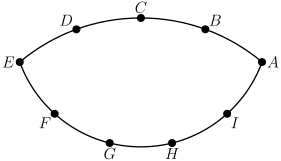
Points and are equally spaced on a minor arc of a circle. Points and are equally spaced on a minor arc of a second circle with center as shown in the figure below. The angle exceeds by Find the degree measure of
小提示:
设 为第二个圆在 处的公共圆心角;那么 同时也是第一个圆的圆周角
Let be the common central angle at in the second circle; then is simultaneously an inscribed angle of the first circle
大提示:
用 表示两个圆中的每段弧;条件 会确定
Express every arc of both circles in terms of the condition pins down
解答:
设 ,即第二个圆的公共圆心角,所以 。由于 也在第一个圆上, 是第一个圆中的圆周角,因而不含 的弧 度数为 ,四段相等弧 、、、 中每段为 。
角 截不含 的弧 ,其度数为 ,所以 。角 截第二个圆中不含 的弧 ,其度数为 ,所以 。已知条件为 因此 。
最后, 截第一个圆上的弧 ,所以 ,而 截第二个圆上的弧 ,所以 。于是 。
Let the common central angle of the second circle, so Since also lies on the first circle, is an inscribed angle there, so the arc not containing measures and each of the four equal arcs measures
Angle subtends the arc not containing which is so Angle subtends the second circle’s arc not containing which is so The given condition reads so
Finally, subtends the first circle’s arc giving and subtends the second circle’s arc giving Hence
7.
在下图中, 是正方形。点 是 的中点。点 和 在 上,点 和 分别在 与 上,使得 是正方形。点 与 在 上,点 与 分别在 与 上,使得 是正方形。 的面积为 。求 的面积。
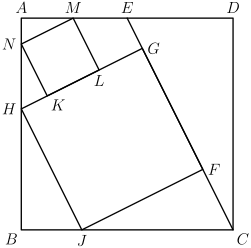
In the diagram below, is a square. Point is the midpoint of Points and lie on and and lie on and respectively, so that is a square. Points and lie on and and lie on and respectively, so that is a square. The area of is Find the area of
小提示:
由倾斜正方形截出的每个直角三角形(、、、)都与 相似,直角边比为
Every right triangle cut off by the tilted squares ( ) is similar to with legs in ratio
大提示:
写出 ,得到 的边长与 的关系;再用完全相同的方式由 得到 的边长
Write to get ’s side from then gives ’s side in exactly the same way
解答:
设 ,则大正方形边长为 ,且 。直角三角形 、、、 和 都相似,直角边比为 。设 的边长为 。在 中,斜边为 ,所以 ,;在 中,较长直角边为 ,所以斜边 。于是 所以 。
接着, 。对边长为 的正方形 ,沿 作同样的分解得到 。两式相除,得 。
因此面积比为 ,所以 的面积为 。
Let so the big square has side and The right triangles and are all similar, with legs in ratio Let be the side of In the hypotenuse is so and in the longer leg is so the hypotenuse is Then so
Next, The identical decomposition along for the square of side gives Dividing the two equations,
The areas are therefore in ratio so the area of is
8.
对正整数 ,令 表示 的各位数字之和。求满足 的最小正整数 。
For positive integer let denote the sum of the digits of Find the smallest positive integer satisfying
小提示:
加法中的每次进位都会使数字和减少 ,所以 ,其中 是进位次数
Each carry in an addition lowers the digit sum by so where counts the carries
大提示:
必须恰有两次进位,且百位一定进位;因此尝试第二个发生进位的位置,并让百位数字尽量小
Exactly two carries must occur, and the hundreds place always carries, so try each choice of the second carrying place and minimize the hundreds digit
解答:
加法中每次进位都把某一位的 替换为下一位的 ,使数字和减少 。因此 ,其中 是进位次数;而 迫使 。对于三位候选数 ,设其数字为 、、,且和为 。由于 ,有 ,所以百位一定进位(),并且个位与十位中恰好一个发生进位。
如果个位进位而十位不进位,则十位计算 必须小于 ,所以 ;此时 ,迫使 。如果十位进位而个位不进位,则 ,所以 ,从而 ,且 、、 可行:。
的确 ,且 ,,所以最小的这样的 是 。
Each carry in an addition replaces in one place by in the next, lowering the digit sum by Hence where is the number of carries, and forces For a three-digit candidate with digits summing to since we have so the hundreds place always carries (), and exactly one of the units and tens places carries.
If the units carry and the tens do not, the tens computation must stay below so then forcing If the tens carry and the units do not, then gives so and works:
Indeed and with so the smallest such is
9.
设 为所有满足 、、 的有序整数三元组 的集合。 中的每个有序三元组按规则 ()生成一个数列。求有多少个这样的数列满足对某个 有 。
Let be the set of all ordered triples of integers with Each ordered triple in generates a sequence according to the rule for Find the number of such sequences for which for some
小提示:
如果任意相邻两项相等,数列会在两步后得到 ;如果相差 ,则在四步内得到
If two consecutive terms are ever equal, the sequence hits two steps later; if they differ by it hits within four steps
大提示:
先数相邻项相等或相差 的三元组并修正重叠,再检查当相差 遇到 时会发生什么
Count triples whose consecutive entries are equal or differ by correcting for overlaps, then check what happens when a difference of meets a
解答:
如果 ,则 ;如果 ,则 ,所以 。因此所有形如 、、、 的三元组都会产生 。这些形式共有 个三元组,但符合两种形式的三元组被重复计算:形如 的有 个;六个族 、、(同号)各有 个;而 和 各有 个。剩下 个三元组。
还有少数其他三元组也可行:如果 ,则 ,且 ,所以 。这 个三元组中, 与 ,已经被计入,所以新增 个,总数为 。
没有其他三元组会达到 :如果两个相邻差都至少为 ,且 ,则 ,并且 ,所以可归纳出各项一直增长,没有因子会为零。如果 且 ,则 且 ,同样进入增长情形。总数为 。
If then and if then so Hence every triple of one of the forms produces a These forms contain triples, but triples fitting two forms are counted twice: the of the form the in each of the six families (matching signs), and the in each of and That leaves triples.
A few other triples also work: if then and so These triples include and which were already counted, so they add new ones, for
No other triple reaches if both consecutive differences are at least and then and so inductively the terms grow forever and no factor ever vanishes. If instead with then and and the same growth takes over. The count is
10.
设 是一个实系数三次多项式,满足 求 。
Let be a third-degree polynomial with real coefficients satisfying Find
小提示:
与 都是三次多项式,所以它们各以 、、、、、 中恰好三个数为根
Each of and is a cubic, so each has exactly three of as roots
大提示:
两个三次多项式只相差一个常数,所以两组根的和相等、两两乘积和也相等;只有一种划分可行
The two cubics differ by a constant, so the two root triples have equal sums and equal pairwise-product sums; only one split works
解答:
与 都是三次多项式,所以它们各自在 、、、、、 中恰好三个点取零。把它们写成 与 ,这两个三次多项式相差常数 ,所以它们的 系数和 系数相同:两组三个根有相同的和与相同的两两乘积和。把 分成两个和相等的三元组,唯一方式是 与 (和都为 ),且两者的两两乘积和确实都为 。
若有必要,把 换成 (这不改变 ),则 。令 ,得到 ,所以 ,且 。因此 。
Each of and is a cubic, so each vanishes at exactly three of Writing them as and the two cubics differ by the constant so their and coefficients agree: the root triples have equal sums and equal sums of pairwise products. The only partition of into two triples of equal sum is and (each summing to ), and indeed both have pairwise-product sum
Replacing by if necessary (which does not change ), we have Setting gives so and Thus
11.
三角形 的边长都是正整数,且 。设 为 与 的角平分线的交点。已知 。求 的最小可能周长。
Triangle has positive integer side lengths with Let be the intersection of the bisectors of and Suppose Find the smallest possible perimeter of
答案:108
小提示:
设 为 的中点:以 为直角顶点的两个直角三角形给出 与
Let be the midpoint of right triangles at give and
大提示:
因为 是 的一半,倍角公式会把 与 联系起来;整数条件和 只留下少数情况
Since is half of the double-angle formula relates to integrality and leave only a few cases to test
解答:
设 为 的中点;由对称性,、、 共线且 。令 、,直角三角形 与 给出 和 。由于 平分 ,倍角公式给出 所以
写 ,则 。需要 ,所以 ,而 迫使 。检验 ,只有 使 为整数,此时 。
边长为 、、 的三角形满足所有条件,周长为 。
Let be the midpoint of by symmetry and are collinear with With and right triangles and give and Since bisects the double-angle formula yields so
Writing this becomes We need so while forces Testing only makes an integer, namely
The triangle with sides satisfies all the conditions, and its perimeter is
12.
考虑集合 的所有 元子集。从每个这样的子集中选出最小元素。所有这些最小元素的算术平均数为 ,其中 与 是互质的正整数。求 。
Consider all -element subsets of the set From each such subset choose the least element. The arithmetic mean of all of these least elements is where and are relatively prime positive integers. Find
小提示:
恰有 个子集的最小元素为
Exactly of the subsets have least element
大提示:
把 解释为按第二小元素计数一个 元集合的 元子集
Interpret as counting -element subsets of a -element set by their second-smallest element
解答:
一个 元子集的最小元素为 ,当且仅当它包含 并从更大的元素中选 个,所以这样的子集有 个,其最小元素为 。平均数为 。
分子可以看作一个具体计数:为了构造 的一个 元子集,使其第二小元素为 ,从 中选最小元素(有 种),再从 中选出 个更大的元素。对 求和会把每个 元子集恰好数一次,所以 。
因此平均数为 ,已经是最简分数,所以 。
A -element subset has least element exactly when it contains together with larger elements, so of the subsets have least element The mean is therefore
The numerator counts something concrete: to build a -element subset of whose second-smallest element is choose its smallest element from ( ways) and its top elements from Summing over produces every -element subset exactly once, so
Hence the mean is which is in lowest terms, and
13.
所有角均以度为单位,乘积 ,其中 与 都是大于 的整数。求 。
With all angles measured in degrees, the product where and are integers greater than Find
小提示:
令 与 分别为不超过 的所有奇数度角和偶数度角的正弦乘积;把 与 配对
Let and be the products of the sines of the odd and even degree angles up to pair with
大提示:
则 ;把每个因子加倍会让乘积再次变成 ,只剩下一个 的幂
Then doubling every factor turns the product into again, leaving only a power of
解答:
令 ,,则所求乘积为 。此时 ,把这个乘积与反向排列的自身相乘,并用 ,得到
乘以 ,并使用 :因为 ,且 会把后半部分也变成 。
由于 ,可得 ,所以 。由于 是质数,写成 且满足 的唯一表示为 、,因此 。
Let and so the desired product is Then and multiplying this by itself in reverse order, using gives
Multiply by and use since and turns the second half into as well.
Because it follows that so Since is prime, the only representation with is and
14.
对每个整数 ,令 为坐标平面中由不等式 与 所定义区域的面积,其中 是不超过 的最大整数。求满足 且 为整数的 的个数。
For each integer let be the area of the region in the coordinate plane defined by the inequalities and where is the greatest integer not exceeding Find the number of values of with for which is an integer.
小提示:
在 且 的区间上,这一条带是面积为 的梯形;它恰在 为偶数时是整数
Over with the strip is a trapezoid of area — an integer exactly when is even
大提示:
因此 为偶数时 的整数性保持不变, 为奇数时每步交替;按 跟踪区间
So integrality of persists while is even and alternates while is odd; track the blocks according to
解答:
在条带 上,有 ,所以这条带内的区域是直线 下方的梯形,面积为 :当 为偶数时是整数,当 为奇数时是半整数。因此当 增加 时, 为偶数则 的整数性不变, 为奇数则每一步翻转。
考虑包含 个值的区间 。从 开始, 的状态以 为周期循环:当 时为整数,当 时为非整数(奇数区间会翻转奇数次,偶数区间保持状态)。数出每个区间内使 为整数的值:若 ,区间交替,首尾为非整数,贡献 ;若 ,每个值都是非整数,贡献 ;若 ,区间交替,首尾为整数,贡献 ;若 ,全部 个值都是整数。
对 ,覆盖 ,四个区间贡献 个整数,总计 。然后 的区间在 中贡献 个整数, 的区间没有贡献;而 时,在 的交替从 为整数开始,又给出 个。总数为 。
On the strip we have so the region above it is a trapezoid under with area an integer when is even, a half-integer when is odd. Hence as grows by the integrality of is unchanged while is even and flips at every step while is odd.
Consider the block of values Starting from the statuses of cycle with period integer for and non-integer for (an odd block flips the status an odd number of times, an even block preserves it). Counting integer values of inside each block: for the block alternates, beginning and ending with non-integers, giving for every value is a non-integer, giving for it alternates, beginning and ending with integers, giving for all values are integers.
For covering the four blocks contribute integers, totaling Then the block contributes integers for the block contributes none, and for the alternation over begins with an integer at and gives more. The total is
15.
一块木头的形状是半径为 、高为 的直圆柱,整个表面都已涂成蓝色。点 和 取在圆柱一个圆形底面的边缘上,使该底面上的弧 度数为 。然后沿通过点 、点 与圆柱中心的平面把木块切成两半,在每一半上露出一个平坦的未涂色面。其中一个未涂色面的面积为 ,其中 、、 是整数,且 不被任何质数的平方整除。求 。
A block of wood has the shape of a right circular cylinder with radius and height and its entire surface has been painted blue. Points and are chosen on the edge of one of the circular faces of the cylinder so that arc on that face measures The block is then sliced in half along the plane that passes through point point and the center of the cylinder, revealing a flat, unpainted face on each half. The area of one of these unpainted faces is where and are integers and is not divisible by the square of any prime. Find
小提示:
把切面竖直投影到含有 和 的圆形底面上:投影区域是圆盘去掉两个 圆弓形
Project the cut face straight down onto the circular face containing and the image is the disk minus two circular segments
大提示:
令 为圆柱中心, 为底面圆心, 为 的中点,则倾斜角满足 ;将投影面积除以
With the cylinder’s center, the face center, and the midpoint of the tilt satisfies divide the projected area by
解答:
把木块立在含 与 的底面上,设 为该底面的圆心, 为 的中点, 为圆柱中心。切割平面在底面上交出弦 ,并且由关于 的对称性,在顶面上交出反射弦,所以切面竖直投影到弦 与其关于 的镜像之间的区域 (如下图阴影所示)。每个被切掉的 圆弓形面积为 ,所以 的面积为 。
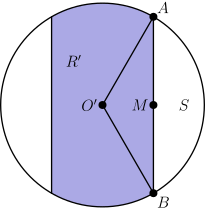
因为 ,三角形 给出 ,且 ,所以 。切面是平面,并且只在 的方向上相对水平面倾斜,倾角 满足 。还原投影时面积要乘以 ,所以未涂色面的面积为 。因此 。
Stand the block on the face containing and and let be the center of that face, the midpoint of and the center of the cylinder. The cutting plane meets the bottom face in chord and, by symmetry through meets the top face in the reflected chord, so the cut face projects vertically onto the region between chord and its mirror image through (shaded below). Each circular segment cut off has area so has area
Since triangle gives and so The cut face is planar and tilted from the horizontal only in the direction of at the angle with Undoing the projection therefore multiplies areas by so the unpainted face has area Thus