2013 AIME I 真题

向下滚动并点击“开始”即可作答!或前往可打印 PDF答案,或由 LIVE by Po-Shen Loh 精心整理的专业解答

所有题目均经美国数学协会(MAA)官方合法授权使用。

或直接跳转到某一道题及其解答: 1 · 2 · 3 · 4 · 5 · 6 · 7 · 8 · 9 · 10 · 11 · 12 · 13 · 14 · 15

想通过互动视频课程系统学习吗?

了解 LIVE课程

计时

3:00:00

1.

AIME 铁人三项包括半英里游泳、3030 英里自行车骑行和八英里跑步。Tom 游泳、骑车和跑步的速度都恒定。他跑步速度是游泳速度的五倍,骑车速度是跑步速度的两倍。Tom 用四又四分之一小时完成 AIME 铁人三项。求他骑车用了多少分钟。

The AIME Triathlon consists of a half-mile swim, a 3030-mile bicycle ride, and an eight-mile run. Tom swims, bicycles, and runs at constant rates. He runs five times as fast as he swims, and he bicycles twice as fast as he runs. Tom completes the AIME Triathlon in four and a quarter hours. How many minutes does he spend bicycling?

答案:150
知识点:路程、速度与时间比与比例单位换算
难度评级:1810
小提示:

Tom 跑步速度是游泳速度的 55 倍,骑车速度是游泳速度的 1010 倍,所以把每一段所用时间都用他的游泳速度表示。

Tom runs 55 times as fast as he swims and bicycles 1010 times as fast, so write each leg’s time using only his swimming speed

大提示:

总时间为 0.5s+3010s+85s=4.25\frac{0.5}{s} + \frac{30}{10s} + \frac{8}{5s} = 4.25 小时;先求出游泳速度 ss

The total time is 0.5s+3010s+85s=4.25\frac{0.5}{s} + \frac{30}{10s} + \frac{8}{5s} = 4.25 hours; solve for the swimming speed ss

解答:

设 Tom 的游泳速度为每小时 ss 英里。则他跑步速度为 5s5s,骑车速度为 10s10s。总时间(单位为小时)为 0.5s+3010s+85s=0.5+3+1.6s=5.1s=4.25 \begin{aligned} &\frac{0.5}{s} + \frac{30}{10s} + \frac{8}{5s} \\ &= \frac{0.5 + 3 + 1.6}{s} \\ &= \frac{5.1}{s} = 4.25 \end{aligned}\text{,}所以 s=5.14.25=1.2s = \frac{5.1}{4.25} = 1.2 英里每小时。

他骑车速度为每小时 1212 英里,因此骑车用时 3012=2.5\frac{30}{12} = 2.5 小时,也就是 150150 分钟。

Let Tom’s swimming speed be ss miles per hour. Then he runs at 5s5s and bicycles at 10s.10s. The total time in hours is 0.5s+3010s+85s=0.5+3+1.6s=5.1s=4.25, \begin{aligned} &\frac{0.5}{s} + \frac{30}{10s} + \frac{8}{5s} \\ &= \frac{0.5 + 3 + 1.6}{s} \\ &= \frac{5.1}{s} = 4.25, \end{aligned} so s=5.14.25=1.2s = \frac{5.1}{4.25} = 1.2 miles per hour.

He bicycles at 1212 miles per hour, so the ride takes 3012=2.5\frac{30}{12} = 2.5 hours, which is 150150 minutes.

2.

求满足以下条件的五位正整数 nn 的个数:

nn 能被 55 整除,

nn 的首位数字和末位数字相等,并且

nn 的各位数字之和能被 55 整除。

Find the number of five-digit positive integers, n,n, that satisfy the following conditions:

• the number nn is divisible by 5,5,

• the first and last digits of nn are equal, and

• the sum of the digits of nn is divisible by 5.5.

答案:200
难度评级:1980
小提示:

能被 55 整除说明末位数字为 0055,而首位数字不能是 00

Divisibility by 55 makes the last digit 00 or 5,5, and the first digit cannot be 00

大提示:

当两端数字都是 55 时,任意选第二、第三位;第四位恰有 22 个取值能让数字和成为 55 的倍数。

With both outer digits 5,5, pick the second and third digits freely; exactly 22 values of the fourth digit make the digit sum a multiple of 55

解答:

因为 nn 能被 55 整除,所以末位数字为 0055;又因为首位数字等于末位数字且不能为 00,所以首末两位都必须是 55。这两位对数字和的贡献为 1010,所以中间三位的和也必须是 55 的倍数。

第二位和第三位可任意选择,共 1010=10010 \cdot 10 = 100 种。无论它们的和是多少,第四位都必须落在模 55 的某个指定余数类中,而 0099 中每个余数类恰有 22 个数字。因此总数为 10102=20010 \cdot 10 \cdot 2 = 200

Since nn is divisible by 5,5, its last digit is 00 or 5;5; since the first digit equals the last digit and cannot be 0,0, both are 5.5. The outer digits contribute 1010 to the digit sum, so the three middle digits must also sum to a multiple of 5.5.

Choose the second and third digits freely, in 1010=10010 \cdot 10 = 100 ways. Whatever their sum is, the fourth digit must land in a prescribed residue class modulo 5,5, and exactly 22 of the digits 00 through 99 lie in each class. The count is 10102=200.10 \cdot 10 \cdot 2 = 200.

3.

ABCDABCD 是正方形,EEFF 分别是 AB\overline{AB}BC\overline{BC} 上的点。过 EE 作平行于 BC\overline{BC} 的直线,过 FF 作平行于 AB\overline{AB} 的直线,将 ABCDABCD 分成两个正方形和两个非正方形的长方形。两个正方形面积之和是正方形 ABCDABCD 面积的 910\frac{9}{10}。求 AEEB+EBAE\frac{AE}{EB} + \frac{EB}{AE}

Let ABCDABCD be a square, and let EE and FF be points on AB\overline{AB} and BC,\overline{BC}, respectively. The line through EE parallel to BC\overline{BC} and the line through FF parallel to AB\overline{AB} divide ABCDABCD into two squares and two nonsquare rectangles. The sum of the areas of the two squares is 910\frac{9}{10} of the area of square ABCD.ABCD. Find AEEB+EBAE.\frac{AE}{EB} + \frac{EB}{AE}.

答案:18
难度评级:2010
小提示:

AE=xAE = xEB=yEB = y;两个小正方形的边长分别为 xxyy,而 ABCDABCD 的边长为 x+yx + y

Let AE=xAE = x and EB=y;EB = y; the two squares then have sides xx and y,y, and ABCDABCD has side x+yx + y

大提示:

展开 x2+y2=910(x+y)2x^2 + y^2 = \frac{9}{10}(x+y)^2,并注意所求量等于 x2+y2xy\frac{x^2 + y^2}{xy}

Expand x2+y2=910(x+y)2x^2 + y^2 = \frac{9}{10}(x+y)^2 and notice that the requested quantity equals x2+y2xy\frac{x^2 + y^2}{xy}

解答:

AE=xAE = xEB=yEB = y,则大正方形边长为 x+yx + y,两个小正方形边长为 xxyy。条件给出 x2+y2=910(x+y)2x^2 + y^2 = \frac{9}{10}(x + y)^2\text{。}两边乘以 1010 并展开,得到 10x2+10y210x^2 + 10y^2 =9x2+18xy+9y2= 9x^2 + 18xy + 9y^2,所以 x2+y2=18xyx^2 + y^2 = 18xy

两边除以 xyxy,得到 AEEB+EBAE=xy+yx=x2+y2xy=18 \begin{aligned} \frac{AE}{EB} + \frac{EB}{AE} &= \frac{x}{y} + \frac{y}{x} \\ &= \frac{x^2 + y^2}{xy} = 18 \end{aligned}\text{。}

Let AE=xAE = x and EB=y,EB = y, so the square has side x+yx + y and the two smaller squares have sides xx and y.y. The condition says x2+y2=910(x+y)2.x^2 + y^2 = \frac{9}{10}(x + y)^2. Multiplying by 1010 and expanding, 10x2+10y210x^2 + 10y^2 =9x2+18xy+9y2,= 9x^2 + 18xy + 9y^2, so x2+y2=18xy.x^2 + y^2 = 18xy.

Dividing by xyxy gives AEEB+EBAE=xy+yx=x2+y2xy=18. \begin{aligned} \frac{AE}{EB} + \frac{EB}{AE} &= \frac{x}{y} + \frac{y}{x} \\ &= \frac{x^2 + y^2}{xy} = 18. \end{aligned}

4.

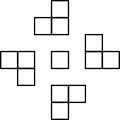
如下图所示的 1313 个方格组成的图形中,88 个方格涂红色,其余 55 个方格涂蓝色。在所有可能的这种涂色中随机选一种。若所选涂色绕中心方格旋转 9090^\circ 后看起来不变的概率为 1n\frac{1}{n},其中 nn 是正整数,求 nn

In the array of 1313 squares shown below, 88 squares are colored red, and the remaining 55 squares are colored blue. If one of all possible such colorings is chosen at random, the probability that the chosen colored array appears the same when rotated 9090^\circ around the central square is 1n,\frac{1}{n}, where nn is a positive integer. Find n.n.

答案:429
难度评级:2300
小提示:

旋转后不变的涂色由一个 L 形臂决定:四条臂必须涂成完全相同。

A coloring unchanged by the rotation is determined by one L-shaped arm: the four arms must be colored identically

大提示:

为得到 88 个红格和 55 个蓝格,中心格必须是蓝色,每条臂需要 22 个红格和 11 个蓝格;再与总涂色数 (135)\binom{13}{5} 比较。

To get 88 red and 55 blue, the center must be blue and each arm needs 22 red and 11 blue; compare with (135)\binom{13}{5} total colorings

解答:

这个旋转会循环置换四条 L 形臂,因此对称涂色必须让四条臂完全相同,外侧 1212 个方格就是某一条臂样式的 44 份副本。于是外侧红格数必须是 44 的倍数。总共有 88 个红格,所以中心格必须是蓝色,并且每条臂必须恰有 22 个红格和 11 个蓝格。

一条臂中蓝格的位置有 33 种选择,所以在 (135)=1287\binom{13}{5} = 1287 种等可能涂色中,恰有 33 种满足对称。概率为 31287=1429\frac{3}{1287} = \frac{1}{429},因此 n=429n = 429

The rotation cycles the four L-shaped arms, so a symmetric coloring colors all four arms identically, and the 1212 outer squares contain 44 copies of whatever the arm shows. The number of red squares among the outer twelve is therefore a multiple of 4.4. Since there are 88 red squares in all, the center must be blue and each arm must contain exactly 22 red squares and 11 blue square.

The blue square within the arm can be chosen in 33 ways, so exactly 33 of the (135)=1287\binom{13}{5} = 1287 equally likely colorings are symmetric. The probability is 31287=1429,\frac{3}{1287} = \frac{1}{429}, so n=429.n = 429.

5.

方程 8x33x23x1=08x^3 - 3x^2 - 3x - 1 = 0 的实根可写成 a3+b3+1c\frac{\sqrt[3]{a} + \sqrt[3]{b} + 1}{c},其中 aabbcc 为正整数。求 a+b+ca + b + c

The real root of the equation 8x33x23x1=08x^3 - 3x^2 - 3x - 1 = 0 can be written in the form a3+b3+1c,\frac{\sqrt[3]{a} + \sqrt[3]{b} + 1}{c}, where a,a, b,b, and cc are positive integers. Find a+b+c.a + b + c.

答案:98
难度评级:2400
小提示:

x3+3x2+3x+1x^3 + 3x^2 + 3x + 1 移到一边:方程变为 (x+1)3=9x3(x+1)^3 = 9x^3

Move x3+3x2+3x+1x^3 + 3x^2 + 3x + 1 to one side: the equation becomes (x+1)3=9x3(x+1)^3 = 9x^3

大提示:

开立方得到 x=1931x = \frac{1}{\sqrt[3]{9} - 1},再利用 u31=(u1)(u2+u+1)u^3 - 1 = (u - 1)(u^2 + u + 1) 有理化。

Take cube roots to get x=1931,x = \frac{1}{\sqrt[3]{9} - 1}, then rationalize using u31=(u1)(u2+u+1)u^3 - 1 = (u - 1)(u^2 + u + 1)

解答:

将方程改写为 9x3=x3+3x2+3x+19x^3 = x^3 + 3x^2 + 3x + 1 =(x+1)3= (x + 1)^3。取实立方根,得到 93x=x+1\sqrt[3]{9}\,x = x + 1,所以 x=1931x = \frac{1}{\sqrt[3]{9} - 1}\text{。}

分子分母同乘 813+93+1\sqrt[3]{81} + \sqrt[3]{9} + 1;分母变为 (93)31=8(\sqrt[3]{9})^3 - 1 = 8,所以 x=813+93+18x = \frac{\sqrt[3]{81} + \sqrt[3]{9} + 1}{8}\text{。}因此 a+b+c=81+9+8=98a + b + c = 81 + 9 + 8 = 98

Rewrite the equation as 9x3=x3+3x2+3x+19x^3 = x^3 + 3x^2 + 3x + 1 =(x+1)3.= (x + 1)^3. Taking real cube roots, 93x=x+1,\sqrt[3]{9}\,x = x + 1, so x=1931.x = \frac{1}{\sqrt[3]{9} - 1}.

Multiply numerator and denominator by 813+93+1;\sqrt[3]{81} + \sqrt[3]{9} + 1; the denominator becomes (93)31=8,(\sqrt[3]{9})^3 - 1 = 8, so x=813+93+18.x = \frac{\sqrt[3]{81} + \sqrt[3]{9} + 1}{8}. Thus a+b+c=81+9+8=98.a + b + c = 81 + 9 + 8 = 98.

6.

Melinda 有三个空盒子和 1212 本课本,其中三本是数学课本。一个盒子能装任意三本课本,一个能装任意四本课本,一个能装任意五本课本。若 Melinda 按随机顺序把课本装进这些盒子,所有三本数学课本都在同一个盒子里的概率可写成 mn\frac{m}{n},其中 mmnn 是互质正整数。求 m+nm + n

Melinda has three empty boxes and 1212 textbooks, three of which are mathematics textbooks. One box will hold any three of her textbooks, one will hold any four of her textbooks, and one will hold any five of her textbooks. If Melinda packs her textbooks into these boxes in random order, the probability that all three mathematics textbooks end up in the same box can be written as mn,\frac{m}{n}, where mm and nn are relatively prime positive integers. Find m+n.m + n.

答案:47
难度评级:2390
小提示:

分别计算三本数学书都进入容量为 33 本、44 本、55 本的盒子的概率。

Compute separately the probability that all three math books land in the 33-box, the 44-box, and the 55-box

大提示:

对于能装 kk 本书的盒子,该概率为 (9k3)(12k)\frac{\binom{9}{k-3}}{\binom{12}{k}};把三个分数相加。

For the box holding kk books, that probability is (9k3)(12k);\frac{\binom{9}{k-3}}{\binom{12}{k}}; add the three fractions

解答:

一次只看一个盒子。装 kk 本书的盒子得到 1212 本书中的一个等可能的 kk 元子集,因此它含有全部三本数学书的概率为 (9k3)(12k)\frac{\binom{9}{k-3}}{\binom{12}{k}}。当 k=3k = 34455 时,分别为 1220\frac{1}{220}9495=155\frac{9}{495} = \frac{1}{55}36792=122\frac{36}{792} = \frac{1}{22}

这些事件互不相交,所以总概率为 1220+155+122=1+4+10220=15220=344 \begin{aligned} \frac{1}{220} + \frac{1}{55} + \frac{1}{22} &= \frac{1 + 4 + 10}{220} \\ &= \frac{15}{220} = \frac{3}{44} \end{aligned}\text{,}因此 m+n=3+44=47m + n = 3 + 44 = 47

Focus on one box at a time. The box of kk books receives a uniformly random kk-subset of the 1212 books, so the probability that it contains all three math books is (9k3)(12k).\frac{\binom{9}{k-3}}{\binom{12}{k}}. For k=3,k = 3, 4,4, and 55 this gives 1220,\frac{1}{220}, 9495=155,\frac{9}{495} = \frac{1}{55}, and 36792=122.\frac{36}{792} = \frac{1}{22}.

The events are disjoint, so the total probability is 1220+155+122=1+4+10220=15220=344, \begin{aligned} \frac{1}{220} + \frac{1}{55} + \frac{1}{22} &= \frac{1 + 4 + 10}{220} \\ &= \frac{15}{220} = \frac{3}{44}, \end{aligned} and m+n=3+44=47.m + n = 3 + 44 = 47.

7.

一个长方体的宽为 1212 英寸,长为 1616 英寸,高为 mn\frac{m}{n} 英寸,其中 mmnn 是互质正整数。长方体的三个面相交于同一个顶点。这三个面的中心点作为顶点形成一个面积为 3030 平方英寸的三角形。求 m+nm + n

A rectangular box has width 1212 inches, length 1616 inches, and height mn\frac{m}{n} inches, where mm and nn are relatively prime positive integers. Three faces of the box meet at a corner of the box. The center points of those three faces are the vertices of a triangle with an area of 3030 square inches. Find m+n.m + n.

答案:41
难度评级:2560
小提示:

把这个顶点放在原点,使长方体为 [0,12]×[0,16]×[0,h][0,12] \times [0,16] \times [0,h],并写出三个面心的坐标。

Place the corner at the origin so the box is [0,12]×[0,16]×[0,h],[0,12] \times [0,16] \times [0,h], and write down the three face centers

大提示:

三个中心为 (6,8,0)(6,8,0)(0,8,h2)(0,8,\frac{h}{2})(6,0,h2)(6,0,\frac{h}{2});用叉积可得三角形面积为 1225h2+2304\frac{1}{2}\sqrt{25h^2 + 2304}

The centers are (6,8,0),(6,8,0), (0,8,h2),(0,8,\frac{h}{2}), (6,0,h2);(6,0,\frac{h}{2}); a cross product gives the triangle’s area as 1225h2+2304\frac{1}{2}\sqrt{25h^2 + 2304}

解答:

设高为 hh,把公共顶点放在原点,所以长方体为 [0,12]×[0,16]×[0,h][0,12] \times [0,16] \times [0,h]。在原点相交的三个面的中心为 P=(6,8,0)P = (6, 8, 0)Q=(0,8,h2)Q = \left(0, 8, \tfrac{h}{2}\right)R=(6,0,h2)R = \left(6, 0, \tfrac{h}{2}\right)

于是 PQ=(6,0,h2)\overrightarrow{PQ} = \left(-6, 0, \tfrac{h}{2}\right)PR=(0,8,h2)\overrightarrow{PR} = \left(0, -8, \tfrac{h}{2}\right),它们的叉积为 (4h,3h,48)(4h, 3h, 48)。面积为 1216h2+9h2+482=1225h2+2304=30 \begin{aligned} &\frac{1}{2}\sqrt{16h^2 + 9h^2 + 48^2} \\ &= \frac{1}{2}\sqrt{25h^2 + 2304} \\ &= 30 \end{aligned}\text{,}所以 25h2=36002304=129625h^2 = 3600 - 2304 = 1296,且 h=365h = \frac{36}{5}

因此 m+n=36+5=41m + n = 36 + 5 = 41

Let the height be hh and place the corner at the origin, so the box is [0,12]×[0,16]×[0,h].[0,12] \times [0,16] \times [0,h]. The three faces meeting at the origin have centers P=(6,8,0),P = (6, 8, 0), Q=(0,8,h2),Q = \left(0, 8, \tfrac{h}{2}\right), and R=(6,0,h2).R = \left(6, 0, \tfrac{h}{2}\right).

Then PQ=(6,0,h2)\overrightarrow{PQ} = \left(-6, 0, \tfrac{h}{2}\right) and PR=(0,8,h2),\overrightarrow{PR} = \left(0, -8, \tfrac{h}{2}\right), whose cross product is (4h,3h,48).(4h, 3h, 48). The area is 1216h2+9h2+482=1225h2+2304=30, \begin{aligned} &\frac{1}{2}\sqrt{16h^2 + 9h^2 + 48^2} \\ &= \frac{1}{2}\sqrt{25h^2 + 2304} \\ &= 30, \end{aligned} so 25h2=36002304=129625h^2 = 3600 - 2304 = 1296 and h=365.h = \frac{36}{5}.

Therefore m+n=36+5=41.m + n = 36 + 5 = 41.

8.

函数 f(x)=arcsin(logm(nx))f(x) = \arcsin(\log_m(nx)) 的定义域是一个长度为 12013\frac{1}{2013} 的闭区间,其中 mmnn 为正整数且 m>1m \gt 1。求最小可能的 m+nm + n 除以 10001000 的余数。

The domain of the function f(x)=arcsin(logm(nx))f(x) = \arcsin(\log_m(nx)) is a closed interval of length 12013,\frac{1}{2013}, where mm and nn are positive integers and m>1.m \gt 1. Find the remainder when the smallest possible sum m+nm + n is divided by 1000.1000.

答案:371
难度评级:2560
小提示:

定义域要求 1logm(nx)1-1 \le \log_m(nx) \le 1,所以 xx 落在 [1mn,mn]\left[\frac{1}{mn}, \frac{m}{n}\right],区间长度为 m21mn\frac{m^2 - 1}{mn}

The domain requires 1logm(nx)1,-1 \le \log_m(nx) \le 1, so xx runs over [1mn,mn],\left[\frac{1}{mn}, \frac{m}{n}\right], which has length m21mn\frac{m^2 - 1}{mn}

大提示:

因此 mn=2013(m21)mn = 2013(m^2 - 1)。由于 gcd(m,m21)=1\gcd(m, m^2 - 1) = 1mm 必须整除 20132013;最小的 m>1m \gt 1 会使和最小。

Then mn=2013(m21).mn = 2013(m^2 - 1). Since gcd(m,m21)=1,\gcd(m, m^2 - 1) = 1, mm must divide 2013,2013, and the smallest m>1m \gt 1 minimizes the sum.

解答:

函数有定义当且仅当 1logm(nx)1-1 \le \log_m(nx) \le 1,也就是 1mnxm\frac{1}{m} \le nx \le m,因此定义域为 [1mn,mn]\left[\frac{1}{mn}, \frac{m}{n}\right],长度为 mn1mn=m21mn=12013\frac{m}{n} - \frac{1}{mn} = \frac{m^2 - 1}{mn} = \frac{1}{2013}\text{。}所以 n=2013(m21)mn = \frac{2013(m^2 - 1)}{m}。由于 mmm21m^2 - 1 互质,mm 必须整除 2013=311612013 = 3 \cdot 11 \cdot 61

因为 n2013mn \approx 2013m,所以 m+nm + nmm 增大而增大,故取最小因子 m=3m = 3:此时 n=201383=5368n = \frac{2013 \cdot 8}{3} = 5368,且 m+n=5371m + n = 5371

除以 10001000 的余数为 371371

The function is defined when 1logm(nx)1,-1 \le \log_m(nx) \le 1, that is 1mnxm,\frac{1}{m} \le nx \le m, so the domain is [1mn,mn],\left[\frac{1}{mn}, \frac{m}{n}\right], with length mn1mn=m21mn=12013.\frac{m}{n} - \frac{1}{mn} = \frac{m^2 - 1}{mn} = \frac{1}{2013}. Hence n=2013(m21)m.n = \frac{2013(m^2 - 1)}{m}. Since mm is relatively prime to m21,m^2 - 1, mm must divide 2013=31161.2013 = 3 \cdot 11 \cdot 61.

Because n2013m,n \approx 2013m, the sum m+nm + n grows with m,m, so take the smallest factor m=3:m = 3: then n=201383=5368n = \frac{2013 \cdot 8}{3} = 5368 and m+n=5371.m + n = 5371.

The remainder upon division by 10001000 is 371.371.

9.

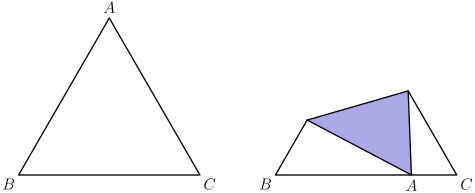
一张纸做的等边三角形 ABCABC 边长为 1212。把这个纸三角形折叠,使顶点 AA 落到边 BC\overline{BC} 上距离点 BB99 的一点。折痕线段的长度可写成 mpn\frac{m\sqrt{p}}{n},其中 mmnnpp 为正整数,mmnn 互质,且 pp 不被任何素数的平方整除。求 m+n+pm + n + p

A paper equilateral triangle ABCABC has side length 12.12. The paper triangle is folded so that vertex AA touches a point on side BC\overline{BC} a distance 99 from point B.B. The length of the line segment along which the triangle is folded can be written as mpn,\frac{m\sqrt{p}}{n}, where m,m, n,n, and pp are positive integers, mm and nn are relatively prime, and pp is not divisible by the square of any prime. Find m+n+p.m + n + p.

答案:113
难度评级:2920
小提示:

折叠保持距离:若折痕与 AB\overline{AB} 交于 PP,则 PPAA 和到 BC\overline{BC} 上的落点距离相等。

Folding preserves distances: if the crease meets AB\overline{AB} at P,P, then PP is equidistant from AA and from the landing point on BC\overline{BC}

大提示:

BBCC 处的 6060^\circ 角三角形中使用余弦定理,求出折痕两个端点的位置;然后在 AA 处再用一次余弦定理。

The law of cosines in the 6060^\circ corner triangles at BB and CC locates both crease endpoints; then apply the law of cosines once more at AA

解答:

AA' 为落点,其中 BA=9BA' = 9CA=3CA' = 3,并设折痕与 AB\overline{AB} 交于 PP,与 AC\overline{AC} 交于 QQ。折叠保持距离,所以 PA=PA=xPA' = PA = xQA=QA=yQA' = QA = y。在三角形 PBAPBA' 中,PB=12xPB = 12 - x,且 B=60\angle B = 60^\circ,由余弦定理得 x2=(12x)2+819(12x) \begin{aligned} x^2 &= (12 - x)^2 + 81 \\ &\quad {}- 9(12 - x) \end{aligned}\text{,}化简得 15x=11715x = 117,所以 x=395x = \frac{39}{5}。类似地,在三角形 QCAQCA' 中,y2=(12y)2+93(12y)y^2 = (12 - y)^2 + 9 - 3(12 - y),得 21y=11721y = 117,所以 y=397y = \frac{39}{7}

最后,在三角形 APQAPQ 中有 A=60\angle A = 60^\circ,因此 PQ2=x2+y2xy=392(125+149135)=39249+25351225=3931225 \begin{aligned} PQ^2 &= x^2 + y^2 - xy \\ &= 39^2\left(\frac{1}{25} + \frac{1}{49} - \frac{1}{35}\right) \\ &= 39^2 \cdot \frac{49 + 25 - 35}{1225} \\ &= \frac{39^3}{1225} \end{aligned}\text{,}所以 PQ=393935PQ = \frac{39\sqrt{39}}{35}。因此 m+n+p=39+35+39m + n + p = 39 + 35 + 39 =113= 113

Let AA' be the landing point, with BA=9BA' = 9 and CA=3,CA' = 3, and let the crease meet AB\overline{AB} at PP and AC\overline{AC} at Q.Q. Folding preserves distances, so PA=PA=xPA' = PA = x and QA=QA=y.QA' = QA = y. In triangle PBA,PBA', with PB=12xPB = 12 - x and B=60,\angle B = 60^\circ, the law of cosines gives x2=(12x)2+819(12x), \begin{aligned} x^2 &= (12 - x)^2 + 81 \\ &\quad {}- 9(12 - x), \end{aligned} which simplifies to 15x=117,15x = 117, so x=395.x = \frac{39}{5}. Similarly, in triangle QCA,QCA', y2=(12y)2+93(12y)y^2 = (12 - y)^2 + 9 - 3(12 - y) gives 21y=117,21y = 117, so y=397.y = \frac{39}{7}.

Finally, in triangle APQAPQ with A=60,\angle A = 60^\circ, PQ2=x2+y2xy=392(125+149135)=39249+25351225=3931225, \begin{aligned} PQ^2 &= x^2 + y^2 - xy \\ &= 39^2\left(\frac{1}{25} + \frac{1}{49} - \frac{1}{35}\right) \\ &= 39^2 \cdot \frac{49 + 25 - 35}{1225} \\ &= \frac{39^3}{1225}, \end{aligned} so PQ=393935.PQ = \frac{39\sqrt{39}}{35}. Thus m+n+p=39+35+39m + n + p = 39 + 35 + 39 =113.= 113.

10.

存在非零整数 aabbrrss,使复数 r+sir + si 是多项式 P(x)=x3ax2+bx65P(x) = x^3 - ax^2 + bx - 65 的一个零点。对每一种可能的 aabb 的组合,令 pa,bp_{a,b}P(x)P(x) 的所有零点之和。求所有可能的 aabb 组合对应的 pa,bp_{a,b} 之和。

There are nonzero integers a,a, b,b, r,r, and ss such that the complex number r+sir + si is a zero of the polynomial P(x)=x3ax2+bx65.P(x) = x^3 - ax^2 + bx - 65. For each possible combination of aa and b,b, let pa,bp_{a,b} be the sum of the zeros of P(x).P(x). Find the sum of the pa,bp_{a,b}’s for all possible combinations of aa and b.b.

答案:80
难度评级:2710
小提示:

实系数迫使零点为 r±sir \pm si 和一个实数 qq,且 q(r2+s2)=65q(r^2 + s^2) = 65

Real coefficients force the zeros to be r±sir \pm si and a real qq with q(r2+s2)=65q(r^2 + s^2) = 65

大提示:

列出 6565 的因数中可写成两个非零平方数之和的情况;对每种情况,±r\pm r 的选择在求和时抵消,只留下对应的 qq

List the ways a factor of 6565 is a sum of two nonzero squares; for each, the choices ±r\pm r cancel in the sum, leaving only the qq’s

解答:

因为 PP 的系数为实数,rsir - si 也是一个零点,第三个零点 qq 为实数。零点之和为 q+2r=aq + 2r = a,所以 q=a2rq = a - 2r 是非零整数。零点之积为 q(r2+s2)=65q(r^2 + s^2) = 65,所以 r2+s2r^2 + s^26565 的因数。由于 rrss 均非零,可能情况为 r2+s2=5=12+22r^2 + s^2 = 5 = 1^2 + 2^2(此时 q=13q = 13)、13=22+3213 = 2^2 + 3^2(此时 q=5q = 5),以及 65=12+82=42+7265 = 1^2 + 8^2 = 4^2 + 7^2(此时 q=1q = 1)。

对于每一种表示 {u,v}\{u, v\},零点 r+sir + si 可以有 r=±ur = \pm u±v\pm v,给出 44 个不同多项式(ss 的符号不影响多项式)。零点之和为 pa,b=q+2rp_{a,b} = q + 2r,四种选择中的 2r2r 项相互抵消,每种表示留下 4q4q

总和为 413+45+41+41=804 \cdot 13 + 4 \cdot 5 + 4 \cdot 1 + 4 \cdot 1 = 80

Since PP has real coefficients, rsir - si is also a zero, and the third zero qq is real. The sum of the zeros is q+2r=a,q + 2r = a, so q=a2rq = a - 2r is a nonzero integer. Their product is q(r2+s2)=65,q(r^2 + s^2) = 65, so r2+s2r^2 + s^2 is a factor of 65.65. With rr and ss nonzero, the possibilities are r2+s2=5=12+22r^2 + s^2 = 5 = 1^2 + 2^2 (with q=13q = 13), 13=22+3213 = 2^2 + 3^2 (with q=5q = 5), and 65=12+82=42+7265 = 1^2 + 8^2 = 4^2 + 7^2 (with q=1q = 1).

For each representation {u,v},\{u, v\}, the zero r+sir + si can have r=±ur = \pm u or ±v,\pm v, giving 44 distinct polynomials (the sign of ss changes nothing). The sum of the zeros is pa,b=q+2r,p_{a,b} = q + 2r, and over the four choices the 2r2r terms cancel, leaving 4q4q from each representation.

The total is 413+45+41+41=80.4 \cdot 13 + 4 \cdot 5 + 4 \cdot 1 + 4 \cdot 1 = 80.

11.

Math 女士的幼儿园班有 1616 名注册学生。教室里有非常多的积木,数量为 NN,并满足以下条件:

• 若班上有 161615151414 名学生到场,则每一种情况下都能把所有积木平均分给每名学生,并且

• 存在三个整数 0<x<y<z<140 \lt x \lt y \lt z \lt 14,使得当 xxyyzz 名学生到场并把积木平均分给每名学生时,都恰好剩下三块积木。

求满足以上条件的最小可能 NN 的不同素因数之和。

Ms. Math’s kindergarten class has 1616 registered students. The classroom has a very large number, N,N, of play blocks which satisfies the conditions:

• If 16,16, 15,15, or 1414 students are present in the class, then in each case all the blocks can be distributed in equal numbers to each student, and

• There are three integers 0<x<y<z<140 \lt x \lt y \lt z \lt 14 such that when x,x, y,y, or zz students are present and the blocks are distributed in equal numbers to each student, there are exactly three blocks left over.

Find the sum of the distinct prime divisors of the least possible value of NN satisfying the above conditions.

答案:148
难度评级:2990
小提示:

NNlcm(14,15,16)=1680\operatorname{lcm}(14, 15, 16) = 1680 的倍数,而小于 1414 的正整数中,除了 9911111313 外都整除 16801680

NN is a multiple of lcm(14,15,16)=1680,\operatorname{lcm}(14, 15, 16) = 1680, and every positive integer below 1414 except 9,9, 11,11, and 1313 divides 16801680

大提示:

因此 xxyyzz 必须分别是 9911111313:用中国剩余定理解 1680m31680m \equiv 3 分别模 9911111313

So x,x, y,y, and zz must be 9,9, 11,11, and 13:13: solve 1680m31680m \equiv 3 modulo 9,9, 11,11, and 1313 by the Chinese remainder theorem

解答:

能被 161615151414 整除说明 N=1680mN = 1680m,其中 1680=lcm(14,15,16)1680 = \operatorname{lcm}(14, 15, 16) =24357= 2^4 \cdot 3 \cdot 5 \cdot 7。小于 1414 的正整数中,除了 9911111313 外都整除 16801680,而整除 NN 的人数会使余数为 00,不可能为 33。所以必有 {x,y,z}={9,11,13}\{x, y, z\} = \{9, 11, 13\},并且需要 1680m31680m \equiv 3 分别模 9911111313

因为 16806(mod9)1680 \equiv 6 \pmod 9,第一个同余为 6m3(mod9)6m \equiv 3 \pmod 9,即 m2(mod3)m \equiv 2 \pmod 3。因为 16808(mod11)1680 \equiv 8 \pmod{11},需要 8m3(mod11)8m \equiv 3 \pmod{11},即 m10(mod11)m \equiv 10 \pmod{11}。因为 16803(mod13)1680 \equiv 3 \pmod{13},需要 m1(mod13)m \equiv 1 \pmod{13}。由中国剩余定理合并得 m131(mod429)m \equiv 131 \pmod{429},所以最小的 mm131131

因此 N=1680131N = 1680 \cdot 131 =24357131= 2^4 \cdot 3 \cdot 5 \cdot 7 \cdot 131,且 131131 是素数,所以不同素因数之和为 2+3+5+7+131=1482 + 3 + 5 + 7 + 131 = 148

Divisibility by 16,16, 15,15, and 1414 means N=1680mN = 1680m where 1680=lcm(14,15,16)1680 = \operatorname{lcm}(14, 15, 16) =24357.= 2^4 \cdot 3 \cdot 5 \cdot 7. Every positive integer less than 1414 divides 16801680 except 9,9, 11,11, and 13,13, and a divisor of NN leaves remainder 0,0, not 3.3. So necessarily {x,y,z}={9,11,13},\{x, y, z\} = \{9, 11, 13\}, and we need 1680m31680m \equiv 3 modulo each of 9,9, 11,11, 13.13.

Since 16806(mod9),1680 \equiv 6 \pmod 9, the first congruence is 6m3(mod9),6m \equiv 3 \pmod 9, i.e. m2(mod3).m \equiv 2 \pmod 3. Since 16808(mod11),1680 \equiv 8 \pmod{11}, we need 8m3(mod11),8m \equiv 3 \pmod{11}, i.e. m10(mod11).m \equiv 10 \pmod{11}. Since 16803(mod13),1680 \equiv 3 \pmod{13}, we need m1(mod13).m \equiv 1 \pmod{13}. By the Chinese remainder theorem these combine to m131(mod429),m \equiv 131 \pmod{429}, so the least mm is 131.131.

Then N=1680131N = 1680 \cdot 131 =24357131,= 2^4 \cdot 3 \cdot 5 \cdot 7 \cdot 131, and since 131131 is prime, the sum of the distinct prime divisors is 2+3+5+7+131=148.2 + 3 + 5 + 7 + 131 = 148.

12.

PQR\triangle PQR 是一个三角形,其中 P=75\angle P = 75^\circQ=60\angle Q = 60^\circ。在 PQR\triangle PQR 内画一个边长为 11 的正六边形 ABCDEFABCDEF,使边 AB\overline{AB}PQ\overline{PQ} 上,边 CD\overline{CD}QR\overline{QR} 上,并且其余顶点中有一个在 RP\overline{RP} 上。存在正整数 aabbccdd,使 PQR\triangle PQR 的面积可表示为 a+bcd\frac{a + b\sqrt{c}}{d},其中 aadd 互质,且 cc 不被任何素数的平方整除。求 a+b+c+da + b + c + d

Let PQR\triangle PQR be a triangle with P=75\angle P = 75^\circ and Q=60.\angle Q = 60^\circ. A regular hexagon ABCDEFABCDEF with side length 11 is drawn inside PQR\triangle PQR so that side AB\overline{AB} lies on PQ,\overline{PQ}, side CD\overline{CD} lies on QR,\overline{QR}, and one of the remaining vertices lies on RP.\overline{RP}. There are positive integers a,a, b,b, c,c, and dd such that the area of PQR\triangle PQR can be expressed in the form a+bcd,\frac{a + b\sqrt{c}}{d}, where aa and dd are relatively prime, and cc is not divisible by the square of any prime. Find a+b+c+d.a + b + c + d.

答案:21
难度评级:2990
小提示:

正六边形的 120120^\circ 内角使 QQ 处的小三角形为等边三角形,所以 QB=QC=1QB = QC = 1;令 QQ 为原点,QRQR 沿 xx 轴建立坐标。

The hexagon’s 120120^\circ angles make the corner triangle at QQ equilateral, so QB=QC=1;QB = QC = 1; set up coordinates with QQ at the origin and QRQR along the xx-axis

大提示:

顶点 FF 位于 DD 正上方,高度为 3\sqrt{3},过 FF4545^\circ 直线 RPRP 给出 QR=2+3QR = 2 + \sqrt{3}

Vertex FF sits directly above DD at height 3,\sqrt{3}, and the 4545^\circ line RPRP through FF gives QR=2+3QR = 2 + \sqrt{3}

解答:

注意 R=45\angle R = 45^\circ。由于正六边形的内角为 120120^\circ,线段 BC\overline{BC}QQ 处截出的小三角形有两个 6060^\circ 的底角,所以三角形 BQCBQC 为等边三角形,且 QB=QC=1QB = QC = 1。令 QQ 为原点,QRQR 沿正 xx 轴。则 C=(1,0)C = (1, 0)D=(2,0)D = (2, 0),六边形的顶点为 B=(12,32)B = \left(\tfrac{1}{2}, \tfrac{\sqrt{3}}{2}\right)A=(1,3)A = (1, \sqrt{3})F=(2,3)F = (2, \sqrt{3})E=(52,32)E = \left(\tfrac{5}{2}, \tfrac{\sqrt{3}}{2}\right)

因为 R=45\angle R = 45^\circ,直线 RPRP 的斜率为 1-1。若它经过 EE,则直线为 x+y=5+32x + y = \tfrac{5 + \sqrt{3}}{2},这会使 FF(其 x+y=2+3x + y = 2 + \sqrt{3})落在三角形外;所以在 RP\overline{RP} 上的顶点是 FF,且 RPRP 是直线 x+y=2+3x + y = 2 + \sqrt{3}。它与 xx 轴交于 R=(2+3, 0)R = (2 + \sqrt{3},\ 0),并与直线 y=3xy = \sqrt{3}\,x(即 QPQP)相交,此时 x(1+3)=2+3x(1 + \sqrt{3}) = 2 + \sqrt{3},得到 PP 的高度 y=3(2+3)1+3=3+32y = \frac{\sqrt{3}(2 + \sqrt{3})}{1 + \sqrt{3}} = \frac{3 + \sqrt{3}}{2}\text{。}

面积为 12QRy\frac{1}{2} \cdot QR \cdot y =12(2+3)3+32= \frac{1}{2}(2 + \sqrt{3}) \cdot \frac{3 + \sqrt{3}}{2} =9+534= \frac{9 + 5\sqrt{3}}{4},所以 a+b+c+d=9+5+3+4a + b + c + d = 9 + 5 + 3 + 4 =21= 21

Note R=45.\angle R = 45^\circ. Because the hexagon’s interior angles are 120,120^\circ, segment BC\overline{BC} cuts off a corner triangle at QQ with two 6060^\circ base angles, so triangle BQCBQC is equilateral and QB=QC=1.QB = QC = 1. Put QQ at the origin with QRQR along the positive xx-axis. Then C=(1,0),C = (1, 0), D=(2,0),D = (2, 0), and the hexagon’s vertices are B=(12,32),B = \left(\tfrac{1}{2}, \tfrac{\sqrt{3}}{2}\right), A=(1,3),A = (1, \sqrt{3}), F=(2,3),F = (2, \sqrt{3}), E=(52,32).E = \left(\tfrac{5}{2}, \tfrac{\sqrt{3}}{2}\right).

Since R=45,\angle R = 45^\circ, line RPRP has slope 1.-1. If it passed through E,E, it would be x+y=5+32,x + y = \tfrac{5 + \sqrt{3}}{2}, which puts FF (with x+y=2+3x + y = 2 + \sqrt{3}) outside the triangle; so the vertex on RP\overline{RP} is F,F, and RPRP is the line x+y=2+3.x + y = 2 + \sqrt{3}. It meets the xx-axis at R=(2+3, 0)R = (2 + \sqrt{3},\ 0) and the line y=3xy = \sqrt{3}\,x (line QPQP) where x(1+3)=2+3,x(1 + \sqrt{3}) = 2 + \sqrt{3}, giving PP height y=3(2+3)1+3=3+32.y = \frac{\sqrt{3}(2 + \sqrt{3})}{1 + \sqrt{3}} = \frac{3 + \sqrt{3}}{2}.

The area is 12QRy\frac{1}{2} \cdot QR \cdot y =12(2+3)3+32= \frac{1}{2}(2 + \sqrt{3}) \cdot \frac{3 + \sqrt{3}}{2} =9+534,= \frac{9 + 5\sqrt{3}}{4}, so a+b+c+d=9+5+3+4a + b + c + d = 9 + 5 + 3 + 4 =21.= 21.

13.

三角形 AB0C0AB_0C_0 的边长为 AB0=12AB_0 = 12B0C0=17B_0C_0 = 17C0A=25C_0A = 25。对每个正整数 nn,点 BnB_nCnC_n 分别位于 ABn1\overline{AB_{n-1}}ACn1\overline{AC_{n-1}} 上,并形成三个相似三角形:ABnCnBn1CnCn1\triangle AB_nC_n \sim \triangle B_{n-1}C_nC_{n-1} ABn1Cn1\sim \triangle AB_{n-1}C_{n-1}。所有三角形 Bn1CnBnB_{n-1}C_nB_n(其中 n1n \ge 1)的并集面积可表示为 pq\frac{p}{q},其中 ppqq 是互质正整数。求 qq

Triangle AB0C0AB_0C_0 has side lengths AB0=12,AB_0 = 12, B0C0=17,B_0C_0 = 17, and C0A=25.C_0A = 25. For each positive integer n,n, points BnB_n and CnC_n are located on ABn1\overline{AB_{n-1}} and ACn1,\overline{AC_{n-1}}, respectively, creating three similar triangles ABnCnBn1CnCn1\triangle AB_nC_n \sim \triangle B_{n-1}C_nC_{n-1} ABn1Cn1.\sim \triangle AB_{n-1}C_{n-1}. The area of the union of all triangles Bn1CnBnB_{n-1}C_nB_n for n1n \ge 1 can be expressed as pq,\frac{p}{q}, where pp and qq are relatively prime positive integers. Find q.q.

答案:961
难度评级:3160
小提示:

对应边要配对:B0C1C0AB0C0\triangle B_0C_1C_0 \sim \triangle AB_0C_0 的相似比为 B0C0AC0=1725\frac{B_0C_0}{AC_0} = \frac{17}{25}

Match up corresponding sides: B0C1C0AB0C0\triangle B_0C_1C_0 \sim \triangle AB_0C_0 has ratio B0C0AC0=1725\frac{B_0C_0}{AC_0} = \frac{17}{25}

大提示:

r=1725r = \frac{17}{25},则三角形 AB1C1AB_1C_1 的相似比为 1r21 - r^2,这些互不重叠的小三角形面积形成首项为 90r2(1r2)90r^2(1 - r^2)、公比为 (1r2)2(1 - r^2)^2 的等比数列。

With r=1725,r = \frac{17}{25}, triangle AB1C1AB_1C_1 has ratio 1r2,1 - r^2, so the disjoint triangles’ areas form a geometric series with first term 90r2(1r2)90r^2(1 - r^2) and ratio (1r2)2(1 - r^2)^2

解答:

由海伦公式,半周长 s=27s = 27,所以 AB0C0\triangle AB_0C_0 的面积为 2715102=90\sqrt{27 \cdot 15 \cdot 10 \cdot 2} = 90。在相似关系 B0C1C0AB0C0\triangle B_0C_1C_0 \sim \triangle AB_0C_0 中,边 B0C0B_0C_0 对应 AC0AC_0,所以相似比为 r=1725r = \frac{17}{25},且 C1C0C_1C_0(对应 B0C0B_0C_0)等于 17r17r。于是 AC1AC0=2517r25=1r2\frac{AC_1}{AC_0} = \frac{25 - 17r}{25} = 1 - r^2\text{,}这就是 AB1C1\triangle AB_1C_1 相对于 AB0C0\triangle AB_0C_0 的相似比。

线段 B1C1\overline{B_1C_1}B0C1\overline{B_0C_1}AB0C0\triangle AB_0C_0 分成三个部分,所以 [B0C1B1]=90(1r2(1r2)2)=90r2(1r2) \begin{aligned} [B_0C_1B_1] &= 90\left(1 - r^2 - (1 - r^2)^2\right) \\ &= 90\,r^2(1 - r^2) \end{aligned}\text{。}之后每一步都在 ABnCn\triangle AB_nC_n 中重复同样构造,所有面积都按 (1r2)2(1 - r^2)^2 缩放,且这些三角形 Bn1CnBnB_{n-1}C_nB_n 的内部互不重叠。

并集面积为等比级数 90r2(1r2)1(1r2)2=90(1r2)2r2=90336625961625=90336961 \begin{aligned} \frac{90\,r^2(1 - r^2)}{1 - (1 - r^2)^2} &= \frac{90(1 - r^2)}{2 - r^2} \\ &= 90 \cdot \frac{\frac{336}{625}}{\frac{961}{625}} \\ &= \frac{90 \cdot 336}{961} \end{aligned}\text{。}因为 961=312961 = 31^290336=3024090 \cdot 336 = 30240 没有公因数,所以答案是 q=961q = 961

By Heron’s formula with s=27,s = 27, the area of AB0C0\triangle AB_0C_0 is 2715102=90.\sqrt{27 \cdot 15 \cdot 10 \cdot 2} = 90. In the similarity B0C1C0AB0C0,\triangle B_0C_1C_0 \sim \triangle AB_0C_0, side B0C0B_0C_0 corresponds to AC0,AC_0, so the ratio is r=1725,r = \frac{17}{25}, and C1C0C_1C_0 (corresponding to B0C0B_0C_0) equals 17r.17r. Hence AC1AC0=2517r25=1r2,\frac{AC_1}{AC_0} = \frac{25 - 17r}{25} = 1 - r^2, which is the similarity ratio of AB1C1\triangle AB_1C_1 to AB0C0.\triangle AB_0C_0.

Segments B1C1\overline{B_1C_1} and B0C1\overline{B_0C_1} split AB0C0\triangle AB_0C_0 into the three pieces, so [B0C1B1]=90(1r2(1r2)2)=90r2(1r2). \begin{aligned} [B_0C_1B_1] &= 90\left(1 - r^2 - (1 - r^2)^2\right) \\ &= 90\,r^2(1 - r^2). \end{aligned} Each successive stage repeats the construction inside ABnCn,\triangle AB_nC_n, scaling all areas by (1r2)2,(1 - r^2)^2, and the triangles Bn1CnBnB_{n-1}C_nB_n have disjoint interiors.

The union’s area is the geometric series 90r2(1r2)1(1r2)2=90(1r2)2r2=90336625961625=90336961. \begin{aligned} \frac{90\,r^2(1 - r^2)}{1 - (1 - r^2)^2} &= \frac{90(1 - r^2)}{2 - r^2} \\ &= 90 \cdot \frac{\frac{336}{625}}{\frac{961}{625}} \\ &= \frac{90 \cdot 336}{961}. \end{aligned} Since 961=312961 = 31^2 shares no factor with 90336=30240,90 \cdot 336 = 30240, the answer is q=961.q = 961.

14.

πθ<2π\pi \le \theta \lt 2\pi,令 P=12cosθ14sin2θ18cos3θ+116sin4θ+132cos5θ164sin6θ1128cos7θ+ \begin{aligned} P &= \frac{1}{2}\cos\theta - \frac{1}{4}\sin 2\theta \\ &\quad {}- \frac{1}{8}\cos 3\theta + \frac{1}{16}\sin 4\theta \\ &\quad {}+ \frac{1}{32}\cos 5\theta - \frac{1}{64}\sin 6\theta \\ &\quad {}- \frac{1}{128}\cos 7\theta + \ldots \end{aligned} 且令 Q=112sinθ14cos2θ+18sin3θ+116cos4θ132sin5θ164cos6θ+1128sin7θ+ \begin{aligned} Q &= 1 - \frac{1}{2}\sin\theta - \frac{1}{4}\cos 2\theta \\ &\quad {}+ \frac{1}{8}\sin 3\theta + \frac{1}{16}\cos 4\theta \\ &\quad {}- \frac{1}{32}\sin 5\theta - \frac{1}{64}\cos 6\theta \\ &\quad {}+ \frac{1}{128}\sin 7\theta + \ldots \end{aligned} 并满足 PQ=227\frac{P}{Q} = \frac{2\sqrt{2}}{7}。若 sinθ=mn\sin\theta = -\frac{m}{n},其中 mmnn 是互质正整数,求 m+nm + n

For πθ<2π,\pi \le \theta \lt 2\pi, let P=12cosθ14sin2θ18cos3θ+116sin4θ+132cos5θ164sin6θ1128cos7θ+ \begin{aligned} P &= \frac{1}{2}\cos\theta - \frac{1}{4}\sin 2\theta \\ &\quad {}- \frac{1}{8}\cos 3\theta + \frac{1}{16}\sin 4\theta \\ &\quad {}+ \frac{1}{32}\cos 5\theta - \frac{1}{64}\sin 6\theta \\ &\quad {}- \frac{1}{128}\cos 7\theta + \ldots \end{aligned} and Q=112sinθ14cos2θ+18sin3θ+116cos4θ132sin5θ164cos6θ+1128sin7θ+ \begin{aligned} Q &= 1 - \frac{1}{2}\sin\theta - \frac{1}{4}\cos 2\theta \\ &\quad {}+ \frac{1}{8}\sin 3\theta + \frac{1}{16}\cos 4\theta \\ &\quad {}- \frac{1}{32}\sin 5\theta - \frac{1}{64}\cos 6\theta \\ &\quad {}+ \frac{1}{128}\sin 7\theta + \ldots \end{aligned} so that PQ=227.\frac{P}{Q} = \frac{2\sqrt{2}}{7}. Then sinθ=mn\sin\theta = -\frac{m}{n} where mm and nn are relatively prime positive integers. Find m+n.m + n.

答案:36
难度评级:3270
小提示:

把两个级数组合成 Q+iPQ + iP:各项会成为一个公比为 ieiθ2\frac{ie^{i\theta}}{2} 的等比级数。

Combine the two series as Q+iP:Q + iP: the terms become a geometric series with ratio ieiθ2\frac{ie^{i\theta}}{2}

大提示:

求和可得 PQ=cosθ2+sinθ\frac{P}{Q} = \frac{\cos\theta}{2 + \sin\theta}。令它等于 227\frac{2\sqrt{2}}{7},平方后保留满足 sinθ0\sin\theta \le 0 的根。

Summing gives PQ=cosθ2+sinθ.\frac{P}{Q} = \frac{\cos\theta}{2 + \sin\theta}. Set it equal to 227,\frac{2\sqrt{2}}{7}, square, and keep the root with sinθ0.\sin\theta \le 0.

解答:

符号以及正弦、余弦的交替提示我们使用 ii 的幂。实际上 Q+iP=1+12ieiθ+14i2e2iθ+18i3e3iθ+=11ieiθ2=22ieiθ \begin{aligned} Q + iP &= 1 + \frac{1}{2}ie^{i\theta} + \frac{1}{4}i^2e^{2i\theta} \\ &\quad {}+ \frac{1}{8}i^3e^{3i\theta} + \cdots \\ &= \frac{1}{1 - \frac{ie^{i\theta}}{2}} = \frac{2}{2 - ie^{i\theta}} \end{aligned}\text{。}因为 2ieiθ=(2+sinθ)icosθ2 - ie^{i\theta} = (2 + \sin\theta) - i\cos\theta,乘以共轭数得到 Q+iP=2(2+sinθ)+2icosθ5+4sinθ \begin{aligned} &Q + iP \\ &= \frac{2(2 + \sin\theta) + 2i\cos\theta}{5 + 4\sin\theta} \end{aligned}\text{,}所以 PQ=cosθ2+sinθ\frac{P}{Q} = \frac{\cos\theta}{2 + \sin\theta}

cosθ2+sinθ=227\frac{\cos\theta}{2 + \sin\theta} = \frac{2\sqrt{2}}{7} 并平方,得 49(1sin2θ)=8(2+sinθ)249(1 - \sin^2\theta) = 8(2 + \sin\theta)^2,化简为 57sin2θ+32sinθ17=(3sinθ1)(19sinθ+17)=0 \begin{aligned} &57\sin^2\theta + 32\sin\theta - 17 \\ &= (3\sin\theta - 1)(19\sin\theta + 17) \\ &= 0 \end{aligned}\text{。}

因为 πθ<2π\pi \le \theta \lt 2\pi 迫使 sinθ0\sin\theta \le 0,所以 sinθ=1719\sin\theta = -\frac{17}{19}(此时 cosθ=6219>0\cos\theta = \frac{6\sqrt{2}}{19} \gt 0 与正的比值一致)。因此 m+n=17+19=36m + n = 17 + 19 = 36

The signs and the alternation between sines and cosines suggest powers of i:i: indeed Q+iP=1+12ieiθ+14i2e2iθ+18i3e3iθ+=11ieiθ2=22ieiθ. \begin{aligned} Q + iP &= 1 + \frac{1}{2}ie^{i\theta} + \frac{1}{4}i^2e^{2i\theta} \\ &\quad {}+ \frac{1}{8}i^3e^{3i\theta} + \cdots \\ &= \frac{1}{1 - \frac{ie^{i\theta}}{2}} = \frac{2}{2 - ie^{i\theta}}. \end{aligned} Since 2ieiθ=(2+sinθ)icosθ,2 - ie^{i\theta} = (2 + \sin\theta) - i\cos\theta, multiplying by the conjugate gives Q+iP=2(2+sinθ)+2icosθ5+4sinθ, \begin{aligned} &Q + iP \\ &= \frac{2(2 + \sin\theta) + 2i\cos\theta}{5 + 4\sin\theta}, \end{aligned} so PQ=cosθ2+sinθ.\frac{P}{Q} = \frac{\cos\theta}{2 + \sin\theta}.

Setting cosθ2+sinθ=227\frac{\cos\theta}{2 + \sin\theta} = \frac{2\sqrt{2}}{7} and squaring, 49(1sin2θ)=8(2+sinθ)2,49(1 - \sin^2\theta) = 8(2 + \sin\theta)^2, which rearranges to 57sin2θ+32sinθ17=(3sinθ1)(19sinθ+17)=0. \begin{aligned} &57\sin^2\theta + 32\sin\theta - 17 \\ &= (3\sin\theta - 1)(19\sin\theta + 17) \\ &= 0. \end{aligned}

Since πθ<2π\pi \le \theta \lt 2\pi forces sinθ0,\sin\theta \le 0, we get sinθ=1719\sin\theta = -\frac{17}{19} (and then cosθ=6219>0,\cos\theta = \frac{6\sqrt{2}}{19} \gt 0, consistent with the positive ratio). Thus m+n=17+19=36.m + n = 17 + 19 = 36.

15.

NN 为满足以下条件的整数有序三元组 (A,B,C)(A, B, C) 的个数:

0A<B<C990 \le A \lt B \lt C \le 99

• 存在整数 aabbcc 和素数 pp,其中 0b<a<c<p0 \le b \lt a \lt c \lt p

pp 整除 AaA - aBbB - bCcC - c,并且

• 每个有序三元组 (A,B,C)(A, B, C)(b,a,c)(b, a, c) 都构成等差数列。

NN

Let NN be the number of ordered triples (A,B,C)(A, B, C) of integers satisfying the conditions

0A<B<C99,0 \le A \lt B \lt C \le 99,

• there exist integers a,a, b,b, and c,c, and prime pp where 0b<a<c<p,0 \le b \lt a \lt c \lt p,

pp divides Aa,A - a, Bb,B - b, and Cc,C - c, and

• each ordered triple (A,B,C)(A, B, C) and each ordered triple (b,a,c)(b, a, c) form arithmetic sequences.

Find N.N.

答案:272
难度评级:3270
小提示:

DDdd 分别是 (A,B,C)(A,B,C)(b,a,c)(b,a,c) 的公差,则模 pp 下同时有 DdD \equiv -dD2dD \equiv 2d,所以 3d3d 能被 pp 整除。

If DD and dd are the common differences of (A,B,C)(A,B,C) and (b,a,c),(b,a,c), then mod pp both DdD \equiv -d and D2d,D \equiv 2d, so 3d3d is divisible by pp

大提示:

因为 0<2d<p0 \lt 2d \lt p,这迫使 p=3p = 3(b,a,c)=(0,1,2)(b,a,c) = (0,1,2);于是数出满足 A1A \equiv 1B0B \equiv 0C2(mod3)C \equiv 2 \pmod 3 的三元组。

Since 0<2d<p,0 \lt 2d \lt p, that forces p=3p = 3 and (b,a,c)=(0,1,2);(b,a,c) = (0,1,2); count triples with A1,A \equiv 1, B0,B \equiv 0, C2(mod3)C \equiv 2 \pmod 3

解答:

dd(b,a,c)(b, a, c) 的公差,则 ab=ca=d>0a - b = c - a = d \gt 0,且 c=b+2d<pc = b + 2d \lt p,因此 0<2d<p0 \lt 2d \lt p。设 D>0D \gt 0(A,B,C)(A, B, C) 的公差。对 pp 取模,得到 D=BAba=dD = B - A \equiv b - a = -d,以及 D=CBcb=2dD = C - B \equiv c - b = 2d,所以 3d3d 能被 pp 整除。由于 0<d<p0 \lt d \lt p,素数 pp 不可能整除 dd,所以 p=3p = 3;此时 2d<32d \lt 3,故 d=1d = 1,且 (b,a,c)=(0,1,2)(b, a, c) = (0, 1, 2)

因此有效三元组恰好是在 [0,99][0, 99] 中递增的等差数列,并满足 A1A \equiv 1B0B \equiv 0C2(mod3)C \equiv 2 \pmod 3。写 A=1+3jA = 1 + 3j,其中 j0j \ge 0;公差满足 D12(mod3)D \equiv -1 \equiv 2 \pmod 3,所以 D=2+3kD = 2 + 3k,其中 k0k \ge 0。限制为 C=A+2DC = A + 2D =5+3j+6k99= 5 + 3j + 6k \le 99,即 j+2k31j + 2k \le 31,每个这样的 (j,k)(j, k) 都可行。

对每个 k=0,1,,15k = 0, 1, \ldots, 15jj322k32 - 2k 种选择,所以 N=k=015(322k)=1632215162=512240=272 \begin{aligned} &N = \sum_{k=0}^{15} (32 - 2k) \\ &= 16 \cdot 32 - 2 \cdot \frac{15 \cdot 16}{2} \\ &= 512 - 240 = 272 \end{aligned}\text{。}

Let dd be the common difference of (b,a,c),(b, a, c), so ab=ca=d>0a - b = c - a = d \gt 0 and c=b+2d<p,c = b + 2d \lt p, whence 0<2d<p.0 \lt 2d \lt p. Let D>0D \gt 0 be the common difference of (A,B,C).(A, B, C). Reducing mod p,p, we get D=BAba=dD = B - A \equiv b - a = -d and D=CBcb=2d,D = C - B \equiv c - b = 2d, so 3d3d is divisible by p.p. Since 0<d<p,0 \lt d \lt p, the prime pp cannot divide d,d, so p=3;p = 3; then 2d<32d \lt 3 gives d=1d = 1 and (b,a,c)=(0,1,2).(b, a, c) = (0, 1, 2).

So the valid triples are exactly the increasing arithmetic progressions in [0,99][0, 99] with A1,A \equiv 1, B0,B \equiv 0, C2(mod3).C \equiv 2 \pmod 3. Write A=1+3jA = 1 + 3j with j0;j \ge 0; the difference satisfies D12(mod3),D \equiv -1 \equiv 2 \pmod 3, so D=2+3kD = 2 + 3k with k0.k \ge 0. The constraint is C=A+2DC = A + 2D =5+3j+6k99,= 5 + 3j + 6k \le 99, i.e. j+2k31,j + 2k \le 31, and every such pair (j,k)(j, k) works.

For each k=0,1,,15k = 0, 1, \ldots, 15 there are 322k32 - 2k choices of j,j, so N=k=015(322k)=1632215162=512240=272. \begin{aligned} &N = \sum_{k=0}^{15} (32 - 2k) \\ &= 16 \cdot 32 - 2 \cdot \frac{15 \cdot 16}{2} \\ &= 512 - 240 = 272. \end{aligned}