
1960 AMC 12 Problem 38
Attempt Problem 38 of the 1960 AMC 12 below, then check your answer against the professionally curated solution from LIVE by Po-Shen Loh. You can also try the full timed exam, view all 1960 AMC 12 solutions, or check the answer key.
All problems are used with official legal permission of the Mathematical Association of America (MAA).
38.
In this diagram and are the equal sides of an isosceles triangle in which is inscribed equilateral triangle Designate angle by angle by and angle by Then:
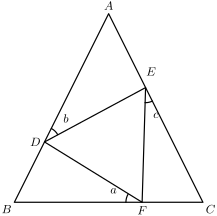
none of these
Answer: D
Small Hint:
Let each base angle of be
Big Hint:
Compare the directions of and using the angles of the equilateral triangle
Solution:
Let each base angle of be Measured from the direction the line has direction so the equilateral condition makes have direction At Similarly, angle chasing at gives Adding these equations yields
Therefore and the correct answer is D.
Problem 38 in Other Years
1950 AMC 12 · 1951 AMC 12 · 1952 AMC 12 · 1953 AMC 12 · 1954 AMC 12 · 1955 AMC 12 · 1956 AMC 12 · 1957 AMC 12 · 1958 AMC 12 · 1959 AMC 12 · 1961 AMC 12 · 1962 AMC 12 · 1963 AMC 12 · 1964 AMC 12 · 1965 AMC 12 · 1966 AMC 12 · 1967 AMC 12