
1960 AMC 12 Solutions
Scroll down to view professionally curated solutions from LIVE by Po-Shen Loh, print PDF solutions, view answer key, or take the full timed exam.
All problems are used with official legal permission of the Mathematical Association of America (MAA).
1.
If is a solution (root) of then equals:
Small Hint:
Substitute into the equation
Big Hint:
Solve the resulting linear equation for
Solution:
Substituting the given root gives Thus so
Therefore, the correct answer is E.
2.
It takes seconds for a clock to strike o’clock beginning at o’clock precisely. If the strikings are uniformly spaced, how long, in seconds, does it take to strike o’clock?
none of these
Small Hint:
Six strikes contain only five time intervals
Big Hint:
Twelve strikes contain eleven intervals of the same length
Solution:
There are equal intervals from the first of strikes to the last, so each interval lasts second. Twelve strikes contain such intervals and therefore take seconds.
Thus, the correct answer is C.
3.
Applied to a bill for the difference between a discount of and two successive discounts of and expressed in dollars, is:
Small Hint:
Successive discounts are applied one after the other, not added
Big Hint:
Compare of the bill with plus of the remaining
Solution:
A discount is The successive discounts total Their difference is dollars.
Therefore, the correct answer is B.
4.
Each of two angles of a triangle is and the included side is inches. The area of the triangle, in square inches, is:
Small Hint:
Determine the third angle of the triangle
Big Hint:
Use the area formula for an equilateral triangle of side
Solution:
The third angle is also so the triangle is equilateral with side Its area is
Thus, the correct answer is C.
5.
The number of distinct points common to the graphs of and is:
infinitely many
four
two
one
none
Small Hint:
Substitute into the circle equation
Big Hint:
After finding count the possible values of
Solution:
Substitution gives so Then gives or Hence there are two common points.
Therefore, the correct answer is C.
6.
The circumference of a circle is inches. The side of a square inscribed in this circle, expressed in inches, is:
Small Hint:
Find the diameter from the circumference
Big Hint:
The diagonal of the inscribed square is the circle’s diameter
Solution:
The diameter is If the square has side its diagonal is so Therefore
Thus, the correct answer is B.
7.
Circle I passes through the center of, and is tangent to, circle II. The area of circle I is square inches. Then the area of circle II, in square inches, is:
Small Hint:
Draw the line through the two centers and the tangency point
Big Hint:
The radius of circle II is twice the radius of circle I
Solution:
Because circle I passes through the center of circle II, the distance between the centers equals the radius of circle I. Internal tangency also makes that distance where is the radius of circle II. Thus and the area is multiplied by It is therefore
Thus, the correct answer is D.
8.
The number can be written as a fraction. When reduced to lowest terms the sum of the numerator and denominator of this fraction is:
none of these
Small Hint:
Write the repeating part using a denominator of
Big Hint:
Add the integer part and then reduce the fraction
Solution:
We have This fraction is already in lowest terms, and
Therefore, the correct answer is D.
9.
The fraction is (with suitable restrictions on the values of and ):
irreducible
reducible to
reducible to a polynomial of three terms
reducible to
reducible to
Small Hint:
Rewrite each quadratic expression as a difference of squares
Big Hint:
The numerator and denominator share a factor
Solution:
Factoring gives Cancelling the common factor, under the stated suitable restrictions, leaves
Thus, the correct answer is E.
10.
Given the following six statements:
All women are good drivers.
Some women are good drivers.
No men are good drivers.
All men are bad drivers.
At least one man is a bad driver.
All men are good drivers.
The statement that negates statement is:
Small Hint:
Negating “all” produces an existence statement
Big Hint:
The negation needs only one man who is not a good driver
Solution:
The negation of “All men are good drivers” is “At least one man is not a good driver.” In the terminology of the choices, that is statement “At least one man is a bad driver.”
Therefore, the correct answer is E.
11.
For a given value of the product of the roots of is The roots may be characterized as:
integral and positive
integral and negative
rational, but not integral
irrational
imaginary
Small Hint:
Use the constant term to determine the possible values of
Big Hint:
For either value of examine the quadratic formula or discriminant
Solution:
By Vieta’s formulas, so The roots are when and when In either case both roots are irrational.
Thus, the correct answer is D.
12.
The locus of the centers of all circles of given radius in the same plane, passing through a fixed point, is:
a point
a straight line
two straight lines
a circle
two circles
Small Hint:
Every center must be exactly one radius from the fixed point
Big Hint:
Identify the locus of points at a fixed positive distance from one point
Solution:
A circle of radius passes through the fixed point exactly when its center is distance from that point. The locus of all such centers is a circle of radius
Therefore, the correct answer is D.
13.
The polygon(s) formed by and is (are):
an equilateral triangle
an isosceles triangle
a right triangle
a triangle and a trapezoid
a quadrilateral
Small Hint:
Find the three pairwise intersections of the lines
Big Hint:
The two slanted lines are mirror images across the -axis
Solution:
The slanted lines meet at while their intersections with are and The latter two points are symmetric about the -axis, so the two slanted sides have equal length. The figure is an isosceles triangle.
Thus, the correct answer is B.
14.
If and are real numbers, the equation has a unique solution [the symbol means that is different from zero]:
for all and
if
if
if
if
Small Hint:
Collect the -terms on one side
Big Hint:
A linear equation has a unique solution when the coefficient of is nonzero
Solution:
Rearranging gives This has a unique solution exactly when or
Thus, the correct answer is E.
15.
Triangle I is equilateral with side perimeter area and circumradius (radius of the circumscribed circle). Triangle II is equilateral with side perimeter area and circumradius If is different from then:
only sometimes
always
only sometimes
always
only sometimes
Small Hint:
All equilateral triangles are similar
Big Hint:
Perimeter and circumradius both scale linearly with side length
Solution:
For equilateral triangles, and with analogous formulas for and Therefore for every such pair of triangles.
Thus, the correct answer is B.
16.
In the numeration system with base counting is as follows: The number whose description in the decimal system is when described in the base system, is a number with:
two consecutive digits
two non-consecutive digits
three consecutive digits
three non-consecutive digits
four digits
Small Hint:
Express using powers of
Big Hint:
After finding the base- digits, compare their values
Solution:
Since its base- representation is Its three digits and are consecutive.
Therefore, the correct answer is C.
17.
The formula gives, for a certain group, the number of individuals whose income exceeds dollars. The lowest income, in dollars, of the wealthiest individuals is at least:
Small Hint:
Set at the income cutoff
Big Hint:
After simplifying powers of solve
Solution:
At the cutoff, Hence and raising both sides to the power gives
Thus, the correct answer is A.
18.
The pair of equations and has:
no common solution
the solution
the solution
a common solution in positive and negative integers
none of these
Small Hint:
Rewrite as in both equations
Big Hint:
Solve the resulting system for and
Solution:
The first equation gives The second gives so Therefore and This pair is not listed among the first four choices.
Thus, the correct answer is E.
19.
Consider equation I: where and are positive integers, and equation II: where and are positive integers. Then:
can be solved in consecutive integers
can be solved in consecutive even integers
can be solved in consecutive integers
can be solved in consecutive even integers
can be solved in consecutive odd integers
Small Hint:
Write the sums of three and four consecutive integers
Big Hint:
Check which required average is compatible with
Solution:
The sum of three consecutive integers is divisible by so it cannot be Four consecutive integers beginning with have sum Setting gives and indeed
Therefore, the correct answer is C.
20.
The coefficient of in the expansion of is:
Small Hint:
In a term using copies of determine the exponent of
Big Hint:
Solve and then compute that binomial coefficient
Solution:
The term using factors of has exponent To obtain we need Its coefficient is
Thus, the correct answer is D.
21.
The diagonal of square I is The perimeter of square II with twice the area of I is:
Small Hint:
Express the area of square I in terms of its diagonal
Big Hint:
Square II’s area is so find its side length
Solution:
A square with diagonal has area Square II therefore has area so its side is and its perimeter is
Thus, the correct answer is E.
22.
The equality where and are unequal non-zero constants, is satisfied by where:
has a unique non-zero value
has two non-zero values
has a unique non-zero value
has two non-zero values
and each have a unique non-zero value
Small Hint:
Factor the difference of the two squares
Big Hint:
Cancel the nonzero factor and solve for
Solution:
Factoring and using gives Hence so Thus and a unique nonzero value.
Therefore, the correct answer is A.
23.
The radius of a cylindrical box is inches, the height is inches. The volume is to be increased by the same fixed positive amount when is increased by inches as when is increased by inches. This condition is satisfied by:
no real value of
one integral value of
one rational, but not integral, value of
one irrational value of
two real values of
Small Hint:
Write the volume increase once with radius and once with height
Big Hint:
Equate the increases and discard the nonpositive solution
Solution:
Increasing the radius changes the volume by while increasing the height changes it by Equating these gives so or The increase must be positive, leaving one rational but nonintegral value.
Thus, the correct answer is C.
24.
If where is real, then is:
a non-square, non-cube integer
a non-square, non-cube, non-integral rational number
an irrational number
a perfect square
a perfect cube
Small Hint:
Convert the logarithmic equation to
Big Hint:
Use to recognize a real solution
Solution:
The equation is equivalent to Since satisfies the equation. To see it is the only admissible real solution, note that the base requires and on while for the function is strictly increasing. Thus a non-square, non-cube integer.
Therefore, the correct answer is A.
25.
Let and be any two odd numbers, with less than The largest integer which divides all possible numbers of the form is:
Small Hint:
Factor into two even factors
Big Hint:
Among and one is divisible by ; then test a small pair
Solution:
We have Both factors are even, and one is divisible by so every such difference is divisible by Taking gives proving that no larger integer always divides it.
Thus, the correct answer is D.
26.
Find the set of -values satisfying the inequality [The symbol means if is positive, if is negative, if is zero. The notation means that can have any value between and excluding and ]
x>11
Small Hint:
Multiply the inequality by
Big Hint:
Rewrite as a compound inequality
Solution:
The inequality is equivalent to so Subtracting and reversing signs as needed gives
Therefore, the correct answer is B.
27.
Let be the sum of the interior angles of a polygon for which each interior angle is times the exterior angle at the same vertex. Then:
and may be regular
and is not regular
and is regular
and is not regular
and may or may not be regular
Small Hint:
An interior angle and its corresponding exterior angle sum to
Big Hint:
The condition fixes every angle but says nothing about the side lengths
Solution:
If an exterior angle is then so Since the exterior angles total the polygon has vertices and All its angles are equal, but its sides need not be equal, so it may or may not be regular.
Thus, the correct answer is E.
28.
The equation has:
infinitely many integral roots
no root
one integral root
two equal integral roots
two equal non-integral roots
Small Hint:
The identical fractional terms cancel wherever the equation is defined
Big Hint:
Check whether the resulting value lies in the original domain
Solution:
For subtracting the identical fractions from both sides leaves But makes the original denominators zero, so it is not in the domain. The equation has no root.
Therefore, the correct answer is B.
29.
Five times ’s money added to ’s money is more than Three times ’s money minus ’s money is If represents ’s money in dollars and represents ’s money in dollars, then:
a>9, b>6
a>9,
a>9,
a>9, but we can put no bounds on
Small Hint:
Use to express in terms of
Big Hint:
Substitute into
Solution:
From we have Substitution into the inequality gives so It follows that
Thus, the correct answer is A.
30.
Given the line and a point on this line equidistant from the coordinate axes. Such a point exists in:
none of the quadrants
quadrant only
quadrants only
quadrants only
each of the quadrants
Small Hint:
A point equidistant from the axes satisfies
Big Hint:
Intersect the given line with both and
Solution:
For the line gives producing a point in quadrant I. For it gives so and producing a point in quadrant II. There are no other possibilities.
Therefore, the correct answer is C.
31.
For to be a factor of the values of and must be, respectively:
Small Hint:
Work modulo so
Big Hint:
Reduce to a linear expression and make both remainder coefficients zero
Solution:
Modulo we have Then Thus Both coefficients vanish when and
Therefore, the correct answer is D.
32.
In this figure the center of the circle is is a straight line, and has a length twice the radius. Then:
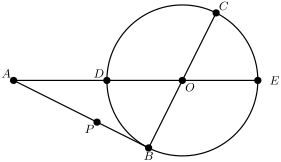
none of these
Small Hint:
Let the radius be and write in terms of and
Big Hint:
Use the tangent relation together with
Solution:
Let the radius be Since is tangent at Write Because the secant passes through the center, while Hence Also and The displayed equation rearranges to Therefore
Thus, the correct answer is A.
33.
You are given a sequence of terms; each term has the form where stands for the product of all prime numbers less than or equal to and takes, successively, the values Let be the number of primes appearing in this sequence. Then is:
Small Hint:
Every from through has a prime divisor at most
Big Hint:
That same prime divisor divides both and
Solution:
For each in the given range, choose a prime divisor of Since it is one of the factors of Therefore divides Moreover so is composite. No term is prime, and
Thus, the correct answer is A.
34.
Two swimmers, at opposite ends of a -foot pool, start to swim the length of the pool, one at the rate of feet per second, the other at feet per second. They swim back and forth for minutes. Allowing no loss of time at the turns, find the number of times they pass each other.
Small Hint:
Reflect the pool each time a swimmer turns so both paths become straight
Big Hint:
The joint position pattern repeats every seconds; inspect one full cycle, including endpoint coincidences
Solution:
The faster swimmer’s position repeats every seconds, and the slower swimmer’s position repeats every seconds. Thus their joint position pattern repeats every seconds. During one such cycle, their positions coincide at seconds. The keyed interpretation counts the simultaneous turn at the endpoint when as one of these encounters. Thus there are counted encounters per cycle and cycles in minutes, giving
Therefore, the correct answer is C.
35.
From point outside a circle, with a circumference of units, a tangent is drawn. Also from a secant is drawn dividing the circle into unequal arcs with lengths and It is found that the length of the tangent, is the mean proportional between and If and are integers, then may have the following number of values:
zero
one
two
three
infinitely many
Small Hint:
Use and
Big Hint:
Test the integer values excluding equal arcs
Solution:
The arc lengths satisfy while the mean-proportional condition gives For integral from through the possible products, up to symmetry, are and The last comes from equal arcs and is excluded. The remaining squares give and two values.
Thus, the correct answer is C.
36.
Let be the respective sums of terms of the same arithmetic progression with as the first term and as the common difference. Let Then is dependent on:
and
and
and
and
neither nor nor
Small Hint:
Use
Big Hint:
Substitute and collect the -terms and -terms separately
Solution:
Using the arithmetic-series formula, In the coefficient of is Simplifying the remaining terms gives Thus depends on and but not on
Therefore, the correct answer is B.
37.
The base of a triangle is of length and the altitude is of length A rectangle of height is inscribed in the triangle with the base of the rectangle in the base of the triangle. The area of the rectangle is:
Small Hint:
At height use similarity to find the horizontal width of the triangle
Big Hint:
The available width is ; multiply it by the rectangle’s height
Solution:
The cross-section parallel to the base at height has width by similarity. Multiplying by the rectangle’s height gives
Thus, the correct answer is A.
38.
In this diagram and are the equal sides of an isosceles triangle in which is inscribed equilateral triangle Designate angle by angle by and angle by Then:
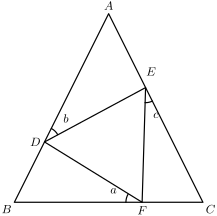
none of these
Small Hint:
Let each base angle of be
Big Hint:
Compare the directions of and using the angles of the equilateral triangle
Solution:
Let each base angle of be Measured from the direction the line has direction so the equilateral condition makes have direction At Similarly, angle chasing at gives Adding these equations yields
Therefore and the correct answer is D.
39.
To satisfy the equation and must be:
both rational
both real but not rational
both not real
one real, one not real
one real, one not real or both not real
Small Hint:
Let after noting that the denominators must be nonzero
Big Hint:
The resulting quadratic has negative discriminant
Solution:
The denominators require and Setting and cross-multiplying gives or Its discriminant is so is not real. Therefore and cannot both be real. Depending on the nonzero complex scale chosen for one can be real and the other nonreal, or both can be nonreal.
Thus, the correct answer is E.
40.
Given right triangle with legs Find the length of the shorter angle trisector from to the hypotenuse:
Small Hint:
Place
Big Hint:
The two trisector rays make angles and with ; intersect each with
Solution:
Place The hypotenuse has equation The trisector ray is Substitution gives Its length is hence The ray gives the longer trisector.
Thus, the correct answer is A.