
2022 AMC 10B Problem 19
Attempt Problem 19 of the 2022 AMC 10B below, then check your answer against the professionally curated solution from LIVE by Po-Shen Loh. You can also try the full timed exam, view all 2022 AMC 10B solutions, or check the answer key.
All problems are used with official legal permission of the Mathematical Association of America (MAA).
19.
Each square in a grid is either filled or empty, and has up to eight adjacent neighboring squares, where neighboring squares share either a side or a corner. The grid is transformed by the following rules:
• Any filled square with two or three filled neighbors remains filled.
• Any empty square with exactly three filled neighbors becomes a filled square.
• All other squares remain empty or become empty.
A sample transformation is shown in the figure below.
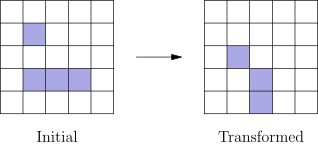
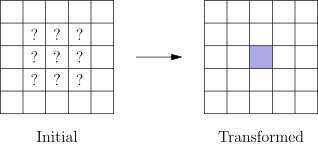
Suppose the grid has a border of empty squares surrounding a subgrid. How many initial configurations will lead to a transformed grid consisting of a single filled square in the center after a single transformation? (Rotations and reflections of the same configuration are considered different.)
Answer: C
Small Hint:
Split into cases according to whether the center is initially filled or empty
Big Hint:
Every initially filled noncenter square must disappear, and no other empty square may be born
Solution:
First suppose the center is initially filled. It must have exactly or filled neighbors to survive. Every such neighbor already touches the center, so to disappear it cannot touch any other filled neighbor. Checking these pairwise nonadjacent positions, the only choices that do not also give some empty square exactly filled neighbors are two opposite corners. There are such configurations.
Now suppose the center is initially empty. Exactly of its eight neighbors must be filled. Each of those three must disappear, so none may be adjacent to both of the others. Also, no empty square besides the center may be adjacent to all three. Applying these two tests gives the following four representative patterns:
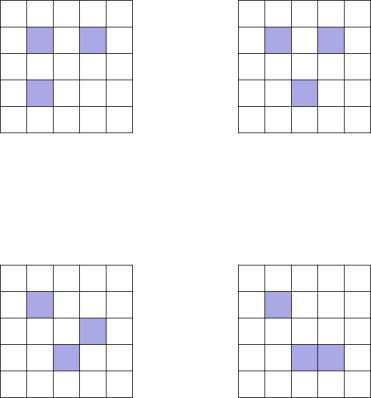
Each of the first three patterns has distinct rotations. The last has rotations and their reflected images, for configurations. Thus the center-empty case contributes and the total is
Thus, the answer is C .
Problem 19 in Other Years
2000 AMC 10 · 2001 AMC 10 · 2002 AMC 10A · 2002 AMC 10B · 2003 AMC 10A · 2003 AMC 10B · 2004 AMC 10A · 2004 AMC 10B · 2005 AMC 10A · 2005 AMC 10B · 2006 AMC 10A · 2006 AMC 10B · 2007 AMC 10A · 2007 AMC 10B · 2008 AMC 10A · 2008 AMC 10B · 2009 AMC 10A · 2009 AMC 10B · 2010 AMC 10A · 2010 AMC 10B · 2011 AMC 10A · 2011 AMC 10B · 2012 AMC 10A · 2012 AMC 10B · 2013 AMC 10A · 2013 AMC 10B · 2014 AMC 10A · 2014 AMC 10B · 2015 AMC 10A · 2015 AMC 10B · 2016 AMC 10A · 2016 AMC 10B · 2017 AMC 10A · 2017 AMC 10B · 2018 AMC 10A · 2018 AMC 10B · 2019 AMC 10A · 2019 AMC 10B · 2020 AMC 10A · 2020 AMC 10B · 2021 AMC 10A Spring · 2021 AMC 10B Spring · 2021 AMC 10A Fall · 2021 AMC 10B Fall · 2022 AMC 10A · 2023 AMC 10A · 2023 AMC 10B · 2024 AMC 10A · 2024 AMC 10B · 2025 AMC 10A · 2025 AMC 10B