
2022 AMC 10B Solutions
Scroll down to view professionally curated solutions from LIVE by Po-Shen Loh, print PDF solutions, view answer key, or take the full timed exam.
All problems are used with official legal permission of the Mathematical Association of America (MAA).
1.
Define to be for all real numbers and What is the value of
Small Hint:
Remember that the operation is absolute difference
Big Hint:
Evaluate each diamond operation from the inside out
Solution:
Working from the innermost operations outward gives Therefore, the given difference is
Thus, the answer is A .
2.
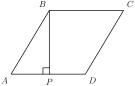
In rhombus point lies on segment so that and What is the area of
Small Hint:
Use the right triangle with legs AP and BP
Big Hint:
The altitude from B splits the rhombus side AD
Solution:
Since is a rhombus, Right triangle then gives Thus the rhombus has base and height so its area is
Thus, the answer is D .
3.
How many three-digit positive integers have an odd number of even digits?
Small Hint:
A three-digit number cannot start with
Big Hint:
Count by the number of even digit positions
Solution:
There are choices for the hundreds and tens digits. Once those two digits are fixed, the units digit must have whichever parity makes the total number of even digits odd. There are always digits of the required parity (including among the even digits).
Therefore, the number of integers is
Thus, the answer is D .
4.
A donkey suffers an attack of hiccups and the first hiccup happens at one afternoon. Suppose that the donkey hiccups regularly every seconds. At what time does the donkey’s th hiccup occur?
seconds after
seconds after
seconds after
seconds after
seconds after
Small Hint:
Convert the elapsed seconds past into minutes and seconds
Big Hint:
Count the number of five-second intervals after
Solution:
Since we want to look at the th hiccup, we need to look at time that is hiccups after the first one.
This would be seconds. Note that so the time would be minutes and seconds after the first hiccup. This would therefore be and seconds.
Thus, the answer is A .
5.
What is the value of
Small Hint:
Rewrite each square-root factor as a product of two nearby fractions
Big Hint:
Pair each factor in the numerator with the matching factor under the square root
Solution:
Let the given positive expression be Squaring it and using gives Hence
Thus, the answer is B .
6.
How many of the first ten numbers of the sequence are prime numbers?
Small Hint:
Express the th term as the sum of two overlapping blocks of ones
Big Hint:
Each term in the sequence has an obvious factorization pattern
Solution:
We claim that none of these numbers can ever be prime.
We prove this claim by noticing that the th number is This shows that the number can be written as the product of two numbers greater than so there are no primes.
Thus, the answer is A .
7.
For how many values of the constant will the polynomial have two distinct integer roots?
Small Hint:
Different root pairs give different values of k
Big Hint:
Integer roots must be factor pairs of
Solution:
Let the roots be Expanding gives Comparing coefficients with the given polynomial yields and
Therefore, we need and distinct such that All the possible factor pairs are and
Each of these unordered pairs produces a unique value for so there are possible values for
Thus, B is the correct answer.
8.
Consider the following sets of elements each: How many of these sets contain exactly two multiples of
Small Hint:
A block has two multiples exactly when its first multiple of ends in or
Big Hint:
Track the units digits of the multiples of
Solution:
A block of ten consecutive integers contains exactly two multiples of precisely when its first multiple of is in one of the first three positions. Thus that multiple must have units digit or
The multiples of with those units digits are, respectively, For each expression, gives a value at most so each class contributes blocks. Therefore, the total is
Thus, the answer is B .
9.
The sum can be expressed as where and are positive integers. What is
Small Hint:
Look for a difference involving consecutive factorial reciprocals
Big Hint:
Rewrite each term so the sum telescopes
Solution:
Each term telescopes because Summing makes every intermediate factorial reciprocal cancel, leaving Hence and
Thus, our answer is D .
10.
Camila writes down five positive integers. The unique mode of these integers is greater than their median, and the median is greater than their arithmetic mean. What is the least possible value for the mode?
Small Hint:
The unique mode must occupy the last two positions
Big Hint:
Let the ordered integers be a,b,c,d,e
Solution:
Let the integers in increasing order be The median is and the unique mode is
Because the mode is larger than the median and is unique, the last two entries must both be so the list is
The mean is so Hence so
To keep the mode unique, and must be distinct positive integers, both less than Since is even, the smallest such sum is so giving
The smallest possible mode is therefore and it is attainable with
Thus, the answer is D .
11.
All the high schools in a large school district are involved in a fundraiser selling T-shirts. Which of the choices below is logically equivalent to the statement “No school bigger than Euclid HS sold more T-shirts than Euclid HS”?
All schools smaller than Euclid HS sold fewer T-shirts than Euclid HS.
No school that sold more T-shirts than Euclid HS is bigger than Euclid HS.
All schools bigger than Euclid HS sold fewer T-shirts than Euclid HS.
All schools that sold fewer T-shirts than Euclid HS are smaller than Euclid HS.
All schools smaller than Euclid HS sold more T-shirts than Euclid HS.
Small Hint:
Use the contrapositive of the implication
Big Hint:
Translate the statement into an implication
Solution:
The statement says: if a school is bigger than Euclid HS, then it did not sell more T-shirts than Euclid HS. Its contrapositive is: if a school sold more T-shirts than Euclid HS, then it is not bigger than Euclid HS. This is exactly choice B . Choice C is stronger than the original statement because it rules out a bigger school selling the same number of T-shirts.
Thus, the answer is B .
12.
A pair of fair -sided dice is rolled times. What is the least value of such that the probability that the sum of the numbers face up on a roll equals at least once is greater than
Small Hint:
Compare with
Big Hint:
Use the complement: no roll has sum
Solution:
To compute this, we can also find the least such that the probability of not rolling a is less than Each roll has an independent probability of of getting so it has a probability of not landing on
Thus, the probability of none of the rolls being is We must find the least such that
If then the probability is which is greater than
If then the probability is which is less than This makes the answer
Thus, the answer is C .
13.
The positive difference between a pair of primes is equal to and the positive difference between the cubes of the two primes is What is the sum of the digits of the least prime that is greater than those two primes?
Small Hint:
Factor the difference of cubes
Big Hint:
Let the twin primes be and
Solution:
Since the primes are away from each other, we can make them equal to where is their average.
Then, making
Therefore, so
The primes are therefore The least prime greater than both of those is and its digit sum is
Thus, the answer is E .
14.
Suppose that is a subset of such that the sum of any two (not necessarily distinct) elements of is never an element of What is the maximum number of elements may contain?
Small Hint:
Pair the numbers below the maximum element so that each pair sums to that maximum
Big Hint:
Let be the largest element of
Solution:
The set has elements, and every pair has sum greater than so this size is attainable.
Conversely, let be the maximum element of For every element of satisfying the number and the number cannot both belong to
Thus, among the numbers below at most one number can be chosen from each pair with sum ; if is even, the middle number cannot be chosen either. Hence at most elements lie below and including gives at most elements.
The maximum value of this has yielding
Thus, the answer is B .
15.
Let be the sum of the first terms of an arithmetic sequence that has a common difference of The quotient does not depend on What is
Small Hint:
Force the quotient to be independent of n
Big Hint:
Write the arithmetic sequence in terms of first term and common difference
Solution:
Write the th term as so the term before the first term is Then
Hence
For this expression to be independent of its numerator in the final fraction must be Thus
Therefore,
Thus, the answer is D .
16.
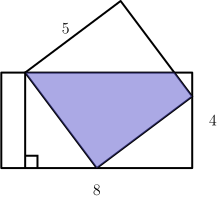
The diagram below shows a rectangle with side lengths and and a square with side length Three vertices of the square lie on three different sides of the rectangle, as shown. What is the area of the region inside both the square and the rectangle?
Small Hint:
The side length gives a –– slope relation
Big Hint:
Use coordinates or similar triangles for the tilted square
Solution:
Label the points as shown:
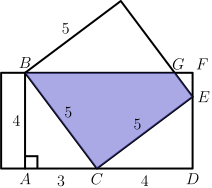
Because and the square side right triangle gives Also and are collinear, so The right triangles and have equal hypotenuses so they are congruent. Thus and
Right triangles and are similar, so Hence The shaded region is a trapezoid whose parallel sides are and and whose height is the perpendicular side Its area is
Thus, the answer is D .
17.
One of the following numbers is not divisible by any prime number less than Which is it?
Small Hint:
For the remaining choice, test divisibility by and
Big Hint:
Eliminate four choices by finding a small prime divisor
Solution:
Use the fact that is divisible by
Choice A is which is divisible by
Choice B is which is divisible by
Choice D is Since is divisible by multiplying by gives divisible by so is divisible by
Choice E is which is divisible by
For choice C, is odd. Also and so is not divisible by or
Thus, our answer is C .
18.
Consider systems of three linear equations with unknowns and where each of the coefficients is either or and the system has a solution other than For example, one such system is with a nonzero solution of How many such systems of equations are there? (The equations in a system need not be distinct, and two systems containing the same equations in a different order are considered different.)
Small Hint:
For three distinct nonzero dependent rows, one row is the ordinary sum of two rows with disjoint supports
Big Hint:
Count all binary coefficient matrices and subtract nonsingular ones
Solution:
There are ordered binary coefficient matrices. A homogeneous system has only the zero solution exactly when its three row vectors are linearly independent, so we count those matrices and subtract.
An independent matrix must have three distinct nonzero rows. There are ordered choices of such rows. Among three distinct nonzero binary vectors, dependence occurs exactly when one is the ordinary sum of the other two; the two summands must have disjoint nonempty supports.
If the sum has support of size choose its two coordinates in ways; its summands are the two corresponding unit vectors. If the sum has support of size choose which one coordinate forms one summand in ways, with the other two coordinates forming the other summand. Thus there are unordered dependent triples, each with row orders.
Hence the number of independent matrices is The desired number of singular matrices, and therefore of systems with a nonzero solution, is
Thus, the answer is B .
19.
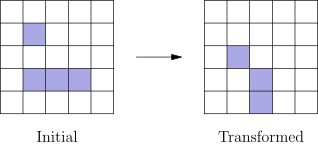
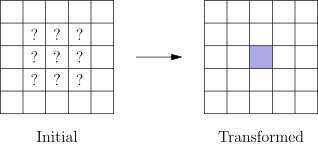
Each square in a grid is either filled or empty, and has up to eight adjacent neighboring squares, where neighboring squares share either a side or a corner. The grid is transformed by the following rules:
• Any filled square with two or three filled neighbors remains filled.
• Any empty square with exactly three filled neighbors becomes a filled square.
• All other squares remain empty or become empty.
A sample transformation is shown in the figure below.
Suppose the grid has a border of empty squares surrounding a subgrid. How many initial configurations will lead to a transformed grid consisting of a single filled square in the center after a single transformation? (Rotations and reflections of the same configuration are considered different.)
Small Hint:
Split into cases according to whether the center is initially filled or empty
Big Hint:
Every initially filled noncenter square must disappear, and no other empty square may be born
Solution:
First suppose the center is initially filled. It must have exactly or filled neighbors to survive. Every such neighbor already touches the center, so to disappear it cannot touch any other filled neighbor. Checking these pairwise nonadjacent positions, the only choices that do not also give some empty square exactly filled neighbors are two opposite corners. There are such configurations.
Now suppose the center is initially empty. Exactly of its eight neighbors must be filled. Each of those three must disappear, so none may be adjacent to both of the others. Also, no empty square besides the center may be adjacent to all three. Applying these two tests gives the following four representative patterns:
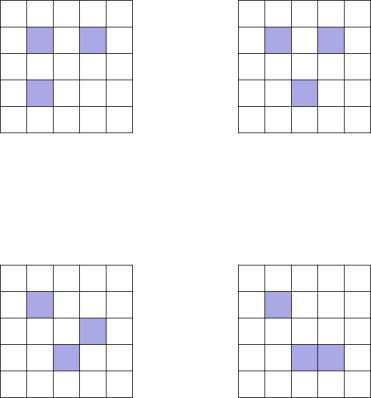
Each of the first three patterns has distinct rotations. The last has rotations and their reflected images, for configurations. Thus the center-empty case contributes and the total is
Thus, the answer is C .
20.
Let be a rhombus with Let be the midpoint of and let be the point on such that is perpendicular to What is the degree measure of
Small Hint:
Show that is the midpoint of making a diameter
Big Hint:
Extend to meet line at
Solution:
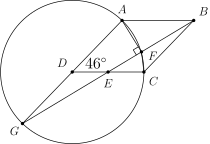
Extend to meet line at Because we have and are vertical angles. Also so Hence
Thus is the midpoint of The circle centered at through also passes through and Since Thales’ theorem places on this circle as well.
Because is opposite The inscribed angle subtending arc is therefore Finally, are collinear, so
Thus, the answer is D .
21.
Let be a polynomial with rational coefficients such that when is divided by the polynomial the remainder is and when is divided by the polynomial the remainder is There is a unique polynomial of least degree with these two properties. What is the sum of the squares of the coefficients of that polynomial?
Small Hint:
First check whether can be constant, and then try a linear polynomial
Big Hint:
Write then reduce this expression modulo
Solution:
The first remainder condition gives for some polynomial Modulo we have so
If is constant, this remainder is which cannot equal Thus must have degree at least
Now let Reducing modulo gives Matching this with yields This constructs a degree- polynomial, and the failed constant case proves that degree is minimal.
Therefore, The sum of the squares of its coefficients is
Thus, the answer is E .
22.
Let be the set of circles in the coordinate plane that are tangent to each of the three circles with equations and What is the sum of the areas of all circles in
Small Hint:
Pair cases according to whether it is internally or externally tangent to the smaller concentric circle
Big Hint:
Every desired circle is internally tangent to the largest concentric circle
Solution:
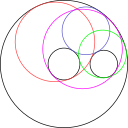
Call the concentric circles of radii and the inner and outer circles. Let a desired circle have radius and let its center be distance from the origin. It must be internally tangent to the outer circle, so
If it is externally tangent to the inner circle, then giving If it contains the inner circle, then giving Thus every desired circle has radius or
The third given circle has radius and center For either value of a desired circle may be internally or externally tangent to it, so the distance between their centers is or In all four cases, if this distance is then so the circle of possible centers intersects the circle of radius about the origin in two points, symmetric across the -axis, as shown. Hence there are desired circles of each radius.
The total area is therefore Thus, E is the correct answer.
23.
Ant Amelia starts on the number line at and crawls in the following manner. For Amelia chooses a time duration and an increment independently and uniformly at random from the interval During the th step of the process, Amelia moves units in the positive direction, using up minutes. If the total elapsed time has exceeded minute during the th step, she stops at the end of that step; otherwise, she continues with the next step, taking at most steps in all. What is the probability that Amelia’s position when she stops will be greater than
Small Hint:
Use geometric probabilities for sums of two or three independent numbers in
Big Hint:
The stopping time depends only on the variables and
Solution:
The stopping time depends only on the time variables, while the final position depends only on the distance variables, so the corresponding probabilities multiply.
For two independent numbers in the probability that their sum is less than is the area of a right triangle, namely
For three independent numbers in the probability that their sum is less than is the volume of a tetrahedron with side intercepts namely
If Amelia stops after two steps. This has probability and independently has probability contributing
If Amelia takes the third step. This has probability and independently has probability contributing
The total probability is
Thus, the answer is C .
24.
Consider functions that satisfy for all real numbers and Of all such functions that also satisfy the equation what is the greatest possible value of the following expression?
Small Hint:
After proving the upper bound, give a piecewise-linear function that attains it
Big Hint:
Use the contraction condition twice on each side of
Solution:
Applying the contraction inequality twice gives and similarly
Set The triangle inequality now yields
To attain the bound, define by linear interpolation through the points and set for or Every segment has slope with absolute value at most so the contraction condition holds. In particular, and Hence while giving the difference
Thus, the answer is B .
25.
Let be a sequence of numbers, where each is either or For each positive integer define Suppose for all What is the value of the sum
Small Hint:
Find and then subtract to isolate the four digits
Big Hint:
The congruence defines the binary digits of the inverse of
Solution:
The desired sum is Also,
Therefore, for a unique Reducing modulo gives
Since and we get Since we have so Hence
Finally,
Thus, the correct answer is A .