
2025 AIME I Problem 11
Attempt Problem 11 of the 2025 AIME I below, then check your answer against the professionally curated solution from LIVE by Po-Shen Loh. You can also try the full timed exam, view all 2025 AIME I solutions, or check the answer key.
All problems are used with official legal permission of the Mathematical Association of America (MAA).
11.
A piecewise linear function is defined by and for all real numbers The graph of has the sawtooth pattern depicted below.
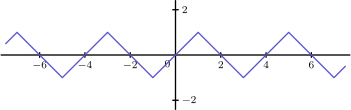
The parabola intersects the graph of at finitely many points. The sum of the -coordinates of all these intersection points can be expressed in the form where and are positive integers such that have greatest common divisor equal to and is not divisible by the square of any prime. Find
Answer: 259
Small hint:
On the parabola intersections are the solutions of with so
Big hint:
Each linear piece turns into a quadratic; add the roots with Vieta’s formulas, but check which roots actually land in the piece’s interval
Solution:
Since only takes values in any intersection has and hence On the rising pieces, with so becomes on the falling pieces, with giving In each case a root is valid exactly when it lies in (rising) or (falling), since then automatically falls in the correct interval.
For the rising pieces the roots are and both are valid exactly when i.e. for nine quadratics, each contributing root sum by Vieta. For the falling pieces the roots are The root with the minus sign requires which holds for those eight quadratics each contribute For only the positive root is valid.
The total is and is squarefree, so
Problem 11 in other years
- 1983 AIME
- 1984 AIME
- 1985 AIME
- 1986 AIME
- 1987 AIME
- 1988 AIME
- 1989 AIME
- 1990 AIME
- 1991 AIME
- 1992 AIME
- 1993 AIME
- 1994 AIME
- 1995 AIME
- 1996 AIME
- 1997 AIME
- 1998 AIME
- 1999 AIME
- 2000 AIME I
- 2000 AIME II
- 2001 AIME I
- 2001 AIME II
- 2002 AIME I
- 2002 AIME II
- 2003 AIME I
- 2003 AIME II
- 2004 AIME I
- 2004 AIME II
- 2005 AIME I
- 2005 AIME II
- 2006 AIME I
- 2006 AIME II
- 2007 AIME I
- 2007 AIME II
- 2008 AIME I
- 2008 AIME II
- 2009 AIME I
- 2009 AIME II
- 2010 AIME I
- 2010 AIME II
- 2011 AIME I
- 2011 AIME II
- 2012 AIME I
- 2012 AIME II
- 2013 AIME I
- 2013 AIME II
- 2014 AIME I
- 2014 AIME II
- 2015 AIME I
- 2015 AIME II
- 2016 AIME I
- 2016 AIME II
- 2017 AIME I
- 2017 AIME II
- 2018 AIME I
- 2018 AIME II
- 2019 AIME I
- 2019 AIME II
- 2020 AIME I
- 2020 AIME II
- 2021 AIME I
- 2021 AIME II
- 2022 AIME I
- 2022 AIME II
- 2023 AIME I
- 2023 AIME II
- 2024 AIME I
- 2024 AIME II
- 2025 AIME II
- 2026 AIME I
- 2026 AIME II