
2025 AIME I Solutions
Scroll down to view professionally curated solutions from LIVE by Po-Shen Loh, print PDF solutions, view answer key, or take the full timed exam.
All problems are used with official legal permission of the Mathematical Association of America (MAA).
1.
Find the sum of all integer bases for which is a divisor of
Small Hint:
Write the two numbers in base they are and
Big Hint:
Since the condition is that divides
Solution:
In base the two numbers are and We need to be divisible by and since certainly divides this is equivalent to being divisible by
For we have so must be or giving or The sum is
2.
On points and lie in that order on side with and Points and lie in that order on side with and Let be the reflection of through and let be the reflection of through Quadrilateral has area Find the area of heptagon
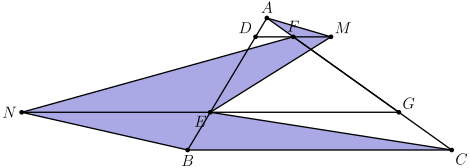
Small Hint:
Since and the points and sit of the way from while and sit of the way, so is a fixed fraction of
Big Hint:
Write and as vectors from then apply the shoelace formula to the heptagon; almost everything cancels
Solution:
Here and so and lie of the way from along their sides while and lie of the way. Triangles sharing angle have areas proportional to the products of the adjacent sides, so and Therefore which gives
Now set and so that and the reflections are and The shoelace formula for sums cross products of consecutive vertices: the two terms at vanish, and
Everything cancels except the single term so the heptagon’s area is
3.
The members of a baseball team went to an ice-cream parlor after their game. Each player had a single scoop cone of chocolate, vanilla, or strawberry ice cream. At least one player chose each flavor, and the number of players who chose chocolate was greater than the number of players who chose vanilla, which was greater than the number of players who chose strawberry. Let be the number of different assignments of flavors to players that meet these conditions. Find the remainder when is divided by
Small Hint:
First find every triple of flavor counts: strictly decreasing positive integers summing to
Big Hint:
For counts the number of ways to assign flavors to the nine distinct players is
Solution:
Let be the numbers of players choosing chocolate, vanilla, and strawberry, with Checking small values of shows the only possibilities are and
Since the players are distinct, each triple of counts contributes a multinomial coefficient: Thus and the remainder modulo is
4.
Find the number of ordered pairs where both and are integers between and inclusive, such that
Small Hint:
The left side factors as
Big Hint:
One line gives with the other gives with Don’t count the origin twice.
Solution:
The equation factors as so every solution has or
Integer solutions of are the constraint gives or pairs. Integer solutions of are the constraint gives or pairs. The families overlap only at so the count is
5.
There are eight-digit positive integers that use each of the digits exactly once. Let be the number of these integers that are divisible by Find the difference between and
Small Hint:
For divisibility by the four digits in odd positions and the four in even positions must have equal sums
Big Hint:
Each side sums to and there are such splits. Then count arrangements with an even units digit, sorted by how many even digits share the units digit’s side.
Solution:
The digits sum to Divisibility by requires the alternating sum of digits to be a multiple of so if the four digits in odd positions sum to then must be a multiple of Since the only possibility is each block of four positions carries digit sum The four-element subsets of with sum are eight in all, and they come in complementary pairs.
Choose which of the subsets occupies the even positions (which include the units place); the complement fills the odd positions. If that subset contains of the even digits, then the units digit can be chosen in ways, the rest of the even positions in ways, and the odd positions in ways, for numbers. Complementary subsets have -values summing to so over all choices Hence and
6.
An isosceles trapezoid has an inscribed circle tangent to each of its four sides. The radius of the circle is and the area of the trapezoid is Let the parallel sides of the trapezoid have lengths and with Find
Small Hint:
The height is twice the inradius, so the area formula gives
Big Hint:
In a tangential quadrilateral the two pairs of opposite sides have equal sums, so each leg is use the Pythagorean theorem to get
Solution:
The circle is tangent to both parallel sides, so the height of the trapezoid is From the area, so By the Pitot theorem the legs together also sum to and since the trapezoid is isosceles each leg is
Dropping a perpendicular from an endpoint of the shorter base, the leg is the hypotenuse of a right triangle with legs and so Therefore
7.
The twelve letters and are randomly grouped into six pairs of letters. The two letters in each pair are placed next to each other in alphabetical order to form six two-letter words, and then those six words are listed alphabetically. For example, a possible result is The probability that the last word listed contains is where and are relatively prime positive integers. Find
Small Hint:
The last word’s first letter is the largest among the six smaller letters of the pairs
Big Hint:
Either pairs with a later letter and no two of through pair together, or the last word is with through all paired into through
Solution:
There are ways to pair the letters. Each word begins with the smaller letter of its pair, so the last word alphabetically is the pair whose smaller letter is largest.
Case is the smaller letter of the last word. Then pairs with one of or ( ways), and no two of the remaining four late letters may pair together (such a pair would start with a letter after ). Those four letters must take distinct partners from in ways, and the two leftover early letters pair with each other. That gives pairings. Case is the larger letter, paired with some before Then none of may pair together, so all five take partners among the other five early letters; the six smaller letters are then exactly through and the largest is For the last word to contain its smaller letter must therefore be so the last word is and match with in ways.
The probability is so
8.
Let be a real number such that the system has exactly one complex solution The sum of all possible values of can be written as where and are relatively prime positive integers. Find Here
Small Hint:
The first equation is a circle centered at with radius the second is the perpendicular bisector of the points and
Big Hint:
Exactly one solution means the bisector is tangent to the circle: set the distance from to the line equal to
Solution:
The first equation says lies on the circle of radius centered at The second says is equidistant from and i.e. it lies on the perpendicular bisector of The system has exactly one solution precisely when this line is tangent to the circle.
The midpoint is and has slope so the bisector has slope in standard form Tangency requires so giving or
The sum is so
9.
The parabola with equation is rotated counterclockwise around the origin. The unique point in the fourth quadrant where the original parabola and its image intersect has -coordinate where and are positive integers, and and are relatively prime. Find
Small Hint:
lies on both curves exactly when and its rotation by both lie on the original parabola, at equal distance from the origin
Big Hint:
Try making the rotated image the mirror point that forces which you can substitute into the parabola
Solution:
A point lies on the image parabola exactly when its rotation by namely lies on the original parabola. So we need and both on The parabola is symmetric in so we look for whose rotated image is the mirror point
Matching -coordinates gives i.e. and then the -coordinate works automatically: Substituting into gives whose positive root is Then so this point is in the fourth quadrant, on both curves.
The problem guarantees the fourth-quadrant intersection is unique, so its -coordinate is giving
10.
The cells of a grid are filled in using the numbers through so that each row contains different numbers, and each of the three blocks heavily outlined in the example below contains different numbers, as in the first three rows of a Sudoku puzzle.
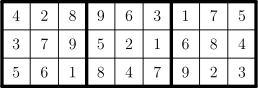
The number of different ways to fill such a grid can be written as where and are distinct prime numbers and are positive integers. Find
Small Hint:
Fill the left block in ways, then decide which digits from each of its rows go into each row of the middle block
Big Hint:
The middle block’s row contents can be chosen in ways, the right block is then determined, and every row of both blocks can be ordered in ways
Solution:
Fill the left block arbitrarily: ways. Let and be the sets of three digits in its rows. In the middle block, row must avoid (those digits already appear in row ), and the block’s three rows must partition Say its top row takes digits from and from Balancing the three rows then forces the middle row to take digits from together with all remaining digits of and the bottom row is determined. The number of content choices is
The right block’s row contents are then forced (row takes whatever is missing from row ), and each of the six rows of the middle and right blocks can be ordered internally in ways. The total is
Therefore
11.
A piecewise linear function is defined by and for all real numbers The graph of has the sawtooth pattern depicted below.
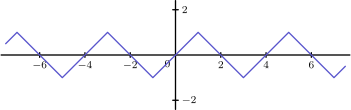
The parabola intersects the graph of at finitely many points. The sum of the -coordinates of all these intersection points can be expressed in the form where and are positive integers such that have greatest common divisor equal to and is not divisible by the square of any prime. Find
Small Hint:
On the parabola intersections are the solutions of with so
Big Hint:
Each linear piece turns into a quadratic; add the roots with Vieta’s formulas, but check which roots actually land in the piece’s interval
Solution:
Since only takes values in any intersection has and hence On the rising pieces, with so becomes on the falling pieces, with giving In each case a root is valid exactly when it lies in (rising) or (falling), since then automatically falls in the correct interval.
For the rising pieces the roots are and both are valid exactly when i.e. for nine quadratics, each contributing root sum by Vieta. For the falling pieces the roots are The root with the minus sign requires which holds for those eight quadratics each contribute For only the positive root is valid.
The total is and is squarefree, so
12.
The set of points in -dimensional coordinate space that lie in the plane whose coordinates satisfy the inequalities forms three disjoint convex regions. Exactly one of those regions has finite area. The area of this finite region can be expressed in the form where and are positive integers and is not divisible by the square of any prime. Find
Small Hint:
The first inequality rearranges to and the second to
Big Hint:
The bounded piece is on the plane; its corners come from the boundaries and
Solution:
Since and similarly the conditions are and Each condition offers two sign patterns, giving four combinations. The combination is impossible on the plane: forces contradicting Two of the remaining combinations allow a coordinate to run off to infinity, producing the two unbounded regions.
The bounded region is (the fourth constraint is then automatic): the set on the plane. Its closure is the triangle whose vertices come from intersecting the boundary lines pairwise: gives gives and gives
With the edge vectors are and whose cross product is of length The area is so
13.
Alex divides a disk into four quadrants with two perpendicular diameters intersecting at the center of the disk. He draws more line segments through the disk, drawing each segment by selecting two points at random on the perimeter of the disk in different quadrants and connecting these two points. Find the expected number of regions into which these line segments divide the disk.
Small Hint:
Each new segment adds plus the number of earlier segments it crosses, so find the expected total number of interior crossings
Big Hint:
Classify by quadrant pairs: a random chord meets a given diameter with probability and two random chords cross with probability
Solution:
With probability no random endpoint or interior crossing coincides with another, so adding chords one at a time, each new chord increases the region count by plus the number of existing chords it crosses inside the disk. Starting from one region, the expected total is where is the expected number of interior crossing pairs. The two diameters cross once. A random chord’s endpoints land in one of the quadrant pairs, each with probability The chord crosses the vertical diameter exactly when its endpoints have opposite -signs, which happens for of the pairs, so it meets each diameter with probability and both diameters together times on average: the chords contribute expected crossings with the diameters.
For two random chords, condition on their quadrant pairs ( equally likely ordered combinations). If one uses quadrants and the other the endpoints always alternate, so they always cross: combinations. If the two pairs are adjacent and disjoint, such as and the chords never cross: combinations. In each of the other combinations, whether the endpoints alternate around the circle reduces to comparing independent uniform points inside shared quadrants — for example, a chord and a chord cross exactly when the two quadrant- points come in one specific order — and the probability is by symmetry. So two random chords cross with probability
The chord pairs contribute expected crossings, so and the expected number of regions is
14.
Let be a convex pentagon with and For each point in the plane, define The least possible value of can be expressed as where and are positive integers and is not divisible by the square of any prime. Find
Small Hint:
Compute and triangles and turn out to have right angles at and
Big Hint:
Split and show that the Fermat point of triangle lies on segment
Solution:
In triangle the law of cosines with gives so since the angle at is right and Likewise with a right angle at and In triangle with
Split where is the minimum of Since we get so and All angles of triangle are less than so is attained at its Fermat point; erecting an equilateral triangle on side away from the standard rotation argument gives and since also has cosine
Both bounds are tight simultaneously: let be the Fermat point of so Since point lies on the circumcircle of whence similarly lies on the circumcircle of and Thus so lies on segment and The answer is
15.
Let denote the number of ordered triples of positive integers such that and is a multiple of Find the remainder when is divided by
Small Hint:
depends only on and cubes of numbers prime to are
Big Hint:
Three units, or one unit, can’t sum to mod With one multiple of each valid target has exactly one cube root; with all three, recurse modulo
Solution:
Since the cube of modulo depends only on and each residue occurs exactly once in Moreover, the only cube roots of modulo are which all agree modulo hence cubing is a bijection from the units modulo onto the set of unit cubes modulo which is exactly the set of units If all three of and are prime to (or exactly one is), then modulo the sum of cubes is or never no solutions.
Exactly one multiple of say for each of the units and choices of the requirement has a right side that is a unit hence has exactly one solution modulo With choices for which variable is the multiple of this case gives triples.
All three multiples of writing etc. with and ranging modulo the condition becomes which depends only on the residues modulo so the count is times the count modulo Repeating the same analysis one level down: the two-unit case gives and the all-divisible case reduces to with and modulo giving that is triples modulo hence here. In total whose remainder modulo is