
1984 AIME Problems
Scroll down and press Start to try the exam! Or, go to the printable PDF, answer key, or professional solutions curated by LIVE by Po-Shen Loh.
All problems are used with official legal permission of the Mathematical Association of America (MAA).
Or jump straight to a single problem with its solution: 1 · 2 · 3 · 4 · 5 · 6 · 7 · 8 · 9 · 10 · 11 · 12 · 13 · 14 · 15
Want to learn professionally through interactive video classes?
Timed
3:00:00
1.
Find the value of if is an arithmetic progression with common difference and
Answer: 93
Small Hint:
Pair the odd-indexed terms with the even-indexed terms
Big Hint:
Each even-indexed term is greater than the odd-indexed term immediately before it
Solution:
Let and There are pairs, and so Also Adding the two equations gives and hence
2.
The integer is the smallest positive multiple of such that every digit of is either or Compute
Answer: 592
Small Hint:
Divisibility by determines the last digit
Big Hint:
Divisibility by restricts the number of digits equal to
Solution:
A multiple of must end in and have digit sum divisible by Because the number of ’s must be a positive multiple of The smallest possible number therefore has three ’s followed by namely Thus
3.
A point is chosen in the interior of so that when lines are drawn through parallel to the sides of the resulting smaller triangles, and in the figure, have areas and respectively. Find the area of
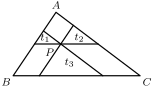
Answer: 144
Small Hint:
Each of the three smaller triangles is similar to
Big Hint:
Convert each area ratio into a linear ratio and add the three linear ratios
Solution:
Let the area of be The three small triangles are similar to so their corresponding linear ratios are Each such scale factor is also the perpendicular distance from to one side divided by the altitude to that side. These are the three barycentric area ratios and which add to Hence Therefore and
4.
Let be a list of positive integers—not necessarily distinct—in which the number appears. The average (arithmetic mean) of the numbers in is However, if is removed, the average of the remaining numbers drops to What is the largest number that can appear in
Answer: 649
Small Hint:
Let be the number of entries in the original list
Big Hint:
To maximize one entry, make every unrestricted positive integer as small as possible
Solution:
If the original list has entries, then so and the total of the entries is Besides the entry make eleven entries equal to the least positive integer, The remaining entry is then This construction is valid, and no larger entry is possible.
5.
Determine the value of if and
Answer: 512
Small Hint:
Express every logarithm using base
Big Hint:
Set and to obtain a linear system
Solution:
Let and The two equations become Equivalently, and which give and Therefore
6.
Three circles, each of radius are drawn with centers at and A line passing through is such that the total area of the parts of the three circles to one side of the line is equal to the total area of the parts of the three circles to the other side of it. What is the absolute value of the slope of this line?
Answer: 24
Small Hint:
The line already bisects the circle centered at
Big Hint:
For the other two equal circles, their signed distances from the line must be opposites
Solution:
For a circle of radius let be the signed difference between the areas on the two sides of a line when the center’s signed distance from the line is The function is odd and strictly increasing for and is constant only after the line no longer cuts the circle. The circle centered at contributes zero, so the line must separate the other two centers.
Let be the midpoint of those two centers. Among the lines through that separate them, the smaller of their two distances to the line is largest when the distances are equal, namely for the line through Even then, the distance is so the line must cut at least one of the two circles. Balance then forces it to cut both. The strict increase of therefore forces the two signed distances to be opposites, so the required line passes through Its slope is Its absolute value is
7.
The function is defined on the set of integers and satisfies if and if Find
Small Hint:
Start by evaluating
Big Hint:
Use downward induction to find a parity pattern for every integer below
Solution:
Directly from the definition, Continuing gives and
We now use downward induction. If is even, then is odd, so the established pattern above gives Thus If is odd, the same argument gives Thus every even has value Since is even,
8.
The equation has one complex root with argument between and in the complex plane. Determine the degree measure of
Answer: 160
Small Hint:
Substitute
Big Hint:
The two possible arguments of are and
Solution:
Let Then so has argument or Taking cube roots gives possible arguments The only one strictly between and is
9.
In tetrahedron edge has length cm. The area of face is and the area of face is These two faces meet each other at a angle. Find the volume of the tetrahedron in
Answer: 20
Small Hint:
Find the altitudes from and to the common edge
Big Hint:
Express the tetrahedron’s volume using the common edge, the two altitudes, and the sine of the dihedral angle
Solution:
Let and be the perpendicular distances from and to From the two face areas, The angle between these two perpendicular directions is the dihedral angle. Hence the scalar triple product gives
10.
Mary told John her score on the American High School Mathematics Examination (AHSME), which was over From this, John was able to determine the number of problems Mary solved correctly. If Mary’s score had been any lower, but still over John could not have determined this. What was Mary’s score? (Recall that the AHSME consists of multiple-choice problems and that one’s score, is computed by the formula where is the number correct and is the number wrong; students are not penalized for problems left unanswered.)
Answer: 119
Small Hint:
For a fixed score express the number wrong in terms of and
Big Hint:
Use and to bound the possible integer values of
Solution:
From we have The conditions and give Evaluating these integer endpoints for scores through always leaves at least two possible values of At both endpoints equal so John can determine Thus the first score over with the required property is
11.
A gardener plants three maple trees, four oak trees, and five birch trees in a row. He plants them in random order, each arrangement being equally likely. Let in lowest terms be the probability that no two birch trees are next to one another. Find
Answer: 106
Small Hint:
First choose the five positions occupied by birch trees
Big Hint:
Place the seven non-birch trees first and use the eight gaps around them
Solution:
The five birch positions form a uniformly chosen -element subset of the positions, so there are possibilities. After the seven non-birch trees are placed, there are eight gaps, including the two end gaps. Choosing five distinct gaps gives arrangements with no adjacent birches. Therefore and
12.
A function is defined for all real numbers and satisfies for all real If is a root of what is the least number of roots must have in the interval
Answer: 401
Small Hint:
Interpret the two identities as reflection symmetries about and
Big Hint:
Composing the two reflections produces a translation by
Solution:
The identities make the root set invariant under reflection about and about Their composition is translation by Starting from the root these operations force every number in to be a root. In the interval, the first set contributes roots and the second contributes for a total of
This bound is attainable: define to be on this invariant set and elsewhere. It has both required reflection symmetries. Hence the least possible number is
13.
Find the value of
Answer: 15
Small Hint:
Use
Big Hint:
Combine the four inverse-cotangent angles two at a time from left to right
Solution:
Let The cotangent addition formula gives Combining the next angle gives and combining the last gives Multiplying by yields
14.
What is the largest even integer that cannot be written as the sum of two odd composite numbers?
Answer: 38
Small Hint:
Test candidate even integers by listing the odd composites no greater than half the candidate
Big Hint:
For sufficiently large even work modulo and try subtracting or
Solution:
In a representation of the smaller odd composite would be at most The only possibilities are and whose complements and are prime. Thus is not representable.
Now let be even. If write If write If write In each case the second summand is an odd multiple of greater than hence is composite; the fixed first summand is also odd and composite. Therefore every even integer greater than is representable, so the largest exception is
15.
Determine if
Answer: 36
Small Hint:
Regard the four left sides as values of one rational function in
Big Hint:
Compare the coefficient of as tends to infinity
Solution:
Define Put With common denominator the numerator of has leading coefficient The four equations say its zeros are and Therefore
Let As tends to infinity, the defining expression gives On the other hand, the sum of the four numerator roots is while the sum of the four denominator roots is so the factored expression gives Hence