
Soluciones del 1993 AMC 8
Desplázate hacia abajo para ver las soluciones preparadas profesionalmente de LIVE by Po-Shen Loh, imprime las soluciones en PDF, consulta la clave de respuestas, o haz el examen cronometrado completo.
Todos los problemas se usan con el permiso legal oficial de la Mathematical Association of America (MAA).
1.
¿Qué par de números no tiene un producto igual a ?
Which pair of numbers does not have a product equal to
Pista pequeña:
Multiplica los dos números de cada par y verifica cuál producto no es
Multiply the two numbers in each pair and check which product is not
Pista grande:
Un número negativo por un número negativo es positivo, así que ten cuidado con los signos de
A negative times a negative is positive, so watch the signs of
Solución:
Revisando cada par: y
Solo no es igual a
Por lo tanto, la respuesta correcta es C.
Checking each pair: and
Only fails to equal
Thus, the correct answer is C .
2.
Cuando la fracción se expresa en su forma más simple, la suma del numerador y el denominador será
When the fraction is expressed in simplest form, then the sum of the numerator and the denominator will be
Pista pequeña:
Encuentra el máximo común divisor de y
Find the greatest common factor of and
Pista grande:
y así que divide ambos entre
and so divide both by
Solución:
Como y la fracción se reduce a
La suma del numerador y el denominador es
Por lo tanto, la respuesta correcta es C.
Since and the fraction reduces to
The sum of numerator and denominator is
Thus, the correct answer is C .
3.
¿Cuál de los siguientes números tiene el mayor factor primo?
Which of the following numbers has the largest prime factor?
Pista pequeña:
Factoriza cada número completamente en primos
Factor each number completely into primes
Pista grande:
Compara el mayor primo de cada factorización; observa que
Compare the largest prime in each factorization; note
Solución:
Factorizando: y
El mayor factor primo entre estos es que es un factor de
Por lo tanto, la respuesta correcta es B.
Factoring: and
The largest prime factor among these is which is a factor of
Thus, the correct answer is B .
4.
Pista pequeña:
Agrupa las potencias de diez:
Group the powers of ten:
Pista grande:
así que el producto es
so the product is
Solución:
Reagrupa como
Como el producto es
Por lo tanto, la respuesta correcta es E.
Regroup as
Since the product is
Thus, the correct answer is E .
5.
¿Cuál de las siguientes gráficas de barras podría representar los datos de la gráfica circular mostrada?
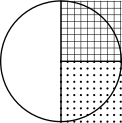
Which one of the following bar graphs could represent the data from the circle graph shown?


Pista pequeña:
Decide qué fracción del círculo completo ocupa cada una de las tres regiones
Decide what fraction of the whole circle each of the three regions takes up
Pista grande:
Cada región sombreada es un cuarto y la región sin sombrear es la mitad, así que las tres barras deben tener alturas en la proporción
Each shaded region is a quarter and the unshaded region is a half, so the three bars should have heights in the ratio
Solución:
Las dos regiones sombreadas son cada una un cuarto del círculo, y la región sin sombrear es la mitad. Así que las tres cantidades están en la proporción o
Una gráfica de barras que coincida debe tener las dos barras sombreadas iguales en altura y la barra sin sombrear exactamente el doble de alta. Solo una gráfica de barras tiene dos barras sombreadas iguales con la barra blanca del doble de su altura.
Por lo tanto, la respuesta correcta es C.
The two shaded regions are each one quarter of the circle, and the unshaded region is one half. So the three quantities are in the ratio or
A matching bar graph must have the two shaded bars equal in height and the unshaded bar exactly twice as tall. Only one bar graph has two equal shaded bars with the white bar double their height.
Thus, the correct answer is C .
6.
Una lata de sopa puede alimentar a adultos o niños. Si hay latas de sopa y se alimenta a niños, ¿a cuántos adultos alimentaría la sopa restante?
A can of soup can feed adults or children. If there are cans of soup and children are fed, then how many adults would the remaining soup feed?
Pista pequeña:
niños necesitan latas, así que encuentra cuántas latas quedan
children need cans, so find how many cans remain
Pista grande:
Cada lata restante alimenta a adultos
Each remaining can feeds adults
Solución:
Alimentar a niños usa latas, dejando latas.
Esas latas alimentan a adultos.
Por lo tanto, la respuesta correcta es B.
Feeding children uses cans, leaving cans.
Those cans feed adults.
Thus, the correct answer is B .
7.
Pista pequeña:
Sumar tres copias de es lo mismo que
Adding three copies of is the same as
Pista grande:
Solución:
Sumando tres términos iguales,
Por lo tanto, la respuesta correcta es A.
Adding three equal terms,
Thus, the correct answer is A .
8.
Para controlar su presión arterial, la abuela de Jill toma media pastilla cada dos días. Si un suministro de medicina contiene pastillas, entonces el suministro de medicina durará aproximadamente
To control her blood pressure, Jill’s grandmother takes one half of a pill every other day. If one supply of medicine contains pills, then the supply of medicine will last approximately
mes
month
meses
months
meses
months
meses
months
año
year
Pista pequeña:
Media pastilla cada dos días significa que una pastilla entera cubre días
Half a pill every other day means one whole pill covers days
Pista grande:
Encuentra el número total de días, luego conviértelo a meses usando unos días por mes
Find the total number of days, then convert to months using about days per month
Solución:
Toma media pastilla cada dos días, así que una pastilla dura días. Entonces pastillas duran días.
A unos días por mes, eso es aproximadamente meses.
Por lo tanto, la respuesta correcta es D.
She takes half a pill every two days, so one pill lasts days. Then pills last days.
At about days per month, that is roughly months.
Thus, the correct answer is D .
9.
Considera la operación definida por la siguiente tabla:
Por ejemplo, Entonces
Consider the operation defined by the following table:
For example, Then
Pista pequeña:
Lee de la fila columna y de la fila columna
Read from row column and from row column
Pista grande:
Ambos valores internos son iguales a así que calcula de la tabla
Both inner values equal so compute from the table
Solución:
De la tabla, y
Entonces
Por lo tanto, la respuesta correcta es D.
From the table, and
Then
Thus, the correct answer is D .
10.
Esta gráfica de líneas representa el precio de una tarjeta coleccionable durante los primeros meses de ¿En qué mes ocurrió la mayor caída mensual del precio?
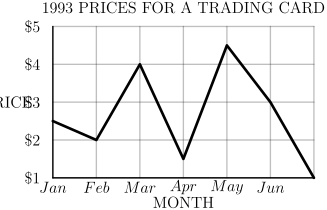
This line graph represents the price of a trading card during the first months of The greatest monthly drop in price occurred during which month?
enero
January
marzo
March
abril
April
mayo
May
junio
June
Pista pequeña:
Una caída ocurre donde la línea baja de un mes al siguiente; mide cuánto cae cada vez
A drop happens where the line goes down from one month to the next; measure how far it falls each time
Pista grande:
Compara solo los segmentos descendentes y encuentra el más pronunciado
Compare only the downward segments and find the steepest one
Solución:
Los cambios de precio de mes a mes son: enero (caída ), febrero (subida), marzo (caída ), abril (subida), mayo (caída ), y junio (caída ).
La mayor caída es que ocurrió en marzo.
Por lo tanto, la respuesta correcta es B.
The price changes month to month are: January (drop ), February (rise), March (drop ), April (rise), May (drop ), and June (drop ).
The largest drop is which occurred during March.
Thus, the correct answer is B .
11.
Considera este histograma de las calificaciones de estudiantes que presentan un examen. ¿En qué intervalo etiquetado está la mediana?
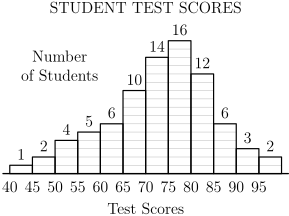
Consider this histogram of the scores for students taking a test. The median is in the interval labeled which value?
Pista pequeña:
Con calificaciones en orden, la mediana es la del medio: la calificación número , contando desde la más baja
With scores in order, the median is the middle one: the st score counting from the lowest
Pista grande:
Suma las alturas de las barras de izquierda a derecha hasta que el total acumulado alcance por primera vez
Add the bar heights from left to right until the running total first reaches
Solución:
Como estudiantes presentaron el examen, la mediana es la calificación número , contando desde la más baja.
Sumando las alturas de las barras desde la izquierda se obtienen los totales acumulados El total supera por primera vez en el intervalo etiquetado que contiene desde la calificación hasta la . Así que la calificación número está en el intervalo etiquetado
Por lo tanto, la respuesta correcta es C.
Since students took the test, the median is the st score counting up from the lowest.
Adding the bar heights from the left gives running totals The total first passes at the interval labeled which contains the th through nd scores. So the st score lies in the interval labeled
Thus, the correct answer is C .
12.
Si cada uno de los tres signos de operación, se usa exactamente una vez en uno de los espacios en la expresión
entonces el valor del resultado podría ser igual a
If each of the three operation signs, is used exactly once in one of the blanks in the expression
then the value of the result could equal
Pista pequeña:
La multiplicación se hace antes que la suma y la resta, así que dónde colocas es lo más importante
Multiplication happens before addition and subtraction, so where you place matters most
Pista grande:
Analiza cada forma de asignar a los tres espacios y calcula el resultado
Work through each way of assigning to the three blanks and compute the result
Solución:
Las seis disposiciones dan y
El único valor entre las opciones es
Por lo tanto, la respuesta correcta es E.
The six arrangements give and
The only value among the choices is
Thus, the correct answer is E .
13.
La palabra «HELP» en letras de bloque está pintada como una región sombreada con trazos de unidad de ancho en un letrero rectangular de por . Cada letra tiene unidades de ancho con un espacio de unidad entre letras, como se muestra. El área de la parte sin sombrear del letrero, en unidades cuadradas, es

The word “HELP” in block letters is painted as a shaded region with strokes unit wide on a by rectangular sign. Each letter is units wide with a -unit gap between letters, as shown. The area of the unshaded portion of the sign, in square units, is
Pista pequeña:
El letrero completo mide unidades cuadradas
The whole sign is square units
Pista grande:
Cuenta los cuadrados unitarios sombreados que forman cada letra, luego resta el total de
Count the shaded unit squares making up each letter, then subtract the total from
Solución:
El letrero completo tiene un área de unidades cuadradas. Contando los cuadrados unitarios sombreados de cada letra se obtiene y para un total sombreado de
El área sin sombrear es
Por lo tanto, la respuesta correcta es D.
The full sign has area square units. Counting the shaded unit squares in each letter gives and for a shaded total of
The unshaded area is
Thus, the correct answer is D .
14.
Los nueve cuadrados de la tabla mostrada deben llenarse de modo que cada fila y cada columna contenga cada uno de los números Entonces
The nine squares in the table shown are to be filled so that every row and every column contains each of the numbers Then
Pista pequeña:
Cada fila y cada columna debe contener exactamente una vez
Each row and each column must contain exactly once
Pista grande:
Una vez que se conocen dos entradas de una fila o columna, la tercera queda forzada; complétala paso a paso
Once two entries of a row or column are known, the third is forced; fill in step by step
Solución:
Llenando la cuadrícula para que cada fila y columna tenga la fila superior queda la fila del medio y la fila inferior La fila del medio fuerza y la última columna fuerza
Así que
Por lo tanto, la respuesta correcta es C.
Filling the grid so each row and column has the top row becomes the middle row and the bottom row The middle row forces and the last column forces
So
Thus, the correct answer is C .
15.
La media aritmética (promedio) de cuatro números es Si el mayor de estos números es entonces la media de los tres números restantes es
The arithmetic mean (average) of four numbers is If the largest of these numbers is then the mean of the remaining three numbers is
Pista pequeña:
Los cuatro números suman
The four numbers sum to
Pista grande:
Resta el número mayor, luego divide la suma restante entre
Subtract the largest number, then divide the remaining sum by
Solución:
Los cuatro números suman así que los tres restantes suman
Su media es
Por lo tanto, la respuesta correcta es A.
The four numbers sum to so the remaining three sum to
Their mean is
Thus, the correct answer is A .
16.
¿Cuál es el valor de la siguiente expresión?
What is the value of the following expression?
Pista pequeña:
Trabaja de abajo hacia arriba: primero simplifica
Work from the bottom up: first simplify
Pista grande:
Luego y toma el recíproco
Then and take the reciprocal
Solución:
Empezando por dentro, así que
Luego y la expresión completa es
Por lo tanto, la respuesta correcta es C.
Starting inside, so
Then and the whole expression is
Thus, the correct answer is C .
17.
Se quitan esquinas cuadradas, de unidades por lado, de una lámina rectangular de cartón de unidades por unidades. Luego se doblan los lados para formar una caja abierta. El área de la superficie, en unidades cuadradas, del interior de la caja es
Square corners, units on a side, are removed from a unit by unit rectangular sheet of cardboard. The sides are then folded to form an open box. The surface area, in square units, of the interior of the box is
Pista pequeña:
Doblar no cambia el área; la superficie interior es igual a la lámina menos los cuatro cuadrados de las esquinas
Folding does not change area; the interior surface equals the sheet minus the four corner squares
Pista grande:
La lámina es resta cuatro cuadrados de esquina de
The sheet is subtract four corner squares
Solución:
La superficie interior es exactamente una cara del cartón después de quitar las esquinas. La lámina tiene un área de y cada esquina quitada tiene un área de
Así que el área de la superficie interior es
Por lo tanto, la respuesta correcta es B.
The interior surface is exactly one face of the cardboard after the corners are removed. The sheet has area and each removed corner has area
So the interior surface area is
Thus, the correct answer is B .
18.
El rectángulo mostrado tiene longitud ancho y y son los puntos medios de y respectivamente. El área del cuadrilátero es
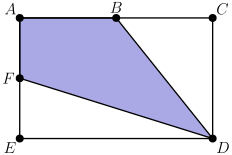
The rectangle shown has length width and and are midpoints of and respectively. The area of the quadrilateral is
Pista pequeña:
El rectángulo tiene un área de quita las partes fuera de
The rectangle has area remove the parts outside
Pista grande:
Resta el triángulo y el triángulo del rectángulo completo
Subtract triangle and triangle from the full rectangle
Solución:
El rectángulo tiene un área de El triángulo tiene un área de y el triángulo tiene un área de
La región restante tiene un área de
Por lo tanto, la respuesta correcta es A.
Rectangle has area Triangle has area and triangle has area
The remaining region has area
Thus, the correct answer is A .
19.
¿Cuál es el valor de la siguiente expresión?
What is the value of the following expression?
Pista pequeña:
Empareja cada término con el que está debajo:
Pair each term with the one below it:
Pista grande:
Cada uno de los pares tiene diferencia
Each of the pairs has difference
Solución:
Cada número de la primera suma es exactamente más que el número correspondiente de la segunda suma, y hay pares de este tipo.
Así que la diferencia es
Por lo tanto, la respuesta correcta es A.
Each number in the first sum is exactly more than the matching number in the second sum, and there are such pairs.
So the difference is
Thus, the correct answer is A .
20.
Cuando se expresa como un solo número entero, la suma de los dígitos es
When is expressed as a single whole number, the sum of the digits is
Pista pequeña:
es un seguido de ceros; restar cambia solo el extremo derecho
is a followed by zeros; subtracting changes only the right end
Pista grande:
El resultado es un bloque de nueves que termina en determina cuántos nueves hay
The result is a block of nines ending in determine how many nines there are
Solución:
Restar de (un seguido de ceros) da un número que es nueves seguidos de
La suma de los dígitos es
Por lo tanto, la respuesta correcta es D.
Subtracting from (a followed by zeros) gives a number that is nines followed by
The digit sum is
Thus, the correct answer is D .
21.
Si la longitud de un rectángulo se aumenta en y su ancho se aumenta en entonces el área se aumenta en
If the length of a rectangle is increased by and its width is increased by then the area is increased by
Pista pequeña:
Nueva área (nueva longitud) (nuevo ancho) veces el área anterior
New area (new length) (new width) times the old area
Pista grande:
Multiplica los dos factores de crecimiento y para obtener el factor por el cual crece el área
Multiply the two growth factors and to get the factor by which the area grows
Solución:
La nueva longitud es veces la anterior y el nuevo ancho es veces el anterior, así que la nueva área es veces el área anterior.
Eso es un aumento del
Por lo tanto, la respuesta correcta es D.
The new length is times the old and the new width is times the old, so the new area is times the old area.
That is an increase of
Thus, the correct answer is D .
22.
Pat Peano tiene muchos , , , , , , , y , pero solo tiene veintidós . ¿Hasta qué número puede numerar las páginas de su álbum de recortes con estos dígitos?
Pat Peano has plenty of ’s, ’s, ’s, ’s, ’s, ’s, ’s, ’s and ’s, but he has only twenty-two ’s. How far can he number the pages of his scrapbook with these digits?
Pista pequeña:
Cuenta cuántos aparecen al numerar las páginas a
Count how many ’s appear when numbering pages through
Pista grande:
Diez aparecen en la posición de las unidades y diez en la posición de las decenas hasta luego sigue los doses restantes después de
Ten ’s appear in the units place and ten in the tens place through then track the remaining twos past
Solución:
Numerar a usa diez en la posición de las unidades y diez en la posición de las decenas, un total de veinte . Las páginas y no usan ninguno.
Los dos restantes se usan en las páginas y Después de eso, las páginas a no necesitan ningún pero requeriría otro así que puede numerar hasta
Por lo tanto, la respuesta correcta es D.
Numbering through uses ten ’s in the units place and ten in the tens place, a total of twenty ’s. Pages and use none.
The remaining two ’s are used on pages and After that, pages through need no but would require another so he can number up to
Thus, the correct answer is D .
23.
Cinco corredores, participan en una carrera: vence a vence a vence a y termina después de y antes de ¿Quién no pudo haber terminado tercero en la carrera?
Five runners, have a race, and beats beats beats and finishes after and before Who could not have finished third in the race?
y
and
y
and
y
and
y
and
y
and
Pista pequeña:
termina delante de y mientras que termina delante de determina el puesto de
finishes ahead of and while finishes ahead of determine ’s place
Pista grande:
Si varios corredores deben terminar todos por delante de un corredor dado, ese corredor no puede estar tan arriba como tercero
If several runners must all finish ahead of a given runner, that runner cannot be as high as third
Solución:
Como vence a y termina delante de y vence a el corredor termina primero y por lo tanto no puede ser tercero.
Las pistas dan la cadena antes de antes de antes de Así que y terminan todos por delante de lo que significa que no puede quedar mejor que en cuarto lugar y tampoco puede ser tercero.
Cada uno de puede terminar tercero: por ejemplo, pone a tercero; pone a tercero; y pone a tercero. Así que solo y no pueden ser terceros.
Por lo tanto, la respuesta correcta es C.
Since beats and finishes ahead of and beats runner finishes first and so cannot be third.
The clues give the chain before before before So and all finish ahead of meaning is no better than fourth and cannot be third either.
Each of can finish third: for example puts third; puts third; and puts third. So only and cannot be third.
Thus, the correct answer is C .
24.
¿Qué número está directamente encima de en este arreglo de números?
What number is directly above in this array of numbers?
Pista pequeña:
Cada fila termina en un cuadrado perfecto: la fila termina en
Each row ends at a perfect square: row ends at
Pista grande:
está en la fila que termina en la fila de arriba termina en y las filas se alinean en sus bordes derechos
is in the row ending at the row above ends at and the rows line up at their right edges
Solución:
Cada fila termina en un cuadrado perfecto, así que la fila que contiene termina en y la fila de arriba termina en
Como las filas están alineadas en sus bordes derechos, está directamente encima de y por lo tanto está directamente encima de
Por lo tanto, la respuesta correcta es C.
Each row ends at a perfect square, so the row containing ends at and the row above it ends at
Since the rows are aligned at their right edges, sits directly above and therefore sits directly above
Thus, the correct answer is C .
25.
Un tablero de ajedrez consiste en cuadrados de una pulgada. Una tarjeta cuadrada, de pulgadas por lado, se coloca sobre el tablero de modo que cubre parte o toda el área de cada uno de cuadrados. El máximo valor posible de es
A checkerboard consists of one-inch squares. A square card, inches on a side, is placed on the board so that it covers part or all of the area of each of squares. The maximum possible value of is
o
or
o
or
o
or
o
or
o más
or more
Pista pequeña:
Una tarjeta inclinada puede cruzar más líneas de la cuadrícula que una tarjeta alineada con los cuadrados; la diagonal de la tarjeta tiene longitud
A tilted card can cross more grid lines than a card lined up with the squares; the card’s diagonal has length
Pista grande:
Intenta inclinar la tarjeta con su centro en una esquina de la cuadrícula y cuenta en cuántos cuadrados entra cada esquina de la tarjeta
Try tilting the card with its center on a grid corner, and count how many squares each corner of the card pokes into
Solución:
Inclina la tarjeta y céntrala en una esquina donde se encuentran cuatro cuadrados de la cuadrícula, como se muestra. Como la diagonal de la tarjeta, es más larga que cada una de las cuatro esquinas de la tarjeta pasa una línea de la cuadrícula hacia el siguiente cuadrado.
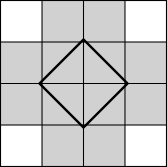
La tarjeta cubre el bloque central de de cuadrados y se extiende a cuadrados más en cada uno de sus cuatro lados, dando cuadrados.
Este es también el máximo posible. La tarjeta mide solo pulgadas de ancho, así que su ancho y alto totales son cada uno a lo sumo pulgadas; por lo tanto se encuentra dentro de un bloque de de cuadrados. Sus cuatro esquinas puntiagudas son las únicas partes que alcanzan el borde de ese bloque, así que nunca puede alcanzar los cuatro cuadrados de las esquinas del bloque, dejando a lo sumo Como es alcanzable, el máximo es que cae en el rango “ o más”.
Por lo tanto, la respuesta correcta es E.
Tilt the card and center it on a corner where four grid squares meet, as shown. Because the card’s diagonal, is longer than each of the four corners of the card reaches past a grid line into the next square.
The card covers the central block of squares and pokes into more squares on each of its four sides, giving squares.
This is also the most possible. The card is only inches wide, so its overall width and height are each at most inches; it therefore lies within a block of squares. Its four pointed corners are the only parts that reach the edge of that block, so it can never reach the four corner squares of the block, leaving at most Since is achievable, the maximum is which falls in the range “ or more.”
Thus, the correct answer is E .