
Soluciones del 1977 AMC 12
Desplázate hacia abajo para ver las soluciones preparadas profesionalmente de LIVE by Po-Shen Loh, imprime las soluciones en PDF, consulta la clave de respuestas, o haz el examen cronometrado completo.
Todos los problemas se usan con el permiso legal oficial de la Mathematical Association of America (MAA).
1.
Si y entonces es igual a
If and then equals
Pista pequeña:
Expresa cada término en función de
Express every term in terms of
Pista grande:
Usa primero para obtener
Use first to obtain
Solución:
Como tenemos Por lo tanto,
Por lo tanto, la respuesta correcta es D.
Since we have Therefore
Therefore, the correct answer is D.
2.
¿Cuál de las siguientes afirmaciones es falsa? Todos los triángulos equiláteros son
Which one of the following statements is false? All equilateral triangles are
equiángulos
equiangular
isósceles
isosceles
polígonos regulares
regular polygons
congruentes entre sí
congruent to each other
semejantes entre sí
similar to each other
Pista pequeña:
Distingue las propiedades determinadas por los ángulos de las determinadas por el tamaño
Separate properties determined by angles from properties determined by size
Pista grande:
Compara dos triángulos equiláteros cuyos lados tienen longitudes diferentes
Compare two equilateral triangles having different side lengths
Solución:
Todo triángulo equilátero es equiángulo, isósceles, regular y semejante a cualquier otro triángulo equilátero. Sin embargo, dos triángulos equiláteros con lados de longitudes diferentes no son congruentes.
Por lo tanto, la respuesta correcta es D.
Every equilateral triangle is equiangular, isosceles, regular, and similar to every other equilateral triangle. Two equilateral triangles with different side lengths are not congruent, however.
Therefore, the correct answer is D.
3.
Un hombre tiene en monedas de uno, cinco, diez, veinticinco y cincuenta centavos. Si tiene la misma cantidad de monedas de cada tipo, el número total de monedas que posee es
A man has in pennies, nickels, dimes, quarters and half dollars. If he has an equal number of coins of each kind, then the total number of coins he has is
Pista pequeña:
Halla el valor de una moneda de cada uno de los cinco tipos
Find the value of one coin of each of the five types
Pista grande:
Las cinco monedas de un conjunto completo valen centavos
The five coins in one complete set are worth cents
Solución:
Una moneda de cada tipo vale centavos. Como hay tres monedas de cada uno de los cinco tipos, es decir, monedas.
Por lo tanto, la respuesta correcta es E.
One coin of each kind is worth cents. Since there are three coins of each of the five kinds, or coins.
Therefore, the correct answer is E.
4.
En el triángulo se cumple que y Si los puntos y están sobre los lados y respectivamente, y y entonces es igual a
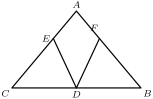
In triangle and If points and lie on sides and respectively, and and then equals
ninguna de las anteriores
none of these
Pista pequeña:
Determina primero los dos ángulos de la base de
First determine the two base angles of
Pista grande:
Usa los dos pares de segmentos de igual longitud para hallar y
Use the two given equal-length pairs to find and
Solución:
Los ángulos de la base de miden Como el triángulo tiene un ángulo vértice de por lo que De manera análoga, implica que Los tres ángulos situados sobre la recta suman así que
Por lo tanto, la respuesta correcta es C.
The base angles of are each Since triangle has vertex angle so Similarly, gives The three angles above the straight line sum to so
Therefore, the correct answer is C.
5.
El conjunto de todos los puntos tales que la suma de las distancias (no dirigidas) desde hasta dos puntos fijos y es igual a la distancia entre y es
The set of all points such that the sum of the (undirected) distances from to two fixed points and equals the distance between and is
el segmento de a
the line segment from to
la recta que pasa por y
the line passing through and
la mediatriz del segmento de a
the perpendicular bisector of the line segment from to
una elipse de área positiva
an ellipse having positive area
una parábola
a parabola
Pista pequeña:
Aplica la desigualdad triangular a y
Apply the triangle inequality to and
Pista grande:
Recuerda cuándo se da la igualdad en la desigualdad triangular
Recall when equality holds in the triangle inequality
Solución:
La desigualdad triangular da La igualdad se cumple exactamente cuando son colineales y está entre y incluidos los extremos. Por lo tanto, el lugar geométrico es el segmento de a
Por lo tanto, la respuesta correcta es A.
The triangle inequality gives Equality holds exactly when are collinear with between and including the endpoints. Thus the locus is the segment from to
Therefore, the correct answer is A.
6.
Si y no son cero, entonces es igual a
If and are not zero, then equals
ninguna de las anteriores
none of these
Pista pequeña:
Reescribe el recíproco exterior como una sola fracción
Rewrite the outside reciprocal using a single fraction
Pista grande:
Suma los dos recíprocos entre corchetes usando un denominador común
Combine the two reciprocals inside the brackets over a common denominator
Solución:
Tenemos Su producto es
Por lo tanto, la respuesta correcta es D.
We have Their product is
Therefore, the correct answer is D.
7.
Si entonces es igual a
If then equals
Pista pequeña:
Sea y usa
Let and use
Pista grande:
Factoriza como producto de dos factores lineales y uno cuadrático
Factor into a linear factor, a second linear factor, and a quadratic factor
Solución:
Sea Como se sigue que
Por lo tanto, la respuesta correcta es E.
Let Since it follows that
Therefore, the correct answer is E.
8.
Para cada terna de números reales no nulos, se forma el número El conjunto de todos los números que se pueden formar es
For every triple of nonzero real numbers, form the number The set of all numbers formed is
ninguna de las anteriores
none of these
Pista pequeña:
Cada una de las tres primeras fracciones es o
Each of the first three fractions is either or
Pista grande:
El signo de la última fracción es el producto de los tres primeros signos
The sign of the final fraction is the product of the first three signs
Solución:
Sean los signos de La expresión es Si los tres signos son positivos, vale y si todos son negativos, vale Si hay signos distintos, la cancelación directa da Por lo tanto, el conjunto es
Por lo tanto, la respuesta correcta es B.
Let be the signs of The expression is If all three signs are positive it is and if all are negative it is If the signs are mixed, direct cancellation gives Hence the set is
Therefore, the correct answer is B.
9.
En la figura adjunta, y los arcos y tienen la misma longitud. Halla la medida de

In the adjoining figure and arc arc and arc all have equal length. Find the measure of
Pista pequeña:
Asigna una variable común a los tres arcos iguales y otra variable al arco
Assign one variable to each of the three equal arcs and another to arc
Pista grande:
Usa tanto la suma de los arcos de la circunferencia completa como el teorema del ángulo entre secantes exteriores en
Use both the full-circle arc sum and the external-secant angle theorem at
Solución:
Sea la medida de cada uno de los arcos y sea la del arco Entonces Al resolver se obtiene El ángulo inscrito subtiende el arco por lo que mide
Por lo tanto, la respuesta correcta es B.
Let each of arcs measure and let arc measure Then Solving gives The inscribed angle subtends arc so it measures
Therefore, the correct answer is B.
10.
Si entonces es igual a
If then equals
Pista pequeña:
La suma de los coeficientes de un polinomio se obtiene evaluándolo en un valor particular
A polynomial’s coefficient sum is obtained by evaluating it at a particular input
Pista grande:
Sustituye en la identidad dada
Substitute into the given identity
Solución:
Al tomar el lado derecho se convierte en la suma de coeficientes buscada. Por lo tanto,
Por lo tanto, la respuesta correcta es E.
Setting makes the right side the desired coefficient sum. Thus
Therefore, the correct answer is E.
11.
Para cada número real sea el mayor entero que no excede a (es decir, el entero tal que ). ¿Cuáles de las siguientes afirmaciones son verdaderas?
para todo
para todos e
para todos e
For each real number let be the largest integer not exceeding (i.e., the integer such that ). Which of the following statements is (are) true?
for all
for all and
for all and
ninguna
none
solo
only
solo y
and only
solo
only
todas
all
Pista pequeña:
Demuestra directamente la propiedad de traslación a partir de
Prove the translation statement directly from
Pista grande:
Prueba las otras dos afirmaciones con valores no enteros entre y
Test the other two claims using noninteger values between and
Solución:
Si entonces así que es verdadera. Al tomar se obtiene y Por lo tanto, y son falsas.
Por lo tanto, la respuesta correcta es B.
If then so is true. Taking gives and Thus and are false.
Therefore, the correct answer is B.
12.
La edad de Al supera en a la suma de las edades de Bob y Carl, y el cuadrado de la edad de Al supera en al cuadrado de la suma de las edades de Bob y Carl. La suma de las edades de Al, Bob y Carl es
Al’s age is more than the sum of Bob’s age and Carl’s age, and the square of Al’s age is more than the square of the sum of Bob’s age and Carl’s age. The sum of the ages of Al, Bob and Carl is
Pista pequeña:
Sea la suma de las edades de Bob y Carl
Let be the sum of Bob’s and Carl’s ages
Pista grande:
Factoriza y usa el valor conocido de
Factor and use the known value of
Solución:
Sea la edad de Al y la suma de las otras dos edades. Entonces y Por consiguiente, el total pedido es
Por lo tanto, la respuesta correcta es D.
Let be Al’s age and the sum of the other two ages. Then and Hence the requested total is
Therefore, the correct answer is D.
13.
Si es una sucesión de números positivos tal que para todo entero positivo entonces la sucesión es una progresión geométrica
If is a sequence of positive numbers such that for all positive integers then the sequence is a geometric progression
para todos los valores positivos de y
for all positive values of and
si y solo si
if and only if
si y solo si
if and only if
si y solo si
if and only if
si y solo si
if and only if
Pista pequeña:
Escribe y en función de
Write out and in terms of
Pista grande:
Iguala las tres primeras razones consecutivas y usa que los términos son positivos
Equate the first three successive ratios and use positivity
Solución:
Los términos siguientes son y Si la sucesión es geométrica, entonces Así, y Como los términos son positivos, necesariamente Recíprocamente, estos valores iniciales producen la sucesión geométrica constante
Por lo tanto, la respuesta correcta es E.
The next terms are and If the sequence is geometric, then Thus and Positivity forces Conversely, these initial values produce the constant geometric sequence
Therefore, the correct answer is E.
14.
¿Cuántos pares de enteros satisfacen la ecuación ?
How many pairs of integers satisfy the equation
más de
more than
Pista pequeña:
Pasa todos los términos a un lado y suma
Move all terms to one side and add
Pista grande:
Factoriza la ecuación como un producto de dos enteros igual a
Factor the equation into a product of two integers equal to
Solución:
Al reordenar y completar el producto se obtiene Los pares de factores enteros de son y que producen y Por lo tanto, hay dos pares ordenados.
Por lo tanto, la respuesta correcta es B.
Rearranging and completing the product gives The integer factor pairs of are and producing and Thus there are two ordered pairs.
Therefore, the correct answer is B.
15.
Cada uno de los tres círculos de la figura adjunta es tangente exteriormente a los otros dos, y cada lado del triángulo es tangente a dos de los círculos. Si cada círculo tiene radio tres, entonces el perímetro del triángulo es
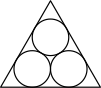
Each of the three circles in the adjoining figure is externally tangent to the other two, and each side of the triangle is tangent to two of the circles. If each circle has radius three, then the perimeter of the triangle is
Pista pequeña:
Los tres centros forman un triángulo equilátero de lado
The three circle centers form an equilateral triangle of side
Pista grande:
Considera los lados exteriores como rectas paralelas desplazadas y compara los inradios de los dos triángulos equiláteros
View the outer sides as parallel offsets and compare the inradii of two equilateral triangles
Solución:
Los centros forman un triángulo equilátero de lado cuyo inradio es Cada lado del triángulo exterior es una tangente paralela desplazada tres unidades hacia afuera, por lo que el triángulo exterior tiene inradio Un triángulo equilátero de inradio tiene lado así que cada lado exterior mide El perímetro es
Por lo tanto, la respuesta correcta es D.
The circle centers form an equilateral triangle of side whose inradius is Each side of the outer triangle is a parallel tangent line three units farther out, so the outer triangle has inradius An equilateral triangle of inradius has side hence each outer side is The perimeter is
Therefore, the correct answer is D.
16.
Si entonces la suma es igual a
If then the sum equals
Pista pequeña:
Compara el término de índice con el de índice
Compare the term indexed by with the term indexed by
Pista grande:
Cuenta los índices pares e impares desde hasta
Count the even and odd indices from through
Solución:
Sea Entonces Cada término de índice par es y cada término de índice impar es Hay índices pares y impares, así que la suma es
Por lo tanto, la respuesta correcta es D.
Let Then Every even-indexed term equals and every odd-indexed term equals There are even indices and odd indices, so the sum is
Therefore, the correct answer is D.
17.
Se lanzan al azar tres dados justos (es decir, todas las caras tienen la misma probabilidad de salir). ¿Cuál es la probabilidad de que los tres números obtenidos puedan ordenarse para formar una progresión aritmética de diferencia común uno?
Three fair dice are tossed at random (i.e., all faces have the same probability of coming up). What is the probability that the three numbers turned up can be arranged to form an arithmetic progression with common difference one?
Pista pequeña:
Enumera los posibles conjuntos de tres valores consecutivos de los dados
List the possible three-element sets of consecutive die values
Pista grande:
Cada conjunto válido tiene seis ordenamientos entre los resultados ordenados
Each qualifying set has six orderings among the ordered outcomes
Solución:
Los conjuntos posibles son y Cada uno tiene ordenamientos, así que de los resultados sirven. La probabilidad es
Por lo tanto, la respuesta correcta es B.
The possible sets are and Each has orderings, so of the outcomes work. The probability is
Therefore, the correct answer is B.
18.
Si entonces
If then
Pista pequeña:
Reescribe todos los logaritmos con la misma base
Rewrite every logarithm using the same base
Pista grande:
Los numeradores y denominadores adyacentes se cancelan en el producto
Adjacent numerators and denominators cancel in the product
Solución:
Por cambio de base,
Por lo tanto, la respuesta correcta es B.
By change of base,
Therefore, the correct answer is B.
19.
Sea el punto de intersección de las diagonales del cuadrilátero convexo y sean y los centros de las circunferencias circunscritas a los triángulos y respectivamente. Entonces
Let be the point of intersection of the diagonals of convex quadrilateral and let and be the centers of the circles circumscribing triangles and respectively. Then
es un paralelogramo
is a parallelogram
es un paralelogramo si y solo si es un rombo
is a parallelogram if and only if is a rhombus
es un paralelogramo si y solo si es un rectángulo
is a parallelogram if and only if is a rectangle
es un paralelogramo si y solo si es un paralelogramo
is a parallelogram if and only if is a parallelogram
ninguna de las anteriores es verdadera
none of the above are true
Pista pequeña:
Dos circuncentros adyacentes están sobre la mediatriz del lado que comparten sus triángulos
Two adjacent circumcenters lie on the perpendicular bisector of the side shared by their triangles
Pista grande:
Usa que son colineales y que son colineales
Use the fact that are collinear and are collinear
Solución:
Tanto como están en la mediatriz de mientras que y están en la mediatriz de Como son colineales, estas mediatrices son paralelas, de modo que Del mismo modo, están en la mediatriz de y están en la de Como son colineales, Por lo tanto, siempre es un paralelogramo.
Por lo tanto, la respuesta correcta es A.
Both and lie on the perpendicular bisector of while both and lie on the perpendicular bisector of Since are collinear, these bisectors are parallel, so Likewise, lie on the perpendicular bisector of and lie on that of Since are collinear, Therefore is always a parallelogram.
Therefore, the correct answer is A.
20.
¿Cuántos caminos formados por una sucesión de segmentos horizontales y/o verticales, cada uno de los cuales conecta dos letras adyacentes del diagrama, deletrean la palabra CONTEST al recorrerlos de principio a fin?
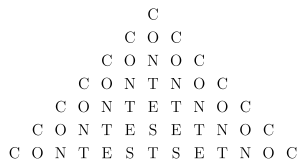
For how many paths consisting of a sequence of horizontal and/or vertical line segments, with each segment connecting a pair of adjacent letters in the diagram below, is the word CONTEST spelled out as the path is traversed from beginning to end?
ninguna de las anteriores
none of these
Pista pequeña:
Invierte cada camino y comienza en la central de la fila inferior
Reverse each path, starting from the central in the bottom row
Pista grande:
Cuenta por separado las familias que van a la izquierda y a la derecha, y luego corrige por el camino que comparten
Count the left-going and right-going families separately, then correct for their common path
Solución:
Invertimos los caminos y deletreamos TSETNOC desde la central inferior. En la familia cuyos movimientos horizontales van hacia la izquierda, cada uno de los seis pasos ofrece dos opciones: subir o ir a la izquierda. Esto da caminos. Por simetría, hay caminos cuyos movimientos horizontales van a la derecha. El camino vertical central pertenece a ambas familias, de modo que el total es Este número no aparece entre las primeras cuatro opciones.
Por lo tanto, la respuesta correcta es E.
Reverse the paths and spell TSETNOC from the central bottom In the family whose horizontal moves go left, each of the six steps has two choices: up or left. This gives paths. By symmetry, paths have horizontal moves going right. The all-vertical central path belongs to both families, so the total is This number is not among the first four choices.
Therefore, the correct answer is E.
21.
¿Para cuántos valores del coeficiente tienen las ecuaciones una solución real común?
For how many values of the coefficient do the equations have a common real solution?
infinitos
infinitely many
Pista pequeña:
Resta las dos ecuaciones para obtener una condición factorizada
Subtract the two equations to obtain a factored condition
Pista grande:
Examina por separado los casos y
Check separately the cases and
Solución:
Al restar la segunda ecuación de la primera se obtiene Si la ecuación común es que no tiene raíces reales. En caso contrario, y al sustituir en se obtiene Este valor funciona, así que exactamente un valor de cumple la condición.
Por lo tanto, la respuesta correcta es B.
Subtracting the second equation from the first gives If the common equation is which has no real roots. Otherwise and substitution into gives This value works, so exactly one value of qualifies.
Therefore, the correct answer is B.
22.
Si es una función real de la variable real no es idénticamente nula y, para todos y entonces, para todos e
If is a real-valued function of the real variable and is not identically zero, and for all and then for all and
existe un número positivo tal que
there is a positive number such that
Pista pequeña:
Sustituye primero
First substitute
Pista grande:
Luego toma y
Next set and
Solución:
Al tomar se obtiene por lo que Ahora toma y La ecuación se convierte en y por consiguiente para todo número real
Por lo tanto, la respuesta correcta es C.
Setting gives so Now set and The equation becomes and hence for every real
Therefore, the correct answer is C.
23.
Si las soluciones de la ecuación son los cubos de las soluciones de la ecuación entonces
If the solutions of the equation are the cubes of the solutions of the equation then
ninguna de las anteriores
none of these
Pista pequeña:
Llama y a las raíces de la segunda ecuación y aplica las fórmulas de Vieta
Call the roots of the second equation and and apply Vieta’s formulas
Pista grande:
Usa
Use
Solución:
Sean las raíces de Entonces y mientras que las raíces de la primera ecuación son Así, Por lo tanto,
Por lo tanto, la respuesta correcta es B.
Let the roots of be Then and while the roots of the first equation are Thus Therefore
Therefore, the correct answer is B.
24.
Halla la suma
Find the sum
Pista pequeña:
Descompón como diferencia de dos fracciones unitarias
Decompose into two unit fractions
Pista grande:
El último denominador corresponde a
The last denominator corresponds to
Solución:
Para Por lo tanto, la suma telescópica es
Por lo tanto, la respuesta correcta es D.
For Hence the sum telescopes to
Therefore, the correct answer is D.
25.
Determina el mayor entero positivo tal que sea divisible por
Determine the largest positive integer such that is divisible by
ninguna de las anteriores
none of these
Pista pequeña:
Cuenta los factores de en
Count the factors of in
Pista grande:
Incluye las contribuciones de los múltiplos de y
Include contributions from multiples of and
Solución:
Hay más factores de que de por lo que el exponente de es Como no aparece, la opción correcta es «ninguna de las anteriores».
Por lo tanto, la respuesta correcta es E.
There are more factors of than of so the exponent of is Since is not listed, the correct choice is “none of these.”
Therefore, the correct answer is E.
26.
Sean y las longitudes de los lados y respectivamente, del cuadrilátero Si es el área de entonces
Let and be the lengths of sides and respectively, of quadrilateral If is the area of then
si y solo si es convexo
if and only if is convex
si y solo si es un rectángulo
if and only if is a rectangle
si y solo si es un rectángulo
if and only if is a rectangle
si y solo si es un paralelogramo
if and only if is a parallelogram
si y solo si es un paralelogramo
if and only if is a parallelogram
Pista pequeña:
Divide el cuadrilátero por cada diagonal y acota cada seno por
Split the quadrilateral along each diagonal and bound every sine by
Pista grande:
Combina las dos cotas de área y analiza cuándo todas se alcanzan con igualdad
Combine the two resulting area bounds and analyze when every bound is an equality
Solución:
Al dividir por la diagonal y usar se obtiene Al dividir por se obtiene de modo análogo Estas cotas siguen siendo válidas para un cuadrilátero no convexo al tomar la diferencia apropiada de las áreas de los triángulos. Al sumarlas se obtiene o bien Para que haya igualdad, las cuatro cotas de los senos deben ser igualdades, por lo que los cuatro ángulos son rectos; recíprocamente, un rectángulo da la igualdad. Así, la igualdad se cumple exactamente para los rectángulos.
Por lo tanto, la respuesta correcta es B.
Splitting along diagonal and using gives Splitting along similarly gives These bounds remain valid for a nonconvex quadrilateral by taking the appropriate difference of triangle areas. Adding them yields or Equality requires equality in all four sine bounds, so all four angles are right angles; conversely a rectangle gives equality. Thus the equality holds exactly for rectangles.
Therefore, the correct answer is B.
27.
Hay dos bolas esféricas de distinto tamaño situadas en dos esquinas de una habitación rectangular; cada una toca dos paredes y el suelo. Si en cada bola hay un punto que está a pulgadas de cada pared que toca la bola y a pulgadas del suelo, entonces la suma de los diámetros de las bolas es
There are two spherical balls of different sizes lying in two corners of a rectangular room, each touching two walls and the floor. If there is a point on each ball which is inches from each wall which that ball touches and inches from the floor, then the sum of the diameters of the balls is
pulgadas
inches
pulgadas
inches
pulgadas
inches
pulgadas
inches
no se puede determinar con la información dada
not determined by the given information
Pista pequeña:
Coloca la esquina en el origen y toma las paredes y el suelo como planos coordenados
Place the corner at the origin with the walls and floor as coordinate planes
Pista grande:
Una esfera de radio tangente a los tres planos tiene centro
A sphere of radius tangent to all three planes has center
Solución:
Para un radio el centro es y el punto dado es Por lo tanto, que se simplifica a o Los dos radios son y así que la suma de los diámetros es pulgadas.
Por lo tanto, la respuesta correcta es C.
For radius the center is and the given point is Thus which simplifies to or The two radii are and so the sum of the diameters is inches.
Therefore, the correct answer is C.
28.
Sea ¿Cuál es el resto al dividir el polinomio entre el polinomio ?
Let What is the remainder when the polynomial is divided by the polynomial
Pista pequeña:
Usa
Use
Pista grande:
Evalúa el resto en las cinco raíces de y usa la cota de su grado
Evaluate the remainder at the five roots of and use its degree bound
Solución:
Sea el resto, de modo que Las cinco raíces de satisfacen y Por ello, y Entonces un polinomio de grado a lo sumo tiene cinco raíces distintas. Debe ser idénticamente nulo, así que
Por lo tanto, la respuesta correcta es A.
Let be the remainder, so The five roots of satisfy and Hence and Therefore a polynomial of degree at most has five distinct roots. It must be identically zero, so
Therefore, the correct answer is A.
29.
Halla el menor entero tal que para todos los números reales y
Find the smallest integer such that for all real numbers and
No existe tal entero
There is no such integer
Pista pequeña:
Aplica Cauchy-Schwarz a los tres números
Apply Cauchy-Schwarz to the three numbers
Pista grande:
Usa valores iguales y no nulos de para comprobar que la cota es óptima
Use equal nonzero values of to test sharpness
Solución:
Por Cauchy-Schwarz, La igualdad ocurre cuando así que ningún valor menor puede funcionar. Por lo tanto, el menor entero es
Por lo tanto, la respuesta correcta es B.
By Cauchy-Schwarz, Equality occurs when so no smaller value can work. Thus the smallest integer is
Therefore, the correct answer is B.
30.
Si y son, respectivamente, las longitudes de un lado, una diagonal más corta y una diagonal más larga de un nonágono regular (véase la figura adjunta), entonces

If and are the lengths of a side, a shortest diagonal and a longest diagonal, respectively, of a regular nonagon (see adjoining figure), then
Pista pequeña:
Escribe las longitudes de las tres cuerdas usando el circunradio del nonágono
Write the three chord lengths using the nonagon’s circumradius
Pista grande:
Compara con mediante la identidad de suma a producto
Compare with using the sum-to-product identity
Solución:
Si el circunradio es las tres cuerdas subtienden ángulos centrales de respectivamente. Así, La identidad de suma a producto da Al multiplicar por se obtiene
Por lo tanto, la respuesta correcta es A.
If the circumradius is the three chords subtend central angles respectively. Thus The sum-to-product identity gives Multiplying by yields
Therefore, the correct answer is A.