
Soluciones del 1990 AIME
Desplázate hacia abajo para ver las soluciones preparadas profesionalmente de LIVE by Po-Shen Loh, imprime las soluciones en PDF, consulta la clave de respuestas, o haz el examen cronometrado completo.
Todos los problemas se usan con el permiso legal oficial de la Mathematical Association of America (MAA).
1.
La sucesión creciente está formada por todos los enteros positivos que no son ni el cuadrado ni el cubo de un entero positivo. Halla el término de esta sucesión.
The increasing sequence consists of all positive integers that are neither the square nor the cube of a positive integer. Find the th term of this sequence.
Pista pequeña:
Cuenta los cuadrados y los cubos hasta un extremo candidato mediante inclusión-exclusión
Count squares and cubes up to a candidate endpoint by inclusion-exclusion
Pista grande:
Los números que son a la vez cuadrados y cubos son sextas potencias
Numbers that are both squares and cubes are sixth powers
Solución:
Hasta hay cuadrados, cubos y sextas potencias contadas en ambos grupos. Por lo tanto, el número de términos permitidos que no superan es Pero queda excluido, mientras que no es cuadrado ni cubo. Por consiguiente, el término es
Through there are squares, cubes, and sixth powers counted in both groups. Thus the number of allowed terms at most is But is excluded, while is neither a square nor a cube. Therefore the th term is
2.
Halla el valor de
Find the value of
Pista pequeña:
Expresa como cuadrados de expresiones radicales conjugadas
Express as squares of conjugate radical expressions
Pista grande:
Después de elevar a la potencia , desarrolla simétricamente la diferencia de los dos cubos
After taking the powers, expand the difference of the two cubes symmetrically
Solución:
Como y la expresión es Al usar con y , se obtiene
Since and the expression is Using with and gives
3.
Sea un polígono regular de lados y un polígono regular de lados , tales que cada ángulo interior de mide de cada ángulo interior de ¿Cuál es el mayor valor posible de ?
Let be a regular -gon and be a regular -gon such that each interior angle of is as large as each interior angle of What is the largest possible value of
Pista pequeña:
Usa para el ángulo interior de un polígono regular de lados
Use for the interior angle of a regular -gon
Pista grande:
Después de simplificar, sea y usa que es positivo
After simplifying, set and use the positivity of
Solución:
La condición sobre los ángulos da que se simplifica a Sea Entonces En particular, es un divisor positivo de y maximizar exige tomar el menor posible. La elección da y el entero positivo que también satisface Por lo tanto, el mayor valor posible de es
The angle condition gives which simplifies to Put Then In particular, is a positive divisor of and maximizing means taking the least possible The choice gives and the positive integer which also satisfies Hence the largest possible is
4.
Halla la solución positiva de
Find the positive solution to
Pista pequeña:
Sea para que los tres denominadores difieran solo por constantes
Set so the three denominators differ only by constants
Pista grande:
Combina las dos primeras fracciones antes de eliminar los denominadores
Combine the first two fractions before clearing denominators
Solución:
Sea Al combinar las dos primeras fracciones y eliminar los denominadores no nulos se obtiene una igualdad entre y Al desarrollar y cancelar se obtiene Así, por lo que La solución positiva es
Set Combining the first two fractions and clearing the nonzero denominators gives an equality between and Expanding and canceling yields Thus so The positive solution is
5.
Sea el menor entero positivo que es múltiplo de y tiene exactamente divisores enteros positivos, incluidos y él mismo. Halla
Let be the smallest positive integer that is a multiple of and has exactly positive integral divisors, including and itself. Find
Pista pequeña:
Descompón en posibles productos de números que sean uno más que los exponentes primos
Factor into possible products of numbers one greater than prime exponents
Pista grande:
El patrón de exponentes puede incluir los factores requeridos y , asignando los mayores exponentes a los menores primos
The exponent pattern can include the required factors and while assigning the largest exponents to the smallest primes
Solución:
Las particiones multiplicativas de dan los patrones de exponentes y Un número divisible por necesita los dos primos y así que el patrón de un solo primo es imposible. Los menores candidatos de los patrones de dos primos son y respectivamente. El menor candidato con tres primos es Tiene divisores, y cada candidato con dos primos es mayor porque y Por lo tanto,
The multiplicative partitions of give exponent patterns and A number divisible by needs both primes and so the one-prime pattern is impossible. The smallest candidates from the two-prime patterns are and respectively. The smallest three-prime candidate is It has divisors, and each two-prime candidate is larger because and Therefore
6.
Una bióloga quiere calcular el número de peces de un lago. El de mayo captura una muestra aleatoria de peces, los marca y los suelta. El de septiembre captura una muestra aleatoria de peces y descubre que están marcados. Para calcular el número de peces que había en el lago el de mayo, supone que el de esos peces ya no está en el lago el de septiembre (por muertes y emigraciones), que el de los peces no estaba en el lago el de mayo (por nacimientos e inmigraciones), y que las cantidades de peces sin marca y con marca de la muestra del de septiembre son representativas de la población total. ¿Qué número de peces calcula la bióloga que había en el lago el de mayo?
A biologist wants to calculate the number of fish in a lake. On May she catches a random sample of fish, tags them, and releases them. On September she catches a random sample of fish and finds that of them are tagged. To calculate the number of fish in the lake on May she assumes that of these fish are no longer in the lake on September (because of death and emigrations), that of the fish were not in the lake May (because of births and immigrations), and that the number of untagged fish and tagged fish in the September sample are representative of the total population. What does the biologist calculate for the number of fish in the lake on May
Pista pequeña:
Determina primero cuántos de los peces marcados originalmente permanecen en septiembre
First determine how many of the original tagged fish remain in September
Pista grande:
Usa la fracción marcada de la muestra para estimar la población de septiembre y luego identifica el que estaba presente en mayo
Use the sample’s tagged fraction to estimate the September population, then identify the that were present in May
Solución:
De los peces marcados, el permanece en septiembre, de modo que quedan peces marcados. La muestra estima que los peces marcados constituyen de la población de septiembre, por lo que esa población es De esos peces, el estaba presente en mayo, así que quedan peces supervivientes de mayo. Estos representan el de la población de mayo. Por lo tanto, la población estimada de mayo es
Of the tagged fish, remain in September, so tagged fish remain. The sample estimates that tagged fish form of the September population, making that population Of those fish, were present in May, so surviving May fish remain. These are of the May population. Thus the estimated May population is
7.
Un triángulo tiene vértices y La ecuación de la bisectriz de puede escribirse en la forma Halla
A triangle has vertices and The equation of the bisector of can be written in the form Find
Pista pequeña:
Halla los vectores unitarios desde hacia y
Find the unit vectors from toward and
Pista grande:
La dirección de la bisectriz interior es la suma de los dos vectores unitarios
The internal angle-bisector direction is the sum of the two unit vectors
Solución:
Tenemos de longitud y de longitud La suma de sus vectores unitarios es así que la bisectriz tiene dirección Un vector normal es Como pasa por su ecuación es o bien Por consiguiente,
We have with length and with length The sum of their unit vectors is so the angle bisector has direction A normal vector is Through its equation is or Hence
8.
En una competencia de tiro, se colocan ocho platos de arcilla en dos columnas colgantes de tres platos cada una y una columna de dos platos. Un tirador debe romper todos los platos de acuerdo con las siguientes reglas:
El tirador elige primero una columna de la cual romperá un plato.
Después debe romper el plato restante más bajo de la columna elegida.
Si se siguen las reglas, ¿en cuántos órdenes distintos pueden romperse los ocho platos?
In a shooting match, eight clay targets are arranged in two hanging columns of three targets each and one column of two targets. A marksman is to break all the targets according to the following rules:
The marksman first chooses a column from which a target is to be broken.
The marksman must then break the lowest remaining target in the chosen column.
If the rules are followed, in how many different orders can the eight targets be broken?
Pista pequeña:
Dentro de cada columna, el orden de abajo hacia arriba está fijado
Within each column, the bottom-to-top order is forced
Pista grande:
Codifica un orden solo mediante la secuencia de columnas elegidas, con multiplicidades y
Encode an order only by the sequence of chosen columns, with multiplicities and
Solución:
Una vez conocida la columna elegida en cada disparo, el plato de esa columna queda determinado. Así, cada orden válido corresponde a una disposición de tres símbolos de la primera columna, tres de la segunda y dos de la tercera. El número de tales disposiciones es
Once the chosen column is known at each shot, the target within that column is forced. Thus every valid order corresponds to an arrangement of three symbols from the first column, three from the second, and two from the third. The number of such arrangements is
9.
Se lanza una moneda equilibrada veces. Sea en términos mínimos, la probabilidad de que nunca aparezcan caras en lanzamientos consecutivos. Halla
A fair coin is to be tossed times. Let in lowest terms, be the probability that heads never occur on consecutive tosses. Find
Pista pequeña:
Cuenta las secuencias válidas de lanzamientos según terminen en cruz o en cara
Count valid length- toss strings according to whether they end in tails or heads
Pista grande:
La recurrencia resultante es similar a la de Fibonacci, con valores iniciales y
The resulting recurrence is Fibonacci-like, with initial counts and
Solución:
Sea el número de secuencias de lanzamientos sin caras consecutivas. Una secuencia válida que termina en cruz se obtiene añadiendo a cualquier secuencia válida de longitud , mientras que una que termina en cara se obtiene añadiendo a cualquier secuencia válida de longitud . Por tanto, con y Esto da La probabilidad es así que
Let be the number of length- toss strings with no consecutive heads. A valid string ending in tails is obtained by appending to any valid length- string, while one ending in heads is obtained by appending to any valid length- string. Hence with and This gives The probability is so
10.
Los conjuntos y son conjuntos de raíces complejas de la unidad. El conjunto también es un conjunto de raíces complejas de la unidad. ¿Cuántos elementos distintos hay en ?
The sets and are both sets of complex roots of unity. The set is also a set of complex roots of unity. How many distinct elements are in
Pista pequeña:
Escribe las raíces como exponenciales cuyos argumentos sean múltiplos de y
Write the roots as exponentials whose arguments are multiples of and
Pista grande:
Las sumas de esos argumentos generan todos los múltiplos de
The sums of those arguments generate all multiples of
Solución:
Los argumentos de los productos de son Como los residuos generan todos los residuos módulo Así, es precisamente el conjunto de las raíces de orden de la unidad. De manera equivalente, su orden es
The arguments of products in are Since the residues generate every residue modulo Thus is precisely the set of th roots of unity. Equivalently, its order is
11.
Alguien observó que Halla el mayor entero positivo para el cual puede expresarse como el producto de enteros positivos consecutivos.
Someone observed that Find the largest positive integer for which can be expressed as the product of consecutive positive integers.
Pista pequeña:
Compara con los productos de enteros consecutivos que comienzan en y en
Compare with products of consecutive integers beginning at and at
Pista grande:
El producto que comienza en es igual a
The product beginning at equals
Solución:
Los enteros consecutivos que comienzan en tienen producto mientras que los que comienzan en tienen producto Para el segundo producto es igual a así que funciona. Para todo el producto que comienza en es menor que el que comienza en es mayor que y el producto aumenta estrictamente con su término inicial. Por consiguiente, ningún funciona y el mayor valor posible es
The consecutive integers beginning at have product while those beginning at have product For the latter product equals so works. For every the product beginning at is below the product beginning at is above and the product strictly increases with its initial term. Hence no works, and the largest possible value is
12.
Un polígono regular de lados está inscrito en una circunferencia de radio La suma de las longitudes de todos los lados y diagonales del polígono de lados puede escribirse en la forma donde y son enteros positivos. Halla
A regular -gon is inscribed in a circle of radius The sum of the lengths of all sides and diagonals of the -gon can be written in the form where and are positive integers. Find
Pista pequeña:
Agrupa las cuerdas según el número de pasos entre vértices donde es o
Group the chords by the number of vertex steps where is or
Pista grande:
Para hay cuerdas de longitud mientras que hay diámetros
For there are chords of length while there are diameters
Solución:
Para igual a y hay cuerdas de longitud y hay diámetros de longitud Las cinco longitudes de cuerda son Su suma es Por lo tanto, el total es Así, y por lo que
For equal to and there are chords of length and there are diameters of length The five chord lengths are Their sum is Therefore the total is Hence and so
13.
Sea el conjunto de potencias donde es un entero con Dado que tiene dígitos y que su primer dígito (el de más a la izquierda) es ¿cuántos elementos de tienen como primer dígito?
Let be the set of powers where is an integer with Given that has digits and that its first (leftmost) digit is how many elements of have as their leftmost digit?
Pista pequeña:
Compara el número de dígitos de con el de
Compare the number of digits of with that of
Pista grande:
Multiplicar por produce un primer dígito exactamente cuando no aumenta el número de dígitos
A multiplication by produces a leading exactly when the digit count does not increase
Solución:
Para el número comienza con exactamente cuando tiene el mismo número de dígitos que En efecto, si tiene dígitos y al multiplicarlo por no aparece un nuevo dígito, entonces de modo que su primer dígito es Si aparece un nuevo dígito, entonces por lo que su primer dígito es a lo sumo
Comenzando con el número de un dígito el número de dígitos llega a después de multiplicaciones. Por lo tanto, aumenta en pasos y permanece sin cambios en pasos. Como no comienza con exactamente elementos de sí lo hacen.
For the number begins with exactly when it has the same number of digits as Indeed, if has digits and multiplication by creates no new digit, then so its leading digit is If multiplication does create a new digit, then so its leading digit is at most
Starting from the one-digit number the digit count reaches after multiplications. Thus it increases on steps and stays unchanged on steps. Since does not begin with exactly elements of do.
14.
El rectángulo que aparece abajo tiene dimensiones y Las diagonales y se cortan en Si se recorta y retira el triángulo , se unen las aristas y , y luego se pliega la figura por los segmentos y se obtiene una pirámide triangular cuyas cuatro caras son triángulos isósceles. Halla el volumen de esta pirámide.
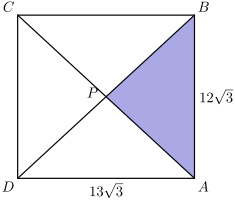
The rectangle below has dimensions and Diagonals and intersect at If triangle is cut out and removed, edges and are joined, and the figure is then creased along segments and we obtain a triangular pyramid, all four of whose faces are isosceles triangles. Find the volume of this pyramid.
Pista pequeña:
Después de unir y , los vértices y se convierten en uno solo; determina las seis longitudes de las aristas del tetraedro
After and are joined, vertices and become one vertex; determine all six edge lengths of the tetrahedron
Pista grande:
Coloca y el vértice unido en un plano de coordenadas; luego localiza usando sus distancias iguales a los demás vértices
Place and the joined vertex in one coordinate plane, then locate from its equal distances to the other vertices
Solución:
Después de plegar, y se convierten en un solo vértice Cada semidiagonal del rectángulo tiene longitud Así, mientras que y
Coloca y Estas coordenadas dan las longitudes requeridas desde hasta y Como está a la misma distancia de y escribe Al igualar y se obtiene Luego, da de modo que
El triángulo de la base tiene área Por lo tanto, el volumen de la pirámide es
After folding, and become one vertex Each half-diagonal of the rectangle has length Thus while and
Place and These coordinates give the required lengths from to and Because is equidistant from and write Equating and gives Then yields so
The base triangle has area Therefore the pyramid’s volume is
15.
Halla si los números reales y satisfacen las ecuaciones
Find if the real numbers and satisfy the equations
Pista pequeña:
Sea y deriva una recurrencia usando y
Let and derive a recurrence using and
Pista grande:
Usa y para hallar los dos coeficientes de la recurrencia antes de calcular
Use and to solve for the two recurrence coefficients before computing
Solución:
Sean y Como y satisfacen Al usar y se obtiene Al resolver, y Por lo tanto,
Let and Since and each satisfy Using and gives Solving yields and Therefore