
2004 AIME II 真题
计时
3:00:00
1.
圆的一条弦垂直于一条半径,且交点是这条半径的中点。该弦把圆分成两个区域,较大区域面积与较小区域面积的比可表示为 ,其中 ,,,,, 都是正整数, 与 互质,且 和 都不被任何质数的平方整除。求 除以 的余数。
A chord of a circle is perpendicular to a radius at the midpoint of the radius. The ratio of the area of the larger of the two regions into which the chord divides the circle to the smaller can be expressed in the form where and are positive integers, and are relatively prime, and neither nor is divisible by the square of any prime. Find the remainder when the product is divided by
小提示:
令半径为 。弦到圆心的距离为 ,所以它所对的圆心角为 。
Take the radius to be the chord then lies at distance from the center, so it subtends a central angle
大提示:
较小区域是圆盘的三分之一减去面积为 的三角形;较大区域是圆盘的三分之二再加上这个三角形。
The smaller region is a third of the disk minus a triangle of area the larger is two-thirds of the disk plus that triangle
解答:
按比例缩放,使半径为 。弦到圆心的距离为 ,所以连到弦两端的半径各与被平分的半径成 角,两条端点半径形成的圆心角为 。它们截出的等腰三角形面积为 ,整个圆盘面积为 。
较小区域是 扇形减去该三角形,面积为 ;较大区域是剩余部分,面积为 。比值为 因而 。
乘积为 ,除以 的余数为 。
Scale so the radius is The chord lies at distance from the center, so each radius to an endpoint of the chord makes a angle with the bisected radius, and the two endpoint radii form a central angle of The isosceles triangle they cut off has area and the whole disk has area
The smaller region is the sector minus the triangle, and the larger region is the rest, The ratio is which has the required form with
The product is whose remainder upon division by is
2.
一个罐子里有 颗红色糖果和 颗蓝色糖果。Terry 随机取出两颗糖果,然后 Mary 从剩下的糖果中随机取出两颗。已知他们取到的颜色组合(不考虑顺序)相同的概率为 ,其中 和 是互质正整数。求 。
A jar has red candies and blue candies. Terry picks two candies at random, then Mary picks two of the remaining candies at random. Given that the probability that they get the same color combination, irrespective of order, is where and are relatively prime positive integers, find
小提示:
他们的组合相同只可能是两人都取到两红、两人都取到两蓝,或两人都各取一红一蓝。
They match only if both draw two reds, both draw two blues, or both draw one candy of each color
大提示:
对两人都取两红的情形,概率为 。
Mary draws from what Terry left: for two reds each, the probability is
解答:
颜色组合相同恰好发生在两人都取两红、两人都取两蓝,或两人都取一红一蓝。Terry 取两红的概率为 。此后剩下 颗红色糖果和 颗蓝色糖果,所以 Mary 取两红的概率为 。该情形的概率为 ;由对称性,两人都取两蓝的情形也有同样的概率 。
对各取一红一蓝的情形,Terry 取到这种组合的概率为 ,此后两种颜色各剩 颗,Mary 取到这种组合的概率为 ,所以该情形概率为 。
总概率为 。因为 ,,该分数已最简,所以 。
The combinations match exactly when both draw two reds, both draw two blues, or both draw one candy of each color. The probability that Terry draws two reds is after which reds and blues remain, so Mary draws two reds with probability That case has probability and by symmetry two blues each is also
For mixed draws, Terry succeeds with probability leaving of each color, and Mary with probability for
The total is Since and the fraction is in lowest terms, and
3.
一个实心长方体由 个全等的、边长为 厘米的小立方体面贴面粘成。当从能看见它三个面的方向观察时,恰有 个边长为 厘米的小立方体看不见。求 的最小可能值。
A solid rectangular block is formed by gluing together congruent -cm cubes face to face. When the block is viewed so that three of its faces are visible, exactly of the -cm cubes cannot be seen. Find the smallest possible value of
小提示:
看不见的立方体正好是不接触这三个可见面的那些,它们形成一个 的长方体。
The unseen cubes are exactly those behind the three visible faces: they form a block
大提示:
将 分解为三个正整数的乘积,逐一比较对应长方体的体积。
Factor as a product of three positive integers in every possible way and compare the resulting volumes
解答:
设长方体尺寸为 。一个小立方体看不见,当且仅当它不接触三个可见面中的任何一个,所以看不见的小立方体形成 的块。因此 。
将 写成三个正整数乘积的方式为 、、、、。对应长方体为 、、、、,体积分别为 ,,,,。
最小值为 。
Let the block measure A cube is hidden exactly when it touches none of the three visible faces, so the hidden cubes form a block, giving
The ways to write as a product of three positive integers are and giving blocks and with volumes and
The smallest is
4.
小于 的正整数中,有多少个至多含有两种不同的数字?
How many positive integers less than have at most two different digits?
小提示:
一位数和两位数都符合条件;对 位数和 位数,可按两种数字分别占据哪些位置来计数。
Every number with one or two digits qualifies; count - and -digit numbers by which positions hold which of two digit values
大提示:
一个 位数若首位数字为 ,另一种数字为 ,则后三位中出现第二种数字的非空位置模式有 种;每种模式有 种数字取法,再加上 个各位相同的数。
A -digit number with leading digit and second value has patterns, each in ways; add the numbers whose digits are all equal
解答:
共有 个小于 的正整数,它们都符合条件。符合条件的 位数要么是各位相同的数(共 个),要么使用首位数字 和另一个数字 ,且第二种数字出现在后两位的某个非空位置集合中。这样的模式有 种,每种有 种取值(先有 种 的选择,再有 种 的选择),所以三位数共有 个。
同理,符合条件的 位数要么是各位相同的数(共 个),要么让 出现在后三位的某个非空位置集合中;这样的模式有 种,每种有 种数字取法,所以四位数共有 个。
总数为 。
All positive integers below qualify. A qualifying -digit number is either a number whose digits are all equal ( of them) or uses a leading digit together with a second value in some of the last two positions: patterns, each realized in ways ( choices for then for ), for numbers.
Similarly a qualifying -digit number has all its digits equal ( possibilities) or has appearing in a nonempty subset of the last three positions: patterns, each in ways, for numbers.
The total is
5.
为完成一项大工程,雇用了 名工人,人数刚好足以按期完成。所有工人在完成前四分之一工程时都留在工地,所以前四分之一按时完成。之后解雇了 名工人,于是第二个四分之一延误完成。又解雇了 名工人,于是第三个四分之一完成时进度进一步落后。已知所有工人的工作效率相同,在完成四分之三工程后,为使整个工程按期或提前完成,至少还必须在剩下的 名工人之外再雇用多少名工人?
In order to complete a large job, workers were hired, just enough to complete the job on schedule. All the workers stayed on the job while the first quarter of the work was done, so the first quarter of the work was completed on schedule. Then workers were laid off, so the second quarter of the work was completed behind schedule. Then an additional workers were laid off, so the third quarter of the work was completed still further behind schedule. Given that all workers work at the same rate, what is the minimum number of additional workers, beyond the workers still on the job at the end of the third quarter, that must be hired after three-quarters of the work has been completed so that the entire project can be completed on schedule or before?
小提示:
选取时间单位,使整个工程计划用 个单位完成;第一个四分之一工程正好用 个单位。
Choose the time unit so the whole job is scheduled for units; the first quarter then takes exactly unit
大提示:
前三个四分之一共用时 ,剩下最后四分之一只有 个时间单位。
The first three quarters take units, leaving of a unit for the final quarter
解答:
取时间单位,使 名工人完成四分之一工程需要 个单位;总工期为 个单位。 名工人完成第二个四分之一需要 个单位, 名工人完成第三个四分之一需要 个单位。已用时间为 剩余时间为 个单位。
最后四分之一需要 个工人时间单位的劳动量,所以总工人数 必须满足 ,即 ,因此至少需要 名工人。
工地上还剩 名工人,所以至少还要雇用 名工人。
Measure time so that workers complete a quarter of the job in unit; the schedule allows units in all. With workers the second quarter takes units, and with workers the third quarter takes units. The time used so far is leaving of a unit for the last quarter.
The last quarter requires worker-units of labor, so the workforce must satisfy that is so at least workers are needed.
Since remain on the job, at least additional workers must be hired.
6.
三只聪明的猴子分一堆香蕉。第一只猴子从堆中拿走一些香蕉,自己留下其中的四分之三,并把剩下的平均分给另外两只。第二只猴子从堆中拿走一些香蕉,自己留下其中的四分之一,并把剩下的平均分给另外两只。第三只猴子拿走堆中剩下的香蕉,自己留下其中的十二分之一,并把剩下的平均分给另外两只。已知每次分香蕉时每只猴子都得到整数个香蕉,且最后第一、第二、第三只猴子得到的香蕉数之比为 。香蕉总数的最小可能值是多少?
Three clever monkeys divide a pile of bananas. The first monkey takes some bananas from the pile, keeps three-fourths of them, and divides the rest equally between the other two. The second monkey takes some bananas from the pile, keeps one-fourth of them, and divides the rest equally between the other two. The third monkey takes the remaining bananas from the pile, keeps one-twelfth of them, and divides the rest equally between the other two. Given that each monkey receives a whole number of bananas whenever the bananas are divided, and the numbers of bananas the first, second, and third monkeys have at the end of the process are in the ratio what is the least possible total for the number of bananas?
小提示:
设三只猴子分别拿走 、、 个香蕉,这样每次留下和分给别人都自动是整数。
Let the monkeys take and bananas, so every keep-and-split is automatically a whole number
大提示:
的条件给出两个线性方程,化简为 ,然后 也随之确定;取最小正整数。
The conditions give two linear equations that reduce to with then determined; take the smallest positive integers
解答:
设第一只猴子拿走 个香蕉,留下 个,并给另外两只各 个;第二只拿走 个,留下 个,并给另外两只各 个;第三只拿走 个,留下 个,并给另外两只各 个。所有分配恰好都是整数,当且仅当 、、 是正整数。最后三只猴子的数量分别为 、 和 。
比值 表示第一份是第三份的三倍,第二份是第三份的两倍:将 代入第一式,得 ,所以 。因此 ,,其中 为正整数,进而 。
总数为 ,当 时最小,答案为 。
Say the first monkey takes bananas, keeping and giving to each of the others; the second takes keeping and giving to each; the third takes keeping and giving to each. All divisions are whole numbers exactly when are positive integers. The final amounts are and
The ratio says the first amount is triple the third and the second is double the third: Substituting into the first equation gives so Thus and for a positive integer and then
The total is least when the answer is
7.
是一张长方形纸片,折叠后使角 与点 重合,而该点位于边 上。折痕为 ,其中 在 上, 在 上。已知 、、。长方形 的周长为 ,其中 和 是互质正整数。求 。
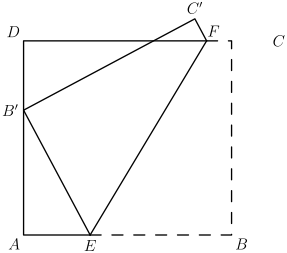
is a rectangular sheet of paper that has been folded so that corner is matched with point on edge The crease is where is on and is on The dimensions and are given. The perimeter of rectangle is where and are relatively prime positive integers. Find
小提示:
折叠保持距离,所以 ;直角三角形 给出 ,且 。
Folding preserves distances, so right triangle gives and
大提示:
折痕上的每个点到 和 的距离相等,所以 ;用 的斜率确定 在 上的位置。
Every point of the crease is equidistant from and so use the slope of to locate on
解答:
折叠把 关于折痕反射到 ,所以 。在直角三角形 中,,且 。取 、、。
折痕上的点到 和 等距,所以 垂直于 。由于 的斜率为 ,过 的折痕斜率为 ,它与直线 (高度 )相交处的横坐标为 。条件 给出 所以
周长为 ,所以 。
Folding reflects to across the crease, so In right triangle and Place
Points on the crease are equidistant from and so is perpendicular to Since has slope the crease through has slope and it meets the line (at height ) at The condition gives so
The perimeter is so
8.
的正整数因子中,有多少个恰好有 个正因数?
How many positive integer divisors of are divisible by exactly positive integers?
小提示:
因为 ,所以 的一个形如 的因子恰有 个正因子。
Since a divisor of has exactly divisors
大提示:
逐个质因子计数乘积为 的有序三元组:把 分到三个因子中有 种,而 和 各有 种去处。
Count ordered triples with product prime by prime: split among three factors in ways, and each of and in ways
解答:
因为 ,所以 。它的因子为 ,其中 、。这样的 有 个因子,所以需要 。
每个乘积为 的正整数有序三元组都会给出可行指数,因为每个因子都不超过 。逐个质因子计数:质数 的指数 分到三个因子中,由隔板法有 种;质数 和 各自都有 个因子可供选择。
总数为 。
Since we have so its divisors are with and Such an has divisors, so we need
Every ordered triple of positive integers with product yields admissible exponents, since each factor is at most Counting prime by prime: the exponent of the prime is split among the three factors in ways by stars and bars, and each of the primes and goes to one of the factors.
The count is
9.
一个正整数数列满足 且 ,其构造方式为:前三项成等比数列,第二、三、四项成等差数列;一般地,对所有 ,、、 成等比数列,而 、、 成等差数列。令 为该数列中小于 的最大项。求 。
A sequence of positive integers with and is formed so that the first three terms are in geometric progression, the second, third, and fourth terms are in arithmetic progression, and, in general, for all the terms and are in geometric progression, and the terms and are in arithmetic progression. Let be the greatest term in this sequence that is less than Find
小提示:
令 。每个等比或等差条件都会确定下一项,从而得到 和 。
Let each progression condition forces the next term, giving and
大提示:
因而 ,推出 ;奇数下标项为 ,偶数下标项为 。
Then forces so odd-indexed terms are and even-indexed terms are
解答:
令 。等比条件给出 ,等差条件给出 ,接着 ,依此类推可归纳得到 特别地,,,所以 。展开得 ,分解为 ,所以 。
当 时,,所以 ,,数列递增。因为 ,而 ,所以小于 的最大项是 。
因此 。
Let The geometric condition gives the arithmetic condition gives then and so on: inductively In particular and so Expanding gives which factors as so
With we get so and the sequence is increasing. Since while the greatest term below is
Therefore
10.
设 是 到 之间、二进制表示中恰有两个 的整数集合。从 中随机选一个数,它能被 整除的概率为 ,其中 和 是互质正整数。求 。
Let be the set of integers between and whose binary expansions have exactly two ’s. If a number is chosen at random from the probability that it is divisible by is where and are relatively prime positive integers. Find
小提示:
中的元素为 ,其中 ,所以能否被 整除只取决于 。
Elements of are with so divisibility by depends only on
大提示:
的幂模 的周期为 ,且 当且仅当 ;数出每个这种差值对应的数对。
Powers of repeat mod with period and exactly when count the pairs with each such difference
解答:
集合 由 个数 组成,其中 。由于 与 互质, 能被 整除当且仅当 。 的幂模 依次循环为 ,周期为 ,所以 当且仅当 。
对每个差值 有 个数对,所以 的倍数在 中的个数为
概率为 。因为 ,而 ,该分数已最简。因此 。
The set consists of the numbers with Since is coprime to we have divisible by exactly when The powers of modulo cycle through with period so exactly when
For each difference there are pairs, so the number of multiples of in is
The probability is and since while it is in lowest terms. Thus
11.
一个直圆锥的底面半径为 ,高为 。一只苍蝇从圆锥表面上一点出发,该点到圆锥顶点的距离为 ,并沿圆锥表面爬到圆锥正对面的一个点,该点到顶点的距离为 。求苍蝇可能爬行的最短距离。
A right circular cone has a base with radius and height A fly starts at a point on the surface of the cone whose distance from the vertex of the cone is and crawls along the surface of the cone to a point on the exact opposite side of the cone whose distance from the vertex is Find the least distance that the fly could have crawled.
小提示:
斜高为 ;将圆锥展开成半径为 的扇形。
The slant height is unroll the cone into a circular sector of radius
大提示:
扇形圆心角为 ,所以正对面的点在扇形中相隔 ;使用余弦定理。
The sector’s central angle is so exactly opposite points are apart in the sector; apply the law of cosines
解答:
圆锥斜高为 。沿经过起点的母线剪开并展开,得到半径为 的扇形,其弧长等于底面周长 。半径为 的整圆周长为 ,所以扇形的圆心角为 。圆锥正对面的点相当于绕底面半圈,在展开扇形中相隔 。
最短路径是展开图中两个点之间的线段,这两个点到顶点的距离分别为 和 ,夹角为 。由余弦定理,
因此 。
The slant height is Cutting the cone along the ruling through the starting point and unrolling gives a sector of radius whose arc has the base circumference since a full circle of radius has circumference the central angle is A point on the exact opposite side of the cone is halfway around, which in the unrolled sector is away.
The shortest crawl is the straight segment between the two points, at radii and with a angle between them. By the law of cosines,
Thus
12.
设 是等腰梯形,其边长为 、、。作半径为 、圆心分别为 和 的两个圆,再作半径为 、圆心分别为 和 的两个圆。有一个位于梯形内部的圆与这四个圆都相切。它的半径为 ,其中 、、、 是正整数, 不被任何质数的平方整除,且 与 互质。求 。
Let be an isosceles trapezoid, whose dimensions are and Draw circles of radius centered at and and circles of radius centered at and A circle contained within the trapezoid is tangent to all four of these circles. Its radius is where and are positive integers, is not divisible by the square of any prime, and and are relatively prime. Find
小提示:
梯形的高为 。内圆圆心在对称轴上;相切条件表明,圆心到 、 的距离均为 ,到 、 的距离均为 。
The trapezoid’s height is Center the inner circle on the axis of symmetry; tangency means its center is at distance from and and from and
大提示:
距离 表示圆心高出 的高度,而距离 表示圆心低于 的高度;两者之和为 。
The center lies above and below and those two heights add to
解答:
从 和 作垂线可知,每条长为 的腰对应的水平偏移为 ,所以梯形高度为 。由对称性,内圆圆心 位于竖直对称轴上;该轴经过点 ,即 的中点,也经过点 ,即 的中点。若内圆半径为 ,外切条件给出 和 。又因为 、,所以
因为 ,移项后平方得 ,再次平方得到 ,即 。
正根为 所以 。
Dropping perpendiculars from and shows each leg of length spans a horizontal offset of so the height of the trapezoid is By symmetry the inner circle’s center lies on the vertical axis through the midpoints of and of If its radius is external tangency gives and so with and
Since moving one radical across and squaring gives and squaring again yields that is
The positive root is so
13.
设 是一个凸五边形,且 ,,,,,,。已知三角形 的面积与三角形 的面积之比为 ,其中 和 是互质正整数。求 。
Let be a convex pentagon with and Given that the ratio between the area of triangle and the area of triangle is where and are relatively prime positive integers, find
小提示:
在三角形 中用余弦定理得 。令 为 与 的交点,则 是平行四边形。
The law of cosines in triangle gives Let be the intersection of and then is a parallelogram
大提示:
三角形 与 相似,比例为 。令 表示点 到 的距离,再用它表示各点到平行线 和 的距离。
Triangles and are similar in ratio so measure every distance to the parallel lines and in terms of the distance from to
解答:
由余弦定理, ,所以 。令 为 与 的交点。因为 且 ,四边形 是平行四边形,所以 和 到直线 的距离均为 ,且位于该直线两侧。于是 。
因为 ,三角形 与 相似,比例为 ,所以 到直线 的距离为 ,且 在 远离 的一侧。因此 到直线 的距离为 ,从而
因此 。由于 ,该分数已最简,答案为 。
By the law of cosines, so Let be the intersection of and Since and quadrilateral is a parallelogram, so lies at the same distance from line as on the opposite side, where
Since triangles and are similar with ratio so the distance from to line is with on the far side of from The distance from to line is therefore giving
Thus which is in lowest terms since The answer is
14.
考虑一个由 个 组成的字符串 ,在其中插入 号可以得到一个算式。例如,算式 可以由八个 这样得到。有多少个 的取值,能通过插入 号使所得算式的值为 ?
Consider a string of ’s, into which signs are inserted to produce an arithmetic expression. For example, could be obtained from eight ’s in this way. For how many values of is it possible to insert signs so that the resulting expression has value
小提示:
全部除以 :需要 个 、 个 、 个 ,满足 ,且 。
Divide everything by you need copies of of and of with and
大提示:
相减得 ;确定 在条件 下恰能取到哪些值。
Subtracting shows determine exactly which values can reach when
解答:
除以 后,各项只能是 、 或 (再长的 ),而目标变为 。设 、、 分别为这三种项的个数,则 ,且 。相减得 所以可能的 与可达到的 值一一对应。
约束为 ,且 (这样 )。当 时, 的取值区间分别为 、、、、、、、、,以及 (当 时只有 可行)。它们的并集是从 到 的所有整数,再加上 ;只有 不可达到。
因此 有 个取值, 也有 个取值。
Dividing by turns the summands into or (no summand with four or more digits fits, since ) and the target into If count the summands of each size, then and Subtracting gives so the possible correspond exactly to the attainable values of
The constraints are and (then follows). For the value ranges over the intervals and (when only fits). Their union is every integer from to together with only is unattainable.
So takes values, and takes values.
15.
一条细长纸带长 个单位、宽 个单位,并被分成 个单位正方形。纸带反复对折。第一次折叠时,将纸带右端折到与左端重合并叠在其上,得到一条 乘 、双层厚的纸带。接着,再把这条纸带的右端折到与左端重合并叠在其上,得到一条 乘 、四层厚的纸带。这个过程再重复 次。最后一次折叠后,纸带变成一叠 个单位正方形。原来从左数第 个正方形的下面有多少个正方形?
A long thin strip of paper is units in length, unit in width, and is divided into unit squares. The paper is folded in half repeatedly. For the first fold, the right end of the paper is folded over to coincide with and lie on top of the left end. The result is a by strip of double thickness. Next, the right end of this strip is folded over to coincide with and lie on top of the left end, resulting in a by strip of quadruple thickness. This process is repeated more times. After the last fold, the strip has become a stack of unit squares. How many of these squares lie below the square that was originally the nd square counting from the left?
小提示:
同时追踪该正方形从左端数的位置和从底部数的位置;对左半部分的正方形,一次折叠保持这两个位置不变。
Track the square’s position counted from the left end and from the bottom of the stack; a fold leaves both unchanged for squares in the left half
大提示:
对右半部分的正方形,新位置从左数等于旧位置从右数,新位置从上数等于旧位置从底部数。
For a square in the right half, the new position from the left is the old position from the right, and the new position from the top is the old position from the bottom
解答:
经过 次折叠后,纸带长 个正方形,厚 层。因此从左数的位置 与从右数的位置 满足 ,从底部数的位置 与从顶部数的位置 满足 。右半部分折到左半部分时,左半部分的正方形保持 和 不变;右半部分的正方形被翻转,新的 是旧的 ,新的 是旧的 。
第 个正方形起始为 。逐次应用规则,十次折叠后的状态为 例如第四次折叠时纸带长度为 ,且 ,所以新的 为 ,新的 是旧的 ,从而 。
在最后的 层堆叠中,该正方形从底部数位于第 层,所以其下方有 个正方形。
After folds the strip is squares long and layers thick, so the positions from the left and from the right satisfy and the positions from the bottom and from the top satisfy When the right half is folded over onto the left, a square in the left half keeps its and while a square in the right half is flipped: its new is its old and its new is its old
The nd square starts at Applying the rule through the ten folds gives For example, at the fourth fold the strip has length and so the new is and the new is the old making
In the final stack of squares, this square sits at height from the bottom, so squares lie below it.