
1999 AIME 详解
向下滚动即可查看来自 LIVE by Po-Shen Loh 的精心整理的解答,打印PDF 解答,查看答案,或参加完整限时模拟考试。
所有题目均经美国数学协会(MAA)官方合法授权使用。
1.
求最小的质数,使它是一个递增等差数列的第五项,并且前四项也都是质数。
Find the smallest prime that is the fifth term of an increasing arithmetic sequence, all four preceding terms also being prime.
小提示:
如果公差不是 的倍数,那么前三项中有一项能被 整除
If the common difference is not a multiple of one of the first three terms is divisible by
大提示:
公差必须是 的倍数,所以从小质数开始尝试公差为 的五项等差数列
The difference must be a multiple of so try five-term progressions with difference starting from small primes
解答:
设这些项为 、、、。偶质数不能作为第一项:若公差为偶数,第二项为偶数;若公差为奇数,第三项为偶数。如果 是奇数,相邻两项奇偶性相反,因此除了第一项以外会有某一项是大于 的偶数,不可能是质数。如果 不是 的倍数,那么 、、 会覆盖模 的所有余数,所以其中一项能被 整除;这一项只能等于 ,从而迫使 ,但此时 是合数。因此 能被 整除。
因为 ,第五项至少为 。取 且 ,得到 ,全部为质数;又因为 (以 和 开头都会失败),不可能有更小的第五项。答案是 。
Let the terms be The even prime cannot be the first term: an even difference makes the second term even, while an odd difference makes the third term even. If were odd, consecutive terms would have opposite parity, so some term other than the first would be even and greater than — impossible. If were not a multiple of then would cover all residues mod so some term would be divisible by that term would have to be itself, forcing but then is composite. Hence is divisible by
With the fifth term is at least Trying and gives all prime, and no smaller fifth term is possible since (the starts and fail as above). The answer is
2.
考虑顶点为 ,,,和 的平行四边形。一条经过原点的直线把这个图形分成两个全等多边形。该直线的斜率为 ,其中 和 是互质的正整数。求 。
Consider the parallelogram with vertices and A line through the origin cuts this figure into two congruent polygons. The slope of the line is where and are relatively prime positive integers. Find
小提示:
当一条直线经过平行四边形的对称中心时,它会把平行四边形分成两个全等部分
A line cuts a parallelogram into two congruent pieces when it passes through the parallelogram’s center of symmetry
大提示:
中心是从 到 的对角线的中点
The center is the midpoint of the diagonal from to
解答:
全等的两部分面积相等。对于任意固定方向,只有一条该方向的直线能平分一个凸图形的面积;由于平行四边形是中心对称图形,这条直线经过其中心。因此,所求的过原点直线也必须经过中心。反过来,平行四边形关于其中心作 旋转对称,所以任何经过中心的直线都会把它分成两个在该旋转下互相对应的部分,因此这两个部分全等。中心是某条对角线的中点:
经过原点和 的直线斜率为 ,且 ,所以 。
Congruent pieces have equal area. For any fixed direction, there is only one line in that direction that bisects the area of a convex figure; because a parallelogram is centrally symmetric, that line passes through its center. Thus the required line through the origin must also pass through the center. Conversely, the rotation about the center swaps the two pieces cut by such a line, so they are congruent. The center is the midpoint of a diagonal:
The line through the origin and has slope and so
3.
求所有正整数 的和,使得 是完全平方数。
Find the sum of all positive integers for which is a perfect square.
小提示:
乘以 并配方:
Multiply by and complete the square:
大提示:
如果该表达式等于 ,那么 ;用所有方式把 分解成平方差
If the expression equals then factor as a difference of squares in every way
解答:
设 。两边乘以 并配方,得 ,所以 这两个因子的和为 ,所以二者都为正:因子对为 、、 和 。
后一个因子减去前一个因子,得到 ,,,或 ,因此 ,,,或 。它们确实分别使表达式成为完全平方数(,,,),其和为 。
Suppose Multiplying by and completing the square gives so The two factors sum to so both are positive: the factor pairs are and
Subtracting the first factor from the second gives or so or Each indeed makes the expression a perfect square ( ), and the sum is
4.
图中两个正方形有同一个中心 ,且边长都是 。 的长度为 ,八边形 的面积为 ,其中 和 是互质的正整数。求 。
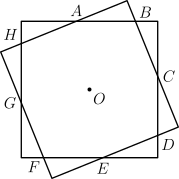
The two squares shown share the same center and have sides of length The length of is and the area of octagon is where and are relatively prime positive integers. Find
小提示:
由交换两个正方形的对称性以及 旋转对称性可知,八边形的八条边全都相等
By the symmetries swapping the two squares and rotating by all eight sides of the octagon are congruent
大提示:
把八边形切成 个以 为顶点的三角形;八边形的每条边都在某个正方形的一条边上,且与 的距离为
Cut the octagon into triangles with apex each side of the octagon lies on a side of a square, at distance from
解答:
整个图形绕 旋转 后保持不变,这会把八边形边 依次对应到 、、;同时图形还具有交换两个正方形的反射对称性,这会把这些边对应到 、、、。因此八边形的八条边长度都相同,均为 。
从 连到八个顶点,把八边形分成 个三角形。每个三角形的底为 ,位于某个单位正方形的一条边上,所以从 到这条底边的高就是中心到该边的距离,即 。面积为
因为 ,答案是 。
The whole configuration is unchanged by rotating about which cycles the octagon side to and it is also unchanged by the reflection that swaps the two squares, which carries those sides to So all eight sides of the octagon have the same length,
Segments from to the eight vertices cut the octagon into triangles. Each has base lying on a side of one of the unit squares, so its height from is the distance from the center to that side, namely The area is
Since the answer is
5.
对任意正整数 ,令 为 的各位数字之和,令 为 。例如, 。 的不同取值中,有多少个不超过 ?
For any positive integer let be the sum of the digits of and let be For example, How many values do not exceed
小提示:
如果加 时没有进位,则 。只有当 的末位是 或 时才会发生进位。
If adding causes no carrying, Carrying happens only when ends in or
大提示:
追踪当 以一串九结尾时数字和如何变化;产生进位的取值形成公差为 的等差数列
Track how the digit sum changes when ends in a run of nines; the carrying values form an arithmetic progression with common difference
解答:
如果 的末位数字至多为 ,加 不会改变其他数字,所以 。否则会发生进位。如果 以数字 结尾,且它前面恰有 个连续的九,那么 会把 变为 ,所以 ,从而 。如果 恰以 个连续的九结尾,那么 会把 变为 ,所以 ,从而 。
两类进位情况给出的正好都是 ,也就是 (),且每个这样的值都能出现。因此 的可能取值为 以及所有 。要求 得 ,共有 个值,再加上 ,总数为 。
If the last digit of is at most adding changes no other digit, so Otherwise there is carrying. If ends in the digit preceded by exactly nines, then replaces by so and If ends in exactly nines, then replaces by so and
Both carrying families give exactly the values that is, for and every such value occurs. So the possible values of are together with all Requiring gives which is values, and adds one more, for a total of
6.
坐标平面第一象限上的一个变换把每个点 映射到点 。四边形 的顶点为 ,,,和 。设 为四边形 的像所围成区域的面积。求不超过 的最大整数。
A transformation of the first quadrant of the coordinate plane maps each point to the point The vertices of quadrilateral are and Let be the area of the region enclosed by the image of quadrilateral Find the greatest integer that does not exceed
小提示:
不要只追踪顶点,改为找出这个变换对四条边所在直线分别做了什么
Instead of tracking the vertices, find what the map does to each of the four boundary lines
大提示:
和 会映射成过原点的直线,而 会映射成 的圆弧
and map to lines through the origin, while maps to an arc of
解答:
追踪四条边。边 和 分别在直线 和 上,它们映射成直线 和 ,也就是从原点出发、与横轴成 和 的射线。边 和 分别在 和 上,它们映射成圆 和 的圆弧。
因此像区域是半径在 与 之间、夹在 与 两条射线之间的圆环扇形,是完整圆环的十二分之一:
因为 ,所以 ,因此不超过 的最大整数是 。
Follow the four edges. Sides and lie on the lines and which map to the lines and — rays from the origin at angles and Sides and lie on and which map to arcs of the circles and
So the image is the part of the annulus between radii and lying between the and rays, one twelfth of the full annulus:
Since we have so the greatest integer not exceeding is
7.
有 个开关,每个开关有四个位置,记为 、、 和 。任意开关改变位置时,只会从 到 、从 到 、从 到 或从 到 。初始时每个开关都在位置 。这些开关分别标有 个不同的整数 ,其中 、 和 分别取 、、、。在第 步(整个过程共有 步),第 个开关前进一档,同时所有标签能整除第 个开关标签的其他开关也前进一档。完成第 步后,有多少个开关会在位置 ?
There is a set of switches, each of which has four positions, called and When the position of any switch changes, it is only from to from to from to or from to Initially each switch is in position The switches are labeled with the different integers where and take on the values At step of a -step process, the th switch is advanced one step, and so are all the other switches whose labels divide the label on the th switch. After step has been completed, how many switches will be in position
小提示:
每遇到一个标签为 的倍数的步骤,标签为 的开关就会前进一次;用指数来计算这些倍数
The switch labeled is advanced once for every label that is a multiple of count those multiples in terms of the exponents
大提示:
标签 会前进 次;数出使这个乘积不是 的倍数的三元组
The label advances times; count the triples for which this product is not a multiple of
解答:
标签为 的开关,恰好会在第 个开关的标签为 的倍数时前进一步。在这些标签中, 的倍数为 ,其中 等条件成立,所以这个开关会前进 次。它回到位置 当且仅当这个次数是 的倍数。
令 、、,每个都从 到 取值。我们计算 不被 整除的三元组:要么三者全为奇数,要么恰有一个是偶数但不被 整除。在 中有 个奇数,以及 个数(、、)是奇数的两倍。第一类有 个,第二类有 个,共 个。
因此 个开关最终在位置 。
The switch labeled is advanced exactly once for each step whose label is a multiple of The multiples of among the labels are the with etc., so that switch advances times. It returns to position exactly when this count is a multiple of
Write each ranging over through We count the triples where is not divisible by either all three are odd, or exactly one is even but not divisible by Among there are odd values and values ( ) that are twice an odd number. That gives triples of the first kind and of the second, or in all.
Therefore switches end in position
8.
令 为非负实数有序三元组 中位于平面 上的三元组集合。如果 对 满足以下三个条件中的恰好两个:、、,就称前者支持后者。令 为 中所有支持 的三元组。 的面积与 的面积之比为 ,其中 和 是互质的正整数。求 。
Let be the set of ordered triples of nonnegative real numbers that lie in the plane Let us say that supports when exactly two of the following are true: Let consist of those triples in that support The area of divided by the area of is where and are relatively prime positive integers. Find
小提示:
是一个三角形,每个类似 的条件都会用一条平行于边的直线切下一角
is a triangle, and each condition like cuts off a corner with a line parallel to a side
大提示:
因为 ,三个不等式只会在一个边界点同时成立;除去该点,每个两不等式区域都是与 相似的三角形
Since all three inequalities hold only at one boundary point; apart from that point, each two-inequality region is a triangle similar to
解答:
是顶点为 、、 的三角形。因为 ,只要 、、 中有两个成立,第三个只能在一个零面积的边界点成立。因此除去这个点后, 是三个区域的并,每个区域对应于某一对不等式成立。
对于 且 的区域,代入 和 后,得到 的一个副本,其坐标和为 ,也就是与 相似、相似比为 的三角形,其面积为 倍的 面积。同理, 和 两对给出的相似三角形的相似比分别为 和 。
面积比为 所以 。
is the triangle with vertices Because whenever two of the inequalities hold, the third can hold only at a boundary point of zero area. So is, up to measure zero, the union of the three regions where a specific pair of inequalities holds.
The region with and becomes, after substituting and a copy of with coordinate sum i.e. a triangle similar to with ratio and area of Likewise the pairs and give similar triangles with ratios and
The ratio of areas is so
9.
函数 定义在复数集上,且 ,其中 和 为正数。这个函数满足:复平面中每个点的像到该点与到原点的距离相等。已知 且 ,其中 和 是互质的正整数。求 。
A function is defined on the complex numbers by where and are positive numbers. This function has the property that the image of each point in the complex plane is equidistant from that point and the origin. Given that and that where and are relatively prime positive integers, find
小提示:
条件表示 对每个 都成立;把两边都写成某个模长乘以
The condition says for every write both sides as a modulus times
大提示:
需要 ,这会确定 ;然后使用
You need which pins down then use
解答:
条件是 对所有 都成立,即 。两边除以 (当 时),得 ,所以 从而 。
由 可得 ,所以 。又 ,答案是 。
The condition is for all that is, Dividing by (for ) gives so which forces
Since we have so As the answer is
10.
平面上给定十个点,任意三点不共线。随机选择四条由这些点中的两点连接而成的不同线段,所有这样的线段集合等可能。这些线段中有三条能组成一个以这十个给定点中的点为顶点的三角形的概率为 ,其中 和 是互质的正整数。求 。
Ten points in the plane are given, with no three collinear. Four distinct segments joining pairs of these points are chosen at random, all such segments being equally likely. The probability that some three of the segments form a triangle whose vertices are among the ten given points is where and are relatively prime positive integers. Find
小提示:
四条线段最多包含一个三角形,因为两个不同三角形总共至少使用五条线段
Four segments can contain at most one triangle, because two different triangles always use at least five segments
大提示:
这样计数有利选择:先从 个可能的三角形中选一个,再任选第四条线段
Count favorable choices as: pick a triangle from the possible ones, then pick any fourth segment
解答:
共有 条线段,所以等可能选择数为 。两个不同三角形至多共用一条边,所以合起来至少使用 条线段;因此一组 条线段至多包含一个三角形。有利集合可以通过先选一个三角形、再选第四条线段来恰好计数一次:
概率为 ,已经是最简分数(),所以 。
There are segments, so equally likely choices. Two distinct triangles share at most one edge, so together they use at least segments; hence a set of segments contains at most one triangle, and the favorable sets are counted exactly once by choosing a triangle and then a fourth segment:
The probability is already in lowest terms (), so
11.
已知 ,角度以度为单位,且 和 是互质的正整数,并满足 ,求 。
Given that where angles are measured in degrees, and and are relatively prime positive integers that satisfy find
12.
三角形 的内切圆与 相切于 ,且半径为 。已知 且 ,求该三角形的周长。
The inscribed circle of triangle is tangent to at and its radius is Given that and find the perimeter of the triangle.
小提示:
从同一顶点引出的切线段相等,所以从 、、 出发的切线长分别为 、 和未知数
Tangent segments from each vertex are equal, so the tangent lengths from are and an unknown
大提示:
用两种方式表示面积: 和海伦公式;得到的方程关于 是一次的
Set the area two ways: and Heron’s formula; the resulting equation is linear in
解答:
从同一点引出的两条切线段相等,所以从 、、 出发的切线长分别为 、 和某个 。因而三边为 、、,半周长为 ,由海伦公式可得面积为 。
面积也等于 。将 两边平方并除以 得 ,所以 且 。
周长为 。
Tangent segments from a point are equal, so the tangent lengths from are and some Then the sides are the semiperimeter is and Heron’s formula gives area
The area also equals Squaring and dividing by gives so and
The perimeter is
13.
四十支队伍进行一场锦标赛,每支队伍都与其他每支队伍恰好比赛一次。没有平局,每支队伍在任意一场比赛中获胜的概率都是 。没有两支队伍获胜场数相同的概率为 ,其中 和 是互质的正整数。求 。
Forty teams play a tournament in which every team plays every other team exactly once. No ties occur, and each team has a chance of winning any game it plays. The probability that no two teams win the same number of games is where and are relatively prime positive integers. Find
小提示:
不同的胜场数必须正好是 ,而这样的排名会决定每一场比赛的胜者
Distinct win totals must be exactly and that ranking determines the winner of every single game
大提示:
概率为 除以 ;通过计算因子 在 中的个数来约分
The probability is divided by reduce by counting the factors of in
解答:
共有 场比赛,因此有 个等可能结果。如果全部 个胜场数都不同,它们必须正好是 。此时胜 场的队伍击败所有队伍,胜 场的队伍只输给那支队伍,依此类推:把这些胜场数分配给各队后,每场比赛结果都被确定。反过来,每个 种分配都对应唯一一种比赛结果,所以概率为 。
由勒让德公式,因子 在 中的指数为 。约成最简分数后,分母为 ,所以 。
There are games, hence equally likely outcomes. If all win totals are distinct, they must be exactly In that case the team with wins beat everyone, the team with wins beat everyone except that team, and so on: the assignment of totals to teams determines every game. Conversely each of the assignments arises from exactly one outcome, so the probability is
By Legendre’s formula the power of dividing is In lowest terms the denominator is therefore so
14.
点 位于三角形 内部,使得角 、 和 全都相等。三角形三边长为 、 和 ,且角 的正切为 ,其中 和 是互质的正整数。求 。
Point is located inside triangle so that angles and are all congruent. The sides of the triangle have lengths and and the tangent of angle is where and are relatively prime positive integers. Find
小提示:
设公共角为 ,并用正弦定理分别计算 :一次在三角形 中,一次在三角形 中
Call the common angle and compute two ways, from triangles and with the law of sines
大提示:
比较后会化简为 ,而每个余切都可用边长和面积表示
The comparison simplifies to and each cotangent can be written in terms of the side lengths and the area
解答:
令 。在三角形 中, 和 处的角分别为 和 ,所以 ,由正弦定理得 。在三角形 中, 和 处的角分别为 和 ,所以 ,且 。
两式相等并代入 、,得 。展开 ,再除以 ,得到 又因为 ,左边等于 。因此 。
使用 及其类似公式,其中 是面积。-- 三角形的面积为 ,所以 因此 ,这是最简分数,且 。
Let In triangle the angles at and are and so and the law of sines gives In triangle the angles at and are and so and
Equating and substituting yields Expanding and dividing by and since the left side is Hence
Using and its analogues, where is the area, since the -- triangle has area So which is in lowest terms, and
15.
考虑一个纸三角形,其顶点为 、 和 。它的中点三角形的顶点是原三角形三边的中点。沿着中点三角形的三条边折叠这个三角形,形成一个三棱锥。这个三棱锥的体积是多少?
Consider the paper triangle whose vertices are and The vertices of its midpoint triangle are the midpoints of its sides. A triangular pyramid is formed by folding the triangle along the sides of its midpoint triangle. What is the volume of this pyramid?
小提示:
三个折起的角会在同一个顶点相遇,该顶点到每个中点的距离等于对应原边长的一半
The three folded corners meet at a single apex, whose distance to each midpoint equals half of the corresponding original side
大提示:
把中点三角形保持在平面 中,并对顶点 解三个距离方程
Keep the midpoint triangle in the plane and solve three distance equations for the apex
解答:
中点为 、 和 。沿中点三角形三边把三个角折起后,三个原顶点会在同一个顶点 处相遇(每对被粘合的半边长度相等)。顶点保持折叠后的距离:(长为 的边的一半,而 平分这条边)、( 的一半),且 ( 的一半)。
把中点三角形保持在平面 中,设 。将 从 中减去,得 ,所以 ;将 从 中减去,得 ,所以 。于是 ,顶点高度为 。
底面是中点三角形,面积是原三角形面积 的四分之一,即 。体积为
The midpoints are and Folding the three corner triangles up along the sides of the midpoint triangle brings the corners together at one apex (each pair of glued half-sides has equal length). The apex keeps its folded distances: (half of the side of length that bisects), (half of ), and (half of ).
Keep the midpoint triangle in the plane and let Subtracting from gives so subtracting from gives so Then so the apex is at height
The base is the midpoint triangle, with area one quarter of the original triangle’s i.e. The volume is