
1965 AMC 12 Problems
Scroll down and press Start to try the exam! Or, go to the printable PDF, answer key, or professional solutions curated by LIVE by Po-Shen Loh.
All problems are used with official legal permission of the Mathematical Association of America (MAA).
Or jump straight to a single problem with its solution: 1 · 2 · 3 · 4 · 5 · 6 · 7 · 8 · 9 · 10 · 11 · 12 · 13 · 14 · 15 · 16 · 17 · 18 · 19 · 20 · 21 · 22 · 23 · 24 · 25 · 26 · 27 · 28 · 29 · 30 · 31 · 32 · 33 · 34 · 35 · 36 · 37 · 38 · 39 · 40
Want to learn professionally through interactive video classes?
Timed
1:15:00
1.
The number of real values of satisfying the equation is:
more than
2.
A regular hexagon is inscribed in a circle. The ratio of the length of a side of the hexagon to the length of the shorter of the arcs intercepted by the side is:
Answer: D
Small Hint:
Each side of an inscribed regular hexagon equals the circle’s radius
Big Hint:
The shorter arc is one sixth of the circumference
Solution:
If the radius is the hexagon side is Its intercepted minor arc has length The ratio is
Therefore, the correct answer is D.
3.
The expression has the same value as:
Answer: B
Small Hint:
Evaluate the exponent first
Big Hint:
Write as
Solution:
Since
Therefore, the correct answer is B.
4.
Line intersects line and line is parallel to The three lines are distinct and lie in a plane. The number of points equidistant from all three lines is:
Answer: C
Small Hint:
Points equidistant from the two parallel lines lie on their midway parallel
Big Hint:
Intersect that midway line with the two angle bisectors of and
Solution:
Points equidistant from parallel lines and lie on the unique line midway between them. Points equidistant from intersecting lines and lie on either of their two angle bisectors. Each angle bisector meets the midway parallel once, giving two points.
Therefore, the correct answer is C.
5.
When the repeating decimal is written in simplest fractional form, the sum of the numerator and denominator is:
Answer: A
Small Hint:
Multiply the decimal by and subtract the original number
Big Hint:
Simplify
Solution:
Let Then so The requested sum is
Therefore, the correct answer is A.
6.
If then equals:
Answer: B
Small Hint:
Use
Big Hint:
Solve the resulting linear equation
Solution:
The exponential and logarithm cancel, so Thus giving
Therefore, the correct answer is B.
7.
The sum of the reciprocals of the roots of the equation is:
Answer: E
Small Hint:
If the roots are then
Big Hint:
Use and
Solution:
By Vieta’s formulas, and Therefore
Thus, the correct answer is E.
8.
One side of a given triangle is inches. Inside the triangle a line segment is drawn parallel to this side forming a trapezoid whose area is one-third of that of the triangle. The length of this segment, in inches, is:
Answer: A
Small Hint:
The smaller triangle above the segment has two-thirds of the original area
Big Hint:
Linear scale factors are square roots of area scale factors
Solution:
The trapezoid occupies one third of the area, so the smaller similar triangle occupies two thirds. Its linear scale factor is Hence the parallel segment has length
Therefore, the correct answer is A.
9.
The vertex of the parabola will be a point on the -axis if the value of is:
Answer: E
Small Hint:
Complete the square in
Big Hint:
The vertex’s -coordinate must equal
Solution:
Completing the square gives The vertex is so it lies on the -axis when
Therefore, the correct answer is E.
10.
The statement is equivalent to the statement:
and
or
Answer: A
Small Hint:
Factor
Big Hint:
A positive-leading quadratic is negative between its two roots
Solution:
We have This product is negative exactly between its roots, so
Therefore, the correct answer is A.
11.
Consider the statements:
and
Of these the following are incorrect:
none
only
only
only
and only
Answer: B
Small Hint:
The product rule for square roots requires nonnegative real radicands
Big Hint:
Evaluate statements II and III directly
Solution:
Statement I improperly applies to negative radicands; over the reals its left side is undefined, and with principal complex roots it equals not Statements II and III both correctly simplify to Thus only I is incorrect.
Therefore, the correct answer is B.
12.
A rhombus is inscribed in triangle in such a way that one of its vertices is and two of its sides lie along and If inches, inches, and inches, the side of the rhombus, in inches, is:
Answer: D
Small Hint:
Let the rhombus side be , with adjacent vertices of the way along and along
Big Hint:
The opposite rhombus vertex lies on , so its two affine coefficients sum to
Solution:
Use as the origin and let the vectors to be If the rhombus side is its opposite vertex is A point lies on when these coefficients sum to Thus giving
Therefore, the correct answer is D.
13.
Let be the number of number-pairs which satisfy and Then is:
more than two, but finite
greater than any finite number
Answer: E
Small Hint:
The inequality describes the disk of radius centered at the origin
Big Hint:
Compare the line’s distance from the origin with
Solution:
The line’s distance from the origin is It therefore crosses the interior of the disk in a segment containing infinitely many points.
Thus, the correct answer is E.
14.
The sum of the numerical coefficients in the complete expansion of is:
Answer: A
Small Hint:
Set both variables equal to to obtain the coefficient sum
Big Hint:
The expression inside the seventh power becomes
Solution:
Setting makes every monomial equal so the value is the sum of the numerical coefficients. It is
Therefore, the correct answer is A.
15.
The symbol represents a two-digit number in the base If the number is double the number then is:
Answer: B
Small Hint:
Translate as and as
Big Hint:
Solve
Solution:
In ordinary notation, and Thus so
Therefore, the correct answer is B.
16.
Let line be perpendicular to line Connect to the midpoint of and connect to the midpoint of If and intersect in point and inches, then the area of triangle in square inches, is:
Answer: C
Small Hint:
Since are midpoints and both perpendicular legs have length
Big Hint:
Use coordinates and ; the two medians meet at the centroid
Solution:
Put and Then and Lines and are medians of triangle so they meet at the centroid Segment has length and is units above its line. Therefore
Thus, the correct answer is C.
17.
Given the true statement: The picnic on Sunday will not be held only if the weather is not fair. We can then conclude that:
If the picnic is held, Sunday’s weather is undoubtedly fair.
If the picnic is not held, Sunday’s weather is possibly unfair.
If it is not fair Sunday, the picnic will not be held.
If it is fair Sunday, the picnic may be held.
If it is fair Sunday, the picnic will be held.
Answer: E
Small Hint:
Translate “ only if ” as
Big Hint:
Take the contrapositive of “not held implies not fair”
Solution:
The statement says: if the picnic is not held, then the weather is not fair. Its contrapositive is: if the weather is fair, then the picnic will be held.
Therefore, the correct answer is E.
18.
If is used as an approximation to the value of the ratio of the error made to the correct value is:
Answer: B
Small Hint:
Subtract the approximation from the correct value
Big Hint:
Divide that error by
Solution:
The error is Dividing by the correct value gives the ratio
Therefore, the correct answer is B.
19.
If is exactly divisible by the value of is:
Answer: C
Small Hint:
The quotient must be monic and linear
Big Hint:
Subtract and compare coefficients
Solution:
The leading terms force quotient Expanding, Thus so and
Therefore, the correct answer is C.
20.
For every the sum of terms of an arithmetic progression is The th term is:
Answer: C
Small Hint:
The th term equals
Big Hint:
Compute the difference of the two quadratic expressions
Solution:
The th term is the difference of consecutive partial sums. Substitution and simplification give
Therefore, the correct answer is C.
21.
It is possible to choose in such a way that the value of
is:
negative
zero
one
smaller than any positive number that might be specified
greater than any positive number that might be specified
Answer: D
Small Hint:
Combine the logarithms into
Big Hint:
Let grow without bound
Solution:
The expression is It is always positive, but tends to as grows. Therefore it can be made smaller than any specified positive number.
Thus, the correct answer is D.
22.
If and are the roots of then the equality
holds:
for all values of
for all values of
only when
only when or
only when or
Answer: A
Small Hint:
The right side requires both roots to be nonzero
Big Hint:
Use to compare the leading coefficients
Solution:
If then and which is the original polynomial for every If at least one denominator on the right is zero.
Therefore, the correct answer is A.
23.
If we write for all such that the smallest value we can use for is:
Answer: D
Small Hint:
Factor
Big Hint:
The larger one-sided bound occurs as approaches
Solution:
For Values with arbitrarily close to make the expression arbitrarily close to so no smaller bound works.
Therefore, the correct answer is D.
24.
Given the sequence the smallest value of such that the product of the first members of this sequence exceeds is:
Answer: E
Small Hint:
Add the exponents in the product
Big Hint:
Require
Solution:
The product is To exceed we need At equality holds, while exceeds it.
Therefore, the correct answer is E.
25.
Let be a quadrilateral with extended to so that Lines and are drawn to form angle For this angle to be a right angle it is necessary that quadrilateral have:
all angles equal
all sides equal
two pairs of equal sides
one pair of equal sides
one pair of equal angles
Answer: D
Small Hint:
Because point is the midpoint of
Big Hint:
In a right triangle, the midpoint of the hypotenuse is equidistant from all three vertices
Solution:
If then is the hypotenuse of right triangle Its midpoint is equidistant from Thus so quadrilateral necessarily has at least one pair of equal sides. No condition involving follows.
Therefore, the correct answer is D.
26.
For the numbers define to be the arithmetic mean of all five numbers; to be the arithmetic mean of and to be the arithmetic mean of and and to be the arithmetic mean of and Then, no matter how are chosen, we shall always have:
none of these
Answer: E
Small Hint:
Express in terms of the subgroup means and
Big Hint:
Compare with
Solution:
We have and so This difference may be positive, zero, or negative depending on the chosen numbers. None of the first four relations always holds.
Therefore, the correct answer is E.
27.
When is divided by the quotient is and the remainder is When is divided by the quotient is and the remainder is If then is:
an undetermined constant
Answer: A
Small Hint:
Use the remainder theorem at and
Big Hint:
Set
Solution:
The remainder theorem gives and Equality implies
Therefore, the correct answer is A.
28.
An escalator (moving staircase) of uniform steps visible at all times descends at constant speed. Two boys, and walk down the escalator steadily as it moves, negotiating twice as many escalator steps per minute as reaches the bottom after taking steps while reaches the bottom after taking steps. Then is:
Answer: B
Small Hint:
Let ’s stepping rate be and the escalator rate be
Big Hint:
Equate and
Solution:
Let take steps per minute, so takes and let the escalator contribute steps per minute. Their travel times are and Thus This gives and then
Therefore, the correct answer is B.
29.
Of students taking at least one subject the number taking Mathematics and English only equals the number taking Mathematics only. No student takes English only or History only, and six students take Mathematics and History, but no English. The number taking English and History only is five times the number taking all three subjects. If the number taking all three subjects is even and non-zero, the number taking English and Mathematics only is:
Answer: A
Small Hint:
Let be the all-three count and both the Math-only and Math-English-only count
Big Hint:
The total becomes
Solution:
Let be the number taking all three and the number taking Mathematics and English only, which also equals the Mathematics-only count. The disjoint-region total is so Since is positive and even, is the only value giving a nonnegative listed count, and
Therefore, the correct answer is A.
30.
Let of right triangle be the diameter of a circle intersecting hypotenuse in At a tangent is drawn cutting leg in This information is not sufficient to prove that:
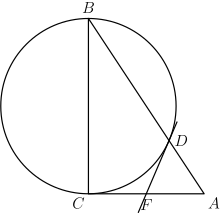
bisects
bisects
Answer: B
Small Hint:
Use coordinates
Big Hint:
The tangent meets at its midpoint; test the angle-bisector claim with the angle-bisector theorem
Solution:
Put and The second intersection of with the circle of diameter is The tangent at meets at Hence bisects also by equal tangents from which supplies choices C and E, and the circle/right-triangle angles supply choice D.
If bisected the angle-bisector theorem in triangle would require The left side is while which need not be Thus choice B is not provable.
Therefore, the correct answer is B.
31.
The number of real values of satisfying the equality where and are positive constants different from is:
an integer greater than
not finite
Answer: C
Small Hint:
Write every logarithm with natural logs
Big Hint:
The equation reduces to
Solution:
Change of base gives Since the denominators are nonzero, Thus or These are distinct because so there are two values.
Therefore, the correct answer is C.
32.
An article costing dollars is sold for at a loss of percent of the selling price. It is then resold at a profit of percent of the new selling price If the difference between and is dollars, then is:
undetermined
Answer: C
Small Hint:
The first loss makes
Big Hint:
The resale condition gives
Solution:
A loss of of the selling price means On resale, so Therefore Thus whose positive root is
Therefore, the correct answer is C.
33.
If the number that is, ends with zeros when given to the base and ends with zeros when given to the base then equals:
Answer: D
Small Hint:
Count the powers of and in
Big Hint:
A base- zero uses , while a base- zero uses
Solution:
The prime valuations are Hence in base and in base Thus
Therefore, the correct answer is D.
34.
For the smallest value of is:
Answer: B
Small Hint:
Set
Big Hint:
Rewrite the expression as
Solution:
Let Since the expression is By AM-GM this is at least with equality at which is allowed.
Therefore, the correct answer is B.
35.
The length of a rectangle is inches and its width is less than inches. The rectangle is folded so that two diagonally opposite vertices coincide. If the length of the crease is then the width is:
Answer: D
Small Hint:
The crease is the perpendicular bisector of a rectangle diagonal
Big Hint:
If the width is its intersections with the long sides differ horizontally by
Solution:
Place the rectangle at and The crease sending to is Because it meets the two horizontal sides. Between those intersections the vertical change is and the horizontal change is Thus Setting gives so and
Therefore, the correct answer is D.
36.
Given distinct straight lines and From a point in a perpendicular is drawn to from the foot of this perpendicular a line is drawn perpendicular to From the foot of this second perpendicular a line is drawn perpendicular to and so on indefinitely. The lengths of the first and second perpendiculars are and respectively. Then the sum of the lengths of the perpendiculars approaches a limit as the number of perpendiculars grows beyond all bounds. This limit is:
Answer: E
Small Hint:
Successive right triangles formed by the two fixed lines are similar
Big Hint:
The perpendicular lengths form a geometric sequence with first term and ratio
Solution:
Each new right triangle has the same acute angle, so the perpendicular lengths form a geometric sequence. Since the first two lengths are the common ratio is Convergence implies and the sum is
Therefore, the correct answer is E.
37.
Point is selected on side of triangle in such a way that and point is selected on side so that The point of intersection of and is Then
is:
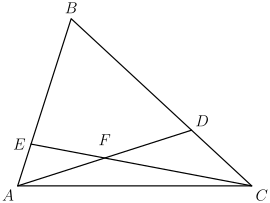
Answer: C
Small Hint:
Assign masses and
Big Hint:
Use the combined masses at and to read the two cevian ratios
Solution:
The side ratios are represented by masses and Then and Along while along Their sum is
Therefore, the correct answer is C.
38.
takes times as long to do a piece of work as and together; takes times as long as and together; and takes times as long as and together. Then in terms of and is:
Answer: E
Small Hint:
Let the work rates of and be and
Big Hint:
Translate the first two conditions as and
Solution:
Let the work rates be and The time statements give From the first two, and Hence
Therefore, the correct answer is E.
39.
A foreman noticed an inspector checking a -inch hole with a -inch plug and a -inch plug and suggested that two more gauges be inserted to be sure that the fit was snug. If the new gauges are alike, then the diameter of each, to the nearest hundredth of an inch, is:
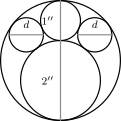
Answer: B
Small Hint:
Use radii and and let a new gauge have radius
Big Hint:
If its center is , subtract its three tangency-distance equations
Solution:
Place the hole’s center at the origin. The -inch and -inch plug centers are and Let a new gauge have radius and center Tangency to the two plugs gives while internal tangency to the hole gives Subtracting pairs of equations yields and Thus so
Therefore, the correct answer is B.
40.
Let be the number of integer values of such that is the square of an integer. Then is:
Answer: D
Small Hint:
Rewrite
Big Hint:
Distinct integer squares and differ by at least
Solution:
Let Then At so one value works.
If and then Distinct integer squares differing from differ by at least which is already greater than a contradiction. If the analogous bound can hold only for Direct substitution for these nine integers gives no square. Hence is the unique solution and
Therefore, the correct answer is D.