
2016 AIME I Problem 3
Attempt Problem 3 of the 2016 AIME I below, then check your answer against the professionally curated solution from LIVE by Po-Shen Loh. You can also try the full timed exam, view all 2016 AIME I solutions, or check the answer key.
All problems are used with official legal permission of the Mathematical Association of America (MAA).
3.
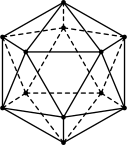
A regular icosahedron is a -faced solid where each face is an equilateral triangle and five triangles meet at every vertex. The regular icosahedron shown below has one vertex at the top, one vertex at the bottom, an upper pentagon of five vertices all adjacent to the top vertex and all in the same horizontal plane, and a lower pentagon of five vertices all adjacent to the bottom vertex and all in another horizontal plane. Find the number of paths from the top vertex to the bottom vertex such that each part of a path goes downward or horizontally along an edge of the icosahedron, and no vertex is repeated.
Answer: 810
Small Hint:
Every path goes: top vertex, around the upper pentagon, down, around the lower pentagon, down. Count each stage separately.
Big Hint:
Around a pentagon there are routes ( to steps, clockwise or counterclockwise), and each upper vertex has downward edges to the lower pentagon
Solution:
Each vertex of the upper pentagon is adjacent to the top vertex, two upper-pentagon neighbors, and two vertices of the lower pentagon; each vertex of the lower pentagon is adjacent to two upper vertices, two lower-pentagon neighbors, and the bottom vertex. So a downward-or-horizontal path with no repeated vertex must descend to the upper pentagon, circle part of it in one direction, drop to the lower pentagon, circle part of it in one direction, and end at the bottom.
There are choices for the first step down. On the upper pentagon the path can take or horizontal steps, in either of two directions (a reversal would repeat a vertex), for options. Then there are edges down to the lower pentagon, again horizontal options there, and final step down.
The total is
Problem 3 in Other Years
1983 AIME · 1984 AIME · 1985 AIME · 1986 AIME · 1987 AIME · 1988 AIME · 1989 AIME · 1990 AIME · 1991 AIME · 1992 AIME · 1993 AIME · 1994 AIME · 1995 AIME · 1996 AIME · 1997 AIME · 1998 AIME · 1999 AIME · 2000 AIME I · 2000 AIME II · 2001 AIME I · 2001 AIME II · 2002 AIME I · 2002 AIME II · 2003 AIME I · 2003 AIME II · 2004 AIME I · 2004 AIME II · 2005 AIME I · 2005 AIME II · 2006 AIME I · 2006 AIME II · 2007 AIME I · 2007 AIME II · 2008 AIME I · 2008 AIME II · 2009 AIME I · 2009 AIME II · 2010 AIME I · 2010 AIME II · 2011 AIME I · 2011 AIME II · 2012 AIME I · 2012 AIME II · 2013 AIME I · 2013 AIME II · 2014 AIME I · 2014 AIME II · 2015 AIME I · 2015 AIME II · 2016 AIME II · 2017 AIME I · 2017 AIME II · 2018 AIME I · 2018 AIME II · 2019 AIME I · 2019 AIME II · 2020 AIME I · 2020 AIME II · 2021 AIME I · 2021 AIME II · 2022 AIME I · 2022 AIME II · 2023 AIME I · 2023 AIME II · 2024 AIME I · 2024 AIME II · 2025 AIME I · 2025 AIME II · 2026 AIME I · 2026 AIME II