2016 AIME I Problems
Scroll down and press Start to try the exam! Or, go to the printable PDF, answer key, or professional solutions curated by LIVE by Po-Shen Loh.
All problems are used with official legal permission of the Mathematical Association of America (MAA).
Or jump straight to a single problem with its solution: 1 · 2 · 3 · 4 · 5 · 6 · 7 · 8 · 9 · 10 · 11 · 12 · 13 · 14 · 15
Want to learn professionally through interactive video classes?
Timed
3:00:00
1.
For let denote the sum of the geometric series Let between and satisfy Find
Answer: 336
Small Hint:
Each series is geometric:
Big Hint:
Both and depend only on so you never need to find
Solution:
The geometric series sums to Therefore so
Adding the two sums over a common denominator,
2.
Two dice appear to be standard dice with their faces numbered from to but each die is weighted so that the probability of rolling the number is directly proportional to The probability of rolling a with this pair of dice is where and are relatively prime positive integers. Find
Answer: 71
Small Hint:
On each die the probability of rolling is since
Big Hint:
The probability of a total of is
Solution:
Since each die rolls with probability A total of arises from the pairs for so its probability is
Thus
3.
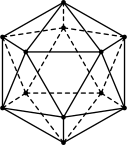
A regular icosahedron is a -faced solid where each face is an equilateral triangle and five triangles meet at every vertex. The regular icosahedron shown below has one vertex at the top, one vertex at the bottom, an upper pentagon of five vertices all adjacent to the top vertex and all in the same horizontal plane, and a lower pentagon of five vertices all adjacent to the bottom vertex and all in another horizontal plane. Find the number of paths from the top vertex to the bottom vertex such that each part of a path goes downward or horizontally along an edge of the icosahedron, and no vertex is repeated.
Answer: 810
Small Hint:
Every path goes: top vertex, around the upper pentagon, down, around the lower pentagon, down. Count each stage separately.
Big Hint:
Around a pentagon there are routes ( to steps, clockwise or counterclockwise), and each upper vertex has downward edges to the lower pentagon
Solution:
Each vertex of the upper pentagon is adjacent to the top vertex, two upper-pentagon neighbors, and two vertices of the lower pentagon; each vertex of the lower pentagon is adjacent to two upper vertices, two lower-pentagon neighbors, and the bottom vertex. So a downward-or-horizontal path with no repeated vertex must descend to the upper pentagon, circle part of it in one direction, drop to the lower pentagon, circle part of it in one direction, and end at the bottom.
There are choices for the first step down. On the upper pentagon the path can take or horizontal steps, in either of two directions (a reversal would repeat a vertex), for options. Then there are edges down to the lower pentagon, again horizontal options there, and final step down.
The total is
4.
A right prism with height has bases that are regular hexagons with sides of length A vertex of the prism and its three adjacent vertices are the vertices of a triangular pyramid. The dihedral angle (the angle between the two planes) formed by the face of the pyramid that lies in a base of the prism and the face of the pyramid that does not contain measures Find
Answer: 108
Small Hint:
The pyramid uses its two base neighbors and and the vertex directly above the dihedral angle sits along
Big Hint:
If is the midpoint of the dihedral angle is use to find
Solution:
The three vertices adjacent to are its two neighbors and in the same hexagonal base and the vertex directly above with perpendicular to the base. The face in the base is and the face avoiding is they meet along
Let be the midpoint of Since and (the interior angle of a regular hexagon), and Because is perpendicular to the base, as well, so the dihedral angle is
In right triangle so
5.
Anh read a book. On the first day she read pages in minutes, where and are positive integers. On the second day Anh read pages in minutes. Each day thereafter Anh read one more page than she read on the previous day, and it took her one more minute than on the previous day until she completely read the page book. It took her a total of minutes to read the book. Find
Answer: 53
Small Hint:
If she finished in days, arithmetic series give and
Big Hint:
Subtracting gives and also divides
Solution:
Say Anh finished on day Summing the arithmetic progressions of pages and of minutes, and so and
Subtracting, so Thus divides both and so divides Since the story spans more than one day,
Then gives and gives Hence
6.
In let be the center of the inscribed circle, and let the bisector of intersect at The line through and intersects the circumscribed circle of at the two points and If and then where and are relatively prime positive integers. Find
Answer: 13
Small Hint:
Show by angle chasing, so
Big Hint:
Triangles and share angle and have so
Solution:
The incenter lies on the bisector between and In triangle the exterior angle at gives On the other hand, (both subtend arc ) and (the bisector), so Hence triangle is isosceles with
Triangles and have a common angle at and so they are similar. Therefore giving
Finally so
7.
For integers and consider the complex number Find the number of ordered pairs of integers such that this complex number is a real number.
Answer: 103
Small Hint:
If the number is real exactly when watch the range of and the denominator
Big Hint:
If both terms are imaginary and must cancel: Factor as
Solution:
If the first term is real, so the number is real exactly when that is Then forces and the denominator rules out That gives pairs.
If then so the whole number is which is real exactly when Note is impossible here since has no integer solution. For the equation becomes that is and for it becomes
Since has positive divisors, has ordered integer solutions, and holds exactly when the positive factor is the larger in absolute value: solutions. Symmetrically the other case gives more. In all of these The total is
8.
For a permutation of the digits let denote the sum of the three -digit numbers and Let be the minimum value of subject to the condition that the units digit of is Let denote the number of permutations with Find
Answer: 162
Small Hint:
Write by place value: the three units digits must sum to or
Big Hint:
The minimum forces hundreds digits and a units-column sum of count which triples from sum to
Solution:
By place value, and all nine digits sum to The units digit of is exactly when or Writing if the units column sums to then while if it sums to then So achieved exactly when and the units digits sum to
The remaining digits must split so the units triple sums to the possibilities are and Each of the splits allows arrangements of the three columns, so
Therefore
9.
Triangle has and This triangle is inscribed in rectangle with on and on Find the maximum possible area of
Answer: 744
Small Hint:
With and the area is and
Big Hint:
Product-to-sum: maximized when
Solution:
Let and so From the right triangles and the sides of the rectangle are and so its area is using the product-to-sum identity and
This is maximized when which the constraint allows, giving area
10.
A strictly increasing sequence of positive integers has the property that for every positive integer the subsequence is geometric and the subsequence is arithmetic. Suppose that Find
Answer: 504
Small Hint:
Write in lowest terms; then and for some positive integer
Big Hint:
Induction gives so note
Solution:
Write the common ratio of as in lowest terms, with since the sequence increases. Because is an integer and we get that divides set Then and the arithmetic condition gives Continuing, induction shows for every that
In particular Let then divides so But and the only value in range for which divides is giving From we need to be a multiple of with so and which are coprime.
Therefore (Indeed the sequence begins and reaches )
11.
Let be a nonzero polynomial such that for every real and Then where and are relatively prime positive integers. Find
Answer: 109
Small Hint:
Substitute and to find three roots of
Big Hint:
Writing forces so is a constant; find it from
Solution:
Setting in the identity gives so Setting gives so and setting gives so Hence for some polynomial
Substituting back, so for all real which forces to be a constant The normalization reads so
Then and
12.
Find the least positive integer such that is a product of at least four not necessarily distinct primes.
Answer: 132
Small Hint:
Check modulo and it is never divisible by any of them
Big Hint:
So every prime factor is at least Test the candidates and using or
Solution:
Let Since is always even, is odd. Checking all residues shows is never modulo or either, so every prime factor of is at least A product of four such primes is at least and the two smallest candidates are and
For the discriminant of is which lies strictly between and so there is no integer solution. For since must be divisible by either or Trying gives that is which satisfies:
Since is increasing for every smaller has and the only four-prime value below that, is unattainable. Hence the least is where
13.
Freddy the frog is jumping around the coordinate plane searching for a river, which lies on the horizontal line A fence is located at the horizontal line On each jump Freddy randomly chooses a direction parallel to one of the coordinate axes and moves one unit in that direction. When he is at a point where with equal likelihoods he chooses one of three directions where he either jumps parallel to the fence or jumps away from the fence, but he never chooses the direction that would have him cross over the fence to where Freddy starts his search at the point and will stop once he reaches a point on the river. Find the expected number of jumps it will take Freddy to reach the river.
Answer: 273
Small Hint:
Only the height matters. If is the expected number of jumps from height then for
Big Hint:
At the fence Sum the recurrence over to telescope, then work down from
Solution:
Horizontal jumps change nothing that matters, so let be the expected number of jumps to reach the river from height Then for each jump goes up, down, or sideways with probabilities so which simplifies to At the fence the three equally likely moves give that is
Summing over telescopes to Substituting and yields
Now run the recurrence downward as from and we get and Freddy starts at height so the answer is
14.
Centered at each lattice point in the coordinate plane are a circle radius and a square with sides of length whose sides are parallel to the coordinate axes. The line segment from to intersects of the squares and of the circles. Find
Answer: 574
Small Hint:
Since the segment is copies of the segment from to
Big Hint:
The line meets the square at exactly when when it only grazes a corner of the square and misses the circle
Solution:
Since the segment passes through the lattice points for and consists of translated copies of the segment from to The line is It meets the square centered at exactly when its height passes within of for some within of that is when or equivalently
For the solutions are and with and and with In the first two the line passes through the center, so it meets the circle as well. In the other two, equality means the line passes exactly through a corner of the square (for the corner ), while its distance to the center is so it misses the circle. Thus each copy of the segment meets squares and circles.
The interior lattice points are each shared by two consecutive copies, so and giving
15.
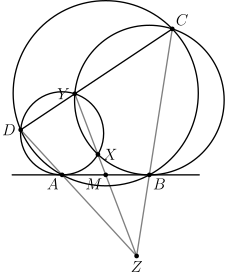
Circles and intersect at points and Line is tangent to and at and respectively, with line closer to point than to Circle passes through and intersecting again at and intersecting again at The three points are collinear, and Find
Answer: 270
Small Hint:
Lines and are radical axes of pairs of the circles, so they meet at a point
Big Hint:
If then show is a parallelogram and
Solution:
Line is the radical axis of and line that of and and line that of and so the three lines meet at the radical center (They cannot be parallel: that would force a symmetric configuration with ) Let The power of with respect to each circle gives so is the midpoint of with between and
Since is cyclic, and since is cyclic, as are collinear these add to so is cyclic. The tangent-chord angle at gives so and symmetrically Hence is a parallelogram, and since is the midpoint of diagonal it is also the midpoint of therefore Moreover and (by the tangent-chord angle at ) so triangles and are similar, giving
Putting it together, which equals