
2007 AIME II Problem 13
Attempt Problem 13 of the 2007 AIME II below, then check your answer against the professionally curated solution from LIVE by Po-Shen Loh. You can also try the full timed exam, view all 2007 AIME II solutions, or check the answer key.
All problems are used with official legal permission of the Mathematical Association of America (MAA).
13.
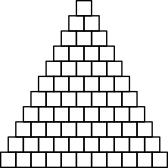
A triangular array of squares has one square in the first row, two in the second, and, in general, squares in the th row for With the exception of the bottom row, each square rests on two squares in the row immediately below, as illustrated in the figure. In each square of the eleventh row, a or a is placed. Numbers are then placed into the other squares, with the entry for each square being the sum of the entries in the two squares below it. For how many initial distributions of ’s and ’s in the bottom row is the number in the top square a multiple of
Answer: 640
Small Hint:
Each entry feeds upward like Pascal’s triangle: for bottom entries the top square is
Big Hint:
Modulo except for the coefficient vanishes, so only matters
Solution:
Label the bottom-row entries Since each square is the sum of the two below it, the contributions accumulate with Pascal’s-triangle weights: the top square equals
Modulo direct checking (or Lucas’ theorem with ) shows that for while and So the top square is a multiple of exactly when
Because the four entries are or their sum is divisible by only when it is or either all four are (one way) or exactly three are (four ways), for choices. The remaining seven entries are free, so the count is
Problem 13 in Other Years
1983 AIME · 1984 AIME · 1985 AIME · 1986 AIME · 1987 AIME · 1988 AIME · 1989 AIME · 1990 AIME · 1991 AIME · 1992 AIME · 1993 AIME · 1994 AIME · 1995 AIME · 1996 AIME · 1997 AIME · 1998 AIME · 1999 AIME · 2000 AIME I · 2000 AIME II · 2001 AIME I · 2001 AIME II · 2002 AIME I · 2002 AIME II · 2003 AIME I · 2003 AIME II · 2004 AIME I · 2004 AIME II · 2005 AIME I · 2005 AIME II · 2006 AIME I · 2006 AIME II · 2007 AIME I · 2008 AIME I · 2008 AIME II · 2009 AIME I · 2009 AIME II · 2010 AIME I · 2010 AIME II · 2011 AIME I · 2011 AIME II · 2012 AIME I · 2012 AIME II · 2013 AIME I · 2013 AIME II · 2014 AIME I · 2014 AIME II · 2015 AIME I · 2015 AIME II · 2016 AIME I · 2016 AIME II · 2017 AIME I · 2017 AIME II · 2018 AIME I · 2018 AIME II · 2019 AIME I · 2019 AIME II · 2020 AIME I · 2020 AIME II · 2021 AIME I · 2021 AIME II · 2022 AIME I · 2022 AIME II · 2023 AIME I · 2023 AIME II · 2024 AIME I · 2024 AIME II · 2025 AIME I · 2025 AIME II · 2026 AIME I · 2026 AIME II