
2007 AIME II Problems
Scroll down and press Start to try the exam! Or, go to the printable PDF, answer key, or professional solutions curated by LIVE by Po-Shen Loh.
All problems are used with official legal permission of the Mathematical Association of America (MAA).
Or jump straight to a single problem with its solution: 1 · 2 · 3 · 4 · 5 · 6 · 7 · 8 · 9 · 10 · 11 · 12 · 13 · 14 · 15
Want to learn professionally through interactive video classes?
Timed
3:00:00
1.
A mathematical organization is producing a set of commemorative license plates. Each plate contains a sequence of five characters chosen from the four letters in AIME and the four digits in No character may appear in a sequence more times than it appears among the four letters in AIME or the four digits in A set of plates in which each possible sequence appears exactly once contains license plates. Find
Answer: 372
Small Hint:
Split into cases by how many ’s the sequence uses; every other character can appear at most once
Big Hint:
With two ’s, place them in ways and fill three spots from the six other characters
Solution:
The available characters are the seven distinct symbols A, I, M, E, where may be used up to twice and every other character at most once. Sequences using at most one consist of five distinct characters chosen from the seven, in order:
Sequences with two ’s: choose the two positions for the ’s in ways, then fill the remaining three positions with distinct characters from the other six in ways, for sequences.
Thus and
2.
Find the number of ordered triples where and are positive integers, is a factor of is a factor of and
Answer: 200
Small Hint:
Since divides both and it must divide
Big Hint:
Write and then which has positive solutions
Solution:
Since divides and it divides Write and with then so For positive and we need so
For each such the equation has ordered positive solutions. Summing,
3.
Square has side length and points and are exterior to the square such that and Find
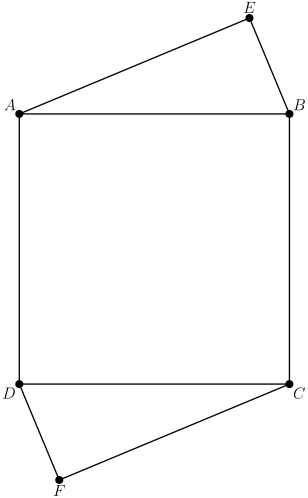
Answer: 578
Small Hint:
Since angles and are right angles
Big Hint:
Extend beyond and beyond to meet at and look for right triangles congruent to
Solution:
Since triangles and are right-angled at and and they are congruent (sides ). Extend beyond and beyond until the two lines meet at
Then These two angles sum to so and triangle is congruent to (equal angles and hypotenuse ). Hence and
Therefore and with a right angle between them at so
4.
The workers in a factory produce widgets and whoosits. For each product, production time is constant and identical for all workers, but not necessarily equal for the two products. In one hour, workers can produce widgets and whoosits. In two hours, workers can produce widgets and whoosits. In three hours, workers can produce widgets and whoosits. Find
Answer: 450
Small Hint:
Let and be the worker-hours needed for one widget and one whoosit; each scenario gives one linear equation
Big Hint:
The first two scenarios give and the third supplies worker-hours in total
Solution:
Let and be the worker-hours required to make one widget and one whoosit. The three scenarios supply and worker-hours, so
The first two equations simplify to and giving and Substituting into the third, so and
5.
The graph of the equation is drawn on graph paper with each square representing one unit in each direction. How many of the by graph paper squares have interiors lying entirely below the graph and entirely in the first quadrant?
Answer: 888
Small Hint:
The segment runs from to count how many unit squares it cuts through in the rectangle of squares
Big Hint:
Since the segment hits no interior lattice point, so it crosses squares; symmetry splits the untouched squares evenly
Solution:
The line meets the axes at and so all qualifying squares lie inside the rectangle, which contains unit squares. Because the segment passes through no interior lattice point; it crosses interior vertical lines and interior horizontal lines, entering a new square at each crossing, so it passes through the interiors of squares.
The other squares lie entirely above or entirely below the segment. The segment’s midpoint is the center of the rectangle, so rotating by about it swaps the two groups. Hence exactly half of them, lie below the graph.
6.
An integer is called parity-monotonic if its decimal representation satisfies if is odd, and if is even. How many four-digit parity-monotonic integers are there?
Answer: 640
Small Hint:
Build the number from right to left, counting how many digits may immediately precede a given digit
Big Hint:
For every digit exactly digits can precede it: the odd digits below together with the even digits above The digit never qualifies.
Solution:
A digit may immediately precede exactly when is odd and less than or even and greater than Checking each from to this always allows exactly digits: for example, allows allows allows (Raising by trades odd choices for even ones, keeping the total at ) Note that is never an allowed predecessor, since is even but exceeds no digit.
So choose the last digit in ways, then each of in ways; the leading digit is automatically nonzero. The count is
7.
Given a real number let denote the greatest integer less than or equal to For a certain integer there are exactly positive integers such that and divides for all such that Find the maximum value of for
Answer: 553
Small Hint:
means count the multiples of in that range
Big Hint:
There are such multiples, so solve then take the largest multiple
Solution:
The condition means The multiples of in this range are so there are exactly of them.
Setting gives The maximum of is
8.
A rectangular piece of paper measures units by units. Several lines are drawn parallel to the edges of the paper. A rectangle determined by the intersections of some of these lines is called basic if (i) all four sides of the rectangle are segments of drawn line segments, and (ii) no segments of drawn lines lie inside the rectangle.
Given that the total length of all lines drawn is exactly units, let be the maximum possible number of basic rectangles determined. Find the remainder when is divided by
Answer: 896
Small Hint:
With drawn lines of length and of length we get and adjacent pairs form basic rectangles
Big Hint:
Maximize over take satisfying and as close as possible to the vertex
Solution:
Suppose of the drawn lines have length and have length so A basic rectangle is bounded by two adjacent lines in each direction, so the lines determine basic rectangles. Setting and we must maximize subject to
As a function of the product is a downward parabola with vertex at For to be an integer we need i.e. The nearest candidates are (giving and product ) and (giving and product ).
So and the remainder upon division by is
9.
Rectangle is given with and Points and lie on and respectively, such that The inscribed circle of triangle is tangent to at point and the inscribed circle of triangle is tangent to at point Find
Answer: 259
Small Hint:
Compute and with the Pythagorean theorem; triangles and turn out congruent
Big Hint:
The tangency point splits by tangent lengths: and where is the common semiperimeter. Then
Solution:
Place so and Then and In particular triangles and are congruent, with common semiperimeter
In any triangle, the distance from a vertex to the incircle’s tangency points on its two sides is the semiperimeter minus the opposite side. In triangle in triangle
Therefore
10.
Let be a set with six elements. Let be the set of all subsets of Subsets and of not necessarily distinct, are chosen independently and at random from The probability that is contained in at least one of or is where and are positive integers, is prime, and and are relatively prime. Find (The set is the set of all elements of which are not in )
Answer: 710
Small Hint:
Condition on and count the sets with or only the empty set satisfies both
Big Hint:
Sum over the expression using
Solution:
Fix with There are subsets and subsets and only the empty set is counted twice, so choices of succeed. Since there are sets of size and choices for each of and the probability is using
This simplifies to Since is odd, we take and
11.
Two long cylindrical tubes of the same length but different diameters lie parallel to each other on a flat surface. The larger tube has radius and rolls along the surface toward the smaller tube, which has radius It rolls over the smaller tube and continues rolling along the flat surface until it comes to rest on the same point of its circumference as it started, having made one complete revolution. If the smaller tube never moves, and the rolling occurs with no slipping, the larger tube ends up a distance from where it starts. The distance can be expressed in the form where and are integers and is not divisible by the square of any prime. Find
Answer: 179
Small Hint:
When the tubes touch while both rest on the ground, the segment joining their centers has length and vertical component
Big Hint:
Total turning is while crossing the small tube, the big tube’s rotation equals the center’s sweep plus the angular contribution from the contact arc; the rest is flat rolling
Solution:
When the rolling tube touches both the ground and the small tube, the segment between centers has length and vertical component so it makes a angle with the horizontal. As the big tube rolls over the small one, its center swings along an arc of radius about the small tube’s center, from above the horizontal on one side to on the other: a sweep of advancing the center horizontally by
During that sweep, the contact arc on the small tube is worth of the big tube’s circumference, and the sweep itself also rotates the big tube by so crossing the small tube turns the big tube by in all. To complete exactly one revolution, the remaining of turning happens rolling on flat ground, where the center advances the rolled distance
Hence and
12.
The increasing geometric sequence consists entirely of integral powers of Given that and find
Answer: 91
Small Hint:
Write with integers and the log-sum condition gives
Big Hint:
The sum lies strictly between and so its base- log pins down
Solution:
Every term is a power of and the ratio is a quotient of powers of so for integers and with since the sequence increases. The first condition gives i.e.
For the second condition, is the largest term, and so lies strictly between and The given bounds then force
Subtracting from yields then Therefore
13.
A triangular array of squares has one square in the first row, two in the second, and, in general, squares in the th row for With the exception of the bottom row, each square rests on two squares in the row immediately below, as illustrated in the figure. In each square of the eleventh row, a or a is placed. Numbers are then placed into the other squares, with the entry for each square being the sum of the entries in the two squares below it. For how many initial distributions of ’s and ’s in the bottom row is the number in the top square a multiple of
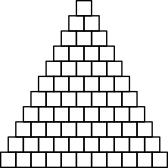
Answer: 640
Small Hint:
Each entry feeds upward like Pascal’s triangle: for bottom entries the top square is
Big Hint:
Modulo except for the coefficient vanishes, so only matters
Solution:
Label the bottom-row entries Since each square is the sum of the two below it, the contributions accumulate with Pascal’s-triangle weights: the top square equals
Modulo direct checking (or Lucas’ theorem with ) shows that for while and So the top square is a multiple of exactly when
Because the four entries are or their sum is divisible by only when it is or either all four are (one way) or exactly three are (four ways), for choices. The remaining seven entries are free, so the count is
14.
Let be a polynomial with real coefficients such that and for all Find
Answer: 676
Small Hint:
If is a root, so is compare leading coefficients to see is monic
Big Hint:
No root can have (moduli would grow forever, or the root product couldn’t be ); then forces
Solution:
The given values rule out a constant polynomial. If has degree and leading coefficient the leading coefficients of the two sides of are and so The equation also shows that whenever is a root, is a root as well.
If some root had then and iterating would produce infinitely many distinct roots — impossible. Since is monic with the product of the roots has modulus so no root can have modulus less than either: every root satisfies Then must also have modulus so Writing we get which simplifies to so
Thus every root is and real coefficients pair them up: The condition gives so
15.
Four circles and with the same radius are drawn in the interior of triangle such that is tangent to sides and to and to and and is externally tangent to and If the sides of triangle are and the radius of can be represented in the form where and are relatively prime positive integers. Find
Answer: 389
Small Hint:
The centers of lie on the angle bisectors, forming a triangle similar to shrunk toward the incenter by factor
Big Hint:
The center of is equidistant from those three centers, so equals the circumradius of the shrunken triangle, namely
Solution:
Let be the common radius, and let be the centers of Each is at distance from two sides of the triangle, so each lies on an angle bisector, and the sides of triangle are parallel to those of at distance Hence is the image of under the homothety centered at the incenter with ratio where is the inradius; in particular its circumradius is where is the circumradius of
The center of is at distance from each of (externally tangent equal circles), so it is the circumcenter of and For the -- triangle, and Heron’s formula gives area so and
Then gives so Since shares no factor with the answer is