
Soluciones del 1990 AMC 8
Desplázate hacia abajo para ver las soluciones preparadas profesionalmente de LIVE by Po-Shen Loh, imprime las soluciones en PDF, consulta la clave de respuestas, o haz el examen cronometrado completo.
Todos los problemas se usan con el permiso legal oficial de la Mathematical Association of America (MAA).
1.
¿Cuál es la menor suma de dos números de cifras que se puede obtener colocando cada uno de los seis dígitos en una de las seis casillas de una suma de dos números de cifras?
What is the smallest sum of two -digit numbers that can be obtained by placing each of the six digits into one of the six boxes of a sum of two -digit numbers?
Pista pequeña:
Un dígito en las centenas cuenta veces, así que coloca allí los dígitos más pequeños
A digit in the hundreds place counts times, so put the smallest digits there
Pista grande:
Los dígitos de las centenas deben ser y , los de las decenas y , y los de las unidades y
Hundreds digits should be and , tens digits and , units digits and
Solución:
Para que la suma sea pequeña, los dos dígitos más pequeños van en las centenas, los dos siguientes en las decenas, y los dos mayores en las unidades.
Una de esas disposiciones es , y toda disposición de este tipo da la misma suma.
Por lo tanto, la respuesta correcta es C.
To make the sum small, the two smallest digits go in the hundreds places, the next two in the tens places, and the two largest in the units places.
One such arrangement is , and every arrangement of this type gives the same sum.
Thus, the correct answer is C .
2.
¿Qué dígito de al cambiarlo por da el mayor número?
Which digit of when changed to gives the largest number?
Pista pequeña:
Cambiar un dígito en un valor posicional más alto aumenta más el número
Changing a digit in a higher place value raises the number by more
Pista grande:
El dígito de más a la izquierda, , está en las décimas, el mayor valor posicional presente
The leftmost digit sits in the tenths place, the largest place value shown
Solución:
Cambiar un dígito en las décimas altera el número más que cambiar cualquier dígito a su derecha. El dígito en las décimas es .
Al cambiarlo se obtiene , que es el mayor resultado posible.
Por lo tanto, la respuesta correcta es A.
Changing a digit in the tenths place changes the number more than changing any digit farther to the right. The digit in the tenths place is .
Changing it gives , which is the largest possible result.
Thus, the correct answer is A .
3.
¿Qué fracción del cuadrado está sombreada?
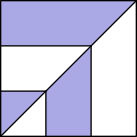
What fraction of the square is shaded?
Pista pequeña:
Refleja la figura a través de la diagonal principal que va de esquina a esquina
Reflect the figure across the main diagonal that runs corner to corner
Pista grande:
Cada pieza sombreada de un lado de la diagonal corresponde a una pieza no sombreada de igual área en el otro lado
Each shaded piece on one side of the diagonal matches an unshaded piece of equal area on the other side
Solución:
La diagonal de una esquina a la esquina opuesta divide el cuadrado en dos mitades iguales. Cada pieza sombreada de un lado de la diagonal es la imagen especular de una pieza no sombreada de igual área en el otro lado.
Así que las áreas sombreada y no sombreada son iguales, y exactamente del cuadrado está sombreado.
Por lo tanto, la respuesta correcta es E.
The diagonal from one corner to the opposite corner splits the square into two equal halves. Every shaded piece on one side of the diagonal is the mirror image of an equal unshaded piece on the other side.
So the shaded and unshaded areas are equal, and exactly of the square is shaded.
Thus, the correct answer is E .
4.
¿Cuál de los siguientes no podría ser el dígito de las unidades del cuadrado de un número entero?
Which of the following could not be the units digit [one’s digit] of the square of a whole number?
Pista pequeña:
El dígito de las unidades de un cuadrado depende solo del dígito de las unidades del número que se eleva al cuadrado
The units digit of a square depends only on the units digit of the number being squared
Pista grande:
Eleva al cuadrado cada uno de los dígitos a y anota solo el dígito de las unidades de cada resultado
Square each of the digits through and record only the units digit of each result
Solución:
El dígito de las unidades de un cuadrado está determinado por el dígito de las unidades del número que se eleva al cuadrado. Elevar al cuadrado a da dígitos de las unidades .
Así que un cuadrado solo puede terminar en o ; nunca puede terminar en o . Entre las opciones, solo es imposible.
Por lo tanto, la respuesta correcta es E.
The units digit of a square is determined by the units digit of the number squared. Squaring through gives units digits .
So a square can only end in or ; it can never end in or . Among the choices, only is impossible.
Thus, the correct answer is E .
5.
¿Cuál de los siguientes es el más cercano al producto ?
Which of the following is closest to the product
Pista pequeña:
está muy cerca de
is very close to
Pista grande:
Estima el producto como
Estimate the product as
Solución:
Como está cerca de , el producto está cerca de
La opción más cercana a es .
Por lo tanto, la respuesta correcta es B.
Since is close to , the product is close to
The choice closest to is .
Thus, the correct answer is B .
6.
¿Cuál de estos cinco números es el mayor?
Which of these five numbers is the largest?
Pista pequeña:
Dividir entre es lo mismo que multiplicar por
Dividing by is the same as multiplying by
Pista grande:
Todas las demás opciones se mantienen cerca de , pero una de ellas se vuelve miles de veces mayor
All the other choices stay near , but one of them becomes thousands of times larger
Solución:
Las opciones A, B y E están todas muy cerca de , y la opción C multiplica por un número diminuto, lo que la hace mucho menor.
La opción D divide entre , que es lo mismo que multiplicar por . Esto la hace miles de veces mayor que , así que es la mayor.
Por lo tanto, la respuesta correcta es D.
Choices A, B, and E are all very close to , and choice C multiplies by a tiny number, making it much smaller.
Choice D divides by , which is the same as multiplying by . This makes it thousands of times larger than , so it is the largest.
Thus, the correct answer is D .
7.
Cuando se multiplican tres números distintos del conjunto , el mayor producto posible es
When three different numbers from the set are multiplied, the largest possible product is
Pista pequeña:
El producto de tres números es positivo solo cuando ninguno o dos de ellos son negativos
A product of three numbers is positive only when none or two of them are negative
Pista grande:
Solo hay dos números positivos, así que usa dos negativos y el mayor positivo
There are only two positive numbers, so use two negatives and the largest positive
Solución:
Para que el producto de tres números sea positivo, o los tres son positivos o exactamente dos son negativos. Solo hay dos números positivos, así que debemos usar dos negativos y uno positivo.
Para maximizar, toma los dos números más negativos y el mayor positivo: .
Por lo tanto, la respuesta correcta es C.
For the product of three numbers to be positive, either all three are positive or exactly two are negative. There are only two positive numbers, so we must use two negatives and one positive.
To maximize, take the two most negative numbers and the largest positive: .
Thus, the correct answer is C .
8.
Un vestido con precio original de se puso en oferta con un de descuento. Si se añadió un de impuesto al precio de oferta, entonces el precio total de venta del vestido fue
A dress originally priced at was put on sale at off. If tax was added to the sale price, then the total selling price of the dress was
Pista pequeña:
Un descuento del deja el del precio
A discount leaves of the price
Pista grande:
Añadir un de impuesto multiplica el precio de oferta por
Adding tax multiplies the sale price by
Solución:
El precio de oferta es
El impuesto es el de que es así que el total es
Por lo tanto, la respuesta correcta es D.
The sale price is
The tax is of which is so the total is
Thus, the correct answer is D .
9.
La escala de calificación mostrada se usa en la Escuela Secundaria Jones. Las quince calificaciones de la clase del Sr. Freeman fueron:
| A | |
| B | |
| C | |
| D | |
| F |
En la clase del Sr. Freeman, ¿qué porcentaje de los estudiantes obtuvo una calificación de C?
The grading scale shown is used at Jones Junior High. The fifteen scores in Mr. Freeman’s class were:
| A | |
| B | |
| C | |
| D | |
| F |
In Mr. Freeman’s class, what percent of the students received a grade of C?
Pista pequeña:
Cuenta cuántas calificaciones caen en el rango
Count how many scores fall in the range
Pista grande:
Divide ese conteo entre los estudiantes para obtener la fracción, luego conviértela a porcentaje
Divide that count by the students to get the fraction, then convert to a percent
Solución:
Una calificación de C corresponde a puntajes de a . Los puntajes que califican son , lo que son estudiantes.
Así que el porcentaje es
Por lo tanto, la respuesta correcta es D.
A grade of C corresponds to scores from to . The qualifying scores are , which is students.
So the percent is
Thus, the correct answer is D .
10.
En este calendario mensual, se suma la fecha tapada por una de las letras a la fecha tapada por . Si esta suma es igual a la suma de las fechas tapadas por y , entonces la letra es
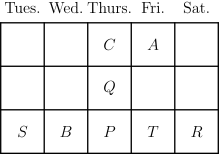
On this monthly calendar, the date behind one of the letters is added to the date behind . If this sum equals the sum of the dates behind and , then the letter is
Pista pequeña:
En un calendario, moverse una columna a la derecha suma a la fecha y moverse una fila hacia abajo suma
On a calendar, moving one column right adds to the date and moving one row down adds
Pista grande:
La fecha tapada por es una unidad menor que la tapada por , así que la fecha buscada debe ser una unidad mayor que la tapada por
The date behind is one less than the date behind , so the missing date must be one more than the date behind
Solución:
Moverse una columna a la derecha suma a la fecha, y moverse una fila hacia abajo suma . Supongamos que tapa la fecha . Entonces , una columna a la derecha, tapa . La letra está dos filas directamente debajo de , así que , y , una columna a la izquierda de en la fila inferior, tapa .
Necesitamos una letra cuya fecha satisfaga , así que . Esa fecha está tapada por .
Por lo tanto, la respuesta correcta es A.
Moving one column right adds to the date, and moving one row down adds . Let have date . Then , one column to the right, is . The letter sits two rows directly below , so , and , one column left of in the bottom row, is .
We need a letter whose date satisfies , so . That date is behind .
Thus, the correct answer is A .
11.
Los números en las caras de este cubo son números enteros consecutivos. Las sumas de los dos números en cada uno de los tres pares de caras opuestas son iguales. La suma de los seis números de este cubo es
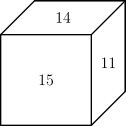
The numbers on the faces of this cube are consecutive whole numbers. The sums of the two numbers on each of the three pairs of opposite faces are equal. The sum of the six numbers on this cube is
Pista pequeña:
Cinco de las caras deben ser ; la sexta es o
Five of the faces must be ; the sixth is either or
Pista grande:
Las tres caras se encuentran en un vértice, así que ningún par de ellas es opuesto; esto descarta una de las dos posibilidades
The three faces meet at one corner, so no two of them are opposite; this rules out one of the two possibilities
Solución:
Los seis números consecutivos incluyen , así que cinco de las caras son y la sexta es o .
Si la sexta fuera , para que las sumas de las caras opuestas sean iguales se forzarían los pares , haciendo que y fueran opuestas. Pero la figura muestra las caras reuniéndose en un vértice, así que ningún par de ellas es opuesto. Por lo tanto, la sexta cara es , con los pares , cada uno sumando .
El total es .
Por lo tanto, la respuesta correcta es E.
The six consecutive numbers include , so five of the faces are and the sixth is or .
If the sixth were , equal opposite sums would force the pairs , making and opposite. But the figure shows meeting at one corner, so no two of them are opposite. Hence the sixth number is , with pairs , each summing to .
The total is .
Thus, the correct answer is E .
12.
Hay veinticuatro números enteros de cifras que usan cada uno de los cuatro dígitos y exactamente una vez. Ordenados de menor a mayor, el número en la posición de la lista es
There are twenty-four -digit whole numbers that use each of the four digits and exactly once. Listed in numerical order from smallest to largest, the number in the th position in the list is
Pista pequeña:
Los números se dividen en cuatro bloques de según su primer dígito
The numbers split into four blocks of by their leading digit
Pista grande:
Las posiciones – empiezan con , las – empiezan con , las – empiezan con ; encuentra el º número que empieza con
Positions – start with , – start with , – start with ; find the th number starting with
Solución:
Cada primer dígito abarca de los números. Las posiciones – empiezan con , las posiciones – empiezan con , y las posiciones – empiezan con .
Así que el número es el º que empieza con : . El quinto es .
Por lo tanto, la respuesta correcta es B.
Each leading digit accounts for of the numbers. Positions – begin with , positions – begin with , and positions – begin with .
So the th number is the th one beginning with : . The fifth is .
Thus, the correct answer is B .
13.
Una propuesta de nuevas tarifas postales para una carta era de ¢ por la primera onza y ¢ por cada onza adicional (o fracción de onza). El franqueo de una carta que pesa onzas fue
One proposal for new postage rates for a letter was ¢ for the first ounce and ¢ for each additional ounce (or fraction of an ounce). The postage for a letter weighing ounces was
¢
Pista pequeña:
La primera onza cuesta ¢; las onzas restantes se cobran como onzas adicionales completas
The first ounce costs ¢; the remaining ounces are billed as full additional ounces
Pista grande:
Una fracción de onza cuenta como una onza adicional completa, así que onzas más allá de la primera cuentan como
A fraction of an ounce counts as a whole additional ounce, so ounces beyond the first counts as
Solución:
La primera onza cuesta ¢. Las onzas restantes se cobran como onzas adicionales, ya que cualquier fracción se redondea hacia arriba a una onza completa.
Eso es ¢ ¢, así que el total es ¢ ¢ ¢
Por lo tanto, la respuesta correcta es C.
The first ounce costs ¢. The remaining ounces are charged as additional ounces, since any fraction rounds up to a full ounce.
That is ¢ ¢, so the total is ¢ ¢ ¢
Thus, the correct answer is C .
14.
Una bolsa contiene solo bolas azules y bolas verdes. Hay bolas azules. Si la probabilidad de sacar al azar una bola azul de esta bolsa es entonces el número de bolas verdes en la bolsa es
A bag contains only blue balls and green balls. There are blue balls. If the probability of drawing a blue ball at random from this bag is then the number of green balls in the bag is
Pista pequeña:
Si la probabilidad de azul es entonces las bolas azules son un cuarto del total
If the probability of blue is then blue balls are a quarter of the total
Pista grande:
Usa las bolas azules para hallar el total, luego resta para obtener las bolas verdes
Use blue balls to find the total, then subtract to get the green balls
Solución:
Como las bolas azules constituyen de la bolsa y hay de ellas, el total es bolas.
Así que el número de bolas verdes es .
Por lo tanto, la respuesta correcta es B.
Since blue balls make up of the bag and there are of them, the total is balls.
So the number of green balls is .
Thus, the correct answer is B .
15.
El área de esta figura es Su perímetro es
(La figura consta de cuatro cuadrados idénticos.)
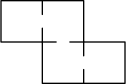
The area of this figure is Its perimeter is
(The figure consists of four identical squares.)
Pista pequeña:
Cada uno de los cuatro cuadrados tiene área
Each of the four squares has area
Pista grande:
Halla la longitud del lado de un cuadrado, luego cuenta cuántas longitudes de lado forman el contorno
Find the side length of one square, then count how many side lengths make up the outline
Solución:
Cada uno de los cuatro cuadrados tiene área , así que cada lado mide
El contorno de esta forma de escalera está compuesto por de esos lados, así que el perímetro es
Por lo tanto, la respuesta correcta es E.
Each of the four squares has area , so each side is
The outline of this staircase shape is made up of such sides, so the perimeter is
Thus, the correct answer is E .
16.
¿Cuál es el valor de la siguiente expresión?
What is the value of the following expression?
Pista pequeña:
Agrupa los términos en pares:
Group the terms in pairs:
Pista grande:
Cada par es igual a ; cuenta los pares y recuerda el que sobra al final
Each pair equals ; count the pairs and remember the leftover at the end
Solución:
Agrupa los términos como Cada par entre paréntesis es igual a .
Los primeros elementos suman términos, así que hay pares, que dan , más el que sobra al final, para un total de .
Por lo tanto, la respuesta correcta es D.
Group the terms as Each parenthesized pair equals .
The first elements number , so there are pairs, giving , plus the leftover at the end for a total of .
Thus, the correct answer is D .
17.
Una acera recta de concreto va a tener pies de ancho, pies de largo y pulgadas de grosor. ¿Cuántas yardas cúbicas de concreto debe pedir un contratista para la acera si el concreto debe pedirse en un número entero de yardas cúbicas?
A straight concrete sidewalk is to be feet wide, feet long, and inches thick. How many cubic yards of concrete must a contractor order for the sidewalk if concrete must be ordered in a whole number of cubic yards?
más de
more than
Pista pequeña:
Primero convierte pulgadas a pies:
First convert inches to feet:
Pista grande:
Halla el volumen en pies cúbicos, luego divide entre ya que yarda cúbica pies cúbicos
Find the volume in cubic feet, then divide by since cubic yard cubic feet
Solución:
El grosor es pulgadas pie, así que el volumen es pies cúbicos.
Como yarda cúbica pies cúbicos, esto es yardas cúbicas. Redondeando hacia arriba a un número entero, el contratista debe pedir yardas cúbicas.
Por lo tanto, la respuesta correcta es A.
The thickness is inches foot, so the volume is cubic feet.
Since cubic yard cubic feet, this is cubic yards. Rounding up to a whole number, the contractor must order cubic yards.
Thus, the correct answer is A .
18.
Cada vértice de un prisma rectangular se corta mediante un plano que atraviesa las tres aristas que concurren allí, eliminando una pequeña pieza triangular en cada uno de los ocho vértices. ¿Cuántas aristas tiene la nueva figura?
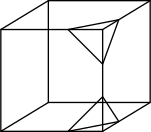
Every corner of a rectangular prism is cut off by a straight slice through the three edges meeting at that corner, removing a small triangular piece at each of the eight corners. How many edges does the new figure have?
Pista pequeña:
El prisma rectangular original tiene aristas, y ninguna de ellas desaparece
The original rectangular prism has edges, and none of them disappear
Pista grande:
Cada corte de vértice crea una nueva cara triangular, añadiendo aristas nuevas
Each corner cut creates a new triangular face, adding new edges
Solución:
Un prisma rectangular empieza con aristas, y cortar los vértices solo las acorta sin eliminar ninguna.
Cada uno de los cortes de vértice crea una pequeña cara triangular con aristas nuevas, añadiendo aristas. El total es .
Por lo tanto, la respuesta correcta es C.
A rectangular prism starts with edges, and cutting corners only shortens them without removing any.
Each of the corner cuts creates a small triangular face with new edges, adding edges. The total is .
Thus, the correct answer is C .
19.
Hay asientos en una fila. ¿Cuál es el menor número de asientos que deben estar ocupados para que la siguiente persona en sentarse tenga que sentarse junto a alguien?
There are seats in a row. What is the fewest number of seats that must be occupied so the next person to be seated must sit next to someone?
Pista pequeña:
Para obligar a la siguiente persona a sentarse junto a alguien, ningún asiento vacío puede tener ambos vecinos vacíos
To force the next person to sit adjacent to someone, no empty seat may have both neighbors empty
Pista grande:
Sienta a la gente de modo que haya exactamente un asiento vacío entre los ocupados: ocupa cada tercer asiento
Seat people so there is exactly one empty seat between occupied ones: occupy every third seat
Solución:
Para obligar a la siguiente persona a sentarse junto a alguien, cada asiento vacío debe ser adyacente a uno ocupado. Cada asiento ocupado puede cubrir como máximo ese asiento y sus dos vecinos, de modo que deben estar ocupados al menos asientos.
Esta cota se puede alcanzar: se repite el patrón vacío-ocupado-vacío, llenando el asiento central de cada grupo de tres. Así se usan exactamente asientos ocupados.
Por lo tanto, la respuesta correcta es B.
To force the next person next to someone, every empty seat must be adjacent to an occupied one. Each occupied seat can account for at most itself and its two neighboring seats, so at least seats must be occupied.
This bound is attainable: use a repeating pattern of empty-occupied-empty, filling the middle seat of every group of three. This uses exactly occupied seats.
Thus, the correct answer is B .
20.
Los ingresos anuales de familias van desde hasta Por error, el mayor ingreso se ingresó en la computadora como La diferencia entre la media de los datos incorrectos y la media de los datos reales es
The annual incomes of families range from to In error, the largest income was entered on the computer as The difference between the mean of the incorrect data and the mean of the actual data is
Pista pequeña:
Solo cambió un valor, así que solo cambia la suma total; el conteo se mantiene en
Only one value changed, so only the total sum changes; the count stays at
Pista grande:
Halla cuánto infló el total esa entrada incorrecta, luego divide eso entre
Find how much the one wrong entry inflated the total, then divide that by
Solución:
Solo cambió una entrada. El total incorrecto supera al total real en
Como esta cantidad extra se reparte entre familias, las medias difieren en
Por lo tanto, la respuesta correcta es A.
Only one entry changed. The incorrect total exceeds the actual total by
Since this extra amount is spread over families, the means differ by
Thus, the correct answer is A .
21.
Una lista de números se forma comenzando con dos números dados. Cada número nuevo de la lista es el producto de los dos anteriores. Halla el primer número si los últimos tres son :
A list of numbers is formed by beginning with two given numbers. Each new number in the list is the product of the two previous numbers. Find the first number if the last three are :
Pista pequeña:
Si un término es el producto de los dos anteriores, entonces dividir un término entre el que está justo antes recupera el término dos posiciones atrás
If a term is the product of the two before it, then dividing a term by the one just before it recovers the term two positions back
Pista grande:
Trabaja hacia atrás desde el final, completando un término anterior a la vez mediante división
Work backwards from the end, filling one earlier term at a time by dividing
Solución:
Como cada término es el producto de los dos anteriores, dividir cualquier término entre el término justo anterior recupera el término dos posiciones antes. Trabajando hacia atrás desde los últimos tres términos :
Estos completan los términos anteriores, dando la lista completa . El primer número es .
Por lo tanto, la respuesta correcta es B.
Since each term is the product of the two before it, dividing any term by the term just before it recovers the term two positions earlier. Working backwards from the last three terms :
These fill in the earlier terms, giving the full list . The first number is .
Thus, the correct answer is B .
22.
Varios estudiantes están sentados en una gran mesa circular. Se van pasando una bolsa que contiene caramelos. Cada persona recibe la bolsa, toma un caramelo, y luego pasa la bolsa a la siguiente persona. Si Chris toma el primer y el último caramelo, entonces el número de estudiantes en la mesa podría ser
Several students are seated at a large circular table. They pass around a bag containing pieces of candy. Each person receives the bag, takes one piece of candy, and then passes the bag to the next person. If Chris takes the first and the last piece of candy, then the number of students at the table could be
Pista pequeña:
Chris toma el caramelo y el caramelo , así que después del primer caramelo de Chris, los caramelos restantes hacen que la bolsa regrese exactamente a Chris
Chris takes piece and piece , so after Chris’s first piece, the remaining pieces bring the bag exactly back to Chris
Pista grande:
El número de estudiantes debe dividir exactamente
The number of students must divide evenly
Solución:
Chris toma el primer caramelo, y luego la bolsa da vueltas hasta que Chris toma el último, el caramelo número . Así que las extracciones posteriores a la primera de Chris deben completar un número entero de vueltas y devolverle la bolsa.
Esto significa que el número de estudiantes divide . Entre las opciones, solo divide .
Por lo tanto, la respuesta correcta es B.
Chris takes the first piece, and then the bag goes around until Chris takes the last (th) piece. So the pieces after Chris’s first must be exactly a whole number of trips around the table back to Chris.
This means the number of students divides . Among the choices, only divides .
Thus, the correct answer is B .
23.
La gráfica relaciona la distancia recorrida (en millas) con el tiempo transcurrido (en horas) en un viaje realizado por un avión experimental. ¿Durante qué hora fue mayor la velocidad promedio de este avión?
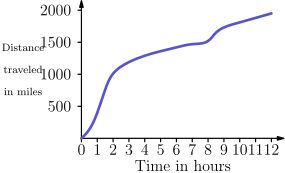
The graph relates the distance traveled (in miles) to the time elapsed (in hours) on a trip taken by an experimental airplane. During which hour was the average speed of this airplane the largest?
primera hora
first
segunda hora
second
tercera hora
third
novena hora
ninth
última hora
last
Pista pequeña:
La velocidad promedio durante una hora es igual a la distancia recorrida en esa hora, que es cuánto sube la curva desde el inicio de la hora hasta su fin
The average speed during an hour equals the distance covered in that hour, which is how far the curve climbs from the start of the hour to its end
Pista grande:
Encuentra el intervalo de una hora en el que la gráfica sube más pronunciadamente
Find the one-hour interval over which the graph rises the most steeply
Solución:
La velocidad promedio durante cualquier hora es igual a la distancia que el avión recorre en esa hora, que en la gráfica es la subida vertical de la curva en ese intervalo de una hora. Así que la mayor velocidad promedio ocurre durante la hora en que la curva es más empinada.
De a la curva sube de unas millas a unas millas, una subida de aproximadamente millas, dando una velocidad promedio cercana a mph. Durante cada una de las otras horas la curva sube menos de millas, así que esas velocidades promedio son todas menores. La subida más empinada, y por tanto la mayor velocidad promedio, es durante la segunda hora.
Por lo tanto, la respuesta correcta es B.
The average speed during any single hour equals the distance the airplane covers in that hour, which on the graph is the vertical rise of the curve over that one-hour interval. So the largest average speed happens during the hour where the curve is steepest.
From to the curve climbs from about miles to about miles, a rise of roughly miles, giving an average speed near mph. During every other hour the curve rises by less than miles, so those average speeds are all smaller. The steepest climb, and hence the largest average speed, is during the second hour.
Thus, the correct answer is B .
24.
Tres triángulos y un rombo equilibran nueve puntos. Además, un triángulo equilibra un rombo y un punto. ¿Cuántos puntos equilibrarán dos rombos?
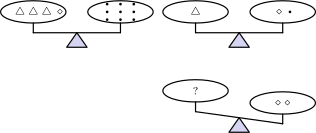
Three triangles and a diamond balance nine dots. Also, one triangle balances a diamond and a dot. How many dots will balance two diamonds?
Pista pequeña:
Representa los pesos de un triángulo, un rombo y un punto por , y , respectivamente; escribe las dos condiciones de equilibrio como ecuaciones
Let a triangle weigh , a diamond , and a dot ; write the two balance conditions as equations
Pista grande:
A partir de y , sustituye para despejar , luego duplícalo
From and , substitute to solve for , then double it
Solución:
Representemos los pesos de un triángulo, un rombo y un punto por , y , respectivamente. Las condiciones dan y .
Sustituyendo, , así que y . Entonces dos rombos pesan puntos.
Por lo tanto, la respuesta correcta es C.
Let a triangle, diamond, and dot weigh , , and . The conditions give and .
Substituting, , so and . Then two diamonds weigh dots.
Thus, the correct answer is C .
25.
¿Cuántos patrones diferentes se pueden formar sombreando exactamente dos de los nueve cuadrados unitarios en una cuadrícula de ? Los patrones que se pueden hacer coincidir mediante reflexiones y/o giros no se consideran diferentes.
How many different patterns can be made by shading exactly two of the nine unit squares in a grid? Patterns that can be matched by flips and/or turns are not considered different.
Pista pequeña:
Los nueve cuadrados son de tres tipos: esquinas, puntos medios de lado, y centro; describe cada patrón por los tipos que usan sus dos cuadrados sombreados y qué tan separados están
The nine squares come in three types: corners, edge-middles, and center; describe each pattern by which types its two shaded squares use and how far apart they are
Pista grande:
Divide en casos según si hay una esquina sombreada, teniendo cuidado de que las reflexiones y giros fusionan muchas colocaciones en un solo patrón
Split into cases by whether a corner is shaded, being careful that flips and turns merge many placements into one pattern
Solución:
Clasifica los dos cuadrados sombreados salvo rotaciones y reflexiones. Patrones que incluyen una esquina: dos esquinas adyacentes (mismo lado), dos esquinas diagonalmente opuestas, esquina con el centro, esquina con un punto medio de lado adyacente, y esquina con un punto medio de lado lejano. Eso son patrones.
Patrones sin ninguna esquina: dos puntos medios de lado adyacentes, dos puntos medios de lado opuestos, y un punto medio de lado con el centro. Eso son más.
En total hay patrones distintos.
Por lo tanto, la respuesta correcta es C.
Classify the two shaded squares up to rotations and reflections. Patterns that include a corner: two adjacent corners (same edge), two diagonally opposite corners, corner with the center, corner with an adjacent edge-middle, and corner with a far edge-middle. That is patterns.
Patterns with no corner: two adjacent edge-middles, two opposite edge-middles, and an edge-middle with the center. That is more.
In total there are distinct patterns.
Thus, the correct answer is C .