
Soluciones del 1987 AMC 8
Desplázate hacia abajo para ver las soluciones preparadas profesionalmente de LIVE by Po-Shen Loh, imprime las soluciones en PDF, consulta la clave de respuestas, o haz el examen cronometrado completo.
Todos los problemas se usan con el permiso legal oficial de la Mathematical Association of America (MAA).
1.
¿Cuánto es ?
What is
Pista pequeña:
Alinea los puntos decimales antes de sumar
Line up the decimal points before adding
Pista grande:
Escribe los números como y
Write the numbers as and
Solución:
Sumando cifra por cifra,
Por lo tanto, la respuesta correcta es E.
Adding place by place,
Thus, the correct answer is E .
2.
¿Cómo se escribe en forma decimal?
What is written as a decimal?
Pista pequeña:
Reescribe la fracción con denominador
Rewrite the fraction with a denominator of
Pista grande:
Multiplica el numerador y el denominador por
Multiply the numerator and denominator by
Solución:
Multiplicando arriba y abajo por se obtiene
Por lo tanto, la respuesta correcta es B.
Multiplying top and bottom by gives
Thus, the correct answer is B .
3.
¿Cuál es el valor de la siguiente expresión?
What is the value of
Pista pequeña:
Estos diez números están igualmente espaciados
The ten numbers are evenly spaced
Pista grande:
Su promedio es así que su suma es
Their average is so their sum is
Solución:
Los diez números igualmente espaciados tienen promedio así que su suma es
Al duplicar se obtiene
Por lo tanto, la respuesta correcta es E.
The ten evenly spaced numbers have average so their sum is
Doubling gives
Thus, the correct answer is E .
4.
Los marcianos miden los ángulos en clerts. Un círculo completo tiene clerts. ¿Cuántos clerts hay en un ángulo recto?
Martians measure angles in clerts. There are clerts in a full circle. How many clerts are there in a right angle?
Pista pequeña:
Un ángulo recto es de un círculo completo
A right angle is of a full circle
Pista grande:
Toma de clerts
Take of clerts
Solución:
Un ángulo recto es la cuarta parte de un círculo completo, así que contiene clerts.
Por lo tanto, la respuesta correcta es C.
A right angle is a quarter of a full circle, so it contains clerts.
Thus, the correct answer is C .
5.
¿Cuál es el área, en metros cuadrados, de la región rectangular que se muestra?
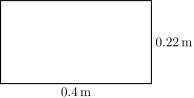
What is the area, in square meters, of the rectangular region shown?
Pista pequeña:
El área de un rectángulo es su largo por su ancho
The area of a rectangle is its length times its width
Pista grande:
Multiplica por
Multiply by
Solución:
El área es metros cuadrados.
Por lo tanto, la respuesta correcta es A.
The area is square meters.
Thus, the correct answer is A .
6.
El menor producto que se puede obtener al multiplicar dos números del conjunto es
The smallest product one could obtain by multiplying two numbers in the set is
Pista pequeña:
El menor producto es el más negativo, que proviene de un factor negativo y uno positivo
The smallest product is the most negative one, which comes from one negative and one positive factor
Pista grande:
Empareja el número más negativo con el número positivo más grande
Pair the most negative number with the largest positive number
Solución:
Un producto negativo proviene de multiplicar un número negativo por uno positivo, y es más negativo cuando ambos factores tienen el mayor valor absoluto.
El producto más negativo es
Por lo tanto, la respuesta correcta es B.
A negative product comes from multiplying a negative number by a positive number, and it is most negative when both factors are largest in size.
The most negative product is
Thus, the correct answer is B .
7.
El cubo grande que se muestra está formado por cubos más pequeños del mismo tamaño. Para cada cara del cubo grande, la cara opuesta está sombreada de la misma manera. El número total de cubos más pequeños que deben tener al menos una cara sombreada es
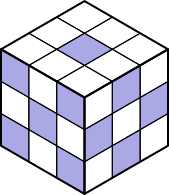
The large cube shown is made up of identical sized smaller cubes. For each face of the large cube, the opposite face is shaded the same way. The total number of smaller cubes that must have at least one face shaded is
Pista pequeña:
Un cubo pequeño muestra una cara sombreada solo cuando uno de sus cuadros de superficie está sombreado, así que cuenta los cubos que quedan completamente en blanco, empezando por el único cubo oculto en el centro del bloque
A small cube shows a shaded face only when one of its surface squares is shaded, so count the cubes that stay completely blank, beginning with the single hidden cube at the center of the block
Pista grande:
Además del cubo central oculto, encuentra los cubos cuyos cuadros expuestos caen todos en una posición en blanco, y luego resta de el número de cubos en blanco
Besides the hidden center cube, find the cubes whose every exposed square lands on a blank position, then subtract the number of blank cubes from
Solución:
Cuenta los cubos sin ninguna cara sombreada y réstalos de Un cubo pequeño queda sin sombrear exactamente cuando cada uno de sus cuadros expuestos está en blanco.
Los tres patrones son: las caras superior e inferior muestran sombreado solo su cuadro central; un par de caras laterales opuestas muestra sombreadas las cuatro esquinas y el centro; el par restante muestra sombreados los cuatro puntos medios de las aristas.
Exactamente cubos pequeños evitan todo cuadro sombreado: el único cubo oculto en el centro mismo del bloque; los dos cubos en los centros de las caras de puntos medios de arista, cuyo único cuadro expuesto es ese centro en blanco; y los cuatro cubos en los puntos medios de las aristas donde una cara de esquinas y centro se encuentra con la cara superior o inferior, ya que allí cada cuadro expuesto es una celda de arista en blanco.
De modo que cubos tienen al menos una cara sombreada.
Por lo tanto, la respuesta correcta es C.
Count the cubes with no shaded face and subtract from A small cube is unshaded exactly when every one of its exposed squares is blank.
The three patterns are: the top and bottom faces show only their center square shaded; one pair of opposite side faces shows the four corners and the center shaded; the remaining pair shows the four edge-midpoints shaded.
Exactly small cubes avoid every shaded square: the one hidden cube at the very center of the block; the two cubes at the centers of the edge-midpoints faces, whose only exposed square is that blank center; and the four cubes at the midpoints of the edges where a corners-and-center face meets the top or bottom face, since there each exposed square is a blank edge cell.
Hence cubes have at least one shaded face.
Thus, the correct answer is C .
8.
En el siguiente problema de suma, y son dígitos distintos de cero:
¿Cuántos dígitos (no necesariamente distintos) tiene la suma de los tres números enteros?
In the addition problem below, and are nonzero digits:
How many digits (not necessarily different) are in the sum of the three whole numbers?
depende de los valores de y
depends on the values of and
Pista pequeña:
El número ya está cerca de así que sumar cualquier cosa empuja la suma más allá
The number is already close to so adding anything pushes the sum past it
Pista grande:
Comprueba también la suma más grande posible, usando
Check the largest possible sum too, using
Solución:
Como y valen al menos la suma es al menos que tiene dígitos.
En el otro extremo, con la suma es todavía dígitos. Así que la suma siempre tiene exactamente dígitos.
Por lo tanto, la respuesta correcta es B.
Since and are at least the sum is at least which has digits.
At the other extreme, with the sum is still digits. So the sum always has exactly digits.
Thus, the correct answer is B .
9.
Al calcular la suma
¿cuál es el mínimo común denominador que se usa?
When finding the sum
what is the least common denominator used?
Pista pequeña:
El mínimo común denominador es el mínimo común múltiplo de
The least common denominator is the least common multiple of
Pista grande:
Usa para cubrir el factor (y el ), luego incluye y
Use to cover the factor (and ), then include and
Solución:
El mínimo común múltiplo debe incluir y (el factor ya está cubierto).
Así que es
Por lo tanto, la respuesta correcta es C.
The least common multiple must include and (the factor is already covered).
So it is
Thus, the correct answer is C .
10.
¿Cuál es el valor de la siguiente expresión?
What is the value of
Pista pequeña:
Combina los primeros tres términos:
Combine the first three terms:
Pista grande:
Calcula luego suma
Compute then add
Solución:
Los primeros tres términos se combinan en
Sumando el último término se obtiene
Por lo tanto, la respuesta correcta es B.
The first three terms combine to
Adding the last term gives
Thus, the correct answer is B .
11.
¿Entre qué dos valores se encuentra la suma ?
The sum is between which two values?
y
and
y
and
y
and
y
and
y
and
Pista pequeña:
Suma primero las partes enteras:
Add the whole-number parts first:
Pista grande:
Las partes fraccionarias son esto es más que pero menos que
The fractional parts are this is more than but less than
Solución:
Las partes enteras suman Las partes fraccionarias son
Como es una cantidad positiva pequeña, el total fraccionario es más que pero muy por debajo de Así que la suma está entre y
Por lo tanto, la respuesta correcta es B.
The whole-number parts sum to The fractional parts are
Since is a small positive amount, the fractional total is more than but well under So the sum lies between and
Thus, the correct answer is B .
12.
¿Qué fracción de la gran región rectangular de por está sombreada?
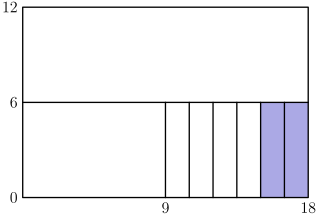
What fraction of the large by rectangular region is shaded?
Pista pequeña:
La línea horizontal divide el rectángulo en una mitad superior y una mitad inferior
The horizontal line splits the rectangle into a top half and a bottom half
Pista grande:
La parte sombreada es el tercio más a la derecha del cuarto inferior derecho del rectángulo
The shaded part is the rightmost third of the bottom-right quarter of the rectangle
Solución:
Toda la región tiene área La región sombreada mide de ancho y de alto, con área
Así que la fracción sombreada es De forma equivalente, es de del total.
Por lo tanto, la respuesta correcta es C.
The whole region has area The shaded region is wide and tall, with area
So the shaded fraction is Equivalently, it is of of the whole.
Thus, the correct answer is C .
13.
¿Cuál de las siguientes fracciones tiene el mayor valor?
Which of the following fractions has the largest value?
Pista pequeña:
Compara cada fracción con
Compare each fraction to
Pista grande:
Una fracción es mayor que exactamente cuando su numerador es más de la mitad de su denominador
A fraction is more than exactly when its numerator is more than half its denominator
Solución:
Para y cada numerador es menor que la mitad de su denominador, así que cada una es menor que
Para el numerador es más de la mitad de así que esta fracción supera y es la mayor.
Por lo tanto, la respuesta correcta es E.
For and each numerator is less than half its denominator, so each is less than
For the numerator is more than half of so this fraction exceeds and is the largest.
Thus, the correct answer is E .
14.
Una computadora puede hacer sumas por segundo. ¿Cuántas sumas puede hacer en una hora?
A computer can do additions per second. How many additions can it do in one hour?
millones
million
millones
million
millones
million
millones
million
millones
million
Pista pequeña:
Una hora tiene segundos
There are seconds in an hour
Pista grande:
Multiplica la tasa por el número de segundos en una hora
Multiply the rate by the number of seconds in an hour
Solución:
Una hora tiene segundos, así que la computadora hace sumas.
Eso es millones.
Por lo tanto, la respuesta correcta es B.
One hour has seconds, so the computer does additions.
That is million.
Thus, the correct answer is B .
15.
Un anuncio de oferta decía: “Compra tres llantas al precio regular y llévate la cuarta llanta por ” Sam pagó por un juego de cuatro llantas en la oferta. ¿Cuál era el precio regular de una llanta?
A sale ad read: “Buy three tires at the regular price and get the fourth tire for ” Sam paid for a set of four tires at the sale. What was the regular price of one tire?
Pista pequeña:
Los cubren tres llantas al precio regular más por la cuarta
The covers three tires at the regular price plus for the fourth
Pista grande:
Resta los luego divide el resto entre las tres llantas a precio completo
Subtract the then divide the rest among the three full-price tires
Solución:
Las tres llantas a precio regular cuestan
Así que una llanta cuesta
Por lo tanto, la respuesta correcta es D.
The three regular-price tires cost
So one tire costs
Thus, the correct answer is D .
16.
Joyce encestó de sus primeros tiros en los primeros tres partidos de la temporada de baloncesto, así que su promedio de tiro de la temporada era En su siguiente partido, hizo tiros y elevó su promedio de tiro de la temporada a ¿Cuántos de estos tiros encestó?
Joyce made of her first shots in the first three games of the basketball season, so her seasonal shooting average was In her next game, she took shots and raised her seasonal shooting average to How many of these shots did she make?
Pista pequeña:
Después del siguiente partido ha intentado tiros
After the next game she has attempted shots
Pista grande:
Un promedio de sobre tiros significa encestados en total; ya tenía
A average on shots means made in all; she already had
Solución:
Después del cuarto partido ha hecho tiros. Un promedio de significa que encestó tiros en total.
Ya había encestado así que encestó de los últimos
Por lo tanto, la respuesta correcta es E.
After the fourth game she has taken shots. A average means she made shots in total.
She had already made so she made of the last
Thus, the correct answer is E .
17.
Abby, Bret, Carl y Dana están sentados en una fila de cuatro asientos numerados del al Joe los mira y dice: “Bret está junto a Carl.” “Abby está entre Bret y Carl.” Sin embargo, cada una de las afirmaciones de Joe es falsa. Bret está en realidad sentado en el asiento ¿Quién está sentado en el asiento ?
Abby, Bret, Carl, and Dana are seated in a row of four seats numbered to Joe looks at them and says: “Bret is next to Carl.” “Abby is between Bret and Carl.” However, each one of Joe’s statements is false. Bret is actually sitting in seat Who is sitting in seat
Abby
Bret
Carl
Dana
No hay información suficiente para estar seguro
There is not enough information to be sure
Pista pequeña:
“Bret está junto a Carl” es falso, así que Carl no está en el asiento ni en el asiento el único asiento restante para Carl es el asiento
“Bret is next to Carl” is false, so Carl is not in seat or seat the only remaining seat for Carl is seat
Pista grande:
Una vez que Carl está en el asiento “Abby está entre Bret y Carl” es falso, así que Abby no puede estar en el asiento coloca a Abby en el último asiento libre y ve quién queda
Once Carl is in seat “Abby is between Bret and Carl” is false, so Abby cannot be in seat place Abby in the last open seat and see who is left
Solución:
Bret está en el asiento Como “Bret está junto a Carl” es falso, Carl no está en el asiento ni en el asiento así que Carl debe estar en el asiento
El asiento entre Bret (asiento ) y Carl (asiento ) es el asiento Como “Abby está entre Bret y Carl” es falso, Abby no está en el asiento así que Abby debe estar en el asiento
Eso deja a Dana en el asiento
Por lo tanto, la respuesta correcta es D.
Bret is in seat Since “Bret is next to Carl” is false, Carl is not in seat or seat so Carl must be in seat
The seat between Bret (seat ) and Carl (seat ) is seat Since “Abby is between Bret and Carl” is false, Abby is not in seat so Abby must be in seat
That leaves Dana in seat
Thus, the correct answer is D .
18.
La mitad de las personas de una habitación se fueron. Un tercio de las que quedaban se pusieron a bailar. Entonces había personas que no estaban bailando. ¿Cuál era el número original de personas en la habitación?
Half the people in a room left. One third of those remaining started to dance. There were then people who were not dancing. What was the original number of people in the room?
Pista pequeña:
Después de que se va la mitad, el número que queda es sobre lo que se aplica la fracción que baila
After half leave, the number remaining is what the dancing fraction applies to
Pista grande:
Los que no bailan son de los que quedan
The non-dancers are of those remaining
Solución:
De los que quedaban, bailó, así que no. Por lo tanto, de las personas restantes es igual a lo que da restantes.
Esos son la mitad del grupo original, así que la habitación empezó con personas.
Por lo tanto, la respuesta correcta es C.
Of those remaining, danced, so did not. Thus of the remaining people equals giving remaining.
Those are half the original group, so the room started with people.
Thus, the correct answer is C .
19.
Una calculadora tiene una tecla de elevar al cuadrado que reemplaza el número que se muestra actualmente por su cuadrado. Por ejemplo, si la pantalla muestra y se presiona , la pantalla pasa a Si la pantalla muestra ¿cuántas veces se debe presionar para producir un número mostrado mayor que ?
A calculator has a squaring key that replaces the number currently displayed with its square. For example, if the display reads and is pressed, the display becomes If the display reads how many times must be pressed to produce a displayed number greater than
Pista pequeña:
Empezando en cada pulsación eleva al cuadrado el número:
Starting from each press squares the number:
Pista grande:
Encuentra el primer término de esa lista que supera
Find the first term in that list that exceeds
Solución:
Presionar la tecla repetidamente da
Como la pantalla supera por primera vez en la cuarta pulsación.
Por lo tanto, la respuesta correcta es A.
Pressing the key repeatedly gives
Since the display first exceeds on the fourth press.
Thus, the correct answer is A .
20.
Considera la afirmación: “Si un número entero no es primo, entonces el número entero no es primo.” ¿Cuál de los siguientes valores de muestra que esta afirmación es falsa?
Consider the statement: “If a whole number is not prime, then the whole number is not prime.” Which of the following values of shows this statement to be false?
Pista pequeña:
Para refutar una afirmación del tipo “si... entonces”, encuentra un caso donde se cumple la parte del “si” pero falla la parte del “entonces”
To disprove an “if ... then” statement, find a case where the “if” part holds but the “then” part fails
Pista grande:
Busca un que no sea primo mientras que sí sea primo
Look for that is not prime while is prime
Solución:
Un contraejemplo necesita que no sea primo pero sí. Para el número no es primo mientras que sí es primo, así que rompe la afirmación.
Los demás no sirven como contraejemplos: y no son primos, mientras que y son primos ellos mismos.
Por lo tanto, la respuesta correcta es A.
A counterexample needs not prime but prime. For the number is not prime while is prime, so it breaks the statement.
The others fail to be counterexamples: and are not prime, while and are themselves prime.
Thus, the correct answer is A .
21.
Supón que significa el recíproco de Por ejemplo, ¿Cuántas de las siguientes cuatro afirmaciones son verdaderas?
Suppose means the reciprocal of For example, How many of the following four statements are true?
Pista pequeña:
Reemplaza cada por y prueba los dos lados de cada afirmación
Replace each with and test the two sides of each statement
Pista grande:
Para
For
Solución:
pero así que falsa. pero así que falsa.
verdadera. verdadera.
Así que exactamente de las afirmaciones son verdaderas.
Por lo tanto, la respuesta correcta es C.
but so false. but so false.
true. true.
So exactly of the statements are true.
Thus, the correct answer is C .
22.
es un rectángulo, es el centro del círculo y está sobre el círculo. Si y ¿entre qué dos valores está el área de la región sombreada?
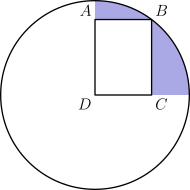
is a rectangle, is the center of the circle, and is on the circle. If and then the area of the shaded region is between which two values?
y
and
y
and
y
and
y
and
y
and
Pista pequeña:
La diagonal es el radio; encuéntrala con el teorema de Pitágoras
The diagonal is the radius; find it with the Pythagorean theorem
Pista grande:
La región sombreada es un cuarto del círculo menos el rectángulo:
The shaded region is a quarter of the circle with the rectangle removed:
Solución:
Como y la diagonal que es el radio.
La región sombreada es el cuarto de círculo en menos el rectángulo:
Esto está entre y
Por lo tanto, la respuesta correcta es D.
Since and the diagonal which is the radius.
The shaded region is the quarter circle at minus the rectangle:
This lies between and
Thus, the correct answer is D .
23.
Supón que la tabla adjunta muestra la población de EE. UU. en , en millones, para cada región y grupo étnico. Redondeando al porcentaje más cercano, ¿qué porcentaje de la población negra de EE. UU. vivía en el Sur?
| NE | MO | Sur | Oeste | |
|---|---|---|---|---|
| Blancos | ||||
| Negros | ||||
| Asiáticos | ||||
| Otros |
Assume the adjoining chart shows the U.S. population, in millions, for each region by ethnic group. To the nearest percent, what percent of the U.S. Black population lived in the South?
| NE | MW | South | West | |
|---|---|---|---|---|
| White | ||||
| Black | ||||
| Asian | ||||
| Other |
Pista pequeña:
Suma la población negra de las cuatro regiones para obtener el total
Add the Black population across all four regions to get the total
Pista grande:
Divide la cifra del Sur entre ese total, luego conviértela a porcentaje
Divide the South’s figure by that total, then convert to a percent
Solución:
La población negra total es millones.
La parte del Sur es que se redondea a
Por lo tanto, la respuesta correcta es D.
The total Black population is million.
The South’s share is which rounds to
Thus, the correct answer is D .
24.
Un examen de opción múltiple consta de preguntas. La puntuación es de por cada respuesta correcta, por cada respuesta incorrecta y por cada pregunta sin responder. La puntuación de John en el examen es ¿Cuál es el número máximo de preguntas que pudo haber respondido correctamente?
A multiple choice examination consists of questions. The scoring is for each correct answer, for each incorrect answer, and for each unanswered question. John’s score on the examination is What is the maximum number of questions he could have answered correctly?
Pista pequeña:
Si respuestas son correctas y son incorrectas, entonces
If answers are correct and are wrong, then
Pista grande:
Prueba el mayor posible: debe ser un número par no negativo con
Try the largest possible : must be a nonnegative even number with
Solución:
Sea el número de correctas y el número de incorrectas, así que Entonces lo que exige que sea par.
Al probar se obtiene pero demasiadas preguntas; todo valor par mayor de exigiría responder aún más. Al probar se obtiene y lo cual sí funciona. Por tanto, el máximo es
Por lo tanto, la respuesta correcta es D.
Let be the number correct and the number wrong, so Then which requires to be even.
Trying gives but too many; every larger even would require still more answered questions. Trying gives and which works. So the maximum is
Thus, the correct answer is D .
25.
Diez bolas numeradas del al están en un frasco. Jack mete la mano en el frasco y saca al azar una de las bolas. Luego Jill mete la mano en el frasco y saca al azar una bola diferente. ¿Cuál es la probabilidad de que la suma de los dos números de las bolas sacadas sea par?
Ten balls numbered to are in a jar. Jack reaches into the jar and randomly removes one of the balls. Then Jill reaches into the jar and randomly removes a different ball. What is the probability that the sum of the two numbers on the balls removed is even?
Pista pequeña:
La suma de dos números es par exactamente cuando ambos son impares o ambos son pares
The sum of two numbers is even exactly when both are odd or both are even
Pista grande:
Hay bolas impares y pares; cuenta los pares de igual paridad entre todos los pares
There are odd and even balls; count the matching-parity pairs out of all pairs
Solución:
La suma es par cuando ambas bolas son impares o ambas pares. Hay pares todos impares y pares todos pares, para pares favorables.
El número total de pares es así que la probabilidad es
Por lo tanto, la respuesta correcta es A.
The sum is even when both balls are odd or both are even. There are all-odd pairs and all-even pairs, for favorable pairs.
The total number of pairs is so the probability is
Thus, the correct answer is A .