
Soluciones del 1981 AMC 12
Desplázate hacia abajo para ver las soluciones preparadas profesionalmente de LIVE by Po-Shen Loh, imprime las soluciones en PDF, consulta la clave de respuestas, o haz el examen cronometrado completo.
Todos los problemas se usan con el permiso legal oficial de la Mathematical Association of America (MAA).
1.
Si entonces es igual a
If then equals
Pista pequeña:
La ecuación ya proporciona el valor de
The equation already gives the value of
Pista grande:
Eleva una vez más al cuadrado el valor conocido
Square the known value once more
Solución:
De obtenemos Por lo tanto,
Por lo tanto, la respuesta correcta es E.
From we get Therefore
Therefore, the correct answer is E.
2.
El punto está en el lado del cuadrado Si tiene longitud uno y tiene longitud dos, entonces el área del cuadrado es

Point is on side of square If has length one and has length two, then the area of the square is
Pista pequeña:
El triángulo es rectángulo
Triangle is a right triangle
Pista grande:
El cateto desconocido también es la longitud del lado del cuadrado
The unknown leg is also the side length of the square
Solución:
Sea la longitud del lado del cuadrado. En el triángulo rectángulo Por consiguiente, que es precisamente el área del cuadrado.
Por lo tanto, la respuesta correcta es C.
Let the square’s side length be In right triangle Hence which is exactly the area of the square.
Therefore, the correct answer is C.
3.
Para es igual a
For equals
Pista pequeña:
Usa como denominador común
Use as a common denominator
Pista grande:
Suma los numeradores resultantes y
Add the resulting numerators and
Solución:
Al usar el denominador común , obtenemos
Por lo tanto, la respuesta correcta es D.
Using the common denominator gives
Therefore, the correct answer is D.
4.
Si tres veces el mayor de dos números es igual a cuatro veces el menor y la diferencia entre los números es entonces el mayor de los dos números es
If three times the larger of two numbers is four times the smaller and the difference between the numbers is then the larger of the two numbers is
Pista pequeña:
Sean y los números mayor y menor, respectivamente
Let and denote the larger and smaller numbers
Pista grande:
Usa junto con
Use together with
Solución:
La relación da Por tanto, así que
Por lo tanto, la respuesta correcta es C.
The relation gives Thus so
Therefore, the correct answer is C.
5.
En el trapecio los lados y son paralelos, y la diagonal y el lado tienen la misma longitud. Si y entonces
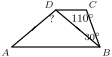
In trapezoid sides and are parallel, and diagonal and side have equal length. If and then
Pista pequeña:
Usa las bases paralelas para hallar el ángulo interior completo en
Use the parallel bases to find the full interior angle at
Pista grande:
Después usa en el triángulo
Then use in triangle
Solución:
Como los ángulos interiores consecutivos dan Por tanto, Como el triángulo cumple Así,
Por lo tanto, la respuesta correcta es C.
Since consecutive interior angles give Hence Because triangle has Therefore
Therefore, the correct answer is C.
6.
Si entonces es igual a
If then equals
Pista pequeña:
Observa que cada denominador es uno menos que su numerador
Notice that each denominator is one less than its numerator
Pista grande:
Sea y compara con
Set and compare with
Solución:
Sea La ecuación se convierte en Al multiplicar en cruz obtenemos por lo que
Por lo tanto, la respuesta correcta es A.
Let The equation becomes Cross-multiplication gives so
Therefore, the correct answer is A.
7.
¿Cuántos de los primeros cien enteros positivos son divisibles por todos los números y ?
How many of the first one hundred positive integers are divisible by all of the numbers
Pista pequeña:
Halla el mínimo común múltiplo de y
Find the least common multiple of and
Pista grande:
Cuenta los múltiplos de ese mínimo común múltiplo hasta
Count the multiples of that least common multiple through
Solución:
El mínimo común múltiplo es Entre los enteros positivos hasta solo es múltiplo de Por tanto, la cantidad es
Por lo tanto, la respuesta correcta es B.
The least common multiple is Among the positive integers through only is a multiple of Thus the count is
Therefore, the correct answer is B.
8.
Para todos los números positivos el producto es igual a
For all positive numbers the product equals
Pista pequeña:
Reescribe cada suma de recíprocos con un denominador común
Rewrite each sum of reciprocals over a common denominator
Pista grande:
Las dos sumas de recíprocos introducen los factores y
The two reciprocal sums introduce factors and
Solución:
Tenemos y Todos los factores de las sumas simétricas se cancelan, y queda
Por lo tanto, la respuesta correcta es A.
We have and All symmetric sum factors cancel, leaving
Therefore, the correct answer is A.
9.
En la figura adjunta, es una diagonal del cubo. Si tiene longitud entonces el área de la superficie del cubo es
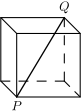
In the adjoining figure, is a diagonal of the cube. If has length then the surface area of the cube is
Pista pequeña:
Relaciona la diagonal espacial del cubo con la longitud de su lado
Relate the cube’s space diagonal to its side length
Pista grande:
Sustituye la longitud del lado en la fórmula para las seis caras cuadradas
Substitute the side length into the formula for six square faces
Solución:
Si la longitud del lado es entonces la diagonal espacial es por lo que El área de la superficie es
Por lo tanto, la respuesta correcta es A.
If the side length is then the space diagonal is so The surface area is
Therefore, the correct answer is A.
10.
Las rectas y son simétricas entre sí respecto de la recta Si la ecuación de la recta es , con y entonces la ecuación de es
The lines and are symmetric to each other with respect to the line If the equation of line is with and then the equation of is
Pista pequeña:
La reflexión respecto de intercambia las dos coordenadas
Reflection across interchanges the two coordinates
Pista grande:
Intercambia y en la ecuación original y luego despeja
Swap and in the original equation, then solve for
Solución:
Al intercambiar y en , obtenemos Al despejar,
Por lo tanto, la respuesta correcta es E.
Interchanging and in gives Solving,
Therefore, the correct answer is E.
11.
Los tres lados de un triángulo rectángulo tienen longitudes enteras que forman una progresión aritmética. Uno de los lados podría tener longitud
The three sides of a right triangle have integral lengths which form an arithmetic progression. One of the sides could have length
Pista pequeña:
Representa los tres lados igualmente espaciados como
Represent the three equally spaced sides as
Pista grande:
Todo triángulo rectángulo integral de este tipo es un múltiplo de un triángulo --
Every such integral right triangle is a multiple of a -- triangle
Solución:
Si los lados son la ecuación pitagórica da de donde y para algún entero positivo Así, los lados son Entre las opciones, puede aparecer.
Por lo tanto, la respuesta correcta es C.
If the sides are the Pythagorean equation gives hence and for some positive integer Thus the sides are Of the choices, can occur.
Therefore, the correct answer is C.
12.
Si y son números positivos y entonces el número que se obtiene al aumentar en y disminuir el resultado en excede a si y solo si
If and are positive numbers and then the number obtained by increasing by and decreasing the result by exceeds if and only if
Pista pequeña:
Escribe los dos cambios porcentuales sucesivos como factores multiplicativos
Write the two successive percentage changes as multiplication factors
Pista grande:
Usa al dividir por
Use when dividing by
Solución:
La cantidad final es Excede a exactamente cuando Al desarrollar se obtiene Como esto equivale a
Por lo tanto, la respuesta correcta es E.
The final amount is It exceeds exactly when Expanding gives Since this is
Therefore, the correct answer is E.
13.
Supón que, al final de cada año, una unidad monetaria ha perdido el del valor que tenía al principio de ese año. Halla el menor entero tal que, después de años, la unidad monetaria haya perdido al menos el de su valor. (Al milésimo más cercano, es )
Suppose that at the end of any year, a unit of money has lost of the value it had at the beginning of that year. Find the smallest integer such that after years the unit of money will have lost at least of its value. (To the nearest thousandth is )
Pista pequeña:
Después de años, la fracción del valor que queda es
After years, the fraction of value remaining is
Pista grande:
Usa
Use
Solución:
Perder al menos el significa que Ahora, Así, de modo que El menor entero es
Por lo tanto, la respuesta correcta es E.
At least lost means Now Thus so The least integer is
Therefore, the correct answer is E.
14.
En una sucesión geométrica de números reales, la suma de los dos primeros términos es y la suma de los seis primeros es La suma de los cuatro primeros términos es
In a geometric sequence of real numbers, the sum of the first two terms is and the sum of the first six terms is The sum of the first four terms is
Pista pequeña:
Factoriza la suma de los seis primeros términos como la suma de los dos primeros multiplicada por
Factor the first-six-term sum into the first-two-term sum times
Pista grande:
Sea y resuelve
Set and solve
Solución:
Si el primer término es y la razón es entonces Como tenemos Con resulta así que La suma de los cuatro primeros términos es
Por lo tanto, la respuesta correcta es A.
If the first term is and ratio is then Since we have With so The first four terms sum to
Therefore, the correct answer is A.
15.
Si y entonces es
If and then is
no está determinado de manera única
not uniquely determined
Pista pequeña:
Toma logaritmos en base de las dos potencias positivas iguales
Take logarithms to base of the two equal positive powers
Pista grande:
Sean y
Let and
Solución:
Sean y Al tomar logaritmos en base obtenemos Como Por lo tanto, así que
Por lo tanto, la respuesta correcta es B.
Let and Taking base- logarithms gives Since Therefore so
Therefore, the correct answer is B.
16.
La representación en base tres de es El primer dígito (a la izquierda) de la representación en base nueve de es
The base three representation of is The first digit (on the left) of the base nine representation of is
Pista pequeña:
Como agrupa los dígitos en base tres de dos en dos desde la derecha
Since group the base-three digits in pairs from the right
Pista grande:
Convierte el par de la izquierda en un dígito de base nueve
Convert the leftmost pair into a base-nine digit
Solución:
La representación tiene un número par de dígitos en base tres, así que su primer dígito en base nueve proviene de Ese par tiene valor por lo que el primer dígito en base nueve es
Por lo tanto, la respuesta correcta es E.
The representation has an even number of base-three digits, so its leftmost base-nine digit comes from That pair has value so the first base-nine digit is
Therefore, the correct answer is E.
17.
La función no está definida para pero, para todo número real no nulo La ecuación se satisface para
The function is not defined for but, for all nonzero real numbers The equation is satisfied by
exactamente un número real
exactly one real number
exactamente dos números reales
exactly two real numbers
ningún número real
no real numbers
infinitos números reales no nulos, pero no todos
infinitely many, but not all, nonzero real numbers
todos los números reales no nulos
all nonzero real numbers
Pista pequeña:
Vuelve a aplicar la relación dada después de sustituir por
Apply the given relation again after replacing by
Pista grande:
Resuelve las dos ecuaciones para y luego compara sus valores en y
Solve the two equations for , then compare its values at and
Solución:
Al sustituir por , obtenemos Al resolver las dos ecuaciones lineales resulta Por consiguiente, así que la igualdad exige Por tanto, o bien Tanto como funcionan, lo que da exactamente dos números reales.
Por lo tanto, la respuesta correcta es B.
Replacing by gives Solving the two linear equations yields Hence so equality requires Thus or Both and work, giving exactly two real numbers.
Therefore, the correct answer is B.
18.
El número de soluciones reales de la ecuación es
The number of real solutions to the equation is
Pista pequeña:
Usa la simetría impar y cuenta primero las soluciones positivas
Use odd symmetry and first count the positive solutions
Pista grande:
Solo las semiondas positivas del seno anteriores a pueden cortar la recta; trata con cuidado la primera
Only positive sine humps below can meet the line, with special care for the first hump
Solución:
La ecuación tiene simetría impar y posee la solución En hay una solución positiva adicional. Para cada la semionda positiva del seno en sube por encima de y luego baja por debajo, lo que da dos soluciones. No hay soluciones positivas después de , porque la siguiente semionda positiva comienza por encima de , mientras que Por tanto, hay soluciones positivas, el mismo número de negativas y además el cero:
Por lo tanto, la respuesta correcta es C.
The equation is odd-symmetric and has the solution On there is one further positive solution. For each the positive sine hump on rises above and then falls below it, giving two solutions. There are no positive solutions beyond , because the next positive hump begins above while Thus there are positive solutions, the same number negative, and zero itself:
Therefore, the correct answer is C.
19.
En es el punto medio del lado biseca y es la medida de Si los lados y tienen longitudes y respectivamente, entonces la longitud es igual a
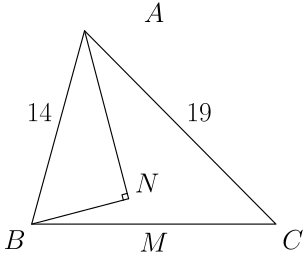
In is the midpoint of side bisects and is the measure of If sides and have lengths and respectively, then length equals
Pista pequeña:
Prolonga a través de hasta que corte
Extend through to meet
Pista grande:
Usa la congruencia a ambos lados de la bisectriz y luego aplica el teorema del segmento medio
Use congruence across the angle bisector, then apply the midpoint theorem
Solución:
Prolonga hasta que corte en Los triángulos rectángulos y son congruentes porque comparten y esta recta biseca el ángulo en Por consiguiente, queda bisecado por y Como se tiene En el triángulo los puntos y son los puntos medios de y por lo que
Por lo tanto, la respuesta correcta es B.
Extend to meet at The right triangles and are congruent because is common and bisects the angle at Hence is bisected by and Since In triangle points and are the midpoints of and so
Therefore, the correct answer is B.
20.
Un rayo de luz parte del punto y viaja en un plano, reflejándose veces entre las rectas y antes de incidir perpendicularmente en un punto (que puede estar en o ) y volver sobre su trayectoria hasta (En cada punto de reflexión, el rayo forma dos ángulos iguales, como se indica en la figura adjunta. La figura muestra la trayectoria para ) Si ¿cuál es el mayor valor que puede tener ?
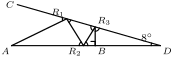
A ray of light originates from point and travels in a plane, being reflected times between lines and before striking a point (which may be on or ) perpendicularly and retracing its path to (At each point of reflection the light makes two equal angles as indicated in the adjoining figure. The figure shows the light path for ) If what is the largest value can have?
No existe un valor máximo.
There is no largest value.
Pista pequeña:
Sigue el ángulo agudo entre el rayo y cada recta reflectora sucesiva
Track the acute angle between the ray and each successive reflecting line
Pista grande:
Cada reflexión aumenta ese ángulo en el ángulo de la cuña,
Each reflection advances that angle by the wedge angle
Solución:
Sea el ángulo agudo inicial entre el rayo y Las relaciones sucesivas entre ángulos exteriores aumentan el ángulo agudo correspondiente en con cada reflexión. En la incidencia perpendicular final, Así, por lo que El mayor entero posible es alcanzado cuando
Por lo tanto, la respuesta correcta es B.
Let be the initial acute angle between the ray and Successive exterior-angle relations increase the corresponding acute angle by at each reflection. At the final perpendicular strike, Thus so The greatest integer possible is attained when
Therefore, the correct answer is B.
21.
En un triángulo cuyos lados tienen longitudes y La medida del ángulo opuesto al lado de longitud es
In a triangle with sides of lengths and The measure of the angle opposite the side of length is
Pista pequeña:
Desarrolla el lado izquierdo como una diferencia de cuadrados
Expand the left side as a difference of squares
Pista grande:
Compara la expresión resultante para con la ley de los cosenos
Compare the resulting expression for with the law of cosines
Solución:
La condición da por lo que Si es el ángulo opuesto a la ley de los cosenos dice que Por tanto, así que y
Por lo tanto, la respuesta correcta es D.
The condition gives so If is opposite the law of cosines says Therefore so and
Therefore, the correct answer is D.
22.
¿Cuántas rectas de un sistema tridimensional de coordenadas rectangulares pasan por cuatro puntos distintos de la forma donde y son enteros positivos no mayores que cuatro?
How many lines in a three-dimensional rectangular coordinate system pass through four distinct points of the form where and are positive integers not exceeding four?
Pista pequeña:
Cuatro puntos reticulares colineales en esta cuadrícula de por por deben avanzar con pasos de coordenadas o
Four collinear lattice points in this -by--by- grid must advance by coordinate steps or
Pista grande:
Cuenta por separado las rectas paralelas a los ejes, las diagonales de las caras y las diagonales espaciales
Count axis-parallel lines, face-diagonal lines, and space diagonals separately
Solución:
Hay rectas paralelas a los ejes. Para las direcciones diagonales de las caras, se elige el par de coordenadas variables de maneras, una de las pendientes diagonales y se fija la coordenada restante de maneras, lo que da Por último, el cubo tiene diagonales espaciales. Por tanto, el total es
Por lo tanto, la respuesta correcta es D.
There are axis-parallel lines. For face-diagonal directions, choose the pair of varying coordinates in ways, choose one of diagonal slopes, and fix the remaining coordinate in ways, giving Finally, the cube has space diagonals. Thus the total is
Therefore, the correct answer is D.
23.
El triángulo equilátero está inscrito en un círculo. Un segundo círculo es tangente interiormente al circuncírculo en y tangente a los lados y en los puntos y Si el lado tiene longitud entonces el segmento tiene longitud
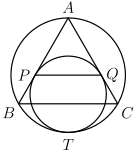
Equilateral is inscribed in a circle. A second circle is tangent internally to the circumcircle at and tangent to sides and at points and If side has length then segment has length
Pista pequeña:
Usa la simetría para situar los centros de ambos círculos y en la altura trazada desde
Use symmetry to place both circle centers and on the altitude from
Pista grande:
Relaciona el radio del círculo menor con el circunradio mediante el semiángulo de en
Relate the smaller circle’s radius to the circumradius using the half-angle at
Solución:
El circunradio del triángulo equilátero es Si el radio menor es su centro se encuentra en la altura y está a de porque su distancia a cualquiera de los lados es y el semiángulo es La tangencia interior en la parte inferior da así que Los puntos de tangencia en los dos lados están separados por
Por lo tanto, la respuesta correcta es C.
The circumradius of the equilateral triangle is If the smaller radius is its center lies on the altitude and is from because its distance to either side is and the half-angle is Internal tangency at the bottom gives so The tangency points on the two sides are separated by
Therefore, the correct answer is C.
24.
Si es una constante tal que y entonces, para cada entero positivo es igual a
If is a constant such that and then for each positive integer equals
Pista pequeña:
Reescribe la condición como una ecuación cuadrática en
Rewrite the condition as a quadratic equation in
Pista grande:
Sus dos raíces son
Its two roots are
Solución:
La ecuación es cuyas raíces son y Así, y Por el teorema de De Moivre,
Por lo tanto, la respuesta correcta es D.
The equation is whose roots are and Thus and By De Moivre’s theorem,
Therefore, the correct answer is D.
25.
En el triángulo de la figura adjunta, y trisecan Las longitudes de y son y respectivamente. La longitud del lado más corto de es
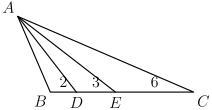
In triangle in the adjoining figure, and trisect The lengths of and are and respectively. The length of the shortest side of is
no está determinada de manera única por la información dada
not uniquely determined by the given information
Pista pequeña:
Sean los tres ángulos iguales a , y aplica el teorema de la bisectriz a un subtriángulo adecuado
Let the three equal angles be , and apply the angle-bisector theorem to a suitable subtriangle
Pista grande:
Iguala las expresiones de la ley de los cosenos para en los tres triángulos adyacentes
Equate law-of-cosines expressions for in the three adjacent triangles
Solución:
Sean y Como biseca y biseca el teorema de la bisectriz da así que y Al aplicar la ley de los cosenos a los triángulos y e igualar sus valores comunes de , se obtiene Por consiguiente, y Los lados son y de modo que el más corto es
Por lo tanto, la respuesta correcta es A.
Let and Since bisects and bisects the angle-bisector theorem gives so and Applying the law of cosines to triangles and and equating their common values gives Hence and The sides are and so the shortest is
Therefore, the correct answer is A.
26.
Alice, Bob y Carol se turnan repetidamente para lanzar un dado. Alice empieza; Bob siempre sigue a Alice; Carol siempre sigue a Bob; y Alice siempre sigue a Carol. Halla la probabilidad de que Carol sea la primera en sacar un seis. (La probabilidad de obtener un seis en cualquier lanzamiento es independientemente del resultado de cualquier otro lanzamiento.)
Alice, Bob, and Carol repeatedly take turns tossing a die. Alice begins; Bob always follows Alice; Carol always follows Bob; and Alice always follows Carol. Find the probability that Carol will be the first one to toss a six. (The probability of obtaining a six on any toss is independent of the outcome of any other toss.)
Pista pequeña:
Para que Carol gane en una ronda, Alice y Bob deben fallar antes de que Carol tenga éxito
For Carol to win in a given round, Alice and Bob must fail before Carol succeeds
Pista grande:
Si los tres fallan, el proceso vuelve a empezar con las mismas probabilidades
If all three fail, the process restarts with the same probabilities
Solución:
Carol gana en la primera ronda con probabilidad Una ronda completa sin ningún seis tiene probabilidad Por lo tanto, la serie geométrica buscada es
Por lo tanto, la respuesta correcta es D.
Carol wins in the first round with probability A complete round with no six has probability Therefore the desired geometric series is
Therefore, the correct answer is D.
27.
En la figura adjunta, el triángulo está inscrito en un círculo. El punto está en , con y el punto está en , con Los lados y tienen cada uno la misma longitud que la cuerda y La cuerda corta los lados y en y respectivamente. La razón entre el área de y el área de es
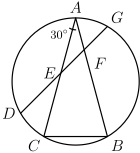
In the adjoining figure triangle is inscribed in a circle. Point lies on with and point lies on with Side and side each have length equal to the length of chord and Chord intersects sides and at and respectively. The ratio of the area of to the area of is
Pista pequeña:
Usa las cuerdas iguales para identificar los arcos iguales pertinentes y los triángulos isósceles
Use equal chords to identify the relevant equal arcs and isosceles triangles
Pista grande:
Normaliza y halla mediante un triángulo --
Normalize and find from a -- triangle
Solución:
Ajusta la escala para que Las relaciones entre arcos correspondientes a cuerdas iguales muestran que el triángulo es un triángulo -- y que Sea Entonces por lo que Las cuerdas iguales también dan Por tanto,
Por lo tanto, la respuesta correcta es C.
Scale so The equal-chord arc relations show that triangle is -- and Put Then so Equal chords also give Hence
Therefore, the correct answer is C.
28.
Considera el conjunto de todas las ecuaciones donde son constantes reales y para Sea el mayor número real positivo que satisface al menos una de estas ecuaciones. Entonces
Consider the set of all equations where are real constants and for Let be the largest positive real number which satisfies at least one of these equations. Then
Pista pequeña:
Para positivo, los coeficientes que empujan una raíz más hacia la derecha toman sus cotas inferiores
For positive the coefficients that push a root farthest right take their lower bounds
Pista grande:
Acota la raíz mayor de entre dos extremos consecutivos de las opciones
Bracket the largest root of at two consecutive choice endpoints
Solución:
Denota por un polinomio permitido. Para donde Así, ninguna raíz positiva puede superar la raíz mayor de Al tomar se obtiene por lo que sí se alcanza. Como tenemos
Por lo tanto, la respuesta correcta es D.
Write an allowed polynomial as For where Thus no positive root can exceed the largest root of Taking gives so itself is attained. Since we have
Therefore, the correct answer is D.
29.
Si entonces la suma de las soluciones reales de es igual a
If then the sum of the real solutions of is equal to
Pista pequeña:
La raíz cuadrada principal obliga a que
The principal square root forces
Pista grande:
Después de elevar una vez al cuadrado, factoriza una diferencia que contiene
After one squaring, factor a difference involving
Solución:
Como al elevar una vez al cuadrado obtenemos Sea Entonces y por lo que Como tenemos es decir, Por tanto, y La única raíz no negativa es y satisface la ecuación original. Por lo tanto, también es la suma de todas las soluciones reales.
Por lo tanto, la respuesta correcta es E.
Since squaring once gives Let Then and so Since we have or Therefore and The only nonnegative root is and it satisfies the original equation. It is therefore also the sum of all real solutions.
Therefore, the correct answer is E.
30.
Si son las soluciones de la ecuación entonces una ecuación cuyas soluciones son es
If are the solutions of the equation then an equation whose solutions are is
ninguna de estas
none of these
Pista pequeña:
Usa la ausencia del término cúbico para hallar
Use the missing cubic term to find
Pista grande:
Cada expresión de la lista se convierte en el recíproco negativo de una raíz original
Each listed expression becomes the negative reciprocal of one original root
Solución:
Las fórmulas de Vieta dan Así, por ejemplo, y de manera análoga las raíces nuevas son Sustituye en Al multiplicar por , obtenemos o bien
Por lo tanto, la respuesta correcta es D.
Vieta’s formulas give Thus, for example, and similarly the new roots are Put in Multiplying by gives or
Therefore, the correct answer is D.