
Soluciones del 2026 AMC 10B
Desplázate hacia abajo para ver las soluciones preparadas profesionalmente de LIVE by Po-Shen Loh, imprime las soluciones en PDF, consulta la clave de respuestas, o haz el examen cronometrado completo.
Todos los problemas se usan con el permiso legal oficial de la Mathematical Association of America (MAA).
1.
¿Cuál es el valor de
What is the value of
Pista pequeña:
Saca el factor común del numerador y del denominador
Factor out from the numerator and denominator
Pista grande:
Solución:
Cancelamos el factor común y obtenemos
Por lo tanto, la respuesta correcta es D.
Cancel the common factor to obtain
Thus, the correct answer is D.
2.
Una tienda de recuerdos vende esculturas de metal macizo de Aquiles en dos tamaños. Una mide cm de altura y la otra cm. Las dos esculturas tienen las mismas proporciones. La más pequeña tiene una masa de gramos. ¿Cuál es la masa, en gramos, de la más grande?
A souvenir shop sells solid metal sculptures of Achilles in two sizes. One is cm tall and one is cm tall. Proportions between the two sculptures are preserved. The smaller sculpture has a mass of grams. What is the mass, in grams, of the larger sculpture?
Pista pequeña:
La masa es proporcional al volumen
Mass scales with volume
Pista grande:
El factor de escala de las longitudes es
The length scale factor is
Solución:
El volumen, y por tanto la masa, se multiplica por el cubo de la razón entre las longitudes. La masa mayor es
Por lo tanto, la respuesta correcta es D.
The volume, and hence mass, scales by the cube of the length ratio. The larger mass is
Thus, the correct answer is D.
3.
Hay abejas en los vértices de una caja rectangular de dimensiones Las abejas pueden volar dentro de la caja, pero ninguna puede alejarse más de unidad de su vértice. ¿Cuál es el volumen, en unidades cúbicas, de la región interior que ninguna abeja puede alcanzar?
Bees occupy the corners of a rectangular box. The bees can fly inside the box, but cannot fly farther than unit from their respective corners. What is the volume, in cubic units, of the region inside the box that cannot be reached by any bee?
Pista pequeña:
Cada abeja alcanza un octavo de una esfera
Each bee reaches one eighth of a sphere
Pista grande:
Las ocho regiones accesibles no comparten ningún volumen
The eight reachable regions have no overlapping volume
Solución:
Los ocho octavos de esfera tienen, en conjunto, el volumen de una esfera de radio Al restarlo del volumen de la caja obtenemos
Por lo tanto, la respuesta correcta es C.
The eight spherical eighths together have the volume of one sphere of radius Subtracting from the box gives
Thus, the correct answer is C.
4.
¿Qué número real positivo satisface la ecuación
What positive real number satisfies the equation
Pista pequeña:
Agrupa en un mismo lado las dos fracciones cuyo numerador es
Group the two fractions with numerator on one side
Pista grande:
Solución:
Al reagrupar y sumar las fracciones obtenemos Como cancelamos y multiplicamos en cruz: Así, La raíz positiva es que pertenece al dominio de la ecuación original.
Por lo tanto, la respuesta correcta es D.
Rearranging and combining gives Since cancel and cross-multiply: Thus The positive root is which is in the domain of the original equation.
Thus, the correct answer is D.
5.
En una circunferencia hay puntos igualmente espaciados. Se unen dos puntos con un segmento si hay exactamente otro punto entre ellos a lo largo de uno de los dos arcos. ¿En cuántas regiones queda dividido el interior del círculo? La figura muestra un ejemplo con puntos igualmente espaciados, que da regiones interiores.
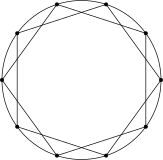
There are equally spaced points that all lie on a circle. A line segment is drawn between two points if there is exactly one point between them along the circle. Into how many regions will this divide the interior of the circle? The figure below shows an example with equally spaced points, in which case there are interior regions.
Pista pequeña:
Cuenta por separado la región central, los triángulos pequeños y las regiones junto a la circunferencia
Count the central region, the small triangles, and the regions along the circle separately
Pista grande:
Relaciona cada triángulo con un punto marcado y cada región exterior con el arco entre dos puntos consecutivos
Match the small triangles to marked points and the outer regions to arcs between consecutive points
Solución:
Hay región central. Cada punto marcado es la punta de un pequeño triángulo, por lo que hay regiones triangulares. Cada arco entre puntos marcados consecutivos bordea una región exterior, lo que da otras El total es
Otra forma es usar la fórmula de Euler para un grafo plano conexo: donde cuenta los vértices, las aristas y las caras, incluida la región exterior al círculo.
Cada uno de los segmentos corta exactamente a otros dos. Cada cruce se cuenta desde ambos segmentos, así que hay vértices interiores. Sumamos los puntos marcados para obtener Cada segmento queda dividido en tres aristas y la circunferencia aporta arcos. Por tanto,
La fórmula de Euler da Restamos la cara exterior y obtenemos regiones dentro del círculo.
Por lo tanto, la respuesta correcta es B.
There is central region. Each marked point is the tip of one small triangle, giving triangular regions. Each arc between consecutive marked points borders one outer region, giving another The total is
Alternatively, use Euler’s formula for a connected planar graph: where counts vertices, counts edges, and counts faces, including the region outside the circle.
Each of the segments crosses exactly two others. Each crossing is counted from both segments, so there are interior vertices. Add the marked points to get Each segment is cut into three edges, and the circle contributes arcs. Thus
Euler’s formula gives Subtract the outside face to get regions inside the circle.
Thus, the correct answer is B.
6.
¿Para cuántos enteros es también un entero?
For how many integers is also an integer?
infinitos
infinitely many
Pista pequeña:
Divide entre con resto
Divide by with remainder
Pista grande:
Solución:
La expresión es igual a Es un entero exactamente cuando es uno de los números y Estos dan cuatro valores distintos de ninguno igual a
Por lo tanto, la respuesta correcta es C.
The expression equals It is an integer exactly when is one of and These give four distinct integers none equal to
Thus, the correct answer is C.
7.
Una circunferencia en el plano de coordenadas pasa por y Su ecuación puede escribirse como para ciertas constantes y ¿Cuánto vale ?
A circle in the coordinate plane passes through and The equation of the circle can be written in the form for some constants and What is
Pista pequeña:
El origen da
The origin gives
Pista grande:
Sustituye y para hallar y
Substitute and to find and
Solución:
Al sustituir obtenemos Por tanto, y
Por lo tanto, la respuesta correcta es A.
Substitution gives Therefore and
Thus, the correct answer is A.
8.
Considera la sucesión infinita de conjuntos
El conjunto de índice tiene un elemento más que el anterior, y sus elementos forman una progresión aritmética que empieza en y tiene diferencia común Sea el número de estos conjuntos que contienen el número ¿Cuál es la suma de las cifras de ?
Consider the infinite sequence of sets
Here the th set contains one more element than the previous set, and its members are the terms of an arithmetic sequence beginning with and having common difference Let be the number of these sets that contain the number What is the sum of the digits of
Pista pequeña:
El último número del conjunto de índice es
The last number in the th set is
Pista grande:
El conjunto contiene exactamente cuando es par y
The set contains exactly when is even and
Solución:
El conjunto de índice va de a en pasos de Por tanto, contiene exactamente cuando es par y Los índices posibles son los enteros pares desde hasta Su cantidad es La suma de sus cifras es
Por lo tanto, la respuesta correcta es D.
The th set runs from to in steps of Thus it contains exactly when is even and The eligible indices are the even integers from through There are Its digit sum is
Thus, the correct answer is D.
9.
Una biblioteca dispone de escritorios en una fila de izquierda a derecha para estudiar en silencio. Los estudiantes llegan de uno en uno y se sientan. Siempre que puede, cada estudiante evita sentarse junto a otro. Si eso no es posible, prefiere sentarse junto a un solo estudiante en lugar de dos. ¿Cuántas configuraciones de asientos ocupados son posibles para entre uno y cinco estudiantes?
A library offers desks arranged in a row from left to right for quiet studying. Students arrive one at a time and sit down at a desk. If possible, each student avoids sitting next to another student. Otherwise they will, if possible, sit next to one student rather than two. How many possible seating configurations (which seats are occupied) for one to five students are there?
Pista pequeña:
Cuenta por separado las configuraciones posibles para cada número de estudiantes
Count the reachable configurations separately for each number of students
Pista grande:
Los dos primeros escritorios ocupados no pueden ser contiguos
The first two occupied desks cannot be adjacent
Solución:
Numeramos los escritorios de izquierda a derecha. Hay configuraciones con un estudiante y pares de asientos no contiguos. Para tres estudiantes, escribimos juntos los números de los escritorios ocupados. Las configuraciones posibles son
Se obtienen probando cada par de asientos no contiguos y eligiendo un escritorio vacío con el menor número de vecinos ocupados. A partir de esas ternas, las únicas configuraciones con cuatro estudiantes son y Los cinco escritorios ocupados dan una configuración más. El total es
Por lo tanto, la respuesta correcta es D.
Number the desks from left to right. There are one-student configurations and nonadjacent pairs. For three students, write the occupied desk numbers together. The reachable configurations are
These follow by trying each nonadjacent pair and selecting a vacant desk with the fewest occupied neighbors. From these triples, the only four-student configurations are and All five desks give one more configuration. The total is
Thus, the correct answer is D.
10.
¿Cuál es el área de la región delimitada por las gráficas de y ?
What is the area of the region bounded by the graphs of and
Pista pequeña:
La segunda desigualdad equivale a
The second inequality is
Pista grande:
Las rectas de la frontera son y
The boundary lines are and
Solución:
Las desigualdades son y Su intersección es un rectángulo.
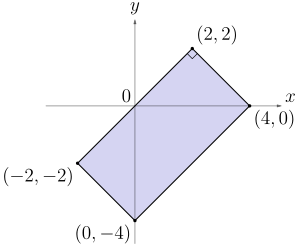
Por el teorema de Pitágoras, las longitudes de sus lados son y Por tanto, el área es
Por lo tanto, la respuesta correcta es E.
The inequalities are and Their intersection is a rectangle.
By the Pythagorean Theorem, the side lengths are and Thus the area is
Thus, the correct answer is E.
11.
En el punto está a del recorrido de a el punto está a del recorrido de a y el punto está a del recorrido de a ¿Cuál es la razón entre el área de y el área de ?
Expresa tu respuesta como una fracción común.
In point is of the way from to point is of the way from to and point is of the way from to What is the ratio of the area of to the area of
Express your answer as a common fraction.
Pista pequeña:
Resta de los tres triángulos de las esquinas
Subtract the three corner triangles from
Pista grande:
El área de dividida entre el área de es
The area of divided by the area of is
Solución:
El triángulo sombreado es
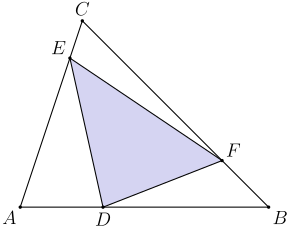
Las fracciones del área ocupadas por los triángulos de las esquinas y son, respectivamente, y La fracción restante es
Por lo tanto, la respuesta correcta es B.
The shaded triangle is
The area fractions of the corner triangles at and are respectively and The remaining fraction is
Thus, the correct answer is B.
12.
Sharon lanza una moneda equilibrada seis veces y lleva la cuenta de las caras y las cruces. El primer lanzamiento es cara. ¿Cuál es la probabilidad de que, después de cada lanzamiento, el número de caras sea distinto del número de cruces?
Expresa tu respuesta como una fracción común.
Sharon tosses a fair coin six times and keeps track of how many heads and tails she has gotten. Her first toss is heads. What is the probability that after every toss Sharon’s count of heads differs from her count of tails?
Express your answer as a common fraction.
Pista pequeña:
El segundo lanzamiento también debe ser cara
The second toss must also be heads
Pista grande:
Cuenta secuencias que empiezan con cara y nunca empatan. Para una ventaja suma los recuentos previos de y Divide el total final entre
Count sequences that start with heads and never tie. At lead add the previous counts for and Divide the last row’s total by
Solución:
Después de la primera cara, las caras deben seguir superando a las cruces: para pasar a tener menos caras, primero tendría que haber un empate.
En el diagrama, es el número de lanzamientos y es el número de caras menos el de cruces. Cada número rodeado cuenta las secuencias que han evitado un empate. Empezamos con después de la primera cara dada. Una cara mueve una columna a la derecha y una cruz una columna a la izquierda. Tachamos todo recorrido que llegue a
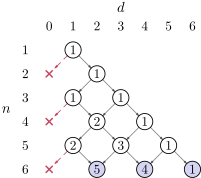
Para llenar un círculo, sumamos los números de donde salen las flechas que llegan a él. Por ejemplo, el de la fila es y el de la fila es
La última fila tiene secuencias válidas. El primer lanzamiento está fijado, así que los cinco restantes tienen resultados igualmente probables. Por tanto,
Por lo tanto, la respuesta correcta es D.
After the first head, heads must stay ahead of tails: a negative lead would require passing through a tie.
In the diagram, is the number of tosses and is heads minus tails. A circled number counts sequences that have avoided a tie. Start with after the given first head. A head moves one column right and a tail one column left. Cross out every route that reaches
To fill a circle, add the numbers at the starts of its incoming arrows. For example, the in row is and the in row is
The last row has successful sequences. The first toss is fixed, so the remaining five tosses have equally likely outcomes. Hence
Thus, the correct answer is D.
13.
Se eligen dos puntos y de forma independiente y uniforme al azar en la circunferencia del plano de coordenadas. ¿Cuál es la probabilidad de que ningún punto de esté a menos de unidad del origen?
Expresa tu respuesta como una fracción común.
Two points and are chosen independently and uniformly at random on the circle in the coordinate plane. What is the probability that no point on lies less than unit from the origin?
Express your answer as a common fraction.
Pista pequeña:
El punto de la cuerda más cercano al origen es su punto medio
The closest point on the chord to the origin is its midpoint
Pista grande:
Una cuerda tangente a la circunferencia unidad abarca un ángulo de en el origen
A chord tangent to the unit circle subtends at the origin
Solución:
Fijamos y llamamos al origen. En la posición límite, es tangente a la circunferencia unidad en de modo que y
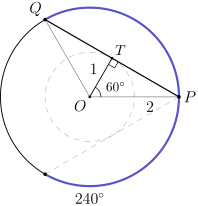
El triángulo rectángulo tiene hipotenusa y cateto adyacente así que La perpendicular desde el centro biseca la cuerda y su ángulo central, lo que da
Las posiciones permitidas de están a no más de de en cada sentido. Este es el arco resaltado de así que la probabilidad es
Por lo tanto, la respuesta correcta es E.
Fix and let be the origin. At the limiting position, is tangent to the unit circle at so and
The right triangle has hypotenuse and adjacent leg so The perpendicular from the center bisects the chord and its central angle, giving
The allowable positions of lie within of in either direction. This is the highlighted arc of so the probability is
Thus, the correct answer is E.
14.
Los números reales y satisfacen las ecuaciones y ¿Cuánto vale ?
Real numbers and satisfy the equations and What is
Pista pequeña:
Escribe como
Write as
Pista grande:
Solución:
Sean y Entonces y Por tanto,
Por lo tanto, la respuesta correcta es E.
Let and Then and Therefore
Thus, the correct answer is E.
15.
Se eligen los números reales y de forma independiente y uniforme al azar, con y ¿Cuál es la probabilidad de que la ecuación tenga una solución real?
Expresa tu respuesta como una fracción común.
Real numbers and are chosen independently and uniformly at random, with and What is the probability that the equation has a real solution?
Express your answer as a common fraction.
Pista pequeña:
Existe una solución real exactamente cuando
A real solution exists exactly when
Pista grande:
Los pares posibles llenan un rectángulo de por Excluye el triángulo
The possible pairs fill a -by- rectangle. Exclude the triangle
Solución:
Existe una raíz real exactamente cuando el discriminante es no negativo. Como y son no negativos, esto equivale a
Colocamos en el eje horizontal y en el vertical. Los pares posibles llenan un rectángulo de ancho y altura La región sombreada satisface
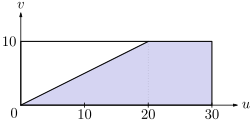
El triángulo sin sombrear tiene catetos y Restamos su área de la del rectángulo para obtener la probabilidad
Por lo tanto, la respuesta correcta es D.
A real root exists exactly when the discriminant is nonnegative. Since and are nonnegative, this is equivalent to
Put on the horizontal axis and on the vertical axis. The possible pairs fill a rectangle of width and height The shaded region satisfies
The unshaded triangle has legs and Subtract its area from the rectangle to get the probability
Thus, the correct answer is D.
16.
Cada uno de los cuadrados de una cuadrícula de se pinta completamente de rojo, blanco o azul. ¿De cuántas maneras puede hacerse sin que un cuadrado rojo comparta un lado con un cuadrado azul?
The squares in a grid of squares are each colored either solid red, white, or blue. In how many ways can this be done so that no square colored red shares a side with a square colored blue?
Pista pequeña:
Cuenta según el número de cuadrados blancos
Count by the number of white squares
Pista grande:
Con dos cuadrados blancos, distingue las posiciones contiguas de las opuestas
With two white squares, distinguish adjacent and opposite positions
Solución:
Sin cuadrados blancos, los cuatro cuadrados están conectados por lados compartidos, así que deben ser todos rojos o todos azules: formas.
Con un cuadrado blanco, elegimos su posición de formas. Los otros tres forman una cadena conectada, así que deben compartir uno de colores, rojo o azul. Esto da formas.
Con dos cuadrados blancos adyacentes, la pareja blanca puede ocupar cualquiera de las filas o columnas: opciones. Los otros dos cuadrados comparten un lado, así que deben ser ambos rojos o ambos azules: opciones. Esto da formas.
Con dos cuadrados blancos opuestos, elegimos una de las diagonales para la pareja blanca. Los otros dos cuadrados no comparten ningún lado, así que cada uno tiene opciones de color independientes. Esto da formas.
Con tres cuadrados blancos, elegimos el cuadrado no blanco de formas y su color de formas, lo que da formas. Pintarlos todos de blanco da una forma.
El total es
Por lo tanto, la respuesta correcta es E.
With no white squares, all four squares are connected by shared sides, so they must all be red or all blue: ways.
With one white square, choose its position in ways. The other three squares form a connected chain, so they must share one of colors, red or blue. This gives ways.
With two adjacent white squares, the white pair can be either row or either column: choices. The remaining two squares share a side, so both must be red or both blue: choices. This gives ways.
With two opposite white squares, choose one of the diagonals for the white pair. The other two squares do not share a side, so each has independent color choices. This gives ways.
With three white squares, choose the nonwhite square in ways and its color in ways, giving ways. All white gives one way.
The total is
Thus, the correct answer is E.
17.
Una lista contiene afirmaciones, cada una verdadera o falsa. La primera dice: «El número de afirmaciones falsas de esta lista es al menos » La segunda dice: «El número de afirmaciones falsas de esta lista es al menos » En general, la afirmación de índice dice: «El número de afirmaciones falsas de esta lista es al menos » ¿Cuántas afirmaciones de la lista son verdaderas?
A list contains statements, each of which is either true or false. The first statement is “The number of false statements in this list is at least ” The second statement is “The number of false statements in this list is at least ” In general, the th statement in the list is “The number of false statements in this list is at least ” How many statements in the list are true?
Pista pequeña:
Todas las afirmaciones verdaderas preceden a las falsas
All true statements come before all false statements
Pista grande:
Si hay afirmaciones falsas, las verdaderas tienen índices
If statements are false, the true ones have indices
Solución:
Sea el número de afirmaciones falsas. Si todas las afirmaciones serían falsas, lo que contradice esa cota. Así, y hay exactamente afirmaciones verdaderas. Por tanto, de donde y el número de afirmaciones verdaderas es
Por lo tanto, la respuesta correcta es B.
Let be the number of false statements. If all statements would be false, contradicting that bound. Thus and there are exactly true statements. Consequently so and the number of true statements is
Thus, the correct answer is B.
18.
¿Cuál es el menor entero positivo para el que no es múltiplo de ?
What is the least positive integer such that is not a multiple of
Pista pequeña:
Pista grande:
Cuenta los factores y en
Count factors of and in
Solución:
Cada múltiplo de aporta un factor Cada múltiplo de aporta otro, cada múltiplo de otro, y cada múltiplo de otro. Hay y múltiplos de cada tipo, respectivamente.
El exponente de en es Al contar de la misma forma los factores obtenemos Como divide al factorial exactamente cuando se cumplen y El mayor valor de que las cumple es así que el primero que no las cumple es
Por lo tanto, la respuesta correcta es C.
Every multiple of contributes a factor of Each multiple of contributes another, each multiple of another, and each multiple of another. There are and such multiples, respectively.
The exponent of in is Counting factors of in the same way gives Since divides the factorial exactly when both and The largest such is so the first failure is
Thus, the correct answer is C.
19.
Un frasco contiene canicas verdes y rojas. Anika y Ben se turnan para sacar una canica al azar y devolverla al frasco. Ben gana en cuanto saca una roja y Anika gana en cuanto saca una verde. Si nadie gana, el juego continúa con el turno del otro jugador. La probabilidad de que Ben acabe ganando es si Anika empieza y si Ben empieza. ¿Cuánto vale ?
Expresa tu respuesta como una fracción común.
A jar contains green marbles and red marbles. In a game, Anika and Ben take turns drawing a random marble from the jar, with replacement. If Ben ever draws a red marble, he wins, and if Anika ever draws a green marble, she wins. Otherwise, the game continues with the next player’s turn. The probability that Ben eventually wins is if Anika goes first and if Ben goes first. What is
Express your answer as a common fraction.
Pista pequeña:
Pista grande:
Solución:
Cuando Anika empieza, debe sacar primero una roja para que Ben pueda ganar, así que Cuando Ben empieza, gana de inmediato o saca una verde, lo que da Por tanto, y
Por lo tanto, la respuesta correcta es D.
Anika must first draw red for Ben to win when she starts, so When Ben starts, he either wins immediately or draws green, giving Hence and
Thus, the correct answer is D.
20.
Annie, Bobby y Casey reciben cada uno un entero de a Los números no tienen por qué ser distintos. ¿De cuántas maneras pueden repartirse los números para que su suma sea divisible por ?
Annie, Bobby, and Casey each receive an integer, not necessarily distinct, from through In how many ways can the numbers be given so that their sum is divisible by
Pista pequeña:
Al dividir y entre quedan restos y
Dividing and by leaves remainders and
Pista grande:
Entre y hay exactamente un número que completa una suma dada hasta un múltiplo de
Among through exactly one number completes any given sum to a multiple of
Solución:
Un residuo módulo es el resto al dividir entre Los números del al dan cada resto una vez, por lo que siempre hay uno que completa la suma de otros dos números hasta un múltiplo de
Contamos según cuántas personas reciben un número entre y Si ninguna lo recibe, los dos primeros números tienen elecciones y el tercero tiene un único residuo adecuado: maneras. Si exactamente una lo recibe, elegimos esa persona y su número, y después otro de los números; el último queda determinado: maneras.
Si exactamente dos lo reciben, elegimos de maneras a la persona que recibe un número del al Cada una de las otras dos tiene opciones, con residuos en El número restante queda determinado: maneras. Si los tres lo reciben, la suma de residuos debe ser lo que da las permutaciones de y o maneras. El total es
Por lo tanto, la respuesta correcta es E.
Here a residue modulo means the remainder after division by The numbers through give every remainder once, so one of them always completes any two chosen numbers to a multiple of
Count by how many people receive a number in through If none do, the first two numbers have choices, and the third has exactly one suitable residue: ways. If exactly one does, choose that person and their number, then one of the other numbers; the last is determined: ways.
If exactly two do, choose the person who receives a number from through in ways. Each of the other two people has choices, with residues in The remaining number is determined: ways. If all three do, their residue sum must be giving permutations of and or ways. The total is
Thus, the correct answer is E.
21.
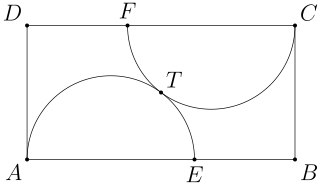
El rectángulo tiene y En su interior hay dos semicírculos congruentes: el primero tiene diámetro con sobre y el segundo tiene diámetro con sobre Los dos semicírculos son tangentes en como muestra la figura.
¿Cuál es el radio de los semicírculos?
Expresa tu respuesta como una fracción común.
Rectangle has and Inside the rectangle are two congruent semicircles, the first with diameter where lies on and the second with diameter where lies on The two semicircles are tangent at See the figure.
What is the radius of the semicircles?
Express your answer as a common fraction.
Pista pequeña:
Sea el radio; une los centros de los semicírculos
Let be the radius and join the semicircle centers
Pista grande:
La separación horizontal entre los centros es y la vertical es
The center separation has horizontal component and vertical component
Solución:
Sea el radio común. Como son tangentes, la distancia entre sus centros es La separación horizontal es y la vertical es Por tanto, Al cancelar queda así que
Por lo tanto, la respuesta correcta es C.
Let be the common radius. Tangency makes the distance between centers Their horizontal separation is and their vertical separation is Thus Cancelling gives so
Thus, the correct answer is C.
22.
Belinda sigue un camino en el plano contenido por completo en la región cuadrada y Diremos que su camino es digno si y solo si cumple todas las condiciones siguientes.
• Cada paso avanza una unidad hacia arriba, hacia abajo o hacia la derecha.
• El camino no vuelve a visitar ningún vértice.
• El camino empieza en y termina en donde y son enteros con y solo toca el eje en esos dos puntos.
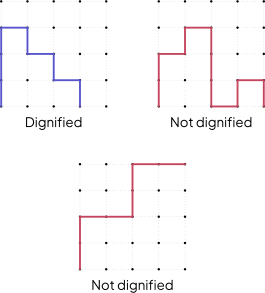
En la figura, el camino de arriba a la izquierda es digno y los otros dos no lo son.
¿Cuántos caminos dignos puede seguir Belinda?
Belinda follows a path on the plane that is entirely contained within the square region and Call her path dignified if and only if all of the following conditions are satisfied.
• Each step is one unit up, down, or to the right.
• The path does not revisit any vertex.
• The path starts at and ends at where and are integers with and touches the -axis only at these two points.
The following figure shows some examples of dignified and not dignified paths.
How many dignified paths can Belinda follow?
Pista pequeña:
Cuenta según la distancia horizontal
Count by the horizontal distance
Pista grande:
Elige la altura de cada paso hacia la derecha; eso determina las partes verticales
Choose the height of each rightward step; the vertical parts are then forced
Solución:
Fijamos el número de pasos hacia la derecha. Cada uno debe estar a altura o porque el camino permanece dentro del cuadrado y solo toca el eje en sus extremos.
Por ejemplo, tomemos dos pasos hacia la derecha a alturas y empezando en El camino debe subir hasta la altura avanzar a la derecha, subir hasta la altura avanzar a la derecha y bajar hasta el eje.
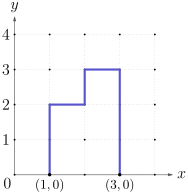
Una vez elegidos el inicio y las alturas, los tramos verticales quedan determinados. Entre pasos hacia la derecha, subimos o bajamos directamente hasta la siguiente altura. Invertir la dirección haría que repitiéramos un vértice. Cada elección de alturas da un camino válido: las alturas siguen siendo positivas y, después de avanzar a la derecha, el camino nunca regresa a una columna anterior.
Con dos pasos hacia la derecha, la coordenada inicial puede ser o hay posiciones iniciales. Cada paso tiene opciones de altura independientes, así que este caso aporta caminos.
En general, sea el número de pasos hacia la derecha. Puede ser o La coordenada inicial puede ser cualquier entero desde hasta lo que da posiciones. Hay opciones para las alturas.
El número total de caminos es
Por lo tanto, la respuesta correcta es C.
Fix the number of rightward steps. Each must be at height or because the path stays in the square and touches the -axis only at its endpoints.
For example, take two rightward steps at heights and starting at The path must go up to height right, up to height right, then down to the axis.
Once the start and heights are chosen, the vertical parts are forced. Between rightward steps, go straight up or down to the next height. Reversing direction would revisit a vertex. Every choice of heights gives a valid path: the heights stay positive, and after moving right the path never returns to an earlier column.
With two rightward steps, the starting -coordinate can be or there are starting positions. Each step independently has height choices, so this case contributes paths.
In general, let be the number of rightward steps. It can be or The starting -coordinate can be any integer from through giving positions. There are choices for the heights.
The total number of paths is
Thus, the correct answer is C.
23.
Los ocho vértices de un cubo se pintan de rojo, blanco o azul de forma aleatoria e independiente. ¿Cuál es el número esperado de caras del cubo con al menos dos vértices azules?
Expresa tu respuesta como una fracción común.
The eight vertices of a cube are randomly and independently colored red, white, or blue. What is the expected number of faces of the cube that have at least two blue vertices?
Express your answer as a common fraction.
Pista pequeña:
Halla la probabilidad para una cara y multiplícala por
Find the probability for one face, then multiply by
Pista grande:
Resta los casos con cero vértices azules o con exactamente uno
Subtract the cases of zero and exactly one blue vertex
Solución:
Para una cara, la probabilidad de tener al menos dos vértices azules es El factor cuenta las posiciones posibles del único vértice azul. Al sumar esta probabilidad para las seis caras obtenemos el valor esperado
Por lo tanto, la respuesta correcta es D.
For one face, the probability of at least two blue vertices is The factor counts the possible positions of the lone blue vertex. Adding this probability over the six faces gives the expected number
Thus, the correct answer is D.
24.
A partir de una lista de tres números se forma una sucesión en la que cada término posterior es el promedio de los tres anteriores. Por ejemplo, si se empieza con los dos términos siguientes son y ¿Cuál de las siguientes ternas iniciales produce una sucesión cuyo término de índice es el mayor?
Starting with a list of three numbers, form a sequence in which each subsequent term is the average of the previous three terms. For example, starting with the sequence the next two terms are and Which of the following initial three terms will produce a sequence that has the greatest th term?
Pista pequeña:
Compara los términos correspondientes restando las sucesiones
Compare corresponding terms by subtracting the sequences
Pista grande:
Cuando tres diferencias consecutivas son positivas, todas las posteriores también lo son
Once three consecutive differences are positive, every later difference is positive
Solución:
La opción C supera término a término a A y a B. Restamos D de C: las primeras seis diferencias son
La siguiente diferencia es positiva, así que todas lo son a partir del quinto término. Restamos E de C: las primeras seis diferencias son
El mismo argumento se aplica. Por tanto, C tiene el término mayor en cada posición a partir de la quinta, incluida la
Por lo tanto, la respuesta correcta es C.
Option C is larger term by term than A and B. Subtract D from C: the first six differences are
The next difference is positive, so from the fifth term onward every difference is positive. Subtract E from C: the first six differences are
The same argument applies. Thus C has the largest term at every index from the fifth onward, including
Thus, the correct answer is C.
25.
La tarjeta rectangular tiene y Como muestra la figura, se coloca encima una segunda tarjeta congruente, de modo que quede sobre y las dos tarjetas compartan el vértice
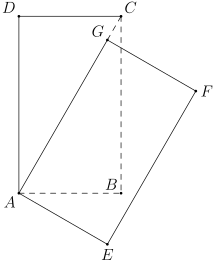
Se añaden más tarjetas siguiendo el mismo patrón, con el vértice en común, hasta formar un abanico. El proceso termina cuando una nueva tarjeta coincide exactamente con La figura resultante es un polígono no convexo con simetría de rotación. ¿Cuál es el área de este polígono?
Rectangular card has and As shown in the figure, a second card, congruent to the first, is stacked onto it so that lies on and the two cards share corner
Additional cards are added, following the same pattern (with shared corner ), creating a fan of cards. The process stops when a new card fits exactly atop The shape then created is a nonconvex polygon with rotational symmetry. What is the area of this polygon?
Pista pequeña:
Cada nueva tarjeta gira así que hay tarjetas en posiciones distintas
Each new card is rotated so there are distinct cards
Pista grande:
Halla la frontera entre dos vértices exteriores consecutivos, incluida su hendidura hacia dentro
Find the boundary between two consecutive outer corners, including its inward notch
Solución:
El rectángulo tiene lados y así que el giro es de Tomamos y El vértice exterior de la siguiente tarjeta es Su borde superior tiene ecuación y corta a en
Entre las semirrectas y la frontera es Solo las dos tarjetas dibujadas y la tarjeta girada en sentido antihorario respecto a entran en el interior de este sector. En esa tercera tarjeta, cada semirrecta forma como máximo con el lado corto, por lo que la tarjeta llega a lo sumo hasta La tarjeta que termina en llega al menos hasta en cada semirrecta. Por eso, la tercera tarjeta no añade nada aquí.
El área del triángulo es La hendidura es el triángulo Su base vertical mide y su altura horizontal es
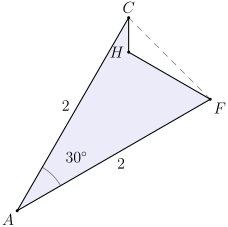
Restamos la hendidura del triángulo grande para obtener el área de un sector: Hay sectores congruentes, lo que da
Por lo tanto, la respuesta correcta es A.
The rectangle has sides and so the rotation is Place and The next card’s outer corner is Its upper edge has equation It meets at
Between the rays and the boundary is Only the two pictured cards and the card rotated counterclockwise from meet the interior of this sector. In that third card, each ray makes at most with the short side, so it reaches at most The card ending at reaches at least along each ray. So the third card adds nothing here.
The area of triangle is The inward notch is triangle Its vertical base has length and its horizontal height is
Subtract the notch from the large triangle to get the area of one sector: There are congruent sectors, giving
Thus, the correct answer is A.