
2026 AMC 10B Solutions
Scroll down to view professionally curated solutions from LIVE by Po-Shen Loh, print PDF solutions, view answer key, or take the full timed exam.
All problems are used with official legal permission of the Mathematical Association of America (MAA).
1.
2.
A souvenir shop sells solid metal sculptures of Achilles in two sizes. One is cm tall and one is cm tall. Proportions between the two sculptures are preserved. The smaller sculpture has a mass of grams. What is the mass, in grams, of the larger sculpture?
Small hint:
Mass scales with volume
Big hint:
The length scale factor is
Solution:
The volume, and hence mass, scales by the cube of the length ratio. The larger mass is
Thus, the correct answer is D.
3.
Bees occupy the corners of a rectangular box. The bees can fly inside the box, but cannot fly farther than unit from their respective corners. What is the volume, in cubic units, of the region inside the box that cannot be reached by any bee?
Small hint:
Each bee reaches one eighth of a sphere
Big hint:
The eight reachable regions have no overlapping volume
Solution:
The eight spherical eighths together have the volume of one sphere of radius Subtracting from the box gives
Thus, the correct answer is C.
4.
What positive real number satisfies the equation
Small hint:
Group the two fractions with numerator on one side
Big hint:
Solution:
Rearranging and combining gives Since cancel and cross-multiply: Thus The positive root is which is in the domain of the original equation.
Thus, the correct answer is D.
5.
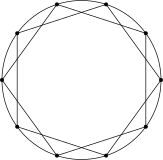
There are equally spaced points that all lie on a circle. A line segment is drawn between two points if there is exactly one point between them along the circle. Into how many regions will this divide the interior of the circle? The figure below shows an example with equally spaced points, in which case there are interior regions.
Small hint:
Count the central region, the small triangles, and the regions along the circle separately
Big hint:
Match the small triangles to marked points and the outer regions to arcs between consecutive points
Solution:
There is central region. Each marked point is the tip of one small triangle, giving triangular regions. Each arc between consecutive marked points borders one outer region, giving another The total is
Alternatively, use Euler’s formula for a connected planar graph: where counts vertices, counts edges, and counts faces, including the region outside the circle.
Each of the segments crosses exactly two others. Each crossing is counted from both segments, so there are interior vertices. Add the marked points to get Each segment is cut into three edges, and the circle contributes arcs. Thus
Euler’s formula gives Subtract the outside face to get regions inside the circle.
Thus, the correct answer is B.
6.
For how many integers is also an integer?
infinitely many
Small hint:
Divide by with remainder
Big hint:
Solution:
The expression equals It is an integer exactly when is one of and These give four distinct integers none equal to
Thus, the correct answer is C.
7.
A circle in the coordinate plane passes through and The equation of the circle can be written in the form for some constants and What is
Small hint:
The origin gives
Big hint:
Substitute and to find and
Solution:
Substitution gives Therefore and
Thus, the correct answer is A.
8.
Consider the infinite sequence of sets
Here the th set contains one more element than the previous set, and its members are the terms of an arithmetic sequence beginning with and having common difference Let be the number of these sets that contain the number What is the sum of the digits of
Small hint:
The last number in the th set is
Big hint:
The set contains exactly when is even and
Solution:
The th set runs from to in steps of Thus it contains exactly when is even and The eligible indices are the even integers from through There are Its digit sum is
Thus, the correct answer is D.
9.
A library offers desks arranged in a row from left to right for quiet studying. Students arrive one at a time and sit down at a desk. If possible, each student avoids sitting next to another student. Otherwise they will, if possible, sit next to one student rather than two. How many possible seating configurations (which seats are occupied) for one to five students are there?
Small hint:
Count the reachable configurations separately for each number of students
Big hint:
The first two occupied desks cannot be adjacent
Solution:
Number the desks from left to right. There are one-student configurations and nonadjacent pairs. For three students, write the occupied desk numbers together. The reachable configurations are
These follow by trying each nonadjacent pair and selecting a vacant desk with the fewest occupied neighbors. From these triples, the only four-student configurations are and All five desks give one more configuration. The total is
Thus, the correct answer is D.
10.
What is the area of the region bounded by the graphs of and
Small hint:
The second inequality is
Big hint:
The boundary lines are and
Solution:
The inequalities are and Their intersection is a rectangle.
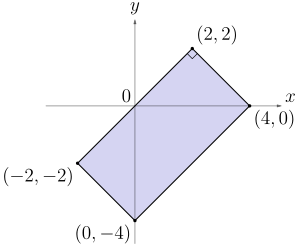
By the Pythagorean Theorem, the side lengths are and Thus the area is
Thus, the correct answer is E.
11.
In point is of the way from to point is of the way from to and point is of the way from to What is the ratio of the area of to the area of
Express your answer as a common fraction.
Small hint:
Subtract the three corner triangles from
Big hint:
The area of divided by the area of is
Solution:
The shaded triangle is
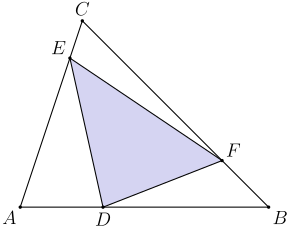
The area fractions of the corner triangles at and are respectively and The remaining fraction is
Thus, the correct answer is B.
12.
Sharon tosses a fair coin six times and keeps track of how many heads and tails she has gotten. Her first toss is heads. What is the probability that after every toss Sharon’s count of heads differs from her count of tails?
Express your answer as a common fraction.
Small hint:
The second toss must also be heads
Big hint:
Count sequences that start with heads and never tie. At lead add the previous counts for and Divide the last row’s total by
Solution:
After the first head, heads must stay ahead of tails: a negative lead would require passing through a tie.
In the diagram, is the number of tosses and is heads minus tails. A circled number counts sequences that have avoided a tie. Start with after the given first head. A head moves one column right and a tail one column left. Cross out every route that reaches
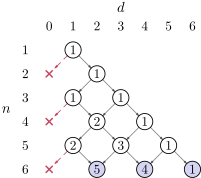
To fill a circle, add the numbers at the starts of its incoming arrows. For example, the in row is and the in row is
The last row has successful sequences. The first toss is fixed, so the remaining five tosses have equally likely outcomes. Hence
Thus, the correct answer is D.
13.
Two points and are chosen independently and uniformly at random on the circle in the coordinate plane. What is the probability that no point on lies less than unit from the origin?
Express your answer as a common fraction.
Small hint:
The closest point on the chord to the origin is its midpoint
Big hint:
A chord tangent to the unit circle subtends at the origin
Solution:
Fix and let be the origin. At the limiting position, is tangent to the unit circle at so and
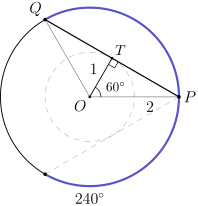
The right triangle has hypotenuse and adjacent leg so The perpendicular from the center bisects the chord and its central angle, giving
The allowable positions of lie within of in either direction. This is the highlighted arc of so the probability is
Thus, the correct answer is E.
14.
Real numbers and satisfy the equations and What is
Small hint:
Write as
Big hint:
Solution:
Let and Then and Therefore
Thus, the correct answer is E.
15.
Real numbers and are chosen independently and uniformly at random, with and What is the probability that the equation has a real solution?
Express your answer as a common fraction.
Small hint:
A real solution exists exactly when
Big hint:
The possible pairs fill a -by- rectangle. Exclude the triangle
Solution:
A real root exists exactly when the discriminant is nonnegative. Since and are nonnegative, this is equivalent to
Put on the horizontal axis and on the vertical axis. The possible pairs fill a rectangle of width and height The shaded region satisfies
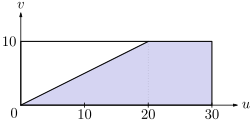
The unshaded triangle has legs and Subtract its area from the rectangle to get the probability
Thus, the correct answer is D.
16.
The squares in a grid of squares are each colored either solid red, white, or blue. In how many ways can this be done so that no square colored red shares a side with a square colored blue?
Small hint:
Count by the number of white squares
Big hint:
With two white squares, distinguish adjacent and opposite positions
Solution:
With no white squares, all four squares are connected by shared sides, so they must all be red or all blue: ways.
With one white square, choose its position in ways. The other three squares form a connected chain, so they must share one of colors, red or blue. This gives ways.
With two adjacent white squares, the white pair can be either row or either column: choices. The remaining two squares share a side, so both must be red or both blue: choices. This gives ways.
With two opposite white squares, choose one of the diagonals for the white pair. The other two squares do not share a side, so each has independent color choices. This gives ways.
With three white squares, choose the nonwhite square in ways and its color in ways, giving ways. All white gives one way.
The total is
Thus, the correct answer is E.
17.
A list contains statements, each of which is either true or false. The first statement is “The number of false statements in this list is at least ” The second statement is “The number of false statements in this list is at least ” In general, the th statement in the list is “The number of false statements in this list is at least ” How many statements in the list are true?
Small hint:
All true statements come before all false statements
Big hint:
If statements are false, the true ones have indices
Solution:
Let be the number of false statements. If all statements would be false, contradicting that bound. Thus and there are exactly true statements. Consequently so and the number of true statements is
Thus, the correct answer is B.
18.
What is the least positive integer such that is not a multiple of
Small hint:
Big hint:
Count factors of and in
Solution:
Every multiple of contributes a factor of Each multiple of contributes another, each multiple of another, and each multiple of another. There are and such multiples, respectively.
The exponent of in is Counting factors of in the same way gives Since divides the factorial exactly when both and The largest such is so the first failure is
Thus, the correct answer is C.
19.
A jar contains green marbles and red marbles. In a game, Anika and Ben take turns drawing a random marble from the jar, with replacement. If Ben ever draws a red marble, he wins, and if Anika ever draws a green marble, she wins. Otherwise, the game continues with the next player’s turn. The probability that Ben eventually wins is if Anika goes first and if Ben goes first. What is
Express your answer as a common fraction.
Small hint:
Big hint:
Solution:
Anika must first draw red for Ben to win when she starts, so When Ben starts, he either wins immediately or draws green, giving Hence and
Thus, the correct answer is D.
20.
Annie, Bobby, and Casey each receive an integer, not necessarily distinct, from through In how many ways can the numbers be given so that their sum is divisible by
Small hint:
Dividing and by leaves remainders and
Big hint:
Among through exactly one number completes any given sum to a multiple of
Solution:
Here a residue modulo means the remainder after division by The numbers through give every remainder once, so one of them always completes any two chosen numbers to a multiple of
Count by how many people receive a number in through If none do, the first two numbers have choices, and the third has exactly one suitable residue: ways. If exactly one does, choose that person and their number, then one of the other numbers; the last is determined: ways.
If exactly two do, choose the person who receives a number from through in ways. Each of the other two people has choices, with residues in The remaining number is determined: ways. If all three do, their residue sum must be giving permutations of and or ways. The total is
Thus, the correct answer is E.
21.
Rectangle has and Inside the rectangle are two congruent semicircles, the first with diameter where lies on and the second with diameter where lies on The two semicircles are tangent at See the figure.
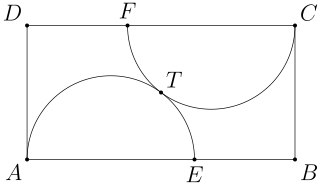
What is the radius of the semicircles?
Express your answer as a common fraction.
Small hint:
Let be the radius and join the semicircle centers
Big hint:
The center separation has horizontal component and vertical component
Solution:
Let be the common radius. Tangency makes the distance between centers Their horizontal separation is and their vertical separation is Thus Cancelling gives so
Thus, the correct answer is C.
22.
Belinda follows a path on the plane that is entirely contained within the square region and Call her path dignified if and only if all of the following conditions are satisfied.
• Each step is one unit up, down, or to the right.
• The path does not revisit any vertex.
• The path starts at and ends at where and are integers with and touches the -axis only at these two points.
The following figure shows some examples of dignified and not dignified paths.
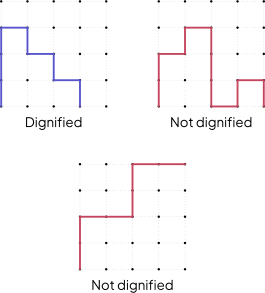
How many dignified paths can Belinda follow?
Small hint:
Count by the horizontal distance
Big hint:
Choose the height of each rightward step; the vertical parts are then forced
Solution:
Fix the number of rightward steps. Each must be at height or because the path stays in the square and touches the -axis only at its endpoints.
For example, take two rightward steps at heights and starting at The path must go up to height right, up to height right, then down to the axis.
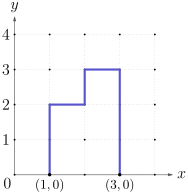
Once the start and heights are chosen, the vertical parts are forced. Between rightward steps, go straight up or down to the next height. Reversing direction would revisit a vertex. Every choice of heights gives a valid path: the heights stay positive, and after moving right the path never returns to an earlier column.
With two rightward steps, the starting -coordinate can be or there are starting positions. Each step independently has height choices, so this case contributes paths.
In general, let be the number of rightward steps. It can be or The starting -coordinate can be any integer from through giving positions. There are choices for the heights.
The total number of paths is
Thus, the correct answer is C.
23.
The eight vertices of a cube are randomly and independently colored red, white, or blue. What is the expected number of faces of the cube that have at least two blue vertices?
Express your answer as a common fraction.
Small hint:
Find the probability for one face, then multiply by
Big hint:
Subtract the cases of zero and exactly one blue vertex
Solution:
For one face, the probability of at least two blue vertices is The factor counts the possible positions of the lone blue vertex. Adding this probability over the six faces gives the expected number
Thus, the correct answer is D.
24.
Starting with a list of three numbers, form a sequence in which each subsequent term is the average of the previous three terms. For example, starting with the sequence the next two terms are and Which of the following initial three terms will produce a sequence that has the greatest th term?
Small hint:
Compare corresponding terms by subtracting the sequences
Big hint:
Once three consecutive differences are positive, every later difference is positive
Solution:
Option C is larger term by term than A and B. Subtract D from C: the first six differences are
The next difference is positive, so from the fifth term onward every difference is positive. Subtract E from C: the first six differences are
The same argument applies. Thus C has the largest term at every index from the fifth onward, including
Thus, the correct answer is C.
25.
Rectangular card has and As shown in the figure, a second card, congruent to the first, is stacked onto it so that lies on and the two cards share corner
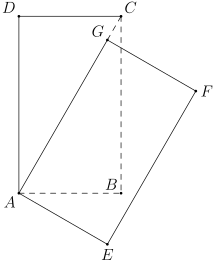
Additional cards are added, following the same pattern (with shared corner ), creating a fan of cards. The process stops when a new card fits exactly atop The shape then created is a nonconvex polygon with rotational symmetry. What is the area of this polygon?
Small hint:
Each new card is rotated so there are distinct cards
Big hint:
Find the boundary between two consecutive outer corners, including its inward notch
Solution:
The rectangle has sides and so the rotation is Place and The next card’s outer corner is Its upper edge has equation It meets at
Between the rays and the boundary is Only the two pictured cards and the card rotated counterclockwise from meet the interior of this sector. In that third card, each ray makes at most with the short side, so it reaches at most The card ending at reaches at least along each ray. So the third card adds nothing here.
The area of triangle is The inward notch is triangle Its vertical base has length and its horizontal height is
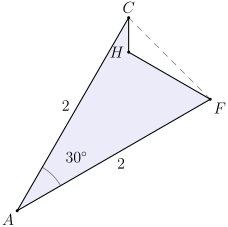
Subtract the notch from the large triangle to get the area of one sector: There are congruent sectors, giving
Thus, the correct answer is A.