
Soluciones del 2016 AMC 10B
Desplázate hacia abajo para ver las soluciones preparadas profesionalmente de LIVE by Po-Shen Loh, imprime las soluciones en PDF, consulta la clave de respuestas, o haz el examen cronometrado completo.
Todos los problemas se usan con el permiso legal oficial de la Mathematical Association of America (MAA).
1.
¿Cuál es el valor de cuando ?
What is the value of when
Pista pequeña:
Sustituye después de combinar las potencias de .
Substitute after combining powers of
Pista grande:
Dividir entre convierte en .
Dividing by turns into
Solución:
La expresión es equivalente a Entonces es igual a por lo que nuestra expresión es igual a
Por lo tanto, la respuesta correcta es D.
The expression is equivalent to Then is equal to so our expression is equal to
Thus, the correct answer is D .
2.
Si ¿cuánto vale ?
If what is
Pista pequeña:
Calcula primero simbólicamente el cociente de la operación.
Compute the operation ratio symbolically first
Pista grande:
.
Solución:
Para cualesquiera dos números no nulos tenemos Usando obtenemos que
Por lo tanto, la respuesta correcta es B.
For any nonzero we have Using we get that
Thus, the correct answer is B .
3.
Sea ¿Cuál es el valor de la siguiente expresión?
Let What is the value of
Pista pequeña:
Para , .
For ,
Pista grande:
Evalúa los valores absolutos de adentro hacia afuera.
Evaluate the absolute values from the inside outward
Solución:
Como tenemos Así, de modo que el valor absoluto más interno es Por lo tanto, la expresión completa es
Por lo tanto, la respuesta correcta es D.
Since we have Thus so the innermost absolute value is Therefore the full expression is
Thus, the correct answer is D .
4.
Zoey leyó libros, uno a la vez. El primer libro le tomó día, el segundo libro le tomó días, el tercer libro le tomó días, y así sucesivamente, tomándole cada libro día más que el anterior. Zoey terminó el primer libro un lunes y el segundo un miércoles. ¿Qué día de la semana terminó su libro número ?
Zoey read books, one at a time. The first book took her day to read, the second book took her days to read, the third book took her days to read, and so on, with each book taking her more day to read than the previous book. Zoey finished the first book on a Monday, and the second on a Wednesday. On what day of the week did she finish her th book?
domingo
Sunday
lunes
Monday
miércoles
Wednesday
viernes
Friday
sábado
Saturday
Pista pequeña:
El tiempo total de lectura es .
The total reading time is
Pista grande:
Compara el día en que termina el libro con el día en que termina el libro módulo .
Compare the finish day of book with the finish day of book modulo
Solución:
El número de días que toma leer libros es Por lo tanto, es días después de que se lee el primer libro. Esto es un múltiplo de así que el libro número se terminó el mismo día que el libro número Por consiguiente, se terminó un lunes.
Por lo tanto, la respuesta correcta es B.
The number of days it takes to read books is Therefore, it is days after the first book is read. This is a multiple of so the th book was finished on the same day as the st book. Therefore, it was finished on a Monday.
Thus, the correct answer is B .
5.
La edad promedio de los primos de Amanda es y su edad mediana es ¿Cuál es la suma de las edades del primo más joven y del primo mayor de Amanda?
The mean age of Amanda’s cousins is and their median age is What is the sum of the ages of Amanda’s youngest and oldest cousins?
Pista pequeña:
La edad total es .
The total age is
Pista grande:
Las dos edades del medio suman .
The two middle ages sum to
Solución:
El total de las edades de los cuatro primos es . Como la mediana es , las dos edades del medio tienen promedio , así que su suma es .
Por lo tanto, las edades del más joven y del mayor suman .
Por lo tanto, la respuesta correcta es D.
The total of the four cousin ages is . Since the median is , the two middle ages have average , so their sum is .
Therefore the youngest and oldest ages sum to .
Thus, the correct answer is D.
6.
Laura sumó dos enteros positivos de tres dígitos. Los seis dígitos de estos números son todos distintos. La suma de Laura es un número de tres dígitos ¿Cuál es el menor valor posible de la suma de los dígitos de ?
Laura added two three-digit positive integers. All six digits in these numbers are different. Laura’s sum is a three-digit number What is the smallest possible value for the sum of the digits of
Pista pequeña:
Muestra que una suma de dígitos menor que es imposible.
Show a digit sum below is impossible
Pista grande:
alcanza una suma de dígitos de .
reaches digit sum
Solución:
Para minimizar la suma de los sumandos, usamos las dos menores cifras no nulas en las centenas, y , y luego las cuatro menores cifras restantes, . Colocar las cifras menores en las decenas muestra que toda suma posible es al menos . Por otra parte, todo número de tres cifras con suma de cifras menor que es como máximo . Por tanto, la suma de las cifras de es al menos .
El ejemplo usa seis cifras distintas y tiene suma de cifras . Así, la menor suma de cifras posible es .
Por tanto, la respuesta correcta es B.
To minimize the sum of the addends, use the two smallest nonzero hundreds digits, and , and then the four smallest remaining digits, . Placing the smaller digits in the tens places shows that every possible sum is at least . On the other hand, any three-digit number with digit sum less than is at most . Therefore the digit sum of is at least .
The example uses six distinct digits and has digit sum . Thus the smallest possible digit sum is .
Thus, the correct answer is B.
7.
La razón de las medidas de dos ángulos agudos es y el complemento de uno de estos dos ángulos es dos veces mayor que el complemento del otro. ¿Cuál es la suma de las medidas en grados de los dos ángulos?
The ratio of the measures of two acute angles is and the complement of one of these two angles is twice as large as the complement of the other. What is the sum of the degree measures of the two angles?
Pista pequeña:
Sea el menor de los ángulos agudos.
Let the smaller acute angle be
Pista grande:
El ángulo mayor tiene el complemento menor.
The larger angle has the smaller complement
Solución:
Sea el ángulo menor Entonces, el ángulo mayor es Observa que su suma es
Sus complementos son entonces y Como es mayor que sabemos que
Por lo tanto, la suma es
Por lo tanto, la respuesta correcta es C.
Let the smaller angle be Then, the larger angle is Note that their sum is
Their complements are then and Since is larger than we know
Therefore, the sum is
Thus, the correct answer is C .
8.
¿Cuál es el dígito de las decenas de ?
What is the tens digit of
Pista pequeña:
Trabaja módulo para obtener el dígito de las decenas.
Work modulo to get the tens digit
Pista grande:
Usa congruencias módulo y .
Use congruences modulo and
Solución:
Para hallar el dígito de las decenas, primero necesitamos hallar el número módulo Primero, podemos hallar Podemos hacerlo con el Teorema Chino del Resto obteniendo primero el número y luego
El número ya que es un múltiplo de
Luego, observa que
Por el teorema chino del resto, podemos obtener que nuestro número es congruente con
Por lo tanto, Esto significa que el dígito de las decenas es
Por lo tanto, la respuesta correcta es A.
To find the tens digit, we first need to find the number modulo First, we can find We can do this with the Chinese Remainder Theorem by first getting the number and then
The number since it is a multiple of
Then, observe that
By the Chinese remainder theorem, we can get that our number is congruent to
Therefore, This means the tens digit is
Thus, the correct answer is A .
9.
Los tres vértices del están sobre la parábola definida por con en el origen y paralelo al eje . El área del triángulo es ¿Cuál es la longitud de ?
All three vertices of lie on the parabola defined by with at the origin and parallel to the -axis. The area of the triangle is What is the length of
Pista pequeña:
Usa los puntos simétricos y .
Use symmetric points and
Pista grande:
El área del triángulo es .
The triangle area is
Solución:
Sean los puntos
Luego, como es paralelo al eje , sabemos que lo que llamaremos Entonces, así que Esto implica que o bien La segunda opción no puede ocurrir, ya que haría que dos puntos fueran iguales, lo que crearía un área de Por ello, sea Entonces también.
Entonces, los puntos son Con base la longitud es y la altura es Esto haría que el área fuera Por lo tanto, así que
Por lo tanto, la respuesta correcta es C.
Let the points be
Then, since is parallel with the -axis, we know which we will let be Then, so This implies that either or The second option cannot happen since that would set two points as the same, which would create an area of As such, let Then also.
Then, the points are With a base of the length is and the height is This would make the area Therefore, so
Thus, the correct answer is C .
10.
Una pieza delgada de madera de densidad uniforme con forma de triángulo equilátero de lado pulgadas pesa onzas. Una segunda pieza del mismo tipo de madera, con el mismo grosor, también con forma de triángulo equilátero, tiene lado de pulgadas. ¿Cuál de las siguientes opciones es la más cercana al peso, en onzas, de la segunda pieza?
A thin piece of wood of uniform density in the shape of an equilateral triangle with side length inches weighs ounces. A second piece of the same type of wood, with the same thickness, also in the shape of an equilateral triangle, has side length inches. Which of the following is closest to the weight, in ounces, of the second piece?
Pista pequeña:
Los pesos escalan como las áreas porque el grosor y la densidad son fijos.
Weights scale like areas because thickness and density are fixed
Pista grande:
El factor de escala de la longitud del lado es .
The side-length scale factor is
Solución:
El área de la superficie aumenta por un factor de ya que las longitudes de los lados aumentan por un factor de Además, como el grosor es constante, el volumen se escala en esa misma proporción. Entonces, al tener la madera la misma densidad, el peso también aumenta por un factor de , de modo que el nuevo peso es Esto es aproximadamente
Por lo tanto, la respuesta correcta es D.
The surface area is increased by a factor of since the side lengths are increased by a factor of Also since the thickness is constant, the volume is scaled up by that much. Then, the wood having the same density makes the weight increase by a factor of as well, so the new weight is This is approximately
Thus, the correct answer is D .
11.
Carl decidió cercar su jardín rectangular. Compró postes de cerca, colocó uno en cada una de las cuatro esquinas y distribuyó el resto de manera uniforme a lo largo de los bordes del jardín, dejando exactamente yardas entre postes vecinos. El lado más largo de su jardín, incluyendo las esquinas, tiene el doble de postes que el lado más corto, incluyendo las esquinas. ¿Cuál es el área, en yardas cuadradas, del jardín de Carl?
Carl decided to fence in his rectangular garden. He bought fence posts, placed one on each of the four corners, and spaced out the rest evenly along the edges of the garden, leaving exactly yards between neighboring posts. The longer side of his garden, including the corners, has twice as many posts as the shorter side, including the corners. What is the area, in square yards, of Carl’s garden?
Pista pequeña:
Sean y los postes en los lados corto y largo, incluyendo las esquinas.
Let and be posts on the short and long sides, including corners
Pista grande:
Usa y .
Use and
Solución:
Sea el número de postes en un lado largo, incluyendo las esquinas, y sea el número de postes en un lado corto, incluyendo las esquinas. El número total de postes es donde el evita contar dos veces las esquinas.
Como un lado largo tiene el doble de postes que un lado corto, . Así , por lo que y .
Hay espacios iguales en un lado corto y espacios iguales en un lado largo. Con yardas entre postes vecinos, las longitudes de los lados son y , así que el área es .
Por lo tanto, la respuesta correcta es B.
Let be the number of posts on a long side, including corners, and let be the number of posts on a short side, including corners. The total number of posts is where the avoids double-counting the corners.
Since a long side has twice as many posts as a short side, . Thus , so and .
There are equal gaps on a short side and equal gaps on a long side. With yards between neighboring posts, the side lengths are and , so the area is .
Thus, the correct answer is B.
12.
Se seleccionan al azar dos números diferentes de y se multiplican. ¿Cuál es la probabilidad de que el producto sea par?
Two different numbers are selected at random from and multiplied together. What is the probability that the product is even?
Pista pequeña:
Cuenta en su lugar los pares con producto impar.
Count the odd-product pairs instead
Pista grande:
Hay pares impares de un total de pares.
There are odd pairs out of pairs
Solución:
El producto es impar si y solo si ambos números son impares. Hay maneras de lograrlo de un total posible de maneras. Esto hace que la probabilidad de que sea impar sea igual a Esto significa que la probabilidad de que sea par es
Por lo tanto, la respuesta correcta es D.
The product is odd if and only if both numbers are odd. There are ways to do this out of a possible ways. This makes the probability of it being odd equal to This means the probability it is even is
Thus, the correct answer is D .
13.
En el Hospital Megapolis, en cierto año, las estadísticas de partos múltiples fueron las siguientes: los conjuntos de gemelos, trillizos y cuatrillizos sumaron de los bebés nacidos. Hubo cuatro veces más conjuntos de trillizos que de cuatrillizos, y hubo tres veces más conjuntos de gemelos que de trillizos. ¿Cuántos de estos bebés estaban en conjuntos de cuatrillizos?
At Megapolis Hospital one year, multiple-birth statistics were as follows: Sets of twins, triplets, and quadruplets accounted for of the babies born. There were four times as many sets of triplets as sets of quadruplets, and there were three times as many sets of twins as sets of triplets. How many of these babies were in sets of quadruplets?
Pista pequeña:
Sean los números de conjuntos de gemelos, trillizos y cuatrillizos.
Let be the numbers of twin, triplet, and quadruplet sets
Pista grande:
Usa y .
Use and
Solución:
Sean los números de conjuntos de gemelos, trillizos y cuatrillizos. Entonces El enunciado da y .
Sustituyendo se obtiene , así que . El número de bebés en conjuntos de cuatrillizos es .
Por lo tanto, la respuesta correcta es D.
Let be the numbers of sets of twins, triplets, and quadruplets. Then The statement gives and .
Substituting gives , so . The number of babies in sets of quadruplets is .
Thus, the correct answer is D.
14.
¿Cuántos cuadrados cuyos lados son paralelos a los ejes y cuyos vértices tienen coordenadas enteras están completamente dentro de la región limitada por la recta la recta y la recta ?
How many squares whose sides are parallel to the axes and whose vertices have coordinates that are integers lie entirely within the region bounded by the line the line and the line
Pista pequeña:
Para cada tamaño de cuadrado, cuenta los posibles puntos reticulares de la esquina superior izquierda.
For each square size, count possible top-left lattice points
Pista grande:
Solo caben los lados de longitud .
Only side lengths can fit
Solución:
Un cuadrado debe estar por encima de , a la izquierda de y por debajo de . Como es un poco más que , las alturas reticulares disponibles en son , y los lados de longitud mayor que no caben.
Cuenta por longitud de lado usando el punto reticular superior izquierdo. Para el lado de longitud , hay opciones. Para el lado de longitud , hay opciones. Para el lado de longitud , hay opciones.
El total es .
Por lo tanto, la respuesta correcta es D.
A square must lie above , to the left of , and below . Since is a little more than , the lattice heights available at are , and side lengths larger than cannot fit.
Count by side length using the top-left lattice point. For side length , there are choices. For side length , there are choices. For side length , there are choices.
The total is .
Thus, the correct answer is D.
15.
Todos los números se escriben en un arreglo de casillas , un número en cada casilla, de tal manera que si dos números son consecutivos entonces ocupan casillas que comparten un lado. Los números en las cuatro esquinas suman ¿Cuál es el número en el centro?
All the numbers are written in a array of squares, one number in each square, in such a way that if two numbers are consecutive then they occupy squares that share an edge. The numbers in the four corners add up to What is the number in the center?
Pista pequeña:
Los números consecutivos adyacentes tienen paridad opuesta.
Adjacent consecutive numbers have opposite parity
Pista grande:
El centro y las cuatro esquinas deben tener todos la misma paridad.
The center and four corners must all have the same parity
Solución:
Coloreemos el arreglo como un tablero de ajedrez, con el centro y las cuatro esquinas de un color y los cuatro cuadrados laterales del otro. Los números consecutivos ocupan cuadrados adyacentes, por lo que el camino alterna colores. Así, los cinco números impares ocupan una clase de color y los cuatro pares, la otra.
La clase formada por el centro y las cuatro esquinas tiene cinco cuadrados, así que contiene los cinco números impares. Por tanto, la suma de las esquinas y el centro es
Como las esquinas suman el centro vale
Así, la respuesta correcta es C.
Color the array like a checkerboard, with the center and four corners one color and the four edge squares the other color. Consecutive numbers occupy adjacent squares, so the path alternates colors. Therefore all five odd numbers occupy one color class and all four even numbers occupy the other.
The color class consisting of the center and four corners has five squares, so it contains the five odd numbers. Hence the sum of the corners and center is
Since the corners have a sum of the center has a value of
Thus, the correct answer is C .
16.
La suma de una serie geométrica infinita es un número positivo y el segundo término de la serie es ¿Cuál es el menor valor posible de ?
The sum of an infinite geometric series is a positive number and the second term in the series is What is the smallest possible value of
Pista pequeña:
Escribe el primer término como y la razón común como .
Write the first term as and common ratio as
Pista grande:
La condición hace que .
The condition makes
Solución:
Sea el primer valor de la serie y sea la razón Así, Esto significa que tenemos que hallar el que maximiza Esta maximización ocurrirá con
Por lo tanto,
Por lo tanto, la respuesta correcta es E.
Let the first value of the series be and let the ratio be Thus, This means we have to find that maximizes This maximization will happen with
Therefore,
Thus, the correct answer is E .
17.
Todos los números se asignan a las seis caras de un cubo, un número a cada cara. Para cada uno de los ocho vértices del cubo, se calcula un producto de tres números, donde los tres números son los asignados a las tres caras que incluyen ese vértice. ¿Cuál es el mayor valor posible de la suma de estos ocho productos?
All the numbers are assigned to the six faces of a cube, one number to each face. For each of the eight vertices of the cube, a product of three numbers is computed, where the three numbers are the numbers assigned to the three faces that include that vertex. What is the greatest possible value of the sum of these eight products?
Pista pequeña:
Empareja las caras opuestas del cubo.
Pair opposite faces of the cube
Pista grande:
Maximiza .
Maximize
Solución:
Empareja las caras opuestas como , y . Cada producto de vértice usa un número de cada par, así que la suma de los ocho productos de vértice es
Las seis etiquetas de las caras suman , así que las tres sumas de pares opuestos tienen un total de . Su producto se maximiza cuando las sumas son lo más iguales posible, es decir , dando como máximo .
Este máximo se alcanza emparejando con , con y con . Por lo tanto, la mayor suma posible es .
Por lo tanto, la respuesta correcta es D.
Pair opposite faces as , , and . Each vertex product uses one number from each pair, so the sum of all eight vertex products is
The six face labels sum to , so the three opposite-pair sums have total . Their product is maximized when the sums are as equal as possible, namely , giving at most .
This maximum is attainable by pairing with , with , and with . Hence the greatest possible sum is .
Thus, the correct answer is D.
18.
¿De cuántas maneras se puede escribir como la suma de una sucesión creciente de dos o más enteros positivos consecutivos?
In how many ways can be written as the sum of an increasing sequence of two or more consecutive positive integers?
Pista pequeña:
Si la longitud es , entonces .
If the length is , then
Pista grande:
Revisa las longitudes que son factores y que dan un entero positivo .
Check factor lengths that give positive integer
Solución:
Supongamos que la sucesión tiene longitud y primer término . Entonces o bien
Así, debe ser un divisor de , con un entero positivo. Al revisar las posibles longitudes divisoras se obtiene Estas son las únicas longitudes que mantienen positivo y entero.
Por lo tanto, hay representaciones.
Por lo tanto, la respuesta correcta es E.
Suppose the sequence has length and first term . Then or
Thus must be a divisor of , with a positive integer. Checking the possible divisor lengths gives These are the only lengths that keep positive and integral.
Therefore there are representations.
Thus, the correct answer is E.
19.
El rectángulo tiene y El punto está en de modo que el punto está en de modo que y el punto está en de modo que Los segmentos y cortan a en y respectivamente. ¿Cuál es el valor de ?
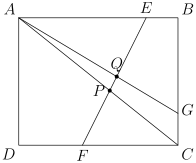
Rectangle has and Point lies on so that point lies on so that and point lies on so that Segments and intersect at and respectively. What is the value of
Pista pequeña:
Primero halla dónde y cortan a .
First find where and cut
Pista grande:
Usa triángulos semejantes para expresar y .
Use similar triangles to express and
Solución:
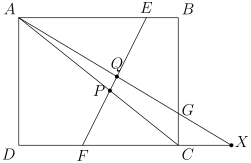
Tenemos y Como los triángulos y son semejantes. Por tanto, así que
Prolonguemos hasta que corte a la recta en Como la semejanza da y por tanto . Así, Como los triángulos y son semejantes, por lo que En consecuencia,
Se sigue que
Por tanto, la respuesta correcta es D.
We have and Since the triangles and are similar. Therefore so
Extend to meet line at Because similarity gives and hence . Thus Since triangles and are similar, so Consequently
It follows that
Thus, the correct answer is D .
20.
Una homotecia del plano, es decir, una transformación de tamaño con factor de escala positivo, envía el círculo de radio con centro en al círculo de radio con centro en ¿Qué distancia se mueve el origen bajo esta transformación?
A dilation of the plane—that is, a size transformation with a positive scale factor—sends the circle of radius centered at to the circle of radius centered at What distance does the origin move under this transformation?
Pista pequeña:
El factor de escala de la homotecia es .
The dilation scale factor is
Pista grande:
El centro de la homotecia está sobre la recta que pasa por los dos centros de los círculos.
The center of dilation lies on the line through the two circle centers
Solución:
El factor de escala de la homotecia es , pues el radio cambia de a . El centro de la homotecia está sobre la recta que pasa por y .
El vector de a es . Si es el centro de la homotecia, entonces el factor de escala da Por tanto, , y así
Bajo una homotecia de factor con centro en , cada punto se desplaza la mitad de su distancia a . Como , el origen se desplaza .
Así, la respuesta correcta es C.
The dilation scale factor is , since the radius changes from to . The center of dilation lies on the line through and .
The vector from to is . If is the dilation center, then the scale factor gives Thus , so
Under a scale factor dilation about , a point moves by half its distance from . Since , the origin moves .
Thus, the correct answer is C.
21.
¿Cuál es el área de la región encerrada por la gráfica de la ecuación ?
What is the area of the region enclosed by the graph of the equation
Pista pequeña:
Trabaja en un cuadrante y multiplica por .
Work in one quadrant and multiply by
Pista grande:
La región del primer cuadrante es un triángulo más un semicírculo.
The first-quadrant region is a triangle plus a semicircle
Solución:
La ecuación es simétrica en los cuatro cuadrantes. En el primer cuadrante se convierte en o bien
En el primer cuadrante, la región encerrada es el triángulo bajo , con área , más un semicírculo de radio , con área .
Multiplicando por , el área total es
Por lo tanto, la respuesta correcta es B.
The equation is symmetric in all four quadrants. In the first quadrant it becomes or
In the first quadrant, the enclosed region is the triangle under , with area , plus a semicircle of radius , with area .
Multiplying by , the total area is
Thus, the correct answer is B.
22.
Un grupo de equipos disputó un torneo de todos contra todos en el que cada equipo jugó contra cada uno de los demás exactamente una vez. Cada equipo ganó juegos y perdió juegos; no hubo empates. ¿Cuántos conjuntos de tres equipos hubo en los que venció a venció a y venció a ?
A set of teams held a round-robin tournament in which every team played every other team exactly once. Every team won games and lost games; there were no ties. How many sets of three teams were there in which beat beat and beat
Pista pequeña:
Primero cuenta todos los conjuntos de tres equipos y luego resta los conjuntos sin ciclo de victorias.
Count all triples of teams, then subtract transitive triples
Pista grande:
Cada equipo, como equipo dominante, aparece en conjuntos transitivos de tres equipos.
Each team is the top team in transitive triples
Solución:
El número total de equipos es Por lo tanto, el número total de ternas es
Ahora debemos restar las ternas que no contienen un ciclo. Esto ocurre exactamente cuando un equipo vence a los otros dos. Hay opciones para ese equipo y maneras de elegir a los dos equipos que vence. Así, el número de ternas sin ciclo es Por lo tanto, el número de ciclos es
Así, la respuesta correcta es A.
The total number of teams is The total number of sets is therefore
Now, we must subtract the total number of sets such that there is no cycle. This only happens if one team beats the other two teams. There are choices for the team that beat the other two and ways to choose the teams they beat. Thus, the total of non-cycles is This means the total number of cycles is
Thus, the correct answer is A .
23.
En el hexágono regular se eligen los puntos sobre los lados respectivamente, de modo que las rectas sean paralelas y estén igualmente espaciadas. ¿Cuál es la razón entre el área del hexágono y el área del hexágono ?
In regular hexagon points and are chosen on sides and respectively, so lines and are parallel and equally spaced. What is the ratio of the area of hexagon to the area of hexagon
Pista pequeña:
Prolonga y hasta que se corten.
Extend and until they meet
Pista grande:
Compara las áreas de tres triángulos semejantes con vértice en el punto de corte.
Compare the areas of three similar triangles with vertex at the extension point
Solución:
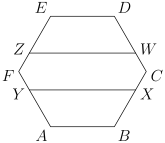
Prolonguemos y hasta que se corten en
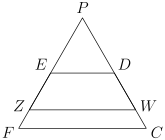
Sea la distancia entre y Como las cuatro rectas dadas están igualmente espaciadas y está a mitad de camino entre y la distancia de a es Sea la altura desde hasta Los triángulos equiláteros y tienen lados en razón así que sus alturas satisfacen de donde Por lo tanto, la razón entre los lados de y es
Tomando la semejanza da y Entonces El hexágono buscado consta de dos copias congruentes de mientras que el hexágono regular consta de dos copias congruentes de Por tanto, la razón pedida es
Así, la respuesta correcta es C.
Extend and until they meet at
Let be the distance between and Because the four given lines are equally spaced and lies halfway between and the distance from to is Let the altitude from to be The equilateral triangles and have side lengths in the ratio so their altitudes satisfy giving Therefore the side-length ratio of to is
Taking similarity gives and Hence The desired hexagon consists of two congruent copies of while the regular hexagon consists of two congruent copies of Thus the requested ratio is
Thus, the correct answer is C .
24.
¿Cuántos enteros de cuatro dígitos con tienen la propiedad de que los tres enteros de dos dígitos forman una sucesión aritmética creciente?
Uno de esos números es donde y
How many four-digit positive integers with have the property that the three two-digit integers form an increasing arithmetic sequence?
One such number is where and
Pista pequeña:
La condición de sucesión aritmética es .
The arithmetic-sequence condition is
Pista grande:
La ecuación de los dígitos tiene dos posibles casos de acarreo.
The digit equation has two possible carry cases
Solución:
De , obtenemos La condición de sucesión aritmética es que se reorganiza como El lado derecho es múltiplo de Como y los cuatro símbolos son dígitos con ese lado está entre y . Por tanto, es o
Caso
Examinamos los valores posibles de
La primera ecuación da , pero la segunda no puede cumplirse.
La primera ecuación da y la segunda, . Esto deja un caso:
La primera ecuación da y la segunda, . Esto deja tres casos:
La primera ecuación da y la segunda, . Esto deja cuatro casos: En total, este caso da los números lo que da soluciones.
Caso lo que significa que los dígitos forman una sucesión aritmética.
Si la diferencia es entonces , lo que da soluciones.
Si la diferencia es entonces , lo que da soluciones. Una diferencia de al menos obligaría a que Así, este caso da soluciones.
En total, el número de soluciones es
Por lo tanto, la respuesta correcta es D.
From , we have The arithmetic-sequence condition is which rearranges to The right side is a multiple of Because and all four symbols are digits with it lies between and . Hence it is either or
Case
We can look at the possible values of
Thus, from the first equation, but can’t work for the second equation.
Thus, from the first equation, and from the second equation. This makes one case for
Thus, from the first equation, and from the second equation. This makes three cases for
Thus, from the first equation, and from the second equation. This makes four cases for Altogether this case gives for solutions.
Case which means the digits are an arithmetic sequence.
If the difference is then makes solutions.
If the difference is then makes solutions. A difference of at least would force This case therefore gives solutions.
In total, the number of solutions is
Thus, the correct answer is D .
25.
Sea donde denota el mayor entero menor o igual que ¿Cuántos valores distintos toma para ?
Let where denotes the greatest integer less than or equal to How many distinct values does assume for
Pista pequeña:
Solo importa la parte fraccionaria de .
Only the fractional part of matters
Pista grande:
Cuenta los puntos de corte distintos para .
Count distinct breakpoints for
Solución:
Escribe , donde . Entonces así que depende solo de la parte fraccionaria .
El valor de cambia solo cuando cruza una fracción , donde y . El número de tales fracciones distintas en es
Incluyendo el valor inicial antes del primer punto de corte, toma valores distintos.
Por lo tanto, la respuesta correcta es A.
Write , where . Then so depends only on the fractional part .
The value of changes only when crosses a fraction , where and . The number of distinct such fractions in is
Including the initial value before the first breakpoint, assumes distinct values.
Thus, the correct answer is A.