
2020 AMC 12A 详解
向下滚动即可查看来自 LIVE by Po-Shen Loh 的精心整理的解答,打印PDF 解答,查看答案,或参加完整限时模拟考试。
所有题目均经美国数学协会(MAA)官方合法授权使用。
1.
Carlos 拿走了一个完整馅饼的 。Maria 拿走了剩余部分的三分之一。整个馅饼还剩下多少?
Carlos took of a whole pie. Maria took one third of the remainder. What portion of the whole pie was left?
小提示:
Carlos 拿走后,馅饼还剩 。
After Carlos takes his share, of the pie remains
大提示:
Maria 拿走这个 的 ,所以剩余部分的 留下
Maria removes of that , so of the remainder is left
解答:
Carlos 拿走 后,剩余部分为 。
Maria 拿走其中三分之一,即 ,所以还剩 。
因此,正确答案是 C。
After Carlos takes the remaining portion is
Maria takes one third of this, namely leaving
Thus, C is the correct answer.
2.
缩写 AMC 显示在下面的矩形网格中,网格线间距为 个单位。组成缩写 AMC 的所有线段长度之和是多少个单位?
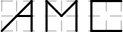
The acronym AMC is shown in the rectangular grid below with grid lines spaced unit apart. In units, what is the sum of the lengths of the line segments that form the acronym AMC?
小提示:
横跨向右一个单位、向上一个单位的线段长度为 。
A segment spanning one unit right and one unit up has length
大提示:
分别合计水平和竖直线段的长度,再合计斜线段的长度
Total the horizontal and vertical pieces separately from the diagonal pieces
解答:
把每个字母拆成线段。字母 包含一条长为 的斜线、一条长为 的竖线,以及一条长为 的横线。
字母 有两条长为 的竖线和两条各长 的斜线。字母 由三条长为 的边组成。
直线段的总长为 ,斜线段的总长为 。
总和为 。
因此,正确答案是 C。
Split each letter into its segments. The is a diagonal of length a vertical of length and a crossbar of length
The has two verticals of length and two diagonals of length each. The is three sides of length
The straight pieces total and the diagonal pieces total
The sum is
Thus, C is the correct answer.
3.
一名司机以每小时 英里的速度行驶 小时,在此期间她的汽车每加仑汽油可行驶 英里。她每英里获得 报酬,唯一开销是每加仑 的汽油。扣除这项开销后,她每小时的净报酬是多少美元?
A driver travels for hours at miles per hour, during which her car gets miles per gallon of gasoline. She is paid per mile, and her only expense is gasoline at per gallon. What is her net rate of pay, in dollars per hour, after this expense?
小提示:
小时内她行驶 英里;求出这段距离的报酬和汽油费用
In hours she drives miles; find her pay and her gasoline cost for that distance
大提示:
用净收入除以 小时,得到每小时的报酬
Divide the net earnings by the hours to get the rate per hour
解答:
小时内她行驶 英里,收入为 。
她用掉 加仑汽油,花费 。
净收入为 ,因此每小时为 。
因此,正确答案是 E。
In hours she drives miles, earning
She uses gallons, costing
Her net earnings are so her rate is per hour.
Thus, E is the correct answer.
4.
有多少个 位正整数,也就是从 到 (含端点)的整数,只含偶数数字且能被 整除?
How many -digit positive integers (that is, integers between and inclusive) having only even digits are divisible by
小提示:
能被 整除的数末位是 或 ,但末位还必须是偶数
A number divisible by ends in or but the last digit must also be even
大提示:
分别数每一位的选择数:首位不能是 。
Count the choices for each digit: the leading digit cannot be
解答:
要能被 整除,末位必须是 或 ,又因为所有数字都要是偶数,所以末位只能是 。
首位是非零偶数:,共有 种选择。中间两位各可以是任意偶数 ,各有 种选择。
总数为 。
因此,正确答案是 B。
To be divisible by the last digit is or and to be even it must be So the units digit is fixed.
The leading digit is a nonzero even digit: give choices. Each of the two middle digits is any even digit giving choices each.
The total is
Thus, B is the correct answer.
5.
从 到 (含端点)的 个整数可以排列成一个 乘 的方阵,使得每一行的和、每一列的和以及两条主对角线上的数之和都相同。这个共同的和是多少?
The integers from to inclusive, can be arranged to form a -by- square in which the sum of the numbers in each row, the sum of the numbers in each column, and the sum of the numbers along each of the main diagonals are all the same. What is the value of this common sum?
小提示:
所有 个数的总和被平均分到 行中
The total of all numbers is split equally among the rows
大提示:
求从 到 的等差数列和,然后除以 。
Sum the arithmetic series from to then divide by
解答:
这 个整数的和为 。
五行的和都相同,并且合起来就是总和,所以每行的和为 。
因此,正确答案是 C。
The sum of the integers is
The five rows each have the same sum and together account for the total, so each row sums to
Thus, C is the correct answer.
6.
在下图所示的平面图形中,有 个单位正方形已被涂色。至少还需要涂色多少个额外的单位正方形,才能使所得图形有两条对称轴?
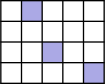
In the plane figure shown below, of the unit squares have been shaded. What is the least number of additional unit squares that must be shaded so that the resulting figure has two lines of symmetry?
小提示:
两条对称轴必须是这个矩形的中央竖直线和中央水平线
The two symmetry lines must be the central vertical and central horizontal lines of the rectangle
大提示:
每个已涂色的正方形都会迫使它关于两条轴的反射位置也被涂色
Each shaded square forces its reflections across both lines to be shaded too
解答:
要同时具有这两种对称性,对称轴必须是 乘 网格的竖直和水平中心线。每个已涂色正方形都会迫使它关于每条轴反射得到的正方形也被涂色。
顶部的正方形不在中心线上,所以它的反射组共有 个正方形,需要再涂 个。中间的正方形在中央列上,所以它的反射组共有 个正方形,需要再涂 个。右下的正方形同样有一个大小为 的反射组,需要再涂 个。
至少还需涂色的正方形数为 。
因此,正确答案是 D。
For both symmetries, the lines must be the vertical and horizontal center lines of the -by- grid. Every shaded square then forces the squares obtained by reflecting it across each line.
The top square lies off-center, so its reflection group has squares, requiring more. The middle square sits on the central column, so its group has squares, requiring more. The bottom-right square again has a group of requiring more.
The least number of additional squares is
Thus, D is the correct answer.
7.
七个体积分别为 、、、、、 和 立方单位的立方体竖直堆叠成一座塔,其中立方体的体积从下到上递减。除了最底下的立方体外,每个立方体的底面都完全落在它下方立方体的顶面上。这座塔的总表面积(包括底面)是多少平方单位?
Seven cubes, whose volumes are and cubic units, are stacked vertically to form a tower in which the volumes of the cubes decrease from bottom to top. Except for the bottom cube, the bottom face of each cube lies completely on top of the cube below it. What is the total surface area of the tower (including the bottom) in square units?
小提示:
这些立方体的边长为 ;分别处理四个竖直侧面和水平面
The cubes have side lengths handle the four vertical faces and the horizontal faces separately
大提示:
从正上方看,所有朝上的水平面积等于底面的 ;从正下方看也一样
Looking straight down, all upward-facing horizontal area equals the base’s the same holds looking up
解答:
这些立方体的边长为 。边长为 的立方体的四个侧面贡献 ,所以竖直侧面的总面积为 。
从正上方看,每一块朝上的水平面都无重叠地投影到底部的 正方形上,面积为 。从下方看同理,再得到 。
总表面积为 。
因此,正确答案是 B。
The side lengths are The four side faces of cube contribute so the vertical faces total
Viewed from directly above, every upward-facing horizontal patch projects onto the base without overlap, giving Viewed from below, the same is true, giving another
The total surface area is
Thus, B is the correct answer.
8.
下列 个数的中位数是多少?
,,,,,,,,,。
What is the median of the following list of numbers?
小提示:
有 个数时,中位数是第 小和第 小的数的平均
With numbers the median averages the th and st smallest
大提示:
不超过 的平方数来自 到 ;数一数列表中不超过某个整数的项有多少
Squares up to come from through count how many list entries are at most a given integer
解答:
中位数是第 小和第 小的值的平均。
不超过 的完全平方数为 (因为 且 ),所以共有 个。
在这个列表中,数值 的项包括 个整数 以及这 个平方数,总数为 。
因此第 个值是 ,第 个值是 ,中位数为 。
因此,正确答案是 C。
The median is the average of the th and st smallest values.
The perfect squares that are at most are (since and ), so there are of them.
Among the list, the numbers are the integers together with those squares, totaling
Thus the th value is and the st value is making the median
Thus, C is the correct answer.
9.
方程 在区间 上有多少个解?
How many solutions does the equation have on the interval
小提示:
在 上, 从 单调下降到 。
On decreases steadily from to
大提示:
的周期是 ;数一数它有多少个分支与这条下降曲线相交
has period count how many of its branches cross that decreasing curve
解答:
在 上, 的图像是一条从 单调下降到 的弧。
函数 的周期为 ,竖直渐近线位于 。它们将区间分成五个分支。在每个分支上, 严格递增,而 递减,所以每个分支至多有一个交点。
中间三个分支都从 变化到 ,所以各有一个交点。在第一个分支上,,而正切趋于 。在最后一个分支上,正切从 开始,在终点为 。因此两个外侧分支也各有一个交点,总计 个。
所以 E 是正确答案。
On the graph of is a single arc decreasing from down to
The function has period with vertical asymptotes at These split the interval into five branches. On every branch is strictly increasing, while is decreasing, so there is at most one intersection per branch.
Each of the three interior branches runs from to so each has one intersection. On the first branch, and the tangent tends to On the last, the tangent starts at and ends at Thus the two outer branches also have one intersection each, for total.
Thus, E is the correct answer.
10.
存在唯一的正整数 满足
的各位数字之和是多少?
There is a unique positive integer such that
What is the sum of the digits of
11.
一只青蛙坐在点 处,开始一系列跳跃。每次跳跃都平行于一条坐标轴,长度为 ,且每次跳跃的方向(上、下、右、左)都独立随机选择。当青蛙到达顶点为 、、 和 的正方形的一条边时,跳跃序列结束。跳跃序列在该正方形的竖直边上结束的概率是多少?
A frog sitting at the point begins a sequence of jumps, where each jump is parallel to one of the coordinate axes and has length and the direction of each jump (up, down, right, or left) is chosen independently at random. The sequence ends when the frog reaches a side of the square with vertices and What is the probability that the sequence of jumps ends on a vertical side of the square?
小提示:
令 为在竖直边上结束的概率;它等于四个相邻点处 值的平均
Let be the probability of ending on a vertical side; it equals the average of at the four neighbors
大提示:
利用对称性:,而内部点可化为一个小方程组
Use symmetry: and the interior points reduce to a small system of equations
解答:
令 为在竖直边上结束的概率。在竖直边上 ,在水平边上 ,在内部点处 是四个相邻点概率的平均。
由左右对称性,。令 ,,且 。则
,,且 。
代入可得 ,因此 。
因此,正确答案是 B。
Let be the probability of ending on a vertical side. On a vertical side on a horizontal side and at an interior point is the average of its four neighbors.
By left-right symmetry Let and Then
and
Substituting gives hence
Thus, B is the correct answer.
12.
坐标平面中的直线 方程为 。将这条直线绕点 逆时针旋转 ,得到直线 。直线 的 轴截距的 坐标是多少?
Line in the coordinate plane has the equation This line is rotated counterclockwise about the point to obtain line What is the -coordinate of the -intercept of line
小提示:
点 在 上,所以也在 上;求新的斜率
The point lies on so it also lies on find the new slope
大提示:
斜率 旋转 后变为 。
Rotating a slope by gives
解答:
注意 满足 ,所以它在 上,旋转后仍在 上。 的斜率为 。
旋转 后的斜率为 。
直线 为 。令 得到 ,所以 ,即 。
因此,正确答案是 B。
Note satisfies so it is on and remains on The slope of is
Rotating by gives slope
Line is Setting gives so and
Thus, B is the correct answer.
13.
存在都大于 的整数 、 和 ,使得对所有 都有 是多少?
There are integers and each greater than such that for all What is
小提示:
将左边写成 的幂,指数为 。
Write the left side as to the power
大提示:
令这个指数等于 ,并从 开始逐层确定嵌套变量
Set that exponent equal to and peel off one nested variable at a time starting with
解答:
左边等于 的 次幂,而这个指数必须等于 。
因为 ,这个指数至多为 。如果 ,它至多为 ,所以 。方程变为 。
清除分母得到 。令 ,则 是 的正因数。在 中,只有 能使 为整数。因此 且 。
所以 B 是正确答案。
The left side equals raised to the exponent which must equal
Because this exponent is at most If it is at most so The equation becomes
Clearing denominators gives Set so is a positive divisor of Among only makes an integer. Hence and
Thus, B is the correct answer.
14.
正八边形 的面积为 。设四边形 的面积为 。 是多少?
Regular octagon has area Let be the area of quadrilateral What is
小提示:
是内接于八边形的正方形
is a square inscribed in the octagon
大提示:
对称放置八边形并计算两个面积;四个角上的三角形组成了差额
Place the octagon symmetrically and compute both areas; the four corner triangles make up the difference
解答:
四个顶点 构成一个正方形,因为它们是正八边形中每隔一个顶点取出的点。
取外接圆半径为一,八边形面积为 ,而正方形 的对角线等于该圆的直径,因此面积为 。
比值为 。
因此,正确答案是 B。
The four vertices form a square, since they are every other vertex of the regular octagon.
Taking a unit circumradius, the octagon’s area is and the square has diagonal equal to the circle’s diameter, giving area
The ratio is
Thus, B is the correct answer.
15.
在复平面中,设 为方程 的解集,设 为方程 的解集。 中一点与 中一点之间的最大距离是多少?
In the complex plane, let be the set of solutions to and let be the set of solutions to What is the greatest distance between a point of and a point of
小提示:
是 的三个立方根;第二个三次式可用分组法分解
is the three cube roots of factor the second cubic by grouping
大提示:
最大距离来自 的一个非实立方根与第二个方程中最远的实根
The largest distance pairs a nonreal cube root of with the farthest real root of the second equation
解答:
集合 由 的三个立方根组成:、 和 。
分组因式分解, ,所以 ,全都是实数。
最大距离是从 到 的距离: 。
因此,正确答案是 D。
The set consists of the cube roots of and
Factoring by grouping, so all real.
The greatest distance is from to
Thus, D is the correct answer.
16.
在坐标平面中,从顶点为 、、 和 的正方形内随机选取一点。该点在某个格点的 个单位以内的概率为 。(若点 的 和 都是整数,则称它为格点。) 四舍五入到十分位是多少?
A point is chosen at random within the square in the coordinate plane whose vertices are and The probability that the point is within units of a lattice point is (A point is a lattice point if and are both integers.) What is to the nearest tenth?
小提示:
由周期性,只需关注一个四个顶点都是格点的单位正方形
By periodicity, focus on a single unit square with a lattice point at each corner
大提示:
一个单位格子中的四个四分之一圆盘组成一个半径为 的完整圆盘;令其面积为 。
The four quarter-disks in one unit cell form one full disk of radius set its area to
解答:
由周期性,只需考虑一个四个角都是格点的单位格子。距离某个角不超过 的区域由四个半径为 的四分之一圆盘组成,合成一个面积为 的完整圆盘。所得的值将小于 ,所以这些四分之一圆盘互不重叠。
令 得到 。
四舍五入到十分位,。
因此,正确答案是 B。
By periodicity it suffices to consider one unit cell with a lattice point at each corner. The region within of a corner consists of four quarter-disks of radius forming one full disk of area The resulting value will be less than so these quarter-disks do not overlap.
Setting gives
To the nearest tenth,
Thus, B is the correct answer.
17.
一个四边形的顶点都在 的图像上,且这些顶点的 坐标是连续的正整数。该四边形的面积为 。最左边顶点的 坐标是多少?
The vertices of a quadrilateral lie on the graph of and the -coordinates of these vertices are consecutive positive integers. The area of the quadrilateral is What is the -coordinate of the leftmost vertex?
小提示:
令 坐标为 ,并使用鞋带公式
Let the -coordinates be and apply the shoelace formula
大提示:
面积化简为 ;令它等于 。
The area simplifies to set it equal to
解答:
设四个顶点的 坐标为 ,对应的 坐标为对这些数取 所得的值。用鞋带公式并化简,面积为 。
令 ,得到 ,所以 。
因此 ,所以 。
因此,正确答案是 D。
Let the vertices have -coordinates with -coordinates of those values. Applying the shoelace formula and simplifying, the area is
Setting gives so
Then so
Thus, D is the correct answer.
18.
四边形 满足 ,,且 。对角线 与 交于点 ,且 。四边形 的面积是多少?
Quadrilateral satisfies and Diagonals and intersect at point and What is the area of quadrilateral
小提示:
设 ,,且 ,则
Place and so
大提示:
因为 ,点 在以 为直径的圆上;它也在直线 上
Since lies on the circle with diameter it also lies on line
解答:
设 ,。因为 ,所以 ;又因 ,所以 。
因为 ,点 在以 为圆心、半径为 的圆上。直线 上的点可写为 ;代入圆方程得到 ,所以 或 。
为使 位于 与 之间,取 ,得到 ,它到直线 的距离为 。
于是 ,且 ,总面积为 。
因此,正确答案是 D。
Place and Since and because
Since lies on the circle of radius centered at Line is substituting gives so or
For to lie between and take giving a distance below line
Then and so the total area is
Thus, D is the correct answer.
19.
存在唯一的严格递增非负整数序列 ,使得 是多少?
There exists a unique strictly increasing sequence of nonnegative integers such that What is
小提示:
令 ;则商为 。
Write then the quotient is
大提示:
将交替项成对分组为 ,每一组在二进制表示中是一段 个一
Group the alternating terms into pairs each a block of ones in binary
解答:
令 ,则 是 个幂 的交替和。
把每个被减去的幂与它上方刚好被加上的幂配对: ,这是一段 个连续的 的幂。
这样的配对有 组,另有剩下的 。这些块占据的指数范围互不重叠,所以幂的总数为 。
因此,正确答案是 C。
Let Then an alternating sum of the powers
Pair each subtracted power with the added power just above it: a block of consecutive powers of
There are such pairs, together with the leftover The blocks occupy disjoint ranges, so the total number of powers is
Thus, C is the correct answer.
20.
设 是坐标平面中顶点为 、 和 的三角形。考虑平面上的以下五个等距变换(刚性变换):绕原点逆时针旋转 、 和 ,关于 轴反射,以及关于 轴反射。在这五种变换中任选三个组成的 个序列(不要求互不相同)中,有多少个会把 送回原来的位置?(例如,先旋转 ,再关于 轴反射,再关于 轴反射,会把 送回原来的位置;但先旋转 ,再关于 轴反射,再次关于 轴反射,则不会把 送回原来的位置。)
Let be the triangle in the coordinate plane with vertices and Consider the following five isometries (rigid transformations) of the plane: rotations of and counterclockwise around the origin, reflection across the -axis, and reflection across the -axis. How many of the sequences of three of these transformations (not necessarily distinct) will return to its original position? (For example, a rotation, followed by a reflection across the -axis, followed by a reflection across the -axis will return to its original position, but a rotation, followed by a reflection across the -axis, followed by another reflection across the -axis will not return to its original position.)
小提示:
因为 是不等边三角形,唯一固定 的等距变换是恒等变换,所以这三个变换的复合必须是恒等变换
Since is scalene, the only isometry fixing is the identity, so the three must compose to the identity
大提示:
前两个变换确定第三个变换;当且仅当前两个的复合仍是这五个映射之一时,第三个变换是允许的
The third transformation is forced by the first two; it is allowed exactly when the product of the first two is again one of the five maps
解答:
因为 是不等边直角三角形,唯一将 映到自身的等距变换是恒等变换,所以一个序列可行,当且仅当三个变换的复合是恒等变换。
令 表示旋转 ,令 表示关于 轴的反射。五个允许的映射是 ;缺少的非恒等映射是两个对角线反射 。在有序三元组中,第三个映射由前两个唯一决定;它被允许,当且仅当前两个的乘积是这五个映射之一。
恰有 个有序对的乘积是恒等变换:每个第一个映射都与它的逆映射配对。得到对角线反射需要一个旋转和一个轴反射; 或 可以在左侧或右侧与 或 配对,共有 对。剩余 个有序对给出有效序列。
所以 A 是正确答案。
Because is a scalene right triangle, the only isometry carrying to itself is the identity, so a sequence works exactly when the three transformations compose to the identity.
Let be the rotation and reflection across the -axis. The five allowed maps are the missing nonidentity maps are the diagonal reflections In an ordered triple, the third map is forced by the first two and is allowed precisely when their product is one of the five.
Exactly ordered pairs have product identity: each first map is paired with its inverse. A diagonal reflection requires one rotation and one axis reflection; or may be paired on either side with or giving pairs. The remaining ordered pairs give valid sequences.
Thus, A is the correct answer.
21.
有多少个正整数 满足: 是 的倍数,并且 与 的最小公倍数等于 与 的最大公因数的 倍?
How many positive integers are there such that is a multiple of and the least common multiple of and equals times the greatest common divisor of and
小提示:
且 ;比较每个质数的指数
and compare exponents of each prime
大提示:
将最大公因数乘以 会使 的指数增加一;求出 中每个质数指数的允许值
Multiplying the gcd by raises the power of by one; work out the allowed exponent of each prime in
解答:
写 。由于 不含其他质数, 只能含有 。在等式 中逐个匹配质因数的指数。
对于 :,所以 有 个值。对于 :,所以 有 个值。
对于 :,且 ,这迫使 有 个值。对于 :,所以 或 有 个值。
总数为 。
因此,正确答案是 D。
Write Since has no other primes, can only involve Matching exponents in
For so gives values. For so gives values.
For with which forces giving value. For so or giving values.
The total is
Thus, D is the correct answer.
22.
设 和 为实数序列,使得对所有整数 都有 其中 。求
Let and be the sequences of real numbers such that for all integers where What is
23.
Jason 掷三枚公平的标准六面骰。然后他查看掷出的点数,并选择一个骰子子集(可以为空,也可以是全部三枚)重新掷。重新掷后,当且仅当三枚骰子朝上点数之和恰好为 时,他获胜。Jason 总是采取最优策略来最大化获胜概率。他选择恰好重新掷两枚骰子的概率是多少?
Jason rolls three fair standard six-sided dice. Then he looks at the rolls and chooses a subset of the dice (possibly empty, possibly all three dice) to reroll. After rerolling, he wins if and only if the sum of the numbers face up on the three dice is exactly Jason always plays to optimize his chances of winning. What is the probability that he chooses to reroll exactly two of the dice?
小提示:
比较重新掷一枚骰子(保留两枚和至多为 的骰子)与重新掷两枚骰子(保留一枚较小的骰子)的获胜概率
Compare the win chance from rerolling one die (keep two summing to at most ) with rerolling two (keep one small die)
大提示:
当没有两枚骰子的和不超过 ,但最小骰子又足够小以优于重掷全部三枚时,恰好重掷两枚是最优
Rerolling exactly two is best when no two dice sum to or less, yet the smallest die is small enough to beat rerolling all three
解答:
重掷一枚骰子、保留点数和为 的两枚骰子时,如果 ,获胜概率为 ,否则为 。重掷两枚骰子、保留点数为 的一枚骰子时,获胜概率等于两枚骰子点数和为 的方式数除以 ;当 最小时,这个概率最大。对 ,这些概率分别是 ,都大于重掷全部骰子的概率 ;对 ,重掷全部骰子更好。
恰好重掷两枚骰子严格最优,当且仅当最小的两枚骰子点数和至少为 (所以重掷一枚不能达到 ),同时最小骰子的点数是 ,或 (所以保留它优于重掷全部三枚)。
将结果排序为 。当 时,只有 一种,排列数为 。当 时, 的排列数之和为 。当 时,从 中可重复地选 ,六个三元组的排列数之和为 。因此在 个有序结果中,有 个满足条件,概率为 。
所以 A 是正确答案。
Rerolling one die, keeping two dice that sum to wins with probability when and otherwise. Rerolling two dice, keeping a die of value wins with probability equal to the number of ways two dice sum to over this is largest when is smallest. For these probabilities are all greater than the reroll-all probability for rerolling all is better.
Rerolling exactly two dice is strictly best precisely when the two smallest dice sum to at least (so rerolling one cannot reach ) while the smallest die is or (so keeping it beats rerolling all three).
Sort the roll as If the only possibility is with orderings. If the possibilities have orderings. If choose with repetition from the six resulting triples have orderings. Thus there are qualifying ordered rolls out of a probability of
Thus, A is the correct answer.
24.
假设 是边长为 的等边三角形,并且具有如下性质:三角形内部存在唯一一点 ,使得 ,,且 。 是多少?
Suppose that is an equilateral triangle of side length with the property that there is a unique point inside the triangle such that and What is
小提示:
对于等边三角形内一点到三个顶点的距离 以及边长 ,四个值满足
For a point at distances from the vertices of an equilateral triangle of side the four values satisfy
大提示:
代入 ,,,并解所得关于 的二次方程
Substitute and solve the resulting quadratic in
解答:
等边三角形内一点到三个顶点的距离为 ,边长为 时,满足 。
令 ,,,并设 得到 ,所以 ,从而 或 。
边长为 的三角形不可能包含一个到某顶点距离为 的点,所以 ,于是 。
因此,正确答案是 B。
A point at distances from the vertices of an equilateral triangle of side satisfies
With letting gives so and or
A triangle of side cannot contain a point at distance from a vertex, so and
Thus, B is the correct answer.
25.
数 ,其中 和 是互质的正整数,具有如下性质:所有满足 的实数 的和为 ,其中 表示不超过 的最大整数, 表示 的小数部分。 是多少?
The number where and are relatively prime positive integers, has the property that the sum of all real numbers satisfying is where denotes the greatest integer less than or equal to and denotes the fractional part of What is
小提示:
在 上,写 且 将方程化为二次方程 。
On write and turning the equation into a quadratic
大提示:
把除以 之后的两个根参数化为 和 ;再确定哪些正整数 会使某个根落在 中
Parameterize the two roots after dividing by as and determine which positive integers put a root in
解答:
没有负数解,而 总是一个解。对 且 ,令 。方程变为 。它的根必须为实数,所以 。
若两个根为 ,它们的和与积都等于 ,所以 。写成 其中 。此时 。根 位于 中,当且仅当 ,而对正整数 , 永远不在该区间中。
所要求的正总和保证 。令 为小于 的最大正整数,则 。所有解的和为 因为 随 递减,上述不等式给出 从而迫使 。
代入得到 ,所以 。因此 。确实,正数解是 ,其中 ,它们的和为 。所以 。
所以 C 是正确答案。
There are no negative solutions, while is always a solution. For and put The equation becomes Its roots must be real, so
If the two roots are their sum and product are both so Write with Then The root lies in exactly when while never lies there for a positive integer
The required positive total ensures Let be the largest positive integer less than so The sum of all solutions is therefore Because decreases with these inequalities imply which forces
Substitution gives so Hence Indeed the positive solutions are for and their sum is Therefore
Thus, C is the correct answer.