
2016 AMC 12A 详解
向下滚动即可查看来自 LIVE by Po-Shen Loh 的精心整理的解答,打印PDF 解答,查看答案,或参加完整限时模拟考试。
所有题目均经美国数学协会(MAA)官方合法授权使用。
1.
2.
当 为何值时,?
For what value of does
小提示:
把每个底数都写成 的幂。
Write every base as a power of
大提示:
左边变为 ,右边变为 。
The left side becomes and the right side
解答:
因为 ,,方程变为 所以 。于是 ,得到 。
所以正确答案是 C。
Since and the equation becomes so Then giving
Thus, the correct answer is C.
3.
对所有实数 和满足 的实数 ,余数函数可定义为 其中 表示小于或等于 的最大整数。 的值是多少?
The remainder function can be defined for all real numbers and with by where denotes the greatest integer less than or equal to What is the value of
4.
个数据值 ,,,,,, 的平均数、中位数和众数都等于 。 的值是多少?
The mean, median, and mode of the data values are all equal to What is the value of
小提示:
令平均数等于 。
Set the mean equal to
大提示:
,然后确认中位数和众数。
then confirm the median and mode
解答:
由平均数条件, 所以 ,得到 。
按非降序排列,数据为 ,所以中位数为 ,众数也为 ,符合要求。
所以正确答案是 D。
The mean condition gives so and
In nondecreasing order the data are so the median is and the mode is as required.
Thus, the correct answer is D.
5.
Goldbach 猜想指出:每个大于 的偶整数都可以写成两个质数之和,例如 。到目前为止,还没有人能证明该猜想为真,也没有人找到反例证明它为假。一个反例应当是什么?
Goldbach’s conjecture states that every even integer greater than can be written as the sum of two prime numbers (for example, ). So far, no one has been able to prove that the conjecture is true, and no one has found a counterexample to show that the conjecture is false. What would a counterexample consist of?
一个大于 且可以写成两个质数之和的奇整数
an odd integer greater than that can be written as the sum of two prime numbers
一个大于 且不能写成两个质数之和的奇整数
an odd integer greater than that cannot be written as the sum of two prime numbers
一个大于 且可以写成两个非质数之和的偶整数
an even integer greater than that can be written as the sum of two numbers that are not prime
一个大于 且可以写成两个质数之和的偶整数
an even integer greater than that can be written as the sum of two prime numbers
一个大于 且不能写成两个质数之和的偶整数
an even integer greater than that cannot be written as the sum of two prime numbers
小提示:
反例要满足命题的前提,但破坏结论。
A counterexample keeps the hypothesis but breaks the conclusion
大提示:
前提是“大于 的偶整数”;结论是“可以写成两个质数之和”。
The hypothesis is “even integer greater than ”; the conclusion is “a sum of two primes”
解答:
反例必须满足“大于 的偶整数”这个前提,同时不满足“可以写成两个质数之和”这个结论。
所以正确答案是 E。
A counterexample must satisfy the hypothesis of being an even integer greater than while failing the conclusion that it can be written as the sum of two prime numbers.
Thus, the correct answer is E.
6.
一个由 枚硬币组成的三角形阵列,第一行有 枚,第二行有 枚,第三行有 枚,依此类推,直到第 行有 枚。 的各位数字之和是多少?
A triangular array of coins has coin in the first row, coins in the second row, coins in the third row, and so on up to coins in the th row. What is the sum of the digits of
7.
下列哪一项描述了 的图像?
Which of these describes the graph of
两条平行直线
two parallel lines
两条相交直线
two intersecting lines
三条直线都经过同一个公共点
three lines that all pass through a common point
三条直线不全经过同一个公共点
three lines that do not all pass through a common point
一条直线和一条抛物线
a line and a parabola
小提示:
把所有项移到一边,并提出 。
Move everything to one side and factor out
大提示:
是三条直线的并。
is the union of three lines
解答:
将所有项移到一边,得到 再分解为 因此图像是直线 、 和 的并集。
前两条直线交于原点,但第三条直线 与 平行,不经过原点。因此,图像由三条不全经过同一个公共点的直线组成。
所以正确答案是 D。
Moving all terms to one side gives which factors as The graph is therefore the union of the lines and
The first two lines intersect at the origin, but the third line is parallel to and does not pass through the origin. So the graph consists of three lines that do not all pass through a common point.
Thus, the correct answer is D.
8.
给定的 长方形中,阴影区域的面积是多少?
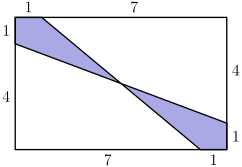
What is the area of the shaded region of the given rectangle?
小提示:
每一条画出的线段都经过长方形的中心。
Every drawn segment passes through the center of the rectangle
大提示:
主对角线把阴影区域分成四个三角形,每个三角形的底为 。
The main diagonal splits the shaded region into four triangles, each with base
解答:
从长方形左上角到右下角的对角线将阴影区域分成四个三角形,它们都在长方形中心相遇。
其中两个三角形的水平底边长为 ,高为 ;另外两个三角形的竖直底边长为 ,高为 。总面积为
所以正确答案是 D。
The diagonal of the rectangle from the upper-left corner to the lower-right corner divides the shaded region into four triangles, all meeting at the center of the rectangle.
Two of these triangles have a horizontal base of length and altitude and the other two have a vertical base of length and altitude The total area is
Thus, the correct answer is D.
9.
在这个单位正方形内有五个全等的小阴影正方形,它们内部互不重叠。如图,中间正方形每条边的中点分别与另外四个小正方形的一个顶点重合。它们的公共边长为 ,其中 、 为正整数。 是多少?
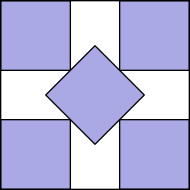
The five small shaded squares inside this unit square are congruent and have disjoint interiors. The midpoint of each side of the middle square coincides with one of the vertices of the other four small squares as shown. The common side length is where and are positive integers. What is
小提示:
画出单位正方形的对角线,其长度为 。
Draw the diagonal of the unit square, which has length
大提示:
该对角线等于两条小正方形对角线加上一条小正方形边:。
That diagonal equals two small-square diagonals plus one small-square side:
解答:
设公共边长为 。单位正方形的对角线长为 ,由两条各长 的小正方形对角线和一条长为 的小正方形边组成,所以
解得 因此 、,所以 。
所以正确答案是 E。
Let be the common side length. The diagonal of the unit square has length and consists of two small-square diagonals (each ) plus one small-square side length so
Solving, Thus and
Thus, the correct answer is E.
10.
五位朋友坐在电影院同一排的 个座位上,座位从左到右编号为 到 。(“左”和“右”从坐在座位上的人的视角看。) 电影中途 Ada 去大厅买爆米花。她回来时发现 Bea 向右移动了两个座位,Ceci 向左移动了一个座位,Dee 和 Edie 交换了座位,并给 Ada 留下了一个端座。Ada 起身前坐在哪个座位?
Five friends sat in a movie theater in a row containing seats, numbered to from left to right. (The directions “left” and “right” are from the point of view of the people as they sit in the seats.) During the movie Ada went to the lobby to get some popcorn. When she returned, she found that Bea had moved two seats to the right, Ceci had moved one seat to the left, and Dee and Edie had switched seats, leaving an end seat for Ada. In which seat had Ada been sitting before she got up?
小提示:
总向右位移必须等于总向左位移。
The total rightward movement must equal the total leftward movement
大提示:
Bea 移动 ,Ceci 移动 ,Dee 和 Edie 的移动相互抵消;求 Ada 的位移。
Bea moves Ceci moves and Dee and Edie cancel; find Ada’s shift
解答:
五位朋友的总位移为零。Dee 和 Edie 交换座位,所以两人的位移相互抵消。Bea 移动 个座位,Ceci 移动 个座位,净位移为 ,所以 Ada 必须移动 个座位才能抵消。
Ada 回来后坐在端座;既然她向左移动了一个座位,该端座只能是 号座,所以她原来坐在 号座。
所以正确答案是 B。
The net displacement of all five friends is zero. Dee and Edie swapped seats, so their movements cancel. Bea moved and Ceci moved a net of so Ada must move to balance.
Ada returns to an end seat; since she moved one seat to the left, that seat must be seat so she had been sitting in seat
Thus, the correct answer is B.
11.
某夏令营的 名学生每人都会唱歌、跳舞或表演。有些学生有不止一种才艺,但没有学生三种才艺都会。有 名学生不会唱歌, 名学生不会跳舞, 名学生不会表演。有多少名学生正好有两种才艺?
Each of the students in a certain summer camp can either sing, dance, or act. Some students have more than one talent, but no student has all three talents. There are students who cannot sing, students who cannot dance, and students who cannot act. How many students have two of these talents?
小提示:
分别数会唱歌、会跳舞、会表演的人数。
Count how many students can do each activity
大提示:
把三个人数相加时,两种才艺的学生被数了两次;减去 。
Adding the three counts tallies two-talent students twice; subtract
解答:
会唱歌、跳舞、表演的人数分别为 、、,总和为 。
因为没有人三种才艺都会,每个学生有一种或两种才艺,所以只有一种才艺的学生被数一次,有两种才艺的学生被数两次。因此,被重复计算的人数为 。
所以正确答案是 E。
The numbers who can sing, dance, and act are and respectively, for a total of
Since no student has all three talents, each student has one or two talents, so single-talent students are counted once and two-talent students are counted twice. The number counted twice is
Thus, the correct answer is E.
12.
在 中,、、。点 在 上,且 平分 。点 在 上,且 平分 。两条角平分线交于 。比值 是多少?
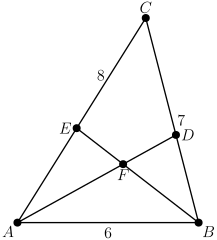
In and Point lies on and bisects Point lies on and bisects The bisectors intersect at What is the ratio
小提示:
在 中应用角平分线定理求 。
Apply the Angle Bisector Theorem in to find
大提示:
在 中,线段 平分 ,所以 。
In segment bisects so
解答:
在 中应用角平分线定理,得到 ,所以 。
在 中, 平分 ,再次应用角平分线定理可得
所以正确答案是 C。
Applying the Angle Bisector Theorem to gives so
Now lies along the bisector of in so by the Angle Bisector Theorem again,
Thus, the correct answer is C.
13.
设 是 的正倍数。一个红球和 个绿球随机排成一行。令 为至少 的绿球在红球同一侧的概率。已知 ,并且当 变大时 趋近于 。使 的最小 的各位数字之和是多少?
Let be a positive multiple of One red ball and green balls are arranged in a line in random order. Let be the probability that at least of the green balls are on the same side of the red ball. Observe that and that approaches as grows large. What is the sum of the digits of the least value of such that
小提示:
写 ;红球有 个等可能位置。
Write the red ball has equally likely positions
大提示:
;解不等式 。
solve
解答:
写 。从一端开始,将红球的可能位置编号为 ,共有 个等可能位置。
红球两侧的绿球都少于 的情形,恰好对应红球位于 中的某个位置,共有 个。因此
解不等式 ,得到 ,即 ,所以 ,也就是 。因此 、,其各位数字之和为 。
所以正确答案是 A。
Write Number the positions of the red ball from one end; there are equally likely positions.
Fewer than of the green balls lie on each side exactly when the red ball is in one of the positions which is positions. Hence
Solving gives so and meaning Thus and whose digit sum is
Thus, the correct answer is A.
14.
一个立方体的每个顶点都要标上 到 中的一个整数,每个整数恰用一次,并且每个面的四个顶点数字之和都相同。通过旋转立方体可以互相得到的标法视为相同。有多少种不同的标法?
Each vertex of a cube is to be labeled with an integer from through with each integer being used once, in such a way that the sum of the four numbers on the vertices of a face is the same for each face. Arrangements that can be obtained from each other through rotations of the cube are considered to be the same. How many different arrangements are possible?
小提示:
每个顶点属于 个面,所以六个面和的总和为 。
Each vertex lies on faces, so the six face-sums total
大提示:
每个面的和为 ;证明 和 必须在相邻顶点上。
The face-sum is show and must be on adjacent vertices
解答:
每个顶点属于 个面,所以 ,从而每个面的和为 。
包含 且和为 的四元子集是 ,,,和 。其中只有一个不含 ,所以经过 的三个不同面中至少有两个包含 。立方体的两个顶点恰好在相邻时才共同位于两个面上;因此 和 相邻。
旋转立方体,使 位于左下前顶点, 位于右下前顶点。经过 而不含 的唯一一个面必须放置 ,它们有 种排列。每种排列都会迫使 位于三个相对顶点,其余各面的和也都为 。因此共有 种标法。
因此,正确答案是 C。
Each vertex belongs to faces, so giving each face-sum
The four-element subsets containing with sum are and Only one omits so at least two of the three distinct faces through contain Two vertices of a cube lie on two common faces exactly when they are adjacent; hence and are adjacent.
Rotate the cube so that is at the lower-left-front vertex and at the lower-right-front vertex. The unique face through that does not contain must use and these can be placed in orders. Each order forces at the three opposite vertices, and the remaining face sums are then Hence there are arrangements.
Thus, the correct answer is C.
15.
圆心为 、、、半径分别为 、、 的三个圆位于直线 的同侧,并分别在 、、 处与 相切,其中 在 与 之间。圆心为 的圆与另外两个圆都外切。 的面积是多少?
Circles with centers and having radii and respectively, lie on the same side of line and are tangent to at and respectively, with between and The circle with center is externally tangent to each of the other two circles. What is the area of
小提示:
两个相切圆的切点间水平距离为 。
The horizontal distance between two tangent points is
大提示:
把 放在高度 上,再用鞋带公式。
Place at heights and use the shoelace formula
解答:
三个圆心到直线 的高度分别为 、、。由于圆 与圆 外切,,所以水平距离为 。同理,圆 与圆 外切,,所以 。
取 、、。由鞋带公式,面积为
所以正确答案是 D。
The centers lie at heights and above line Since circle is externally tangent to circle we have so the horizontal distance is Since circle is tangent to circle we have so
Place and By the shoelace formula, the area is
Thus, the correct answer is D.
16.
将 、、 以及 的图像画在同一坐标系中。平面上有多少个 坐标为正的点位于两条或更多条图像上?
The graphs of and are plotted on the same set of axes. How many points in the plane with positive -coordinates lie on two or more of the graphs?
小提示:
令 ,把四个函数值改写为 。
Let and rewrite all four as
大提示:
找出哪些 会让这四个表达式中任意两个相等。
Find every where two of these four expressions are equal
解答:
令 ,则 ,,且 。两条图像相交时, 中有两个相等,并且对应的 有效。
令 得 ,所以 或 ;令 得到同样的值。令 得 ,即 ,此时 与 都等于 。其余配对没有实数解。
不同交点为 、、、 和 ,所以共有 个。
所以正确答案是 D。
Let Then and Two graphs meet where two of are equal for some valid
Setting gives so or setting gives the same values. Setting gives i.e. where and are both The remaining pairings have no real solution.
The distinct intersection points are and so there are
Thus, the correct answer is D.
17.
设 是正方形。令 、、、 分别为以 、、、 为底、且在正方形外侧的等边三角形的中心。正方形 的面积与正方形 的面积之比是多少?
Let be a square. Let and be the centers, respectively, of equilateral triangles with bases and each exterior to the square. What is the ratio of the area of square to the area of square
小提示:
等边三角形的中心距底边为其高的 。
The center of an equilateral triangle lies of its height from the base
大提示:
比较两个正方形的对角线;面积比是长度比的平方。
Compare diagonals of the two squares; the area ratio is the square of the length ratio
解答:
设正方形 的边长为 。每个等边三角形的高为 ,其中心到正方形相应边的距离是该高的 ,即 。
正方形 的对角线长为 。正方形 的对角线等于 的边长加上两段长为 的距离,即 。面积比等于对角线长度之比的平方:
所以正确答案是 B。
Let square have side length Each equilateral triangle has height and its center lies of that height, namely from the square’s side.
Square has diagonal Square has diagonal equal to the side of plus twice namely The area ratio is the square of the ratio of diagonals:
Thus, the correct answer is B.
18.
对某个正整数 ,数 有 个正整数因数,其中包括 和 本身。数 有多少个正整数因数?
For some positive integer the number has positive integer divisors, including and the number How many positive integer divisors does the number have?
小提示:
,所以 恰有三个质因数。
so has exactly three prime factors
大提示:
各指数加一的乘积为 ;推出 。
The exponents plus one multiply to deduce
解答:
数 能被三个不同的质数 整除。若其质因数指数为 ,则 ,其中 。因为已经至少有三个大于 的因数,所以恰好只有三个,这说明没有其他质数整除 。
中的每个指数都满足 ,因此每个因数个数中的因子 都满足 。因数 都具有这种形式,所以指数按某种顺序为 。从 中已有的指数减去 ,再除以 ,得到 中的指数按某种顺序为 。因此 ,其中不同质数 选自 。
所以 中的指数为 和 ,而 引入第三个质数,因为 不能被 整除。因此 的因数个数为
因此,正确答案是 D。
The number is divisible by the three distinct primes If its prime exponents are then where Because there are already at least three factors greater than there are exactly three, so no other prime divides
Each exponent in is so each divisor-count factor is The factors all have that form, so the exponents are in some order. After subtracting the exponent from and dividing by the exponents in are in some order. Thus for two distinct primes chosen from
Consequently has exponents and while introduces a third prime because is not divisible by Hence the number of divisors of is
Thus, the correct answer is D.
19.
Jerry 从实数轴上的 出发。他投掷一枚公平硬币 次。若正面朝上,他向正方向移动 单位;若反面朝上,他向负方向移动 单位。他在这个过程中某一时刻到达 的概率为 ,其中 和 是互质正整数。 是多少?(例如,若投掷序列为 HTHHHHHH,他成功。)
Jerry starts at on the real number line. He tosses a fair coin times. When he gets heads, he moves unit in the positive direction; when he gets tails, he moves unit in the negative direction. The probability that he reaches at some time during this process is where and are relatively prime positive integers. What is (For example, he succeeds if his sequence of tosses is HTHHHHHH.)
小提示:
统计 个投掷序列中,累计位置到达 的序列数。
Count the toss sequences in which the running total reaches
大提示:
反面至多 次时一定到达 ;反面有 或 次时只有部分顺序可行。
With at most tails he always reaches with or tails only some orders work
解答:
统计 次投掷中累计总和达到过 的序列数。如果反面至多出现 次,他一定能达到 ,贡献 个序列。
恰有 次反面时,他只能在第 次或第 次投掷首次达到 。要在第 次达到,前四次必须全为正面,之后剩下的那个正面有 个可能位置。否则第 和第 次是正面,前四次中有一次反面,最后两次是反面,同样有 种可能。因此这一情形贡献 个序列。恰有 次反面时,只有 HHHHTTTT 可行,贡献 个序列。正面少于 次时不可能达到 。
所以有利序列共有 个,全部序列有 个,概率为 。因此 。
因此,正确答案是 B。
Count the sequences of tosses whose running total reaches With at most tails he certainly reaches contributing sequences.
With exactly tails, he can first reach on toss or toss Reaching it on toss requires four initial heads, after which the remaining head has possible positions. Otherwise, tosses and are heads, one of the first four tosses is a tail, and the last two are tails, again giving possibilities. Thus this case contributes With exactly tails, only HHHHTTTT works, giving He cannot reach with fewer than heads.
So there are favorable sequences out of a probability of Then
Thus, the correct answer is B.
20.
二元运算 满足:对所有非零实数 、、,,且 。(这里的点 表示通常的乘法。)方程 的解可写为 ,其中 、 是互质正整数。 是多少?
A binary operation has the properties that and that for all nonzero real numbers and (Here the dot represents the usual multiplication operation.) The solution to the equation can be written as where and are relatively prime positive integers. What is
21.
一个四边形内接于半径为 的圆。该四边形的三条边长为 。第四条边长是多少?
A quadrilateral is inscribed in a circle of radius Three of the sides of this quadrilateral have length What is the length of its fourth side?
小提示:
每条长 的边对应圆心角 ,其中 。
Each side of length subtends a central angle with
大提示:
第四条边对应 ;使用 。
The fourth chord has the same length as one subtending use
解答:
设长为 的边所对的圆心角为 ,圆的半径为 。对以圆心为顶点的等腰三角形应用余弦定理,得到 所以 。
三条相等的边占据三段圆心角均为 的连续弧,所以第四段弧的圆心角为 。它所对的弦与圆心角为 的弦等长,并且 它的长度平方为 所以第四条边长为 。
所以正确答案是 E。
Let be the central angle subtending a side of length with radius By the law of cosines on the isosceles triangle from the center, so
The three equal sides use three consecutive arcs of angle so the fourth arc has angle Its chord has the same length as a chord with central angle and Its length squared is so the fourth side is
Thus, the correct answer is E.
22.
有多少个正整数有序三元组 满足 ,,且 ?
How many ordered triples of positive integers satisfy and
小提示:
分解:、、。
Factor:
大提示:
分别处理质数 ,并使用指数的 。
Handle each prime separately, using of the exponents
解答:
因为 ,且 ,所以 整除 ,而 和 都不能被 整除。同理, 整除 ,而 和 都不能被 整除;此外, 必须含有因子 。
写 、、,最小公倍数条件要求 ,且 。第一对可以取 ,第二对可以取 ,因此共有 个有序三元组。
所以正确答案是 A。
Because and the factor divides while neither nor is divisible by Also divides while neither nor is divisible by and must have the factor
Writing and the lcm conditions require and The first pair can be and the second can be Thus there are ordered triples.
Thus, the correct answer is A.
23.
从区间 中独立随机选取三个数。所选三个数能作为一个面积为正的三角形的边长的概率是多少?
Three numbers in the interval are chosen independently and at random. What is the probability that the chosen numbers are the side lengths of a triangle with positive area?
小提示:
三元组 填满单位立方体;不能构成三角形意味着某个数 另外两个数之和。
The triples fill a unit cube; failure means one number the sum of the other two
大提示:
每个区域,例如 都是体积为 的四面体。
Each region such as is a tetrahedron of volume
解答:
有序三元组 填满体积为 的单位立方体。不能构成三角形,恰好意味着某个数大于或等于另外两个数之和。
区域 是一个四面体,顶点为 ,体积为 。类似地,区域 和 的体积也各为 ,而且内部互不相交。因此不能构成三角形的概率为 ,能构成三角形的概率为 。
所以正确答案是 C。
The ordered triples fill the unit cube of volume They fail to form a triangle exactly when one value is at least the sum of the other two.
The region is a tetrahedron with vertices of volume The analogous regions and also have volume and have disjoint interiors. So the failure probability is and the triangle probability is
Thus, the correct answer is C.
24.
存在一个最小正实数 ,使得存在正实数 ,并且多项式 的所有根都是实数。事实上,对这个 值, 是唯一的。这个 的值是多少?
There is a smallest positive real number such that there exists a positive real number such that all the roots of the polynomial are real. In fact, for this value of the value of is unique. What is this value of
小提示:
若根为 ,则 且 。
If the roots are then and
大提示:
对 使用算术平均数与几何平均数不等式;最小的 迫使 。
Apply AM-GM to the minimum forces
解答:
由韦达定理,实根 满足 ,,且 ,所以 。
乘积为正,说明三个根全为正,或有两个根为负。在后一种情形中,将根写成 ,其中 。和为正迫使 ,于是 ,矛盾。因此三个根都为正。
由算术平均数与几何平均数不等式,,所以 ,等号成立当且仅当 。在这个最小的 下,
因此,正确答案是 B。
By Vieta’s formulas, the real roots satisfy and so
The positive product means either all three roots are positive or two are negative. In the latter case write the roots as with The positive sum forces and then a contradiction. Hence all three roots are positive.
By the AM-GM inequality, so with equality if and only if At this smallest
Thus, the correct answer is B.
25.
设 为正整数。Bernardo 和 Silvia 轮流在黑板上写数和擦数:Bernardo 先写下最小的 位完全平方数。每当 Bernardo 写下一个数,Silvia 就擦去它的最后 位数字。然后 Bernardo 写下下一个完全平方数,Silvia 再擦去最后 位,如此继续,直到黑板上最后留下的两个数相差至少 。令 为黑板上没有出现过的最小正整数。例如,当 时,Bernardo 写下的数为 ,,, 和 ;Silvia 擦除后黑板上显示的数为 ,,, 和 ,因此 。求 的各位数字之和。
Let be a positive integer. Bernardo and Silvia take turns writing and erasing numbers on a blackboard as follows: Bernardo starts by writing the smallest perfect square with digits. Every time Bernardo writes a number, Silvia erases the last digits of it. Bernardo then writes the next perfect square, Silvia erases the last digits of it, and this process continues until the last two numbers that remain on the board differ by at least Let be the smallest positive integer not written on the board. For example, if then the numbers that Bernardo writes are and and the numbers showing on the board after Silvia erases are and and thus What is the sum of the digits of
小提示:
对偶数 ,黑板上显示的数是 ,其中 。
For even the numbers shown are for
大提示:
证明 ,然后对 求和。
Show then add over
解答:
取 。最小的 位完全平方数是 。Silvia 擦除数字后,黑板上显示的数为 ,其中 。
令 。从 到 要出现至少为 的跳跃,需要 ,因此写 ,其中 。当 时跳跃只有 ,所以第一次更大的跳跃满足 。令 ,。因为 能被 整除,
因此第一次至少为 的跳跃出现在使 成立的最小 处。因为 ,所以 。间隙之前最后显示的数是 ,所以最小的未出现正整数为
对 求和,得到 相加时没有进位,所以各位数字之和为 。
所以正确答案是 E。
Take The smallest perfect square with digits is and after Silvia erases, the numbers shown are for
Put A jump of at least from to requires so write with The case gives a jump of only so the first larger jump has Let and Because is divisible by
Therefore the first jump of at least occurs at the first for which Since this is The last displayed value before the gap is so the smallest missing integer is
Summing over There are no carries, so the digit sum is
Thus, the correct answer is E.