
2014 AMC 12A 详解
向下滚动即可查看来自 LIVE by Po-Shen Loh 的精心整理的解答,打印PDF 解答,查看答案,或参加完整限时模拟考试。
所有题目均经美国数学协会(MAA)官方合法授权使用。
1.
下列式子的值是多少?
What is
2.
在剧院,儿童票半价。 张成人票和 张儿童票共 。 张成人票和 张儿童票要花多少钱?
At the theater children get in for half price. The price for adult tickets and child tickets is How much would adult tickets and child tickets cost?
小提示:
儿童票是成人票的一半,所以把所有票都换算成成人票。
A child ticket costs half an adult ticket, so measure everything in adult tickets
大提示:
张成人票花 ;再求 张成人票的费用。
adult tickets cost ; find the cost of adult tickets
解答:
儿童票半价,所以 张成人票和 张儿童票相当于 张成人票,因此一张成人票价格为 。
第二次购买相当于 张成人票,费用为 。
所以正确答案是 B。
Since a child ticket is half an adult ticket, adult and child tickets equal adult tickets, so one adult ticket costs
The second purchase equals adult tickets, costing
Thus, the correct answer is B.
3.
Ralph 沿 Jane 街走,依次经过四栋房子,每栋房子颜色不同。他先经过橙色房子,再经过红色房子;并且先经过蓝色房子,再经过黄色房子。蓝色房子不与黄色房子相邻。彩色房子的排列顺序有多少种可能?
Walking down Jane Street, Ralph passed four houses in a row, each painted a different color. He passed the orange house before the red house, and he passed the blue house before the yellow house. The blue house was not next to the yellow house. How many orderings of the colored houses are possible?
小提示:
按橙色房子先出现还是蓝色房子先出现分类。
Split into cases by whether the orange house or the blue house comes first
大提示:
因为蓝色和黄色不能相邻,所以它们之间至少隔一栋房子。
Because blue and yellow cannot be adjacent, at least one house must separate them
解答:
若橙色先出现,则蓝色和黄色不能相邻,迫使顺序为橙、蓝、红、黄。
若蓝色先出现,则黄色可以在第三或第四个位置(不能在第二个位置以避免相邻),得到蓝、橙、黄、红和蓝、橙、红、黄。
这就是全部 种有效顺序。
所以正确答案是 B。
If orange comes first, then blue and yellow cannot be adjacent, forcing the order orange, blue, red, yellow.
If blue comes first, yellow can be in the third or fourth position (never second, to avoid adjacency), giving blue, orange, yellow, red and blue, orange, red, yellow.
These are the only valid orderings.
Thus, the correct answer is B.
4.
假设 头奶牛在 天内产 加仑牛奶。按这个速率, 头奶牛在 天内会产多少加仑牛奶?
Suppose that cows give gallons of milk in days. At this rate, how many gallons of milk will cows give in days?
小提示:
先求一头奶牛一天产多少牛奶。
Find how much milk one cow gives in one day
大提示:
一头奶牛每天产 加仑;再乘以 头奶牛和 天。
One cow gives gallons per day; scale by cows and days
解答:
产奶速率为每头奶牛每天 加仑。
所以 头奶牛在 天内产 加仑。
所以正确答案是 A。
The rate is gallons per cow per day.
So cows over days produce gallons.
Thus, the correct answer is A.
5.
一次代数小测中, 的学生得 分, 得 分, 得 分,其余得 分。本次小测成绩的平均数与中位数之差是多少?
On an algebra quiz, of the students scored points, scored points, scored points, and the rest scored points. What is the difference between the mean and the median of the students’ scores on this quiz?
小提示:
中位数是把所有人成绩排序后处在中间的分数。
The median is the score of the middle student after ordering everyone
大提示:
计算加权平均 ,再与中位数比较。
Compute the weighted mean and compare it to the median
解答:
其余 的学生得 分。由于 的学生得分不超过 ,而 的学生得分不超过 ,所以中位数是 。
平均数为
两者之差为 。
所以正确答案是 C。
The remaining scored Since scored at most and scored at most the median is
The mean is
The difference is
Thus, the correct answer is C.
6.
一个两位数与把它的数字倒序得到的数之差,是这两个数任一者数字和的 倍。这个两位数与其倒序数之和是多少?
The difference between a two-digit number and the number obtained by reversing its digits is times the sum of the digits of either number. What is the sum of the two-digit number and its reverse?
小提示:
把这个数写成 ,倒序数写成 。
Write the number as and its reverse as
大提示:
差为 ,令它等于 得 。
The difference is , and setting it equal to gives
解答:
设较大的数为 ,则 化简得 。
满足条件的非零数字只有 、,所以这个数是 ,倒序数是 。
两数之和为 。
所以正确答案是 D。
Let the larger number be Then which simplifies to
The only nonzero digits satisfying this are and so the number is and its reverse is
Their sum is
Thus, the correct answer is D.
7.
一个等比数列的前三项为 、 和 。第四项是什么?
The first three terms of a geometric progression are and What is the fourth term?
8.
一位顾客打算购买一件电器,有三张优惠券,但只能使用其中一张:
优惠券 :标价优惠 ,但标价须至少为 。
优惠券 :标价减 ,但标价须至少为 。
优惠券 :标价超过 的部分优惠 。
对下列哪个标价,优惠券 的降价幅度会同时大于优惠券 和优惠券 ?
A customer who intends to purchase an appliance has three coupons, only one of which may be used:
Coupon off the listed price if the listed price is at least
Coupon off the listed price if the listed price is at least
Coupon off the amount by which the listed price exceeds
For which of the following listed prices will coupon offer a greater price reduction than either coupon or coupon
小提示:
令 为标价,把每张优惠券的降价金额写成 的表达式。
Let be the listed price and write each coupon’s reduction as an expression in
大提示:
优惠券 在 时优于优惠券 ,在 时优于优惠券 。
Coupon beats coupon when and beats coupon when
解答:
当价格 时,三张优惠券的降价金额分别为 、 和 。
优惠券 优于优惠券 需要 ,即 。优惠券 优于优惠券 需要 ,即 。
所列价格中,只有 落在 内。
所以正确答案是 C。
For a price the reductions are and
Coupon beats coupon when that is Coupon beats coupon when that is
The only listed price in is
Thus, the correct answer is C.
9.
从 开始的五个正连续整数的平均数为 。从 开始的 个连续整数的平均数是多少?
Five positive consecutive integers starting with have average What is the average of consecutive integers that start with
10.
在边长为 的等边三角形的三条边上,分别以这些边为底作三个全等的等腰三角形。这三个等腰三角形的面积和等于原等边三角形的面积。每个等腰三角形的一条腰长是多少?
Three congruent isosceles triangles are constructed with their bases on the sides of an equilateral triangle of side length The sum of the areas of the three isosceles triangles is the same as the area of the equilateral triangle. What is the length of one of the two congruent sides of one of the isosceles triangles?
小提示:
每个等腰三角形底边为 ;设它的高为 。
Each isosceles triangle has base ; let its height be
大提示:
三个面积为 的三角形总面积为 ;先求 ,再用勾股定理。
Three triangles of area sum to ; solve for , then use the Pythagorean theorem
解答:
等边三角形的面积为 。每个等腰三角形的底边为 ,设其高为 ,则 ,所以 。
一条腰是从顶点到一个底边端点的斜边,因此其长度为
所以正确答案是 B。
The equilateral triangle has area Each isosceles triangle has base and height so giving
A congruent side is the hypotenuse from the apex to a base endpoint:
Thus, the correct answer is B.
11.
David 从家开车去机场赶飞机。他第一小时开了 英里,但发现如果继续保持这个速度会迟到 小时。于是他在剩余路程中把速度提高了 英里每小时,结果提前 分钟到达。机场离他家多少英里?
David drives from his home to the airport to catch a flight. He drives miles in the first hour, but realizes that he will be hour late if he continues at this speed. He increases his speed by miles per hour for the rest of the way to the airport and arrives minutes early. How many miles is the airport from his home?
小提示:
设第一小时后离航班还有 小时,并把剩余距离用两种方式表示。
Let be the time still needed after the first hour, and write the remaining distance two ways
大提示:
剩余距离 满足 和 。
The leftover distance satisfies and
解答:
设第一小时后的剩余距离为 ,距离航班还有 小时。若继续以 英里每小时行驶,他会迟到一小时,所以 。改以 英里每小时行驶,他会提前半小时,所以 。
令两式相等,得到 ,所以 ,且 。
总路程为 英里。
所以正确答案是 C。
Let be the remaining distance after one hour and the remaining time until the flight. At mph he would be an hour late, so At mph he is half an hour early, so
Setting these equal gives so and
The total distance is miles.
Thus, the correct answer is C.
12.
两个圆交于点 和 。小弧 在其中一个圆上为 ,在另一个圆上为 。大圆面积与小圆面积之比是多少?
Two circles intersect at points and The minor arcs measure on one circle and on the other circle. What is the ratio of the area of the larger circle to the area of the smaller circle?
小提示:
公共弦 在一个圆中等于 ,在另一个圆中等于 。
The common chord equals in one circle and in the other
大提示:
面积比为 ,且 。
The area ratio is , and
解答:
设对应 弧的圆半径为 ,对应 弧的圆半径为 。公共弦的长度满足 ,所以 。
较小的圆心角对应较大的半径,因此 。所求面积比为
所以正确答案是 D。
Let the circles have radii (with the arc) and (with the arc). The common chord has length so
The smaller central angle gives the larger radius, so The area ratio is
Thus, the correct answer is D.
13.
一家精致的住宿加早餐旅馆有 个房间,每个房间都有独特的颜色主题装饰。某天 位朋友来过夜,当晚没有其他客人。这些朋友可以按任何组合住房,但每个房间最多住 人。店主有多少种方式把客人分配到房间?
A fancy bed and breakfast inn has rooms, each with a distinctive color-coded decor. One day friends arrive to spend the night. There are no other guests that night. The friends can room in any combination they wish, but with no more than friends per room. In how many ways can the innkeeper assign the guests to the rooms?
小提示:
按房间入住人数分类:全是单人、一对同住、或两对同住。
Split into cases by the room occupancies: all singles, one pair, or two pairs
大提示:
每种情况按“分组方式数”乘以“把这些组放进不同房间的方式数”来数。
Count each case as (ways to form the groups) times (ways to place the groups into distinct rooms)
解答:
全是单人:把 位朋友分到 个房间有 种。
一对同住:选这对有 种,再把 个组放进房间有 种,共 种。
两对同住:选出单独住的人有 种,剩余四人分成两对有 种,因此共有 种分组方式。再把这 组安排进房间,有 种方式,共 种。
总数为 。
所以正确答案是 B。
All singles: assign friends to rooms in ways.
One pair: choose the pair in ways, then place the groups into rooms in ways, giving
Two pairs: choose the solo friend in ways and split the rest into two pairs in ways ( groupings), then place the groups into rooms in ways, giving
The total is
Thus, the correct answer is B.
14.
设 为三个整数,使得 ,, 成等差数列,而 ,, 成等比数列。 的最小可能值是多少?
Let be three integers such that is an arithmetic progression and is a geometric progression. What is the smallest possible value for
小提示:
设公差为 ,则 、。
Let the common difference be : and
大提示:
因为 成等比数列,;这会化简为 。
Since is geometric, ; this simplifies to
解答:
设 ,则 ,。因为 成等比数列, 化简得 ,所以 。
于是 、,其中 为正整数,因此 。最小值为 ,此时 、、。
所以正确答案是 C。
Let so and Since is geometric, which simplifies to so
Then and for a positive integer giving The smallest value is (with ).
Thus, the correct answer is C.
15.
五位回文数是形如 的正整数,其中 不为零。设 为所有五位回文数之和。 的各位数字之和是多少?
A five-digit palindrome is a positive integer with respective digits where is not zero. Let be the sum of all five-digit palindromes. What is the sum of the digits of
小提示:
回文数 等于 。
A palindrome equals
大提示:
每个 出现在 个回文数中,每个 出现在 个回文数中,每个 也出现在 个回文数中;再结合数字和 。
Each appears in palindromes, each in , each in ; combine with the digit sum
解答:
写 。对所有回文数求和时,每个 与 种 搭配;每个 或 的值与另外两位有 种搭配。
利用 ,
的各位数字之和为 。
所以正确答案是 B。
Write Summing over all palindromes, each value of occurs with choices of and each value of or occurs with choices of the other two digits.
Using
The sum of the digits of is
Thus, the correct answer is B.
16.
在乘积 中,第二个因数有 位数字。该乘积是一个各位数字之和为 的整数。 是多少?
The product where the second factor has digits, is an integer whose digits have a sum of What is
17.
一个 的长方体盒子内装有一个半径为 的球和八个半径为 的小球。每个小球都与盒子的三个面相切,大球与每个小球相切。 是多少?
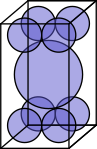
A rectangular box contains a sphere of radius and eight smaller spheres of radius The smaller spheres are each tangent to three sides of the box, and the larger sphere is tangent to each of the smaller spheres. What is
小提示:
上方四个小球的球心形成边长为 的正方形,大球球心在其正下方的盒子轴线上。
The four top small-sphere centers form a square of side , directly below the big sphere’s center
大提示:
球心距为 (半径和),水平偏移为 ,所以竖直差为 ;再加上上下各 。
With center distance (sum of radii) and horizontal offset , the vertical gap is ; then add at the top and bottom
解答:
把盒子的一个角放在原点。每个小球位于一个角落,其球心到相邻三个面各相距 。上方四个小球的球心构成边长为 的正方形,正方形中心在盒子的中轴线上,一个顶点到中心的距离为 。
大球球心在中轴线上,到每个上方小球球心的距离为 ,因此两者的竖直距离为 。
大球球心的高度是 ,上方小球球心的高度是 ,所以 。由此 ,并得到 。
所以正确答案是 A。
Place the box with a corner at the origin. Each small sphere sits in a corner with center unit from three faces. The four top small-sphere centers form a square of side whose center lies on the box axis; a corner of that square is from the center.
The big sphere’s center is on the axis, at distance from each top small center. The vertical gap between them is
The big center is at height and the top small centers at height so giving and
Thus, the correct answer is A.
18.
函数 的定义域是一个长度为 的区间,其中 、 是互质正整数。 是多少?
The domain of the function is an interval of length where and are relatively prime positive integers. What is
小提示:
从外向内逐层剥离对数,并要求每一层的真数为正。
Peel the logarithms from the outside in, requiring each argument to be positive
大提示:
记住底数小于 会反转不等号;每得到一个真数为正的条件就先化简它,再处理下一层内部的对数。
Remember that bases below reverse inequalities; translate each successive positivity condition before moving to the next inner logarithm
解答:
从外向内看, 有定义当且仅当 ,这等价于 。
因为底数 ,这意味着 ,于是 。
又因为 ,不等号反向,得到 ,即 。区间长度为 ,所以 。
所以正确答案是 C。
Working from the outside, is defined exactly when which is equivalent to
Since the base this means hence
As this reverses to i.e. The length is so
Thus, the correct answer is C.
19.
恰有 个不同的有理数 满足 ,使方程 至少有一个整数解 。 是多少?
There are exactly distinct rational numbers such that and has at least one integer solution for What is
小提示:
若 是整数根,则解出 。
If is an integer root, solve for
大提示:
要求 ,并检查所得 值互不相同。
Require , and check the resulting values of are all distinct
解答:
若整数 是根,则 ,所以 。对 , 递增; 时 而 时 。
因此 可取 ,共 个值。若两个不同整数 给出相同的 则会使 ,从而推出 。这没有整数解,所以所有 个 互不相同。
所以正确答案是 E。
If an integer is a root, then so For increases, and gives while gives
Thus ranges over which is values. If two integers gave the same then forces which has no integer solutions, so all values of are distinct.
Thus, the correct answer is E.
20.
在 中,,,。点 和 分别在 和 上。 的最小可能值是多少?
In and Points and lie on and respectively. What is the minimum possible value of
小提示:
将 关于直线 反射到 ,将 关于直线 反射到
Reflect over line to and over line to
大提示:
路径变为 ,直线段 最短;再用 和余弦定理。
The path becomes , minimized as the straight segment ; use the Law of Cosines with
解答:
将 关于直线 反射到 ,将 关于直线 反射到 。于是 、,从而 ,这是从 到 的一条折线路径。
当这条路径成为直线段 时长度最小。此时 、,并且 。
由余弦定理, 所以 。
所以正确答案是 D。
Reflect across line to get and reflect across line to get Then and so a broken path from to
This is minimized when the path is the straight segment We have and
By the Law of Cosines, so
Thus, the correct answer is D.
21.
对每个实数 ,令 表示不超过 的最大整数,并定义 所有满足 且 的 组成若干互不相交区间的并。这些区间长度之和是多少?
For every real number let denote the greatest integer not exceeding and let The set of all numbers such that and is a union of disjoint intervals. What is the sum of the lengths of those intervals?
小提示:
写 ,其中 ,,于是 。
Write with and so
大提示:
条件 给出 ;把这些长度相加并裂项化简。
The condition gives ; sum these lengths and telescope
解答:
写 ,其中 为整数且 ,。于是 ,而 等价于 ,也就是 。
因此每个 对应的区间长度为 ,所以总长度为
所以正确答案是 A。
Write with integer () and Then and becomes i.e.
Each contributes an interval of length so the total is
Thus, the correct answer is A.
22.
数 介于 和 之间。有多少对整数 满足 且
The number is between and How many pairs of integers are there such that and
小提示:
在相邻的 与 之间,可能有两个或三个 的幂。
Between consecutive powers and there are either two or three powers of
大提示:
题目要求区间内有三个这样的幂;若 分别表示含两个和三个二的幂的区间数,则 ,且 。
The inequality asks for three such powers; if count the two-power and three-power gaps, then and
解答:
因为 ,每个区间 内含有两个或三个 的幂。不等式链 恰好在该区间含有三个连续的 的幂时成立,而且此时 唯一。
设 和 分别为 时区间 内含两个和三个 的幂的区间数。由于 ,这些区间内共有 个 的幂,因此 ,且 。
解得 。
所以正确答案是 B。
Because each interval contains either two or three powers of The chain holds exactly when the interval contains three consecutive powers of and then there is a unique such
Let and be the numbers of intervals for containing two and three powers of respectively. Since there are powers of in total, giving and
Solving,
Thus, the correct answer is B.
23.
分数 其中 是循环小数节的长度。求 。
The fraction where is the length of the period of the repeating decimal expansion. What is the sum
小提示:
因为 ,循环节满足 。
Since , the repeating block satisfies
大提示:
把循环小数按 进制每两位一组分块,并利用 的展开;跟踪进位,直到第一个 进制数字再次出现。
Group the repeating decimal into base- digits and use follow the carries until the first base- digit repeats
解答:
把循环节按每两位一组读取(即用 进制), 的展开是 ,因为 。令 为循环节的第 个 进制数字。将循环节乘以 ,首先得到 。随后的进位给出 ,此后不再进位,并依次得到 ,其中 。下一个数字又是 ,所以循环节是 ,其中缺少 。
如果从 到 的所有数块都出现,数字和将是 。去掉缺少的 要减去 ,得到 。
因此,正确答案是 B。
Reading the block in pairs of digits (base ), expands as since Let be the th base- digit of the repeating block. Multiplying the block by shows first that The resulting carry gives after which there is no carry and successively for The next digit is again so the period is with omitted.
If the blocks through all appeared, the digit sum would be Removing the missing subtracts giving
Thus, the correct answer is B.
24.
令 ,并对 ,定义 。有多少个 值满足 ?
Let and for let For how many values of is
小提示:
若 ,其中 为非负整数,则 ,之后数值按 循环。
If for a nonnegative integer then and afterward the values cycle
大提示:
所以 需要 ,其中 ;画出 并数它与每条 的交点。
So needs with ; graph and count intersections with each line
解答:
若 ,则 。因此,如果 ,其中 是非负整数,那么 ,此后的值按 交替出现。所以, 当且仅当对某个整数 ,有 。
函数 在 时等于 ,在 时等于 ,在 时等于 。它的图像是分段直线,转折点为 和 。
当 时,直线 与图像有三个交点;当 时,各有两个交点。交点总数为 。
所以正确答案是 C。
If then So if for a nonnegative integer then after which the sequence alternates Thus exactly when for some integer
Now equals for for and for Its graph is piecewise linear with turning points and
A line meets this graph three times for and twice for The total is
Thus, the correct answer is C.
25.
抛物线 的焦点为 ,并经过点 与 。有多少个满足 、坐标均为整数且 的点?
The parabola has focus and goes through the points and For how many points with integer coordinates is it true that
小提示:
是 与 的中点,所以这条弦是通径,准线与它平行
is the midpoint of and so this chord is the latus rectum and the directrix is parallel to it
大提示:
准线为 ;参数化格点后,把 化为 。
The directrix is ; parametrize the lattice points and reduce to
解答:
因为 是 与 的中点,所以线段 是通径。准线与 平行,并位于焦点另一侧、相距 ,其方程为 。
令点到焦点和准线的距离相等,得到 。令 ,可推出 是 的倍数;再令 ,可推出 为奇数。写成 后,所有整数点可表示为
于是 等价于 ,即 。因此共有 个整数坐标点。
所以正确答案是 B。
Since is the midpoint of and the segment is the latus rectum, so the directrix is parallel to at distance on the far side, namely
Equating distances to focus and directrix gives Writing forces to be a multiple of and forces odd; with the integer points are
Then iff i.e. That gives lattice points.
Thus, the correct answer is B.